Friday, 13 November 2020

The Fast-Tracking Approach To AI Ethics Is Unwise For AI Autonomous Systems 

By Lance Eliot, the AI Trends Insider 

The existing and ongoing pell-mell rush to get AI systems out-the-door is worrisome. There is a potential price to be paid for the flimsy assumption that soonest AI is the best kind of AI. For example, some have put together contact tracing apps that have AI capabilities to bolster the intended functionality of slowing or preventing the spread of the infectious virus, but insufferably those same apps oftentimes are privacy intrusion nightmares. Had there been concentrated attention toward incorporating AI Ethics precepts, perhaps those scurrying to push out an AI beneficial application would have been more likely to consider the downsides of their creation too. 

For clarification, AI Ethics is a set of ethics-oriented guidelines or principles that offer guidance when designing, building, testing, fielding, and maintaining an AI system. There is currently a multitude of such proposed AI Ethics indications and no single set has become the one-and-only globally accepted standard, though nonetheless they all pretty much adhere to a similar theme and core values.   

In that sense, those that try to use it as an excuse that there isn’t an anointed all-hands standard are disingenuous at best, and by readily embracing nearly any of the bona fide ones they would be doing well and able to proceed unabated. 

Okay, so let’s hope that entities developing AI will see the light and opt to adopt a viable AI Ethics code set. Doing so is intended to make them aware of the qualms about AI such as the potential for privacy intrusions, the potential for inherent hidden biases in AI-based decision making, and so on.   

One assumes that awareness will spark AI development efforts that foundationally detect those kinds of problematic and endangering issues beforehand, rather than after shipping the AI into the hands of the public.

Letting the horse out of the barn prematurely is a bad idea and the goal ought to be making sure first and foremost that the horse is ready to be let loose.   

But what happens to AI Ethics when it is crunch time and a kind of panic occurs to roll out AI?   

While in the throes of a crisis, it can seem daunting to keep AI Ethics at the forefront, since the usual perception is that worrying about those AI Ethics codifications are bound to stymie the pace of development and undercut the urgent tempo to get AI into the hands of end-users. 

That is a decidedly short-minded viewpoint and though it might seem like the value of being quick to market is a worthwhile tradeoff, the result can reverberate for a long time to come. The public will not especially remember that there was a presumed urgency and instead will only tend to know that the AI fostered into the world was insidious and ultimately nefarious. 

If enough of those kinds of haphazard make-and-bake AI apps are tossed into the market, we will inevitably witness a colossal backlash that will make the so-far optional AI Ethics principles and guidelines into becoming mandatory and potentially overly onerous as a reaction to those that scrimped at the beginning.   

Maybe AI will get banned entirely. 

Somehow, there needs to be a balance found that can appropriately make use of the AI Ethics precepts and yet allow for flexibility when there is a real and fully tangible basis to partially cut corners, as it were. 

Of course, some would likely abuse the possibility of a slimmer version and always go that route, regardless of any truly needed urgency of timing. Thus, there is a chance of opening a Pandora’s box whereby a less-than fully AI Ethics protocol becomes the default norm, rather than serving as a break-glass exception when rarely so needed. 

It can be hard to put the Genie back into the bottle.   

In any case, there are already some attempts at trying to craft a fast-track variant of AI Ethics principles.  

We can perhaps temper those that leverage the urgent version with both a stick and a carrot. 

The carrot is obvious that they are seemingly able to get their AI completed sooner, while the stick is that they will be held wholly accountable for not having taken the full nine yards on the use of the AI Ethics. This is a crucial point that might be used against those taking such a route and be a means to extract penalties via a court of law, along with penalties in the court of public opinion. 

Let’s next take a look at a well-known set of AI Ethics, promulgated by the OECD (Organization for Economic Cooperation and Development), and see if we can shape those into offering a fast-track variant. 

The OECD has proffered these five foundational precepts as part of undertaking AI efforts: 

  1. AI should benefit people and the planet by driving inclusive growth, sustainable development, and well-being. 
  2. AI systems should be designed in a way that respects the rule of law, human rights, democratic values, and diversity, and they should include appropriate safeguards – for example, enabling human intervention where necessary – to ensure a fair and just society. 
  3. There should be transparency and responsible disclosure around AI systems to ensure that people understand AI-based outcomes and can challenge them. 
  4. AI systems must function in a robust, secure, and safe way throughout their life cycles and potential risks should be continually assessed and managed. 
  5. Organizations and individuals developing, deploying, or operating AI systems should be held accountable for their proper functioning in line with the above principles. 

For ease of reference, this is the official shorthand list of the five AI Ethics principles: 

  1. Inclusive growth, sustainable development, and well-being 
  2. Human-centered values and fairness 
  3. Transparency and explainability 
  4. Robustness, security, and safety 
  5. Accountability 

What can be done to fast-track this set of AI Ethics? Some might leap to the easy way out by simply lopping one or more from the list. In other words, just cut the stack down to four, or maybe three, or heaven forbid even just one or two of the precepts.   

It isn’t apparent as to which of the five would be “best” to ditch. You could liken this to having to cut off a limb and be arguing about which appendage is the less vital one. No, I don’t think this will do.   

Each of the five has a distinct purpose. None of the other five will make up for having omitted one of the other precepts. Knocking out any of them is akin to taking out the leg of a stool, wherein the stool no longer properly stands. 

For those that have suggested chopping out one or more of the five, it seems to defy any reasonable logic and you are essentially arbitrarily willing to wholly weaken and undermine the concrete flooring upon which any AI has to be properly constructed.  

Case rejected. 

That might seem stubborn and unyielding, lest there are some other means to try and turn these precepts into a slimmer variant. Consider these possibilities: 

  • Prioritize the five and weigh your effort accordingly – they are all essential but you could argue that in a pinch they are not all equal, thus, for a given AI, assign weights to each of the five, and then structure your AI development effort according to those with the greater importance or weighting. 
  • Take the shortened version of one or more of the precepts – for each of the five there are lots of subordinated items to normally be considered, but for a bona fide crunch you could shorten some of those underlying elements and knowingly skip a few underlings, keep track as you do so and realize what you are missing accordingly. 
  • Double-up on the precepts – the principles do not need to necessarily be considered one-at-a-time, and there are synergies to be had by considering simultaneously more than one while undertaking your AI effort, thus a double-up is bound to reduce the time and effort, though be careful that it does not become a morass and a gigantic blur.   
  • Borrow from a similar AI app – many that are embarking upon developing AI are doing so for the first time and as such they have little or no prior base to build upon, yet for those that are actively in AI and have other AI systems under their belt they can readily reuse prior aspects that already passed the AI Ethics precepts (just be mindful and do not blindly and falsely borrow something unlike what you are doing now). 
  • Parcel out wisely the precepts – in some instances an AI effort places the rigors of the AI Ethics precepts onto the shoulder of one person that becomes the AI Ethics guru, this might be handy, unfortunately, this can also become a bottleneck and slows down the entire effort, reconsider if there is a single link in the chain and how to better parcel out the workload. 
  • Cautiously crowdsource the precepts – in an open-source manner some are doing AI that relishes using crowdsourcing to either perform the AI development or serve to scrutinize and test it, in which case you could have the AI Ethics become likewise crowdsourced, just as long as the crowd knows what it is doing and this is not an unbridled castoff that undermines the precepts.   
  • Combine these fast-tracks – the aforementioned fast-tracks can be combined in various sensible ways and produce even larger short-cuts accordingly, but do not cut to the bone and end-up losing the core by taking too many slimdowns at once. 

As mentioned, you can use one or more of the fast-track facets at the same time. How will you know that you have gone too far?   

Here are the key supplementals for taking on a fast-track approach with the AI Ethics principles: 

  • Establish internal checks-and-balances – make sure to set up the responsibilities for the AI Ethics precepts and include numerous checks-and-balances for gauging how they are proceeding.   
  • Potentially use an external third-party auditor – in addition to internal checks-and-balances, it can be helpful to use an external auditor that does not presumably feel attached to what has been done and therefore will independently and forthrightly conduct their review.   
  • Explicitly plan to include the AI Ethics considerations – sometimes the AI Ethics considerations are belatedly shoved into an AI effort as though a second class citizen and not worthy of resources and nor priority, rate them instead as primary for all AI implementations and include them dutifully in all of your AI planning accordingly.   
  • Boost the fail-safe catchall of the AI – properly devised AI should already have fail-safe catchalls so that if it goes awry in the field the AI will presumably realize troubles are afoot and will do something prudent as a contingency, this is even more so a crucial component when taking the fast-track. 

All told, I’ve provided a workable semblance of how to fast-track an AI effort as it pertains to using AI Ethics guidelines during the project. Again, do not interpret this as a license to wildly proceed and merely try to skate through the AI Ethics precepts. Your AI is going to be better if it undergoes a robust and complete AI Ethics effort, and likewise, those using your AI will benefit, and the totality of AI adoption will be kept enlivened. 

Self-Driving Cars and Autonomy Levels   

You might be wondering how the AI Ethics principles come to play in real-world AI applications. A handy exemplar would be the development of AI-based true self-driving cars. As a clarification, true self-driving cars are ones where the AI drives the car entirely on its own and there isn’t any human assistance during the driving task.   

These driverless vehicles are considered a Level 4 and Level 5, while a car that requires a human driver to co-share the driving effort is usually considered at a Level 2 or Level 3. The cars that co-share the driving task are described as being semi-autonomous, and typically contain a variety of automated add-on’s that are referred to as ADAS (Advanced Driver-Assistance Systems).   

There is not yet a true self-driving car at Level 5, which we don’t yet even know if this will be possible to achieve, and nor how long it will take to get there. 

Meanwhile, the Level 4 efforts are gradually trying to get some traction by undergoing very narrow and selective public roadway trials, though there is controversy over whether this testing should be allowed per se (we are all life-or-death guinea pigs in an experiment taking place on our highways and byways, some point out).   

Since semi-autonomous cars require a human driver, the adoption of those types of cars won’t be markedly different than driving conventional vehicles, so there’s not much new per se to cover about them on this topic (though, as you’ll see in a moment, the points next made are generally applicable).   

For semi-autonomous cars, it is important that the public needs to be forewarned about a disturbing aspect that’s been arising lately, namely that despite those human drivers that keep posting videos of themselves falling asleep at the wheel of a Level 2 or Level 3 car, we all need to avoid being misled into believing that the driver can take away their attention from the driving task while driving a semi-autonomous car. 

You are the responsible party for the driving actions of the vehicle, regardless of how much automation might be tossed into a Level 2 or Level 3. 

For my framework about AI autonomous cars, see the link here: https://aitrends.com/ai-insider/framework-ai-self-driving-driverless-cars-big-picture/   

Why this is a moonshot effort, see my explanation here: https://aitrends.com/ai-insider/self-driving-car-mother-ai-projects-moonshot/   

For more about the levels as a type of Richter scale, see my discussion here: https://aitrends.com/ai-insider/richter-scale-levels-self-driving-cars/ 

For the argument about bifurcating the levels, see my explanation here: https://aitrends.com/ai-insider/reframing-ai-levels-for-self-driving-cars-bifurcation-of-autonomy/ 

AI Ethics And Self-Driving Cars 

For Level 4 and Level 5 true self-driving vehicles, there won’t be a human driver involved in the driving task. All occupants will be passengers; the AI is doing the driving.  

Many of the automakers and self-driving tech firms have been adopting the AI Ethics precepts (this varies from firm-to-firm). One can argue that all of them ought to be doing so, which is worthwhile to mention herein as an impetus to get some of them off-the-dime and get in gear with including AI Ethics facets. Please do so.   

Let’s next consider an example of how AI Ethics applies to self-driving cars. Besides the bevy of sensors facing outward to detect the roadway, self-driving cars are likely to have a camera or two that are facing inward too. Why so? 

It is assumed that self-driving cars will be mainly used in fleets for purposes of ridesharing. The fleet owners will seemingly be large firms like automakers, car rental agencies, ridesharing firms, and the like (though, I am somewhat of a contrarian and argue that individuals will also own self-driving cars). 

With those self-driving cars roaming around and taking on passengers, there is quite obviously the chance that a rowdy rider will decide to mark graffiti on the interior or maybe rip up the seats. By having a camera that points inward, the actions of those unruly people can be tracked. The AI might be trained to look for such behavior and immediately warn or scold the person, potentially stopping the miscreant from doing any further damage. 

The inward-facing cameras are readily recording whatever happens inside the vehicle. Seems innocent and sensibleConsider another perspective. Suppose you went to the bar after work and opted to take a self-driving car home, doing so rightfully rather than driving yourself in your conventional car while drunk. During the journey home, you blabber about your work, your personal life, and all sorts of confidential commentary that is spilling out of you while intoxicated.  

It is all captured on video. Who owns that video? What will they do with it? Currently, this is an open question and each self-driving car owner is presumably going to decide whatever they believe is appropriate to do about those videos. Meanwhile, you personally have inadvertently created a personal privacy exposure for yourself and are potentially left in the lurch. 

How does this relate to AI Ethics precepts? Take a look again at the OECD five. You might hopefully realize that at least one of the AI Ethics principles applies, and indeed it could readily be argued that all five apply to this scenario. 

Some automakers and self-driving tech firms would currently say that the inward-facing camera is merely a piece of technology, and they would absolve themselves of any duty related to how it might be used. 

Likewise, if they have an AI monitoring system that can examine the video in real-time or after-the-fact to catch those that are doing something untoward, the makers of that AI would almost surely claim that however it might be used is not their concern.   

If those organizations were fully embracing the AI Ethics guidelines, they would instead be having serious and contemplative discussions about the societal implications of that feature. Also, they would aim to figure out how to best put the feature into use and include it for those that buy their self-driving cars and opt to use them as ridesharing vehicles. 

Without the nudge of the AI Ethics precepts, it can be quite easy to overlook important and societally impactful facets such as this and meanwhile naively profess a type of head-in-the-sand rationale for not dealing with thorny issues. 

For why remote piloting or operating of self-driving cars is generally eschewed, see my explanation here: https://aitrends.com/ai-insider/remote-piloting-is-a-self-driving-car-crutch/   

To be wary of fake news about self-driving cars, see my tips here: https://aitrends.com/ai-insider/ai-fake-news-about-self-driving-cars/   

The ethical implications of AI driving systems are significant, see my indication here: http://aitrends.com/selfdrivingcars/ethically-ambiguous-self-driving-cars/   

Be aware of the pitfalls of normalization of deviance when it comes to self-driving cars, here’s my call to arms: https://aitrends.com/ai-insider/normalization-of-deviance-endangers-ai-self-driving-cars/ 

Conclusion   

AI Ethics are only now becoming prominent and we will need to wait and see how those involved in making and fielding AI opt to adopt such guidelines. The excuse that incorporating AI Ethics is too much effort or will needlessly delay getting AI onto the streets is false and frankly, hogwash. 

You can potentially fast-track the AI Ethics facets when (and only when) there is an AI that might be instrumental for the benefit of humanity and for which the timing presupposes an urgency, but this is not the norm, and those doing a wink-wink to undercut the AI Ethics elements are doing a disservice to themselves and the rest of us. 

Maybe there ought to be an inward-facing camera watching those making AI and we could catch those kinds of scoundrels in the act. 

Copyright 2020 Dr. Lance Eliot. This content is originally posted on AI Trends. 

[Ed. Note: For reader’s interested in Dr. Eliot’s ongoing business analyses about the advent of self-driving cars, see his online Forbes column: https://forbes.com/sites/lanceeliot/] 

http://ai-selfdriving-cars.libsyn.com/website

Data Teams Unite! Countdown to Data + AI Summit Europe

Data + AI Summit 2020 Europe takes place virtually in just a few days,from 17-19 November – and it’s free to attend! Formerly known as Spark + AI Summit, Data + AI Summit will bring together thousands of data teams to learn from practitioners, leaders, innovators and the original creators of Spark, Delta Lake, MLflow and Koalas.

In June, we were able to successfully transform Summit into a completely virtual experience. The Data + AI Summit will be even better with optimised engagement throughout the conference platform, plus hundreds of sessions at your fingertips, anytime and from anywhere. Although the conference schedule is scheduled for  European attendees, all content will be available on demand for our global audience.

We’ve spent the last two months building a conference that will bring data teams together again with 125+ sessions, an incredible line-up of keynotes and countless opportunities to connect with your peers — more than 20,000 data scientists, data engineers, analysts, business leaders and other data professionals.

Our virtual platform launches on 13 November, but here’s a sneak peek at what awaits you. As soon as the platform launches, get a head start by building your agenda and your personal profile to get the most from your conference experience. If you haven’t already registered, there’s still time! General admission is FREE and content will be available live – and on demand after the event.

Personalised dashboard

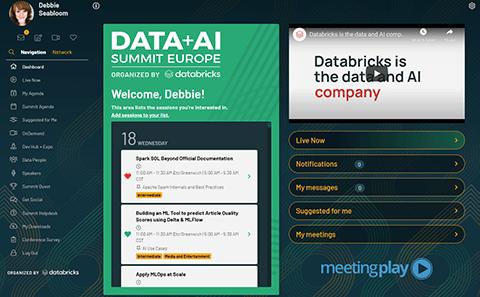
As you enter the conference you will be welcomed by your personalised dashboard — a home for everything you need to know about the conference. We have highlighted the most useful links to access content and a quick view of your agenda. The left navigation panel will help you explore every aspect of the Summit. And keep an eye on your inbox for notifications so you don’t miss any updates.

Sample personalized dashboard available to attendees of the Data + AI 2020 Europe Summit

Build your agenda

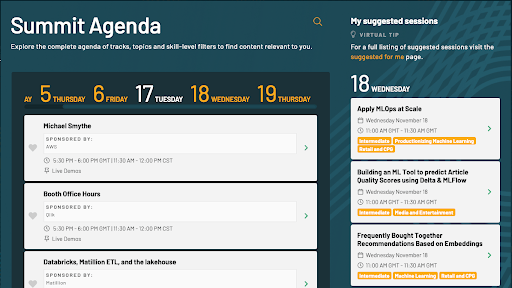
Our agenda is jam-packed this year with two days filled with technical content for data scientists, engineers, analysts and IT and business leaders. To add sessions to your agenda, simply click on the heart next to the session title.

We have an incredible lineup of keynotes from industry thought leaders such as Ali Ghodsi, Matei Zaharia and Reynold Xin, as well as luminary keynotes from Malcolm Gladwell, Mae Jemison, Dr. Kira Radinsky, Jeremy Singer-Vine and many others. We recommend you take time to play with the agenda filters and explore the speakers’ pages to build your ideal agenda.

Sample personalized agenda available to attendees of the Data + AI 2020 Europe Summit

Dev Hub + Expo

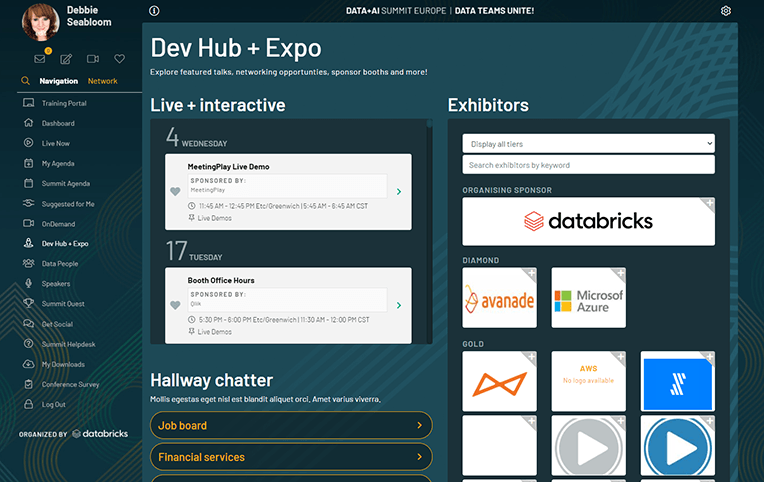
Connect with your peers and sponsors at the Dev Hub + Expo! We are making live networking happen at our Hallway Chatter rooms where you can chat live with like-minded attendees or hear a lightning talk from community members. You can also learn more about Delta Lake, Apache Spark™, MLflow, Redash and more at the Databricks Booth, and interact with our amazing sponsors.

Sample Dev Hub and Expo available to attendees of the Data + AI 2020 Europe Summit

We want to be able to bring people together and connect in a virtual space. We are doing this in many ways throughout the platform. Check out the Data People page for a directory of who’s around. You can also go to the Suggested for Me tab to meet like-minded individuals and to discover recommended sessions/experiences.

Summit Quest and evening events

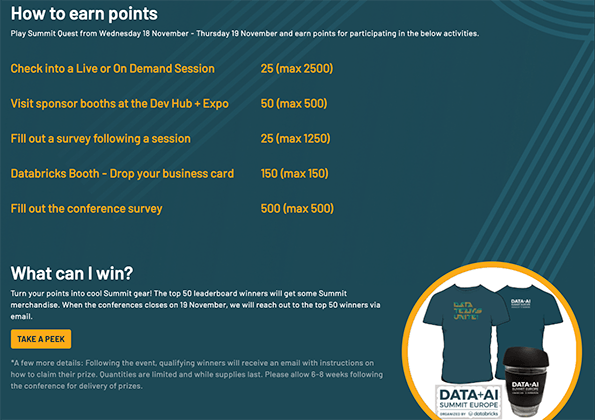
Don’t forget to set aside time to do our daily body breaks, get social, and rack up points to hit the top of the Summit Quest leaderboard. The more points you accumulate, the more you have a chance to be one of our Top 50 leaderboard winners for some exclusive Summit merchandise.

Each evening, attendees will be able to ‘choose their own adventure’ by joining a live DJ set from DJ Kingmost, attend our highly engaging live Meetups or explore everything the Dev Hub + Expo hall has to offer.

Sample personalized Summit Quest leaderboard available to attendees of the Data + AI 2020 Europe Summit

There is so much more that we can share, but now it is your turn to discover what Data + AI Summit Europe has to offer. If you have registered, join the experience on 13 November and check out this guide for even more reasons to get excited. And if you haven’t yet registered, it’s not too late. Join us for all the action at Data + AI Summit 2020 and we look forward to seeing you there!

--

Try Databricks for free. Get started today.

The post Data Teams Unite! Countdown to Data + AI Summit Europe appeared first on Databricks.

Brazilian duo glide through Sao Paulo streets with broomsticks for Muggles

SAO PAULO (Reuters) - In the famously traffic-choked streets of Brazilian megalopolis Sao Paulo, two men have invented a novel way of getting from point A to B - and they are raising a lot of eyebrows in the process.
On a recent Saturday, Vinícius Sanctus, 39, and Alessandro Russo, 28, could be seen coasting down the city's main thoroughfares on a pair of broomsticks, each one attached to a single motorized wheel.
In motion, the contraptions look uncannily like the brooms used by witches and wizards in the Harry Potter universe, described in the famed books by British author J.K. Rowling and later depicted in a series of hit films.
To steer, the duo simply lean in the direction they wish to travel. While it takes a bit of practice at first, the broomsticks, which can reach top speeds of 60 kilometers per hour (37 ...


Read More on Datafloq

Ferrari lifts the lid on convertible version of SF90 Stradale hybrid

MILAN (Reuters) - Ferrari unveiled the SF90 Spider on Thursday, a convertible version of its SF90 Stradale hybrid and part of the Italian luxury carmaker's drive to make 60% of sales from hybrid technology by 2022.
The new car will feature the same specifications as the 4WD SF90 Stradale released last year, with a 780 horse power 8-cylinder combustion engine integrated with two front-mounted electric motors adding an extra 220 horse power, plus a retractable hard top.
One hundred kilos heavier than the Stradale, the Spider will cost 473,000 euros ($558,000) in Italy, outpricing the 430,000 euro Stradale at the top of Ferrari's price range for series-production cars.
First deliveries are expected in the second quarter of next year, in Europe.
"We consider the SF90 our range supercar," Chief Commercial and Marketing Officer Enrico ...


Read More on Datafloq

Daimler will shrink with shift to electric, autonomous cars: CEO

By Edward Taylor
FRANKFURT (Reuters) - Daimler will be a smaller company five years from now, focused on capturing recurring revenues with software-based services as Mercedes-Benz seeks to redefine luxury in an era of electric self-driving cars, Chief Executive Ola Kaellenius said.
The Stuttgart-based company founded by Carl Benz, who patented the first gasoline-powered car in 1886, is accelerating plans to shift the carmaker beyond combustion-engine vehicles, a step which will result in job losses.
"The next five years we will become a smaller company," Kaellenius told a Reuters Events broadcast on Thursday. "We will have a fundamental change in the industrial footprint on the powertrain side," he said.
Jobs will disappear because it takes less time to build an electric car than a conventional gasoline or diesel version.
...


Read More on Datafloq

Amazon shifts some voice assistant, face recognition computing to its own chips

By Stephen Nellis
(Reuters) - Amazon.com Inc on Thursday said it shifted part of the computing for its Alexa voice assistant to its own custom-designed chips, aiming to make the work faster and cheaper while moving it away from chips supplied by Nvidia Corp.
When users of devices such as Amazon's Echo line of smart speakers ask the voice assistant a question, the query is sent to one of Amazon's data centers for several steps of processing. When Amazon's computers spit out an answer, that reply is in a text format that must be translated into audible speech for the voice assistant.
Amazon previously handled that computing using chips from Nvidia but now the "majority" of it will happen using its own "Inferentia" computing chip. First announced in 2018, the Amazon chip is custom designed to speed up large volumes of machine learning tasks such as ...


Read More on Datafloq

Thursday, 12 November 2020

Announcing the Launch of SQL Analytics

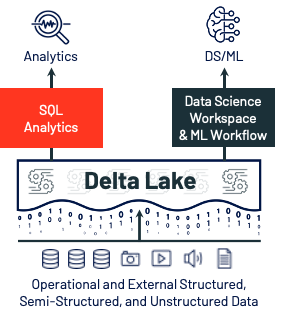
Today, we announced the new SQL Analytics service to provide Databricks customers with a first-class experience for performing BI and SQL workloads directly on the data lake. This launch brings to life a new experience within Databricks that data analysts and data engineers are going to love. The service provides a dedicated SQL-native workspace, built-in connectors to let analysts query data lakes with the BI tools they already use, query performance innovations that deliver fast results on larger and fresher data sets than analysts traditionally have access to, and new governance and administration capabilities. With this launch, we are the first to realize the complete vision of lakehouse architecture, combining data warehousing performance with data lake economics to deliver up to 9x better price/performance than traditional cloud data warehouses.

Data SQL Analytics service architecture

The enemy is complexity

Most customers routinely operate their business with a complex data architecture in the cloud that combines data warehouses and data lakes. As a result, customers’ data is moved around the organization through data pipelines that create a multitude of data silos. A large amount of time is spent maintaining these pipelines and systems rather than creating new value from data, and the downstream consumers of the data struggle to get a single source of truth due to the inherent data silos that get created. The situation becomes very expensive, both financially and operationally, and decision-making speed and quality are negatively affected.

Arriving at this problem was a gradual progression. It began with customers moving data from relational databases to data warehouses to do business intelligence 40 years ago. Then, data lakes began to emerge about 10 years ago because data warehouses couldn’t handle raw, video, audio, image, and natural language data, as well as very large scale structured data.

Data lakes in the cloud have high durability, low cost, and unbounded scale, and they provide good support for the data science and machine learning use cases that many enterprises prioritize today. But, all the traditional analytics use cases still exist. Therefore, customers generally have, and pay for, two copies of their data, and they spend a lot of time engineering processes to keep them in sync. This has a knock-on effect of slowing down decision making, because analysts and line-of-business teams only have access to data that’s been sent to the data warehouse rather than the freshest, most complete data in the data lake.

Finally, as multi-cloud becomes an increasingly common reality for enterprises, all of this data movement is getting repeated across several cloud platforms.

The whole situation is a mess.

The complexity from intertwined data lakes and data warehouses is not desirable, and our customers have told us that they want to be able to consolidate and simplify their data architecture. Advanced analytics and machine learning on unstructured and large-scale data are one of the most strategic priorities for enterprises today, – and the growth of unstructured data is going to increase exponentially – therefore it makes sense for customers to think about positioning their data lake as the center of data infrastructure. However, for this to be achievable, the data lake needs a way to adopt the strengths of data warehouses.

The lakehouse combines the best of data warehouses and data lakes

The answer to this complexity is the lakehouse, a platform architecture that combines the best elements of data lakes and data warehouses. The lakehouse is enabled by a new system design that implements similar data structures and data management features to those in a data warehouse directly on the low-cost storage used for cloud data lakes. The architecture is what you would get if you had to redesign data warehouses in the modern world, now that cheap and highly reliable storage (in the form of object stores) is available. You can read more about the characteristics of a lakehouse in this blog.

The foundation of the lakehouse is Delta Lake. Delta Lake has brought reliability, performance, governance, and quality to data lakes, which is necessary to enable analytics on the data lake. Now, with the right data structures and data management features in place, the last mile to make the lakehouse complete was to solve for how data analysts actually query a data lake.

Introducing SQL Analytics

SQL Analytics allows customers to perform BI and SQL workloads on a multi-cloud lakehouse architecture that provides up to 9x better price/performance than traditional cloud data warehouses. This new service consists of four core components: A dedicated SQL-native workspace, built-in connectors to common BI tools, query performance innovations, and governance and administration capabilities.

A SQL-native workspace

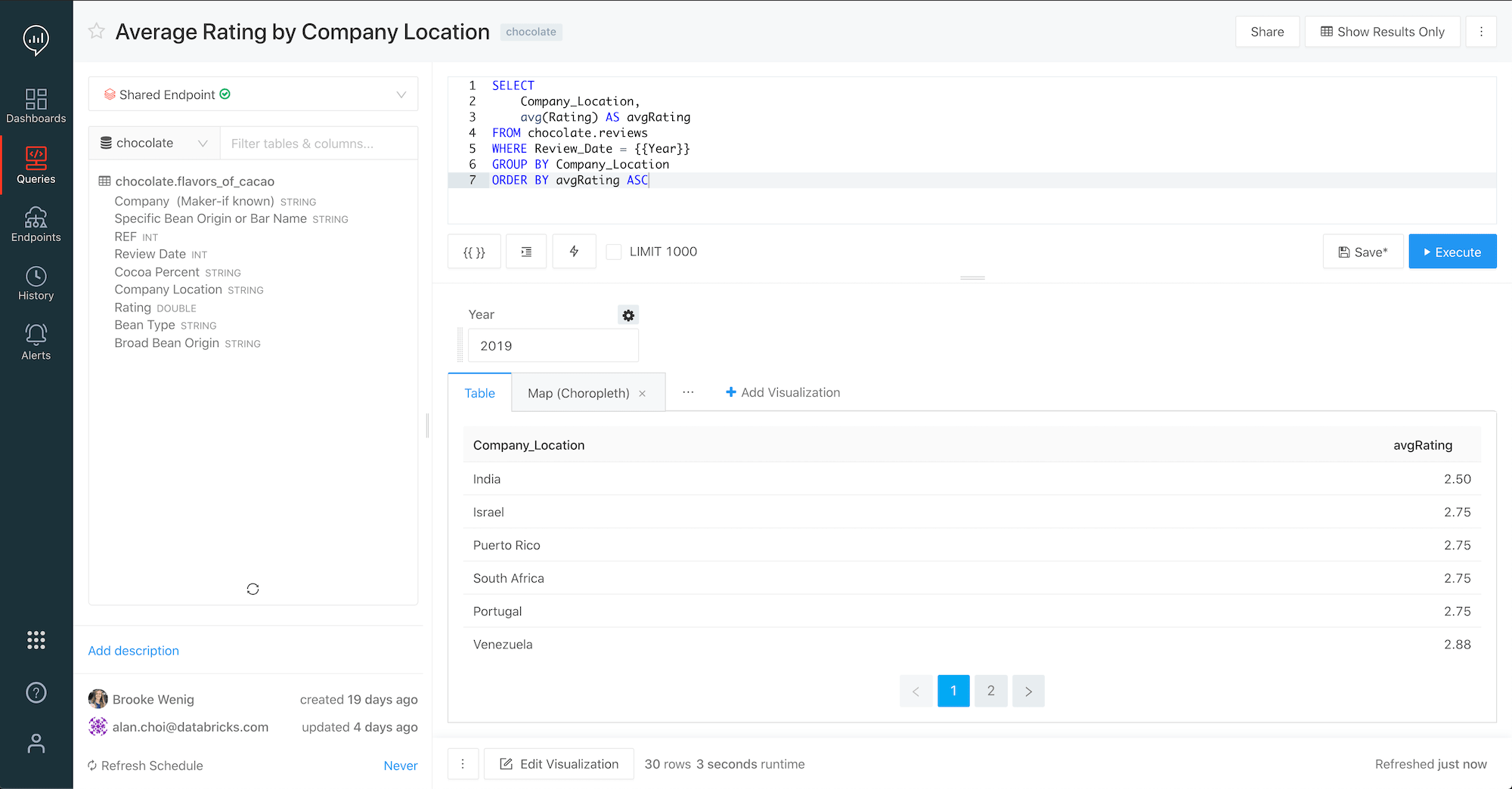
SQL Analytics provides a new, dedicated workspace for data analysts that uses a familiar SQL-based environment to query Delta Lake tables on data lakes. Because SQL Analytics is a completely separate workspace, data analysts can work directly within the Databricks platform without the distraction of notebook-based data science tools (although we find data scientists really like working with the SQL editor too). However, since the data analysts and data scientists are both working from the same data source, the overall infrastructure is greatly simplified and a single source of truth is maintained.

The workspace allows analysts to easily explore schemas, save regularly used code as snippets for quick reuse, and cache query results to keep subsequent run times short. Additionally, query updates can be scheduled to automatically refresh, as well as to issue automatic alerts on refresh, via email or Slack, when meaningful changes occur in the data.

Databricks SQL-native query editor

SQL-native query editor

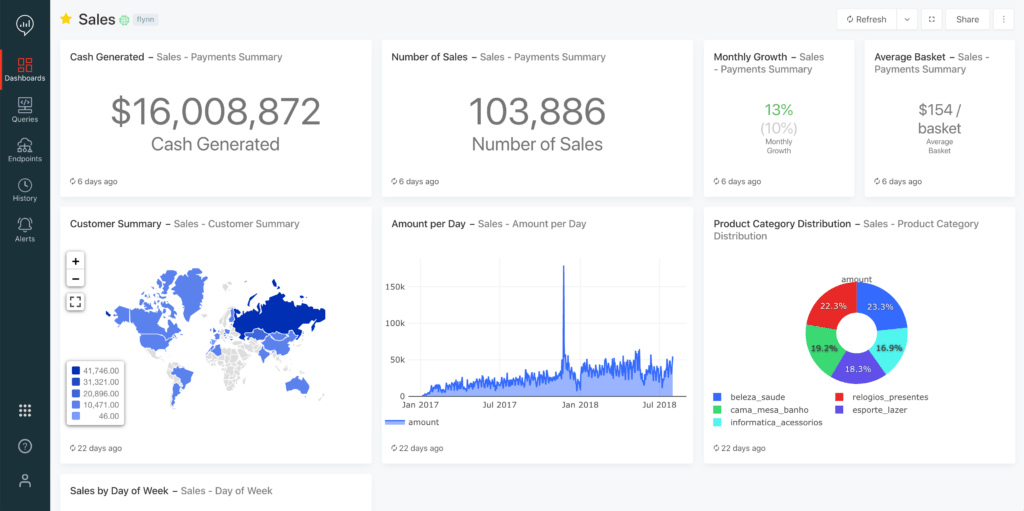
The workspace also allows analysts to make sense of data through rich visualizations, and to organize those visualizations into drag-and-drop dashboards. Once built, dashboards can be easily shared with stakeholders to make sharing data insights ubiquitous across an organization.

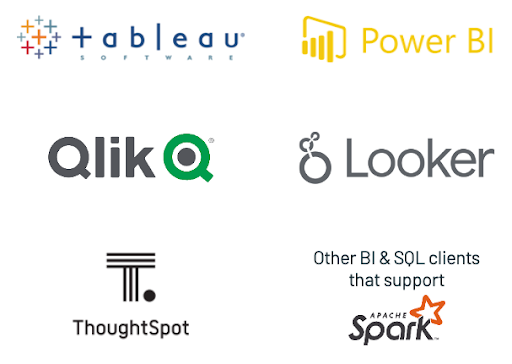
Databricks SQL Analytics’ built-in connectors for BI software like Tableau and Microsoft Power BI allow users to query the freshest, most complete data in the data lake.

Visualizations and dashboards

Built-in connectors to existing BI tools and broad partner support

For production BI, many customers have made investments in BI software like Tableau and Microsoft Power BI. To allow those tools to have the best possible experience querying the freshest, most complete data in the data lake, SQL Analytics includes built-in connectors for all major BI tools available today.

Databricks SQL Query Analytics’ comes out of the box with pre-built connectors for all the major BI tools available.

Across the data lifecycle, the launch of SQL Analytics is supported by the 500+ partners in the Databricks ecosystem. We’re very pleased to have the following partners investing above and beyond with us in this launch to enable customers to use their favorite analytics tools with SQL Analytics and lakehouse architecture:

Fast query performance

A big part of enabling analytics workloads on the data lake is solving for performance. There are two core challenges to solve to deliver great performance: query throughput and user concurrency. By delivering both, we’ve been able to achieve up to 9x better price/performance for SQL workloads using lakehouse architecture than other cloud data warehouses.

30 TB TPC-DS price/performance benchmark test for leading cloud data warehouse solutions.

30TB TPC-DS Price/Performance benchmark test (lower is better)

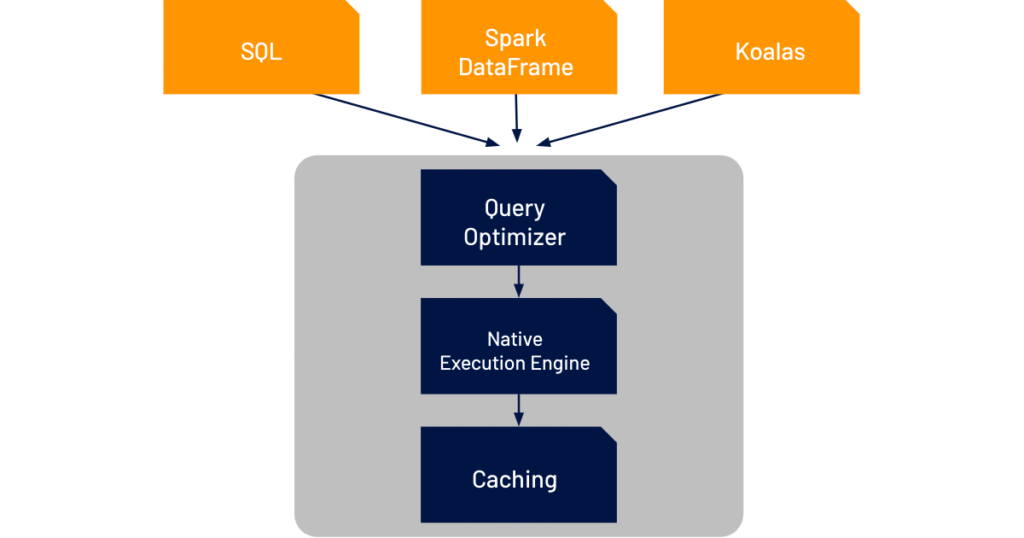
Earlier this year, we announced Delta Engine, our polymorphic query execution engine. Delta Engine accelerates the performance of Delta Lake for both SQL and data frame workloads through three components: an improved query optimizer, a caching layer that sits between the execution layer and the cloud object storage, and a polymorphic vectorized execution engine that’s written in C++. With Delta Engine, customers have observed query execution times up to 10x faster than Apache Spark 3.0.

With throughput handled, we turned our attention to user concurrency. Historically, data lakes have struggled to maintain fast performance under high user counts. To solve this, SQL Analytics adds new SQL-optimized compute clusters that auto-scale in response to user load to provide consistent performance as the number of data analysts querying the data lake increases. Setting up these clusters is fast and easy through the console, and Delta Engine is built-in to ensure the highest level of query throughput. External BI clients can connect to the clusters via dedicated endpoints.

Governance and administration

Finally, in the SQL Analytics console, we allow admins to apply SQL data access controls (AWS, Azure) onto your tables to gain much greater control over how data in the data lake is used for analytics. Additionally, we provide deep visibility into the history of all executed queries, allowing you to explore the who, when, and where of each query along with the executed code to assist you in compliance and auditing. The query history also allows you to understand the performance of each phase of query execution to assist with troubleshooting.

On the administrative side, you can aggregate details for query runtimes, concurrent queries, peak queued queries per hour, etc. to help you better optimize your infrastructure over time. You can also set controls around runtime limits to prevent bad actors and runaway queries, enqueued query limits, and more.

Getting started

SQL Analytics completes the final step in moving lakehouse architecture from vision to reality, and Databricks is proud to be the first to bring a complete lakehouse solution to market. All members of the data team, from data engineers and architects to data analysts to data scientists, are collaborating more than ever. The unified approach of the Databricks platform makes it easy to work together and innovate with a single source of truth that substantially simplifies data infrastructure and lower costs.

SQL Analytics is available in preview today. Existing customers can reach out to their account team to gain access. Additionally, you can request access via the SQL Analytics product page.

Sign-up for access to SQL Analytics

--

Try Databricks for free. Get started today.

The post Announcing the Launch of SQL Analytics appeared first on Databricks.

Analytics on the Data Lake With Tableau and the Lakehouse Architecture

Over the past two years we’ve seen a number of organizations moving their data work to the cloud. It simplifies access and scales to handle the biggest volumes. At Tableau, we’re all about customer choice and flexibility, and we’ve enabled our customers to move to the cloud faster than ever.

Analytics and data science/machine learning efforts are beginning to converge, and we’re seeing growing interest in connecting directly to data lakes for analysis as a result. A lot of data is coming into a cloud data lake very fast, from web logs and IoT sensors and it tends to be messy. We need a way to make sense of the data, and to have it delivered in a reliable and performant manner.

To enable this, we’re seeing more and more of our customers adopting a Lakehouse architecture. This new architecture takes the best of data lakes (low cost, flexible content structures) and data warehouses (high performance, data reliability) into a single place to store your data. With our partner Databricks, we’ve seen a number of joint customers adopt a lakehouse architecture to power their Tableau deployments. Databricks uses Delta Lake to enable a lakehouse architecture by improving the performance and reliability of data lake, so Tableau users can query the data lake directly.

This week Databricks is announcing a new SQL Analytics service that is going to provide Tableau customers with an entirely new experience for analyzing data that resides in the data lake. The performance and scale that they can achieve are unlike anything we’ve seen before.

Tableau users will be the most excited by the new SQL Analytics Endpoints which can be used immediately with our existing Databricks connector, no update required. This will improve access to your data lake for analytics in two ways:

  • Simple setup. SQL Analytics endpoints simplify the configuration of Databricks clusters used by Tableau to query the data lake, There is no need to deal with cluster management for Tableau users, just connect to Databricks SQL Analytics endpoint and go!
  • Performance improvements. SQL Analytics uses the Databricks Delta Engine, a vectorized query engine with an improved query optimizer and caching capabilities for really fast query performance.
Delta Engine architecture used with the new SQL Analytics service for Tableau from Databricks.

Figure 1: Delta Engine architecture

Customer Examples

Here are some examples of customers who are using a Lakehouse architecture with Databricks and Tableau.

  • Wehkamp uses Databricks with Delta Lake as a data lake, serving their entire organization for reporting and ad-hoc analysis using Tableau, and using Databricks for data science. You can read about Wehkamp’s implementation in this case study.
  • Flipp, a retail service provider, uses Databricks with Delta Lake to create a lakehouse that their data science team uses for machine learning, their engineering team uses for product feature analysis, and their sales team uses to provide analysis to their customers with Tableau. You can watch their session at the Tableau Conference.
  • The US Air Force uses Databricks with Delta Lake to manage all their cash flow analytics, and then provide the results in Tableau to analyze over 65 million records per quarter. You can watch the US Air Force present their implementation at the Data + AI Industry Leadership Forum.
Sample BI visualization in Tableau demonstrating the powerful analytics capabilities made possible by the Lakehouse architecture pioneered by Databricks.

Figure 2. A sample Flipp visualization

Learn more about Databricks and Tableau here.

--

Try Databricks for free. Get started today.

The post Analytics on the Data Lake With Tableau and the Lakehouse Architecture appeared first on Databricks.

Fiat Chrysler and Engie agree to set up e-mobility joint venture

MILAN (Reuters) - Fiat Chrysler and Engie EPS, a part of French utility Engie that focuses on energy storage systems and microgrids, plan to set up a joint venture to boost electric mobility, the two companies said on Thursday.
Fiat Chrysler's Italian division and Engie EPS, which is also based in Italy, have entered into a memorandum of understanding aimed at creating the joint venture, they said in a statement.
The new venture will offer a full range of products and solutions, including residential, business and public charging infrastructure as well as green energy packages for electric vehicle customers across Europe, they said.
Fiat Chrysler (FCA) launched the electric 500 small car and several Fiat, Jeep and Maserati hybrid models this year in a bid to catch up with rivals in the race for green mobility.
...


Read More on Datafloq

China will strive to achieve major tech breakthroughs: President Xi

BEIJING (Reuters) - China will strive to achieve major breakthroughs in key technologies, state media quoted President Xi Jinping as saying on Thursday.
China will build trading platforms for international financial assets, Xi was quoted as saying.

(Reporting by Stella Qiu and Kevin Yao; Editing by Toby Chopra)
...


Read More on Datafloq

Foxconn sees strong iPhone 12 demand, reiterates U.S. investment

By Yimou Lee and Ben Blanchard
TAIPEI (Reuters) - Apple <AAPL.O> supplier Foxconn <2317.TW> forecast strong demand for the new iPhone 12 in the holiday quarter and stressed that it would continue investing in the United States as scheduled and is looking at making new products there.
Foxconn's planned $10 billion investment in the U.S. state of Wisconsin did not create enough jobs in 2019 to earn tax credits, the state government said last month, the second year the company missed targets touted by President Donald Trump as a major economic win.
For many, the factory has become a symbol of failed promises in Midwestern states that were key to Trump's 2016 election but flipped to Democrat Joe Biden last week. Trump is seeking some recounts.
Foxconn said on Thursday ...


Read More on Datafloq

China's Tencent profit surges 89% as it rides gaming boom

By Pei Li
HONG KONG (Reuters) - Chinese gaming and social media giant Tencent Holdings Ltd reported an 89% rise in quarterly profit on Thursday, with its blockbuster game Honour of Kings and solid advertising businesses helping it to beat forecasts and lift its shares. The world's largest gaming firm by revenue has benefited from healthy growth of paying users for video games in China and international markets.
Its flagship game Honor of Kings reported a record 100 million daily active users in the first 10 months of 2020.
Tencent made 38.5 billion yuan ($5.8 billion) profit for the three months through September. That was ahead of an analyst average estimate of 30.81 billion yuan, data from Refinitiv showed. Revenue rose 29% to 125.4 billion yuan.
The ...


Read More on Datafloq

Waste not, want not: Dutch students build electric car from recycled material

EINDHOVEN (Reuters) - Dutch students have created a fully functioning electric car made entirely out of waste, including plastics fished out of the sea, recycled PET bottles and household garbage.
The bright yellow, sporty two-seater which the students named 'Luca', can reach a top speed of 90 kilometres (56 miles) per hour and has a reach of 220 kilometres when fully charged, the Technical University of Eindhoven said.
"This car is really special, because it's made all out of waste", project manager Lisa van Etten told Reuters.
"Our chassis is made out of flax and recycled PET bottles. For the interior we also used unsorted household waste."
Hard plastics normally found in televisions, toys and kitchen appliances were used for the car's body, while the seat cushions consist of coconut and horse hairs.
...


Read More on Datafloq

YouTube back up after worldwide outage

(Reuters) - YouTube, owned by Alphabet Inc's Google <GOOGL.O>, said late on Wednesday it had fixed a glitch that led to a worldwide outage of the video-streaming service.
DownDetector.com, a website which monitors outages, showed nearly 286,000 incidents of people reporting issues with the service.
The issue started at around 6:53 p.m. ET (23:53 GMT), according to Downdetector.com, with users complaining about trouble in watching videos on the platform.
"We're so sorry for the interruption. This is fixed across all devices & YouTube services," YouTube said in a tweet https://bit.ly/36r4sjz, without explaining what had caused the outage.
Google did not respond to a Reuters request for comment on the outage.

...


Read More on Datafloq

Analysis: India startups seek high-tech solutions to colossal food waste

By Mayank Bhardwaj and Rajendra Jadhav
NEW DELHI (Reuters) - Startups and venture capital are pouring into what might seem an unlikely place: India's vast, outdated agriculture industry.
Seizing on controversial new deregulation, entrepreneurs are selling farmers apps to connect them to big buyers nationwide and using artificial intelligence (AI) to improve the rickety supply chains that lose one-fourth of India's produce to wastage.
Enormous amounts of India's grain, fruit and vegetables rot between farm and table because of manual handling, repeated loading and unloading, poor inventory management, lack of adequate storage and slow movement of goods. This rate of wastage from faulty supply chains is four to five times that of most large economies, experts say.
Prime Minister Narendra Modi's government introduced changes it calls a watershed that will "remove middlemen and ...


Read More on Datafloq

China's SMIC facing delays on some U.S.-made supplies-Global Times

(Reuters) - China's Semiconductor Manufacturing International Corp (SMIC) is facing some delays in getting U.S.-made equipment, parts and materials, the Global Times newspaper reported on Thursday, after Washington imposed export restrictions against the firm.
SMIC, China's largest contract chipmaker, has been among several Chinese tech firms including Huawei Technologies that have been targeted by the Trump Administration over national security issues.
In September, the U.S. Commerce Department's Bureau of Industry and Security informed some firms that they need to obtain a license before supplying goods and services to SMIC due to because of "unacceptable risk" that such exports could be diverted to military end use. SMIC has said it has no relationship with the Chinese military.
SMIC said it is operating normally and hopes to be able to resume normal procurement, the Global Times said.
...


Read More on Datafloq

Singapore looks to woo global tech execs with special visa

SINGAPORE (Reuters) - Singapore on Thursday announced a new work visa for foreign executives of technology firms, a sector the low-tax global business hub hopes will power future economic growth.
Under the Tech.Pass programme launching in January, up to 500 experienced executives can apply for the two-year visas, which allow participants to operate a business, invest in or become a director in Singapore-based companies, and mentor start-ups.
"Tech.Pass will add to the critical mass of established tech talent in Singapore and create a flywheel effect to further strengthen our position as a leading tech hub for the region," trade minister Chan Chun Sing said, announcing the programme.
Armed with lucrative grants and incentives, Singapore has in recent years been ramping up its efforts to lure tech firms and investors, including global players like Facebook, Alphabet's Google and Chinese tech giants like Tencent and Alibaba. https://reut.rs/36vVUIj
...


Read More on Datafloq

Sony PS5 sold out online as pandemic chills real-world retailing

By Sam Nussey
TOKYO (Reuters) - Sony Corp's PlayStation 5 (PS5) console launched in core markets on Thursday to intense interest online, but with first day real-world sales limited to pre-order pick-ups due to the COVID-19 pandemic that has driven a boom in gaming demand.
Sony has made launch sales online only to maintain social distancing, calling for consumers to "be safe, stay home, and place your order online".
The next-generation console, which retails for $500 or $400 without a disk-drive, was sold out on major retailing sites in Japan with some conducting lotteries to distribute limited stock.
On Japan's top flea market platform from Mercari Inc, consoles were selling for more than $900.
Pent-up demand for the PS5, which offers ...


Read More on Datafloq

Google curtails free photo storage, pushes users to buy more space

By Paresh Dave
OAKLAND, Calif. (Reuters) - Alphabet Inc's Google will start limiting how many high-quality photos users can store on the company's cloud back-up service starting next June, it announced on Wednesday, in a move that could help protect profit margins.
"Growing demand for storage" means Google Photos can no longer honor a years-old policy of unlimited capacity for high-quality images, the company said in a blog post. Storage of images, along with files in Google's document editing services, will instead be capped at a combined total of 15 gigabytes.
"Original quality" images, or incredibly high-resolution copies, were the only ones to previously count against the limit. Google's plans for additional storage, dubbed Google One, start a $2 a month.
More than 1 billion people use Google Photos each month, but the ...


Read More on Datafloq

Tech companies tied to U.S. lawsuit against Google ask judge to extend protective order deadline

By Diane Bartz
WASHINGTON (Reuters) - Microsoft Corp, Oracle Corp and other companies that have provided information to the government for its antitrust lawsuit against Alphabet's Google requested more time on Wednesday to propose a protective order for their confidential data.
The group, which also includes AT&T Inc, Amazon.com, Comcast Corp, Duck Duck Go, Inc, Sonos, Inc, and T-Mobile US, Inc, said it would not be able to make proposals for a protective order on Friday, as federal Judge Amit Mehta had ordered. It requested an extension until Nov. 20.
The U.S. Justice Department sued Google on Oct. 20, accusing the $1 trillion company of illegally using its market muscle to hobble rivals, in the biggest challenge to the power and influence of Big Tech in decades.
Google has said it will fight the ...


Read More on Datafloq

U.S. Treasury seeks 'resolution' with ByteDance on security concerns

By David Shepardson
WASHINGTON (Reuters) - The U.S. Treasury Department said on Wednesday it wants a resolution of national security risks it has raised over ByteDance's 2017 acquisition on Musical.ly, which it then merged into the TikTok video-sharing app.
The statement came a day after China-based ByteDance filed a petition with the U.S. Court of Appeals in Washington challenging a Trump administration order set to take effect on Thursday requiring it to divest TikTok.
"The Treasury Department remains focused on reaching a resolution of the national security risks arising from ByteDance’s acquisition of Musical.ly," Treasury spokeswoman Monica Crowley said. "We have been clear with ByteDance regarding the steps necessary to achieve that resolution."
TikTok did not immediately comment.
President Donald Trump ...


Read More on Datafloq

BMW unveils electric SUV to challenge Tesla, plans U.S. launch in early 2022

By Joseph White
DETROIT (Reuters) - German luxury automaker BMW AG unveiled on Wednesday an electric sport utility vehicle (SUV) called the BMW iX, planned to go on sale in the United States in early 2022 to compete with Tesla Inc and other rivals.
BMW said the iX should have a driving range of 300 miles (480 km). That's less than the estimated driving range of the Tesla Model X Long Range, which is rated at 371 miles in the United States. BMW said drivers would be able to add 75 miles of range in ten minutes at a fast-charging station.
BMW said the iX would be comparable in size to the current BMW X5 SUV. The dashboard will be a sweeping, curved screen.
The electric iX will enter a fast-growing field of ...


Read More on Datafloq

U.S. aide warns Brazil, without evidence, of Huawei 5G 'Big Brother' surveillance

BRASILIA (Reuters) - A U.S. official said on Wednesday that Chinese surveillance of the world through 5G technology was like Big Brother in George Orwell's novel 1984, as he urged Brazilian companies not to buy equipment from China's Huawei Technologies Co Ltd.
Keith Krach, U.S. under secretary of state for economic growth, energy and the environment, said multinational companies will increasingly stay away from countries that do not have safe civilian networks and risk their data and intellectual property being stolen.
"This story about the Chinese Communist party ... it is a real and urgent threat to democracies like ours around the world," Krach said in a speech on economic security at Brazil's Getulio Vargas Foundation think tank.
"They are trying to export dictator out of the box with their surveillance tools. It is the extension of that Orwellian 1984 Big Brother surveillance," he said, without ...


Read More on Datafloq

Facebook extends ban on U.S. political ads for another month

By Elizabeth Culliford and Katie Paul
(Reuters) - As election misinformation continued to rage online, Facebook Inc <FB.O> said on Wednesday its post-election ban on political ads would likely last another month, raising concerns from campaigns and groups eager to reach voters for key Georgia Senate races in January.
Facebook, which had announced the ban as part of measures to combat misinformation and other abuses on its site, had previously said the ban would last at least a week but could be extended. Alphabet Inc's Google <GOOGL.O> also appeared to be sticking with its post-election political ad ban.
"While multiple sources have projected a presidential winner, we still believe it's important to help prevent confusion or abuse on our platform," Facebook told advertisers in an email seen by Reuters, which told advertisers to expect the pause to last another month though there "may be ...


Read More on Datafloq

BMW CEO says he is weighing options for mobility JV with Daimler

By Joseph White
DETROIT (Reuters) - BMW AG Chief Executive Oliver Zipse said Wednesday he is weighing options for the company's mobility services joint venture with Daimler AG, including bringing in new partners or possibly a partial sale.
BMW wants to continue to participate in the mobility services market "whether we bring in new partners or whether we sell it," Zipse told a videoconference of reporters.
"This is a very dynamic environment," he said. "You will see where we make one or the other move."
The future of Free Now, the BMW-Daimler venture that includes car sharing, ride hailing and other services, has been uncertain. Last month, Germany's Manager Magazin reported Uber Technologies Ltd had offered 1 billion euros for the venture.
...


Read More on Datafloq

Mercedes-Benz Berlin plant head to join Tesla, union says

FRANKFURT (Reuters) - The head of the Berlin engine plant run by Mercedes-Benz has defected to rival Tesla, German union IG Metall said on Wednesday, calling on employees to protest over his departure.
Tesla declined to comment on whether it had found a new manager for a Gigafactory being built on the outskirts of Berlin. Last month, a source told Reuters that Evan Horetsky, a Tesla manager who oversaw the construction of the electric carmaker's Gruenheide plant, had left his position.
Daimler said on Wednesday that Rene Reif, the 57-year-old manager of its Mercedes-Benz Berlin plant, which makes powertrains, would go into early retirement at the end of the year, at his own request.
German unions have lamented the fact that traditional carmakers are throttling back investment into combustion engine technologies as regulators are clamp down on emissions and as demand for vehicles is hit by ...


Read More on Datafloq

Wednesday, 11 November 2020

Japanese town deploys 'Monster Wolf' robots to deter wild bears

TOKYO (Reuters) - A Japanese town has deployed robot wolves in an effort to scare away bears that have become an increasingly dangerous nuisance in the countryside.
The town of Takikawa on the northern island of Hokkaido purchased and installed a pair of the robots after bears were found roaming neighbourhoods in September. City officials said there have been no bear encounters since.
Bear sightings are at a five-year high, mostly in rural areas in western and northern Japan, national broadcaster NHK has reported. There have been dozens of attacks so far in 2020, two of them fatal, prompting the government to convene an emergency meeting last month to address the threat they pose.
The so-called 'Monster Wolf' robot consists of a shaggy body on four legs, a blond mane and fierce, glowing-red eyes. When its motion detectors are activated, it moves its ...


Read More on Datafloq

Honda says will be first to mass produce level 3 autonomous cars

TOKYO (Reuters) - Japan's Honda Motor Co <7267.T> said on Wednesday it will be the world's first automaker to mass produce sensor-packed level 3 autonomous cars that will allow drivers to let their vehicles navigate congested expressway traffic.
"Honda is planning to launch sales of a Honda Legend (luxury sedan) equipped with the newly approved automated driving equipment" before the end of March 2021, Honda said in a press release.
The race to build self-driving cars is a key technology battleground for automakers, with technology companies such as Google parent Alphabet Inc <GOOGL.O> also investing billions of dollars in a field expected to boost car sales.
Japan's government earlier in the day awarded a safety certification to Honda's autonomous "Traffic Jam Pilot" driving technology, which legally allow drivers to take their eyes off the road.
...


Read More on Datafloq

TikTok to increase Irish staff to 1,100 in rapid expansion

By Padraic Halpin
DUBLIN (Reuters) - TikTok will increase its number of employees in Ireland to 1,100 by early 2021 from just 20 in January, the Chinese-owned video app said on Wednesday, a pace of expansion Ireland's foreign investment agency said was one of the fastest on record.
TikTok said its senior executive team for Europe, the Middle East and Africa is now based in Dublin, overseeing privacy and data protection for Europe. The 900 people currently employed in Ireland represent almost half of TikTok's 2,000 European staff.
The move comes as President Donald Trump and other American lawmakers have said TikTok is a national security risk and called for the divestment of the service in the United States, an order ByteDance filed an appeal over late on Tuesday.
The video ...


Read More on Datafloq

Dutch government orders further anti-spying measures for telecoms

AMSTERDAM (Reuters) - The Dutch government on Wednesday ordered a raft of new security regulations for telecommunications providers, including rules on equipment and software suppliers and a requirement that only people with background checks are allowed access to networks.
The requirements, which will cover major providers KPN <KPN.AS>, T-Mobile and Vodafone <VOD.L>, are part of a series of moves to strengthen standards after a 2019 assessment of the risks posed by China and other countries identified as having an "offensive cyber strategy".
In a ministerial decree, junior Economic Affairs Minister Mona Keijzer also specified that telecoms providers must retain network data for at least three months in case it is needed to analyse "advanced threats and attack vectors".
Britain and France have effectively banned China's Huawei [HWT.UL] from helping build their 5G telecoms networks. The Dutch government said last year vendors could be ...


Read More on Datafloq