Monday, 10 February 2020

T-Mobile and Jenkins Case Study

Saving Thousands of Hours and Millions of Dollars at T-Mobile with Jenkins

Most people know T-Mobile as a wireless service provider. After all, we have an international presence and we’re the third largest mobile carrier in the United States. But we’re also a technology company with new products that include our TVision Home television service, our T-Mobile Money personal banking offering, and our SyncUp Drive vehicle monitoring and roadside assistance device.

T-Mobile and Jenkins - a case study

Behind the scenes, T-Mobile is also a leader in the open source community. We have shared 35+ code repositories on GitHub — including our POET pipeline framework automation library — to help other organizations support their internal and external customers by adopting robust and intelligent practices that speed up the CI/CD cycle.

I’m a senior systems reliability engineer in T-Mobile’s system reliability engineering (SRE) unit. Our team successfully rolled out phase-1 of POET implementation to 30+ teams. This was a huge success and the plan is to scale it up to our 350 developer teams and 5,000 active users with a stable, reliable CI/CD pipeline using a combination of Jenkins and CloudBees Core running on a Kubernetes cluster.

Fewer Plugins, More Masters

We started by building a streamlined container-based pipeline infrastructure that is centrally managed and easily adaptable to development methodologies. The result frees our developer teams to focus on developing and testing applications rather than on maintaining the Jenkins environment.

We then reduced the number of Jenkins plugins we use in our master from 200 to four. There are over 1,000 such add-ons, including build tools, testing utilities and cloud-integration resources. They are an excellent way to extend the platform, but they are also the Achilles' heel of Jenkins because they can cause conflicts.

Next, we moved from a single master powering all our Jenkins slaves to multiple masters, and now have 30 pipeline engines powering roughly 10 teams each. This setup has reduced CPU loads and other bottlenecks while allowing T-Mobile’s DevOps teams to continue enjoying the benefits of horizontal scaling.

Spinning-Up Jenkins Pipelines in Two Minutes

As a result of this work, my SRE team can now spin up a Jenkins master from a Docker image in roughly two minutes, test it and roll it out to our production environment. Individual teams can then customize their CI/CD pipelines to meet the needs of specific projects. We allow these teams to extend the platform, but we have restricted the list of add-ons to 16 core plugins. These plugins are preconfigured in a Docker container, and every team starts with an identical CI/CD pipeline, which they can then set up to their liking at the folder level.

This streamlined and centralized approach to deploying our pipeline allows the SRE team to put everything in motion and then get out of the way. But that’s only half the story. The real magic happens when our developer teams take ownership of the simplified CI/CD pipelines. They no longer have to worry about the underlying Jenkins technology and can shift their attention to on-boarding their solutions.

The POET Pipeline minimizes the need for Jenkins Groovy code, which is cumbersome, error-prone and difficult to incorporate into third-party libraries. Instead, everything starts with pipeline definition files located within the pipeline source code and step containers are created to perform builds, deployments and other pipeline functions.

We include 40 generic containers in the POET Pipeline, so our developers don’t have to start from scratch. Of course, they have to know how to create Docker containers and how to write a YAML file to extend the pipeline functionalities. By simplifying the infrastructure, keeping plugins to a minimum and eliminating the need for Groovy, we’ve given our developers the freedom to define their own pipelines without having to depend on a centralized management team.

Our Developers Are No Longer Infrastructure Engineers

To further empower our developers, we’ve authored comprehensive POET Pipeline documentation, including easy-to-understand help files, tutorials and videos for self-guided learning and self-service support. This valuable resource also frees up our pipeline management team and our developers to concentrate on innovation.

This documentation is part of the "customer-focused" approach we’ve adopted. We treat our internal development teams as our customers, and the POET Pipeline is our product. Can you imagine T-Mobile asking subscribers to rebuild their smartphones every time they make a call? Or making them talk to a CSR before sending a text message? Then why should we ask our developers to serve double duty as infrastructure engineers?

Reducing Downtime

On top of keeping developers happy and simplifying management tasks, our streamlined POET Pipeline framework has dramatically reduced downtime. Our plugin-heavy, single-master Jenkins environment hogged CPU cycles, caused all kinds of configuration headaches and was constantly going down.

On any given week, we had to restart Jenkins two or three times. Sometimes, our builds put such a strain on our environment that we had to restart it overnight and reset everything when our teams weren’t working. With POET Pipeline, we’ve reduced downtime to a single such incident per year.

Scaling Our Successes

By eliminating the need for a pipeline specialist on every development team, we have also incurred substantial labor and cost savings as a result of our work with Jenkins and CloudBees Core. When you consider a typical work year of 2,000 hours and multiply that by 350 teams, you’re looking at hundreds of thousands of hours and tens of millions of dollars. We can now redirect these resources into and to building revenue-generating products to better serve T-Mobile’s external customers.

These numbers are huge, but don’t let them fool you into thinking that the POET Pipeline is not for you. We may have hundreds of teams and thousands of developers, but Jenkins is scalable, and any size organization can use the tools we’ve developed. That’s why we’ve chosen to share our pipeline with the open source community on GitHub.

Innovating with the World

Innovation does not occur in a vacuum. By putting our code out there for others to use and modify, we are helping developers around the world shift their focus from managing pipelines to building better applications. In turn, we benefit by applying the wisdom of the wider community to our internal projects.

Everyone wins, but the real winners are T-Mobile’s customers. They can look forward to new and improved offerings because we’re spending less time managing our pipeline framework and more time delivering the products and services that simplify and enhance their lives.

IoT in scientific research: putting the limelight on data security

Internet of Things (IoT) enabling devices offer an extensive range of opportunities for scientists working in laboratories. Software solutions revolutionise the laboratory environment, facilitating greater levels of connectivity and efficiency. These changes are expected to fuel new waves of scientific discoveries. Yet for all the benefits IoT brings, some researchers harbour reservations over whether their data is truly secure on these online platforms.When data takes an online format, it inevitably triggers questions regarding security in the digital age; this is because IoT services regularly deal with data storage and online processing. The fear of having personal or business data intercepted is now more prevalent than ever, as we become more reliant on digital technologies for even the most basic tasks. The WannaCry ransomware worm was an example of a powerful cyberattack that spread like “wildfire”, encrypting hundreds of thousands of computers and crippling a number of public services globally. The following year the Cambridge Analytica scandal came to light, it saw a political consultancy company harvesting personal data from Facebook to influence political campaigns without the consent of individuals. Just recently, concerns have been raised over the Amazon ‘Ring’ product which has come under fire for “allegedly violating consumers’ privacy ...


Read More on Datafloq

India joins the list to chase “Quantum Supremacy with Rs 8,000 crore

The Department of Science and Technology (DST), which is drafting the contours of the mission to be detailed in a month, is looking to build a homegrown 50 Qubit ‘Quantum Computer’ in 4-5 years as part of the mission

Trends: How big data is Changing P2P Lending?

Peer-to-peer (P2P) lending platforms facilitate digital, online loans by matching lenders with borrowers. Instead of a bank acting as the lender, the platform connects a multitude of lenders with numerous borrowers, such as consumers or small businesses. The lenders who could be private individuals seeking to invest their money, rather than licensed creditor providers. For the process to work, P2P platforms naturally need to process a lot of data, and this is where big data holds considerable potential for P2P lending. Big data, AI, and machine learning could further accelerate P2P lending, giving it a truly disruptive power and transforming the lending environment for borrowers and lenders. With this in mind, here are four main ways big data is already impacting P2P lending. 1. Complete, in-depth borrower profilesP2P loans are by nature unsecured; hence the importance of a comprehensive approval process. Banks and other traditional lenders, given their bureaucratic approach, may be more likely to exclude certain types of borrowers, including “safe” ones who are actually likely to repay. This offers an opportunity for non-traditional lenders, especially investors who lend through P2P platforms. Big data enables P2P lenders or investors to become more specific and local when assessing borrowers. Depending ...


Read More on Datafloq

Breaking the Status Quo to Address 5G Security Issues

5G is the talk of the town and it faces a lot of threats. With such value at stake, how can telecom companies evolve to stay ahead of the competition? Well, the world’s first 5G cybersecurity hackathon will play a crucial role in strengthening ties around 5G platforms. Our businesses will run increasingly on 5G networks, including critical infrastructure to the transportation system, and our homes with IoT devices. This is why it is important to secure networks from all aspects. Organizations tend to invest more in cybersecurity testing services to improve their security and ensure the safety of crucial consumer data.

Solution: Ethical Hacking

Ethical hacking is one of the most common approaches used across all IT domains. White-hat hackers play an important role in the identification of software vulnerabilities and all software development practices. Security testing firms have offer penetration testing to ensure that a system or software is free from any sort of security vulnerabilities. So what if a similar approach is used for mobile networks? What if the same solutions are applied to safeguard the future security of 5G mobile technology?

Securing 5G

Well, there are a number of ways in which the new 5G standard breaks the status quo ...


Read More on Datafloq

Sunday, 9 February 2020

Retail-based tech startups experiment with new models

While some of these businesses are taking over the functioning of the full kirana (corner) store to control merchandising, inventory, invoicing, financing and branding, others are creating self-checkout stores and technology solutions for retailers.

Impact of Augmented Reality in Modern Age 2020

Technology has given many opportunities for individuals to play, learn, get entertained with their favorite games, TV shows and other stuff via different platforms more importantly online sites those were not available in olden times. With passage of time, online sites start becoming an outdated technology and were replaced with Android & IOS mobile apps.Innovation has no limits and mobile apps have given us option to experience Augmented Reality Marketing by using different available options most commonly by inspiring visualization and hearing. Next to VR an advanced technology named as Augmented Reality (AR) has captured today’s world.Since mobile is becoming an integral part of our life and mobile companies are always in a competitive environment to introduce the best of the market in their latest releases. A very good example of Augmented Reality can be seen in the latest release of iPhone X that allows user with AR Kit to enjoy Augmented Reality in gaming, shopping and more importantly to test makeup supplies before they go to buy it in real.Since invention of AR that happened in early 90s, there were so many sites those have made remarkable achievements to empower users with developed platforms around the world to join ...


Read More on Datafloq

The Dangers of Deepfake Video

It wasn't long ago that a person could cite a video recording as evidence that something occurred. However, that's not the case anymore due to the rise of deepfake video. Deepfakes are pictures, audio recordings or video footage that appear so real that there's no sign of inauthenticity.

It's easy to imagine how a person could use a deepfake to assert that a world leader or celebrity said something they didn't. Or, a disgruntled spouse could even create a deepfake video that apparently shows their partner in bed with someone else.

How is Deepfake Video Made?

Deepfake videos became possible due to machine learning models called "generative adversarial networks" (GANs). They work when a generator model trains on a data set and creates fake content.

Another so-called "discriminator model" tries to detect what's not real. The generative model learns from its own past attempts and uses them to create progressively more realistic content. The discriminator aims to identify what's new and what's part of the original training data. When it can no longer tell, the generator has successfully fooled the discriminator.

Why Are Deepfakes Dangerous?

Most of the known deepfakes created so far were done for research purposes or to show people what's possible and make them ...


Read More on Datafloq

Saturday, 8 February 2020

Recognize your Employee’s Good Work to Improve Office Morale

As an employer, recognizing employee exemplary performance is part of motivating them. Failing to recognize employees' outstanding skills creates a disconnection between you and the workforce. Such a disconnect could lead to a myriad of drawbacks that can cost the business’s growth. don’t recognize employee’s excellent performance once or twice, do it regularly. Such consistent talent recognition not only shows a sense of care but also challenges other employees to work at their level best. Always give specific and sincere feedback so that workers can be able to know where to correct or maintain or improve. Be Specific When Recognizing Employees Work Employee recognition should be performed without creating any kind of business in the office. When recognizing the work of outstanding employees, state exactly what they did right. This will enable the other employees to understand why you are congratulating their fellow staff member and not them. For example, an employee might have brought in 100 reviews in one month while other employees have brought in less than 20 reviews. Be specific and mention that exact outstanding performance. The others will also follow suit and work hard to break the record. Let Employee Recognition Be a Regular Thing It ...


Read More on Datafloq

The Dangers of Deepfake Video

It wasn't long ago that a person could cite a video recording as evidence that something occurred. However, that's not the case anymore due to the rise of deepfake video. Deepfakes are pictures, audio recordings or video footage that appear so real that there's no sign of inauthenticity.

It's easy to imagine how a person could use a deepfake to assert that a world leader or celebrity said something they didn't. Or, a disgruntled spouse could even create a deepfake video that apparently shows their partner in bed with someone else.

How is Deepfake Video Made?

Deepfake videos became possible due to machine learning models called "generative adversarial networks" (GANs). They work when a generator model trains on a data set and creates fake content.

Another so-called "discriminator model" tries to detect what's not real. The generative model learns from its own past attempts and uses them to create progressively more realistic content. The discriminator aims to identify what's new and what's part of the original training data. When it can no longer tell, the generator has successfully fooled the discriminator.

Why Are Deepfakes Dangerous?

Most of the known deepfakes created so far were done for research purposes or to show people what's possible and make them ...


Read More on Datafloq

Trip to DevOps World | Jenkins World

I had the privilege of being invited to DevOps World | Jenkins World 2019 for presenting the work I did during Google Summer of Code 2019. What follows is a day-by-day summary of an amazing trip to the conference.

Day 0: December 1, 2019

Travelling to Lisbon

I am an undergraduate student from New Delhi, India and had traveled to Lisbon to attend the conference. I had an early morning flight to Lisbon from Delhi via Istanbul. At the Airport, I met Parichay who had been waiting there from his connecting flight. After flying 8000 km, we reached Lisbon. We took a taxi to the hotel and were greeted there by one of my Google Summer of Code mentors, Oleg. After four months of working with him on my GSoC project, meeting him was an amazing experience. Later that day, after stretching our legs in the hotel, we met Long for an early dinner, who came to the hotel after exploring much of Lisbon.

Day 1: Hackfest, December 2

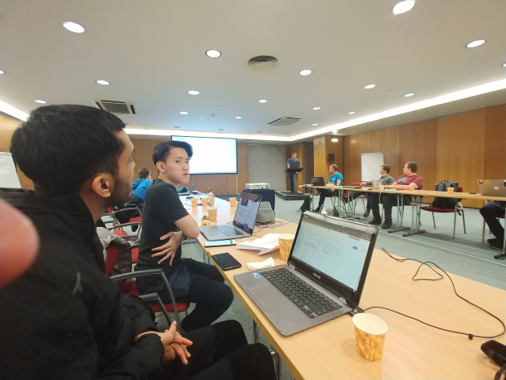
A photo from the HackFest

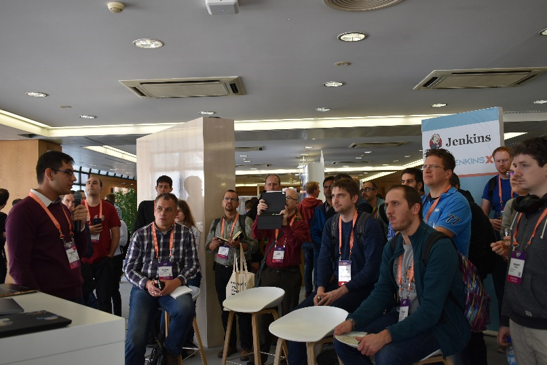
Next morning, we all met for breakfast where we all got to taste some Pastel de Nata. We then took a cab to the Congress Centre for attending the Jenkins and Jenkins X hackfest. At the Hackfest, I met Mark, Joseph, Kasper, Andrey and other Jenkins contributors. I also met Oleg, this time together with his son and his wife. After our introductions, and a short presentation by Oleg, I started hacking on the Folder Auth plugin and made it possible to delete user sids from roles. The best part of hacking there was to get instant feedback on what I was working on. More and more people kept coming throughout the day. It was great to see so many people working hard to improve Jenkins. At the end, everyone presented what they had achieved that day. Having skipped lunch for some snacks, Oleg and others tried hard to get some pizza delivered without much success. After the Hackfest, everyone was hungry and most attendees including me went looking for nearby restaurants. Since it was early and most restaurants were not open yet, we all decided to have burgers. It was a great learning experience listening to and talking about Jenkins, Elasticsearch, Jira, GitHub and a lot of other things. After that, we took a taxi back to the hotel and I went to bed.

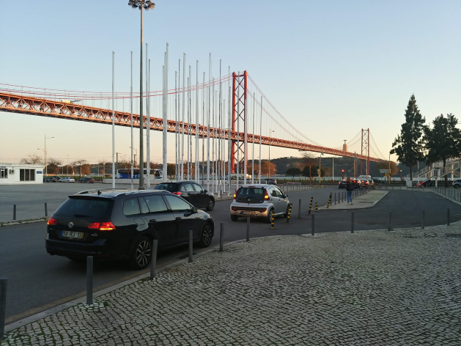
Sunset outside the conference center

Day 2: Contributor Summit, December 3

We had the Jenkins and Jenkins X contributor summit the next day. Me and Parichay took the bus to the Congress Centre in the morning. After registration, I got my ‘Speaker’ badge and the conference T-shirt. The contributor summit took place in the same hall as the Hackfest, but the seating arrangement was completely different and there were a lot more people. The summit started with everyone introducing themselves. It turned out that there were a lot of people from Munich. There were presentations and talks about all things Jenkins, Jenkins X and the Continuous Delivery Foundation by Kohsuke, Oleg, Joseph, Liam, Olivier, Wadek and others. I had no experience with Jenkins X which made the summit very interesting. After lunch, the talks were over, and everyone was free to join any session discussing various things about Jenkins. I attended the Cloud Native Jenkins and the Configuration-as-Code sessions.

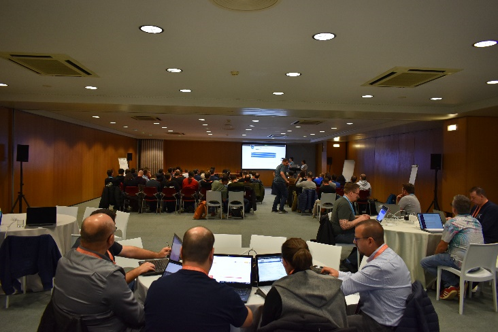
The Contributor Summit
My badge

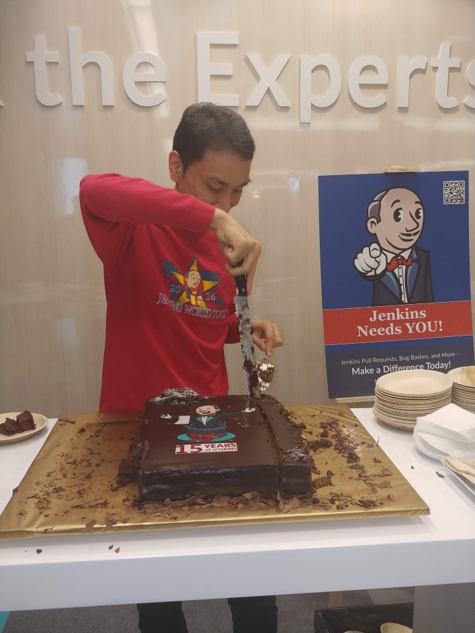
While some of the conference attendees were in the Contributor summit, the others were going through certifications and trainings. At around 5 o’clock in the evening, the summit and the trainings all got over and the expo hall was thrown open. On the entrance, there was a large stack of big DWJW bags. I did not realize why those bags were kept there. Since everyone was taking one, I took one as well. As soon as I went into the hall, I realized that those bags were for collecting swag. I had never seen anything like this where sponsors were just giving away T-shirts, stickers and other stuff. There were snacks and Kohsuke was cutting the extremely tasty 15 years of Jenkins cake. After having the cake, I went on a swag-collecting spree going from one sponsor booth to the other. This was an amazing experience, not only was I able to get cool stuff, I was also able to learn a lot about the software these companies made and how it fits into the DevOps pipeline.

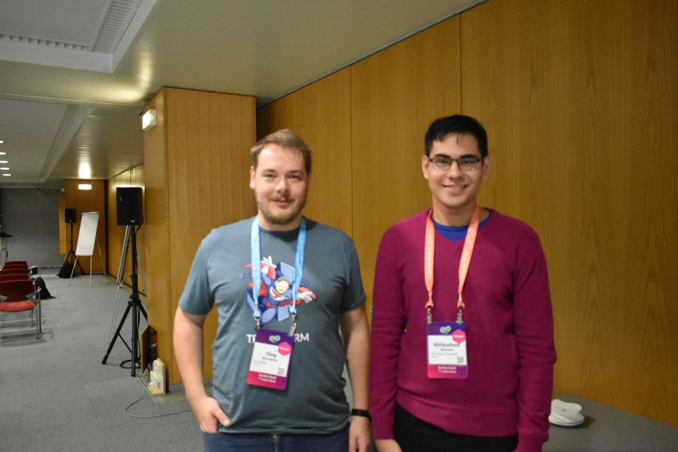
Photo with Oleg

After the conference got over, me, Long and Parichay went to the Lisbon Mariott Hotel for the Eurodog party. After collecting another T-shirt, I went to the nearest restaurant (McDonald’s) with Andrey who I had earlier met at the Hackfest.

Kohsuke cutting cake
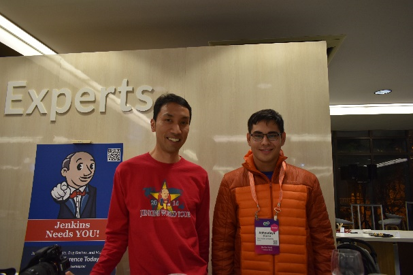
Photo with Kohsuke
Photo with Oleg and Joseph

Day 3: December 4

This was the first official day of the conference and it began with the keynote. There were over 900 people in the keynote hall. It was amazing to see so many people attending the conference. After the keynote got over, I went to several sessions throughout the day learning about how companies are using Jenkins and implementing DevOps tools.

15 years of Jenkins

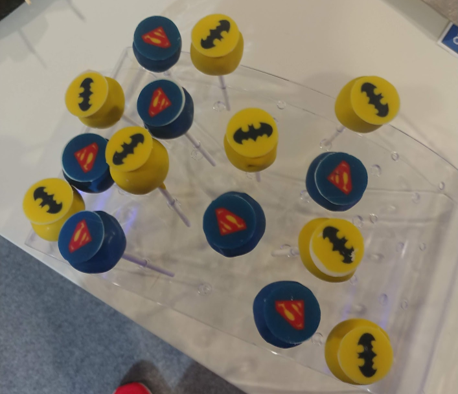
In the evening, we had the Sonatype Superparty which was a lot of fun. There were neon lights, arcade machines, VR experiences, superheroes and more swag. There was a lot of good food including pizzas and burgers and hot dogs. Superhero inspired desserts were very interesting. I was able to talk to Oleg and Wadek about the security challenges in Jenkins. During the party, I also got a chance to meet the CEO of Cloudbees, Sacha Labourey.

Batman vs Superman
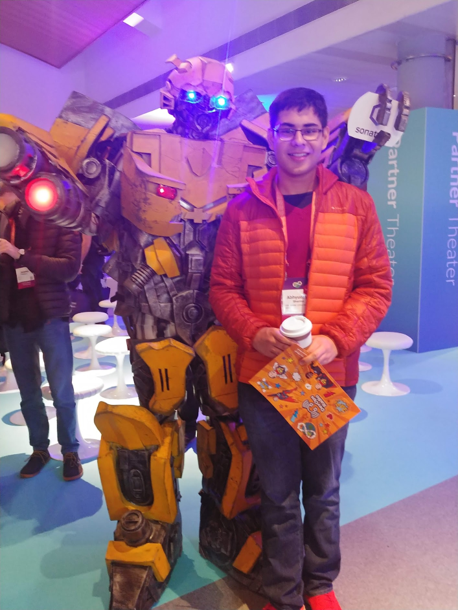
A photo with Bumblebee

Day 4, December 5

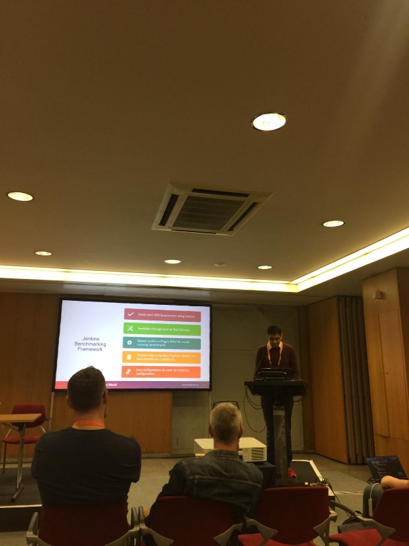
This was the last day of the conference and it began with another keynote. After the keynote, I attended a very interesting talk on how the European Observatory built software for large telescopes using Jenkins. After that, I prepared for my talk on the work I did during Google Summer of Code 2019. I had my presentation in the community booth during the lunch time. Presenting in front of real people was an amazing experience and very different from the ones we had on Zoom chats for our GSoC evaluations. In the evening, I got another chance to present my project at the Jenkins Community Lightning Talks.

Me speaking at the community booth
Me speaking at the community lightining talks

After that, the conference came to an end and I went back to the hotel. After relaxing for some time, me, Parichay and Long were invited by Oleg to a dinner at Corinthia Hotel with Kohsuke, Mark and his wife, Tracy, Alyssa, and Liam. Unfortunately, Long couldn’t attend the dinner because he had the flight back earlier that evening. After the amazing dinner, I thanked everyone for such an amazing trip and said goodbye.

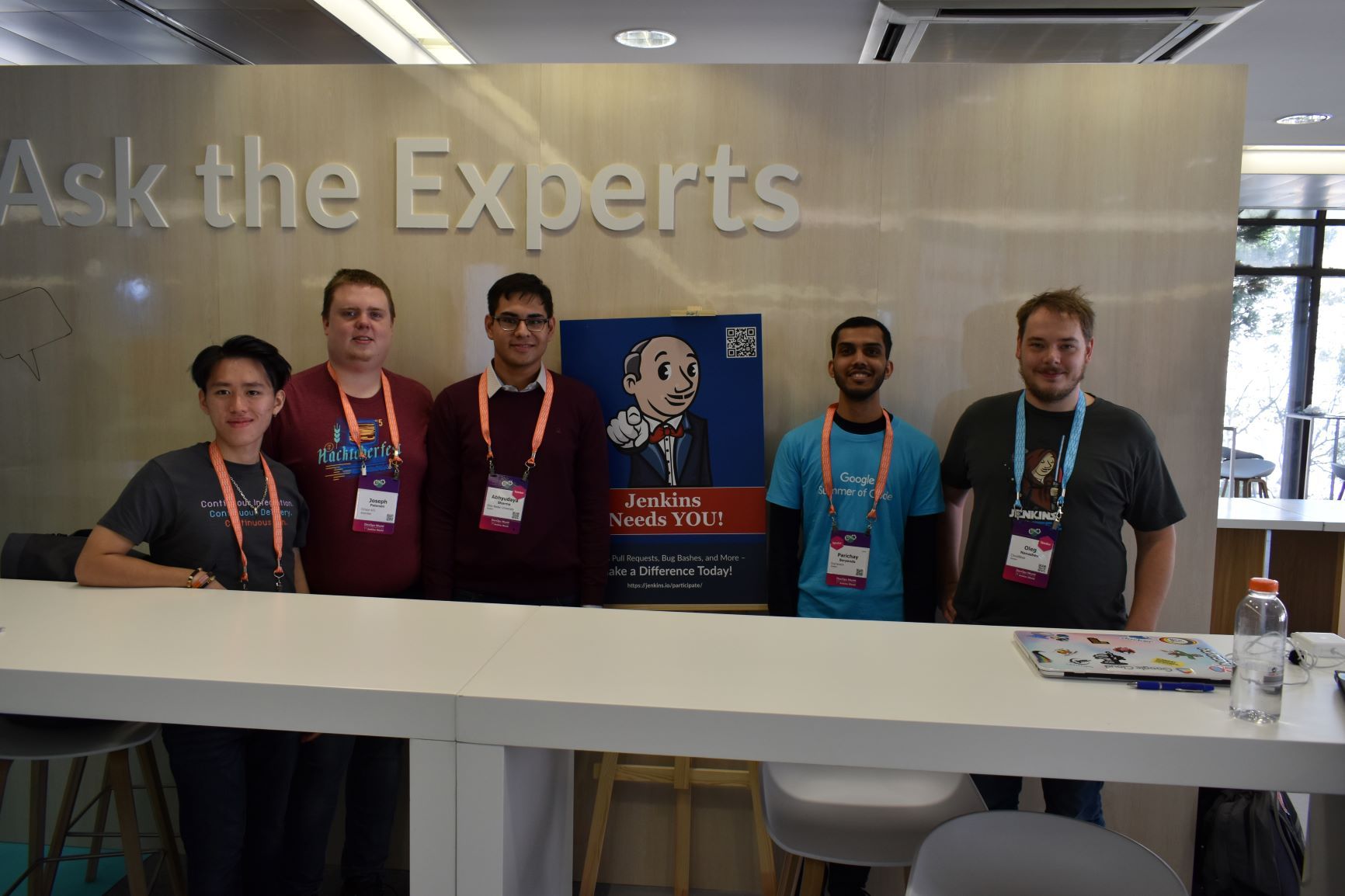
GSoC Group Photo

DWJW was the best experience I’ve ever had. I was able to learn about a lot of new things and talk to some amazing people. In the end, I would like to especially thank Oleg for helping me throughout and making it possible for me to attend such a wonderful conference. I would like to thank my other mentors Runze Xia and Supun for their support in my Google Summer of Code project. I would like to thank Google for organizing Google Summer of Code, everyone at Jenkins project for sponsoring my travel, and CloudBees for inviting me to the conference.

Looking forward to seeing you all again soon!

CI. CD. Continuous Fun.

Friday, 7 February 2020

How data is driving new approaches to transportation

Analysing digital streams of information from electric scooters and motor-assisted bicycles are helping solve travel congestion issues.

Do You Know the Vital Steps to Programmatic Advertising Success?

In today’s digital world, programmatic advertising plays an essential role in the digital transformation of how businesses perform, succeed and hold on to customers. It is the automated buying and selling of online advertising that makes transactions efficient and more effective.

Nowadays, programmatic platforms are developing their inventory and database in a manner that any format and channel can be accessed programmatically including smartphones, tablets, desktop, connected TV, etc.

Stats Associated with Programmatic Advertising

Here are some of the key stats related to Programmatic Advertising in 2020 and beyond, have a look:


It has been predicted that almost 88% of US digital display ad dollars will be transacted programmatically by 2021, which equates to a staggering $81 billion.
Advertisers will spend $98 billion on programmatic advertising in 2020 alone, which will make up to 68% of their total annual digital media advertising spend.
Programmatic advertising will climb over 80% in all the USA, Canada, the UK, and Denmark markets when it comes to all digital media by 2020.
The giants will show off an incredible combined revenue equating to more than half of advertisers’ total programmatic display budgets. 
It has also predicted that this slice of the ad spend pie will increase further during 2020, climbing to a huge 63%.
The rise of connected TV is ...


Read More on Datafloq

Uber gets California nod to restart self-driving test

The California Department of Motor Vehicles issued a permit on Wednesday to the company’s selfdriving unit, Uber Advanced Technologies.

AI Employed to Track Spread of Coronavirus and Seek a Vaccine

By John P. Desmond, AI Trends Editor

The coronavirus was declared a global emergency by the World Health Organization on January 30. AI is being employed extensively to track the spread of the new deadly virus, for now dubbed the 2019-novel coronavirus (2019-nCoV).

Receiving fair attention as a result is BlueDot, a venture-backed startup that has built an AI platform to process billions of pieces of data, such as from world air travel, to identify outbreaks. BlueDot issued its first alert on Dec. 31, ahead of the US Centers for Disease Control and Prevention, which issued its own warning on Jan. 6, according to an account in Forbes.

BlueDot was founded by Kamran Khan, an infectious disease physician and professor of Medicine and Public Health at the University of Toronto. He was on the front line of healthcare work during the outbreak of SARS (Severe Acute Respiratory Syndrome) in China in 2002-2003.

“We are currently using natural language processing (NLP) and machine learning (ML) to process vast amounts of unstructured text data, currently in 65 languages, to track outbreaks of over 100 different diseases, every 15 minutes around the clock,” stated Khan.

To do the work manually would require over 100 people to do well, he said. Instead, health experts can focus on a response.

Millions of posts about coronavirus on social media and news sites are allowing algorithms to generate near-real-time information for public health officials tracking its spread, according to an account in STAT.

“The field has evolved dramatically,” stated John Brownstein, a computational epidemiologist at Boston Children’s Hospital who operates a public health surveillance site called healthmap.org The site uses AI to analyze data from government reports, social media, news sites, and other sources.

John Brownstein, epidemiologist, Boston Children’s Hospital

Many are involved in the effort to track and predict the course of the disease. “Groups across the country are developing models for the spread (of coronavirus) domestically and internationally,” he said. healthmap.org is working with Buoy Health, a Boston startup, to build a symptom-checker to assess the symptoms of coronavirus that distinguish it from seasonal flu.

InterSystems of Cambridge, Mass., a supplier of database and healthcare information systems, is  working with healthcare providers in China to analyze data on coronavirus patients. “Machine learning is very good at identifying patterns in the data, such as risk factors that might identify zip codes or cohorts of people that are connected to the virus,” stated Don Woodlock, a vice president at InterSystems.

AI Brings a “Higher Probability of Getting Lucky”

Forbes asked experts how AI can be employed to battle the coronavirus, especially in the effort to develop a vaccine.

Steve Bennett, the Director of Global Government Practice at SAS and former Director of National Biosurveillance at the U.S. Department of Homeland Security, stated, “Now, when it comes to finding a cure for coronavirus, creating antivirals and vaccines is a trial and error process. However, the medical community has successfully cultivated a number of vaccines for similar viruses in the past, so using AI to look at patterns from similar viruses and detect the attributes to look for in building a new vaccine gives doctors a higher probability of getting lucky than if they were to start building one from scratch.”

Prasad Kothari, who is the VP Data Science and AI for The Smart Cube, stated, “In recent times, immunotherapy and Gene therapy empowered through AI algorithms such as boltzmann machines (entropy-based combinatorial neural networks) have stronger evidence of treating such diseases which stimulate body’s immunity systems. For this reason, Abbvie’s Alluvia HIV drug is one possible treatment. If you look at data of affected patients and profile virus mechanics and cellular mechanism affected by the coronavirus, there are some similarities in the biological pathways and treatment efficacy. But this is yet to be tested.”

In Pursuit of a Vaccine

The race is on to produce a vaccine for the rapidly-spreading virus, and the question of whether AI can speed up the process is on many fine minds.

The Coalition for Epidemic Preparedness Innovations (CEPI) announced on Jan. 23 that it will give three companies a total of $12.5 million to develop 2019-CoV vaccines. CEPI is a nonprofit formed in 2016 to fund and shepherd the development of new vaccines against emerging infectious diseases. CEPI is trying to have vaccines developed and tested faster than any previous effort, anywhere, ever. “This is what CEPI was created to do,” stated CEO Richard Hatchett in an account in Science.

Chinese researchers posted a sequence of  2019-CoV in a public database on Friday evening, Jan. 10. On Saturday morning, a team at the Vaccine Research Center of the US National Institute of Allergy and Infectious Diseases (NIAID) began to analyze the sequence. The following Monday, Barney Graham, deputy director of the research center, discussed his finding with researchers at Moderna, a maker of vaccines. On Tuesday, they signed a deal to collaborate.

Barney Graham, deputy director, Vaccine Research Center of the US National Institute of Allergy and Infectious Diseases (NIAID)

Moderna uses messenger RNA (mRNA) that can cause the body to produce a viral protein that can trigger the desired immune responses. Moderna has nine vaccines in clinical trials that use the mRNA platform. “It was a really, really hard scientific challenge to make the first one, but once you get the first one working, the next one becomes really easy,” stated Stéphane Bancel, Moderna’s CEO. “Once you get the sequence, it’s the same manufacturing process by the same group in the same room.”

Another company working on a 2019-nCoV vaccine with help from CEPI is Inovio, which began its project that same Saturday morning. Inovio produces vaccines made of DNA. It has a vaccine in human trials targeting Middle East respiratory syndrome (MERS), a disease caused by a similar coronavirus. The MERS vaccine relies on a protein on the viral surface called the “spike.”

“Our team worked around the clock and was able to design a spike-focused vaccine [ for 2019-nCoV] by that Sunday night,” says CEO J. Joseph Kim.

Inovio and Moderna say they will have enough vaccine in one month to begin animal testing.

The third grant form CEPI is going to researchers at the University of Queensland, Australia. They are developing a vaccine consisting of viral proteins produced in cell cultures. Keith Chappell, a molecular virologist with the team, says the goal is to have a candidate vaccine ready for human testing in 16 weeks.

“This is incredibly ambitious and we can provide no guarantee that we can meet this target,” Chappell stated. “Our team is working as hard and fast as we possibly can. It is reassuring to us that we are not the only team tasked with a response.”

Read the source articles in Forbes, STAT and Science.

Crumbling Infrastructure and AI Autonomous Cars

By Lance Eliot, the AI Trends Insider

I should sue! That’s what my friends told me to do.

They were looking at the damage done to the right fender and front right tire of my car.  I had been driving innocently down a street in downtown Los Angeles and encountered a whopper of a pothole. I was doing the legal speed limit and was not driving recklessly.

When I turned a corner, an unexpected pothole loomed just after making the turn, and the right side of my car was doomed to enter into the gaping asphalt gash.

My guess is that I was going relatively slowly as I made the turn and it seemed to me that such a low speed would have made hitting the pothole a non-issue.

Nonetheless, there was a loud bang and scraping sound when I hit the pothole. I quickly pulled over to the side of the road to do a quick visual inspection of my car. The fender was scrapped and slightly bent. The tire appeared to be intact but had a strange bulbous-like protrusion now at the surface of the rubber.

Certainly, I was not the first person to find myself having become a victim of this particular pothole.

This specific street was popular since it led you to the on-ramp for the Harbor Freeway. Typically, each day, downtown L.A. office workers would go this way in the evening after work to get onto the freeway and make their way home. I’d bet that tons of drivers had hit that pothole. Maybe I should launch a class action lawsuit rather than suing solely on my own behalf!

Potholes On The Mind

Potholes like this monster tend to get worse over time. More and more cars fall into it or ram it or roll over it, all of which causes the hole to widen and deepen.

Now I’m not saying that this was one of those huge abyss-like monstrosities that seem to swallow-up entire cars. Admittedly, this pothole was still in its infancy. But, however you want to characterize it, the hole was relatively lethal and had already taken a chomp out of my car.

It was quite unsettling when I hit the pothole.

It made me wonder afterwards if other drivers might lose control of their car or become so startled that they might drive wildly after having struck the pothole. I watched for a few moments to see what other drivers did, and by-and-large most of them seemed to take the banging and bumping of hitting the pothole in stride. They probably had experienced this pothole before, or perhaps have encountered so many potholes throughout the Southern California area that they had become numb to hitting them.

There were a few drivers that struck the pothole and definitely appeared to momentarily nearly lose control of their car. They swerved toward the curb that was just a few feet from the hole. I suppose it was possible that if a pedestrian happened to be standing at that exact spot on the sidewalk, perhaps right at the curb, maybe waiting to get a ridesharing lift, they could have been endangered.

It would have to be some driver that really got a shock from plastering into the pothole, though this is not as remote a chance as you might think. There are lots of Los Angeles drivers that I’d dare say should probably not have a driver’s license as they seem to drive without any due care or drive like a frightened mouse that goes a kilter at the slightest afront. A novice teenage driver just learning to drive might be taken aback by hitting the hole and perhaps lose control of their car. Besides cars, I also considered the impact of a motorcyclist hitting the pothole and the idea made me shudder.

Some of you might be thinking that I was not properly paying attention to the road and that if I had been more alert that I would have seen the pothole before striking it. I would like to argue that point with you. I went back to the corner and drove the turn again, wanting to see if it was feasible to see the pothole before making the turn. I suppose that I was trying to amass evidence for suing, or at least to be able to explain to my friends why I “stupidly” struck a gap pothole.

At the turn, there were too many other objects nearby to be able to clearly see the roadway beyond the corner. There was a fire hydrant near the corner. There was a pedestrian stand. There was a posted sign about when you could park on that street. There was a street sign indicating the name of the street. All in all, even if you knew to look for the pothole, it was well obscured by the other objects at the corner.

Upon making the turn, you would only have a split second to see the pothole. I estimated that you would need to be crawling at the lowest possible speed of a car to have any amount of time to first notice the pothole and then take an evasive maneuver. Let’s also keep in mind that if you did magically see the pothole in time to make an evasive maneuver, what maneuver would you make?

If you tried to swing wide to the left around the pothole, there was a danger of striking another car coming down the street. If going left was unwise, going to the right was equally unwise or worse. There was insufficient room to try to go to the right of the pothole, which you’d end-up having to drive up onto the curb. You could try to weave directly over the pothole, putting your right tire just to the right of the pothole, making sure to keep the tire in the gutter next to the curb and not go up over the curb. This was a rather finesse-like approach and would have taken some advanced preparations to get to just the correct position moments before coming upon the hole.

Generally, I would say that the “safest” approach was to go ahead and bite-the-bullet and hit the pothole, assuming that you were not forewarned about its presence. Hitting the pothole and making sure to keep control of your car seemed a less risky approach than the other alternatives. Trying to hit the brakes just as you encountered the pothole was another possibility, but I’d bet that a car behind you that was also making the same turn would have been likely to rear-end your car. I realize you might say that would be their fault, and I get that notion, regardless though I’d rather take the chance of harming my suspension or my tire versus getting struck by another car from behind and possibly suffering whiplash.

For those of you in the hyper-digital age, you might be yelling at me right now and clamoring that I ought to be using a traffic app on my smartphone that might have warned me about the pothole.

Indeed, there are a number of traffic or roadway related apps that allow a crowdsourcing approach to keeping track of the deteriorating roadway infrastructure. People using the app can mark spots that contain potholes and other roadway difficulties. Other people using the app can then be forewarned.

There are some apps that also allow the posted item to be transmitted to the local roadway repair crews.

Of course, it isn’t as though a roadway repair crew is going to instantaneously appear and fix the hole or other roadway matter. The odds are that they have hundreds or maybe thousands of these kinds of reported roadway issues. They need to prioritize which ones they work on. It takes time for the crew to come out and make the repair. Presumably, the worst of the roadway blemishes that present the highest risk to drivers and pedestrians are getting the higher priority over the other bothersome but not “killer” kinds of roadway problems.

One concern expressed by those that study our crumbling roadway infrastructure is that we seem to be mired in a continual mode of quick repair. This fix-and-forget kind of approach is belied by the fact that often times a repair is made that lasts only a short time. For the pothole at the corner, suppose a repair crew slops in some fresh asphalt. It might fill-in the hole for a brief period of time. Meanwhile, cars continue to roll over the patch and the pothole will be potentially reborn. Sure enough, the pothole might become a monster again, and the cycle of coming to do another quick-fix will repeat itself.

The American Society of Civil Engineers recently published a report that says there are around 57% of the roads in Los Angeles that can be rated at a poor condition. By poor condition, they are asserting that those roads are in significant deterioration, are well-below roadway standards, and have a strong risk of overall failure. In my daily one to two-hour commute here in Southern California, I’d wholeheartedly agree that at least seemingly half of the roads are in bad shape here. Maybe more. Maybe a lot more.

Those of you that aren’t here in California are probably not especially sympathetic to our roadway plight in that you likely have something going on where you live that has a similar gloomy roadway dilemma, perhaps even worse than our roads. Here’s a big number for you: $4.6 trillion dollars. That’s how much the American Society of Civil Engineers estimates is the cumulative price needed to make our U.S. transportation infrastructure into something of an above average grade (right now, they say that the U.S. is maybe a D+).

My story about the pothole is really a microcosm of our overall roadway infrastructure. We have lots and lots of infrastructure that is crumbling around us. We depend upon the infrastructure to make our way to work and for going to the store and for living our lives. The infrastructure is decaying and wearing out. Attempts at quick fixes are only momentarily keeping things intact. One might claim that those quick fixes end-up masking the overarching problems and we are therefore deluding ourselves by making the quick fixes.

Our economy depends upon our ability to drive on the roads. One could say that our society depends on our ability to drive on the roads. Our elaborate and crisscrossing roadway infrastructure is the essence of how we live.

It is easy to take it for granted.

When I tell people that we need to do something about our roads, I usually get a kind of yawn and am told that we just need to all stop whining (though, once they themselves have hit a pothole, and felt the “pain” of our worsening roads, they suddenly become converts to doing something about the infrastructure!). When I tell people about the nearly $5 trillion dollars needed to invest in our infrastructure to keep it going and hopefully bolster it, the number is so astronomical that most people cannot fathom how much money that is.

Autonomous Cars And Foul Infrastructure

What does this have to do with AI self-driving driverless autonomous cars?

At the Cybernetic AI Self-Driving Car Institute, we are developing AI software for self-driving cars. One aspect involves making sure that the AI can handle driving on rough roads and contend with our deteriorating roadway infrastructure.

Allow me to elaborate.

I’d like to first clarify and introduce the notion that there are varying levels of AI self-driving cars. The topmost level is considered Level 5. A Level 5 self-driving car is one that is being driven by the AI and there is no human driver involved. For the design of Level 5 self-driving cars, the automakers are even removing the gas pedal, brake pedal, and steering wheel, since those are contraptions used by human drivers. The Level 5 self-driving car is not being driven by a human and nor is there an expectation that a human driver will be present in the self-driving car. It’s all on the shoulders of the AI to drive the car.

For self-driving cars less than a Level 5 and Level 4, there must be a human driver present in the car. The human driver is currently considered the responsible party for the acts of the car. The AI and the human driver are co-sharing the driving task. In spite of this co-sharing, the human is supposed to remain fully immersed into the driving task and be ready at all times to perform the driving task. I’ve repeatedly warned about the dangers of this co-sharing arrangement and predicted it will produce many untoward results.

For my overall framework about AI self-driving cars, see my article: https://aitrends.com/selfdrivingcars/framework-ai-self-driving-driverless-cars-big-picture/

For the levels of self-driving cars, see my article: https://aitrends.com/selfdrivingcars/richter-scale-levels-self-driving-cars/

For why AI Level 5 self-driving cars are like a moonshot, see my article: https://aitrends.com/selfdrivingcars/self-driving-car-mother-ai-projects-moonshot/

For the dangers of co-sharing the driving task, see my article: https://aitrends.com/selfdrivingcars/human-back-up-drivers-for-ai-self-driving-cars/

Let’s focus herein on the true Level 5 self-driving car. Much of the comments apply to the less than Level 5 self-driving cars too, but the fully autonomous AI self-driving car will receive the most attention in this discussion.

Here’s the usual steps involved in the AI driving task:

  • Sensor data collection and interpretation
  • Sensor fusion
  • Virtual world model updating
  • AI action planning
  • Car controls command issuance

Another key aspect of AI self-driving cars is that they will be driving on our roadways in the midst of human driven cars too. There are some pundits of AI self-driving cars that continually refer to a Utopian world in which there are only AI self-driving cars on the public roads. Currently there are about 250+ million conventional cars in the United States alone, and those cars are not going to magically disappear or become true Level 5 AI self-driving cars overnight.

Indeed, the use of human driven cars will last for many years, likely many decades, and the advent of AI self-driving cars will occur while there are still human driven cars on the roads. This is a crucial point since this means that the AI of self-driving cars needs to be able to contend with not just other AI self-driving cars, but also contend with human driven cars. It is easy to envision a simplistic and rather unrealistic world in which all AI self-driving cars are politely interacting with each other and being civil about roadway interactions. That’s not what is going to be happening for the foreseeable future. AI self-driving cars and human driven cars will need to be able to cope with each other.

For my article about the grand convergence that has led us to this moment in time, see: https://aitrends.com/selfdrivingcars/grand-convergence-explains-rise-self-driving-cars/

See my article about the ethical dilemmas facing AI self-driving cars: https://aitrends.com/selfdrivingcars/ethically-ambiguous-self-driving-cars/

For potential regulations about AI self-driving cars, see my article: https://aitrends.com/selfdrivingcars/assessing-federal-regulations-self-driving-cars-house-bill-passed/

For my predictions about AI self-driving cars for the 2020s, 2030s, and 2040s, see my article: https://aitrends.com/selfdrivingcars/gen-z-and-the-fate-of-ai-self-driving-cars/

Returning to the topic of our crumbling transportation infrastructure, let’s consider what kind of impact this situation might have on AI self-driving cars, along with pondering the future of the infrastructure as framed in light of the hopeful and likely advent of AI self-driving cars.

Crumbling Infrastructure

We’ll start with the assumption that the roads will continue for the foreseeable future to deteriorate and it will be a sad and unavoidable fact of life.

As such, what should AI developers be doing in terms of the AI for self-driving cars? Some AI developers tell me that there’s nothing special they need to do. The road is the road. Good or bad, there’s presumably no need to care. Just focus on having the AI be able to drive a car and that’s sufficient, in their book.

I tend to disagree with their head-in-the-sand approach.

We believe that the AI ought to be specially prepared for a likely lousy infrastructure that contains roadway potholes, pits, cracks, debris, and for which the painted lines on the roads will be faded or disappear, and that street signs might be obscured or missing, etc. These are all the potential and inevitable consequences if there is not something Herculean done to improve the infrastructure.

One aspect that catches the attention of the AI developers that don’t seem to believe in caring about the untoward infrastructure involves my mentioning the faded or disappearance of lane markers and lane lines. This gets those AI developers to suddenly pay attention. The reason for their attention is that many of them are using the now-classic navigation technique of watching for lane markers and lane lines to know where the AI is supposed to position the self-driving car.

The AI system uses the camera sensors to try and detect where those lane markers and lane lines are. Then, once so detected, the AI guides the controls of the self-driving car to stay within those lines when traveling in a lane, and also for purposes of changing lanes. It is essential that this AI approach must have available relatively obvious and clear-cut lane markings. Without the lane markings, the AI system is pretty much unable to discern where a lane is and where to keep the self-driving car while moving along on the roads.

Human drivers of course also depend upon the lane markers and lane lines, but they are also able to handle a great deal of ambiguity when the lane indications are slim or intermittent. Us humans seem to be able to mentally gauge where a lane might or must be, even when the lane itself does not stand out or otherwise has evaporated in terms of a marked path. That’s how good us humans are. Sure, I realize that some humans do get confused in such cases, and they might weave or wander into someone else’s pretend lane, but by-and-large most capable human drivers can handle this vagueness when it occurs.

So, the point is that the traditional AI technique of relying on apparent lane markings and lane lines is likely to get undermined as the roadways worsen. It is crucial to bump-up the AI to be more sophisticated in ascertaining lane positioning. If we don’t boost the AI for this, the vaunted hope of having less fatalities due to the advent of AI self-driving cars will be called more so into question.

For my article about the zero fatalities topic, see: https://aitrends.com/selfdrivingcars/self-driving-cars-zero-fatalities-zero-chance/

For the dangers of the simpleton pied piper AI approaches, see my article: https://aitrends.com/selfdrivingcars/pied-piper-approach-car-following-self-driving-cars/

It is important that the AI be versed in defensive driving, see my article: https://aitrends.com/selfdrivingcars/art-defensive-driving-key-self-driving-car-success/

Here’s the kinds of foibles that can occur when driving, per my article: https://aitrends.com/selfdrivingcars/ten-human-driving-foibles-self-driving-car-deep-learning-counter-tactics/

Another aspect about the AI system is that it needs to be using all of its capabilities to try and detect roadway issues and obstacles, which will be even more so crucial as the crumbling infrastructure continues to degrade.

Example About Potholes

Let’s use my pothole example.

As mentioned, I was unable to detect the pothole prior to making the right turn at the corner of the downtown street. Could the AI have done a better job?

I’m not so sure it could have in this circumstance since the visual images coming into the cameras of the self-driving car would not have readily revealed the pothole beforehand, the sensors too would have been visually blocked as were my eyes by the various obstacles at the street corner, such as the light post, fire hydrant, and so on. The radar of the self-driving car would not likely have gotten a good bounce off the street area around the corner. The LIDAR would have likewise likely not been able to detect the pothole. Etc.

Once the AI started to maneuver the self-driving car around the corner, it would then have a chance at detecting the pothole. Suppose the AI was not trained to do so or otherwise was not particularly setup to cope with potholes? In that case, the odds are that the AI would drive straight into the pothole and not even realize what was happening. All of a sudden, the self-driving car would be bumping and shoved to the side, all of which might be a complete mystery to the AI. The AI might even lose control of the self-driving car per se, allowing the self-driving car to drift over into someone else’s lane or up onto the curb.

The AI might via the IMU (Inertial Measurement Unit) be able to realize that something is afoot when the overall balance of the self-driving was askew, but if it had not already detected the pothole it would be an unknown as to why the self-driving car has suddenly gone somewhat astray.

For aspects about the IMU on a self-driving car, see my article: https://aitrends.com/selfdrivingcars/proprioceptive-inertial-measurement-units-imu-self-driving-cars/

For my article about edge cases, see: https://aitrends.com/selfdrivingcars/edge-problems-core-true-self-driving-cars-achieving-last-mile/

For safety and AI self-driving cars, see my article: https://aitrends.com/selfdrivingcars/safety-and-ai-self-driving-cars-world-safety-summit-on-autonomous-tech/

For reaction time aspects of AI systems, see my article: https://aitrends.com/selfdrivingcars/cognitive-timing-for-ai-self-driving-cars/

Would the AI be able to quickly enough counter the physics of the lurch caused by the hitting of the pothole?

Would it be able to correct for the shove that the self-driving car got by rolling into and over the pothole?

Even if it was able to detect the pothole in-advance of hitting it, would the AI be able to appropriately identify the alternatives such as swerving over or trying to come to a halt and assess the risks associated with those alternatives, thus making a “reasoned” selection of what to do?

These are serious questions regarding the driving capability of the AI.

AI Development Mindset

I suppose some AI developers would assert that the AI has to be ready for potholes all the time anyway, and there isn’t a special case involved in dealing with these roadway evils. Though this is partially true, it also belies the idea that with a crumbling infrastructure the pothole is going to no longer be a rare event of an edge case nature and will instead be a probable and frequent encounter.

The AI might need to cope with having to drive down any given street and be dodging a large crack in the street there, and a pothole over here, and then another pothole a few feet to the left, and maybe debris chopped out of a pothole by a prior car that hit the hole.

I tend to refer to this as the AI dodgeball mode. The AI needs to be able to play a kind of dodgeball game of maneuvering in and around the various obstacles and roadway problems. I doubt that most AI developers have considered ensuring that the AI can handle this somewhat repeated and continual effort of lots of dodges to be strung together, doing so while keeping the self-driving car safely on the road and not hit any other cars or nearby pedestrians.

In essence, the usual assumption is that the self-driving car will encounter one anomaly, the AI will be able to deal with it distinctly, and then if another anomaly appears it will be completely later in time, considered a separate occurrence and fully independent of the first encounter. The reality is that a lot of the roads are likely to be a morass of deterioration on a given road, often due to the heavy traffic on that particular road.

Also, as a road starts to deteriorate, it often accelerates in deterioration as there is a kind of momentum that a rough road gets rougher faster and sooner than might a road that otherwise is more resilient and not prone to getting beat-up. The rule-of-thumb is that a worsening road will tend toward getting worse, perhaps exponentially so. Worseness begets more worseness. Meanwhile, a road that is in good shape will likely be at first “resistant” to getting torn-up, and only once a threshold has been reached will it become the proverbial snowball that grows to become an avalanche of snow over time.

For detecting and avoiding roadway debris, see my article: https://aitrends.com/selfdrivingcars/roadway-debris-cognition-self-driving-cars/

For my article on street scene free space, see: https://aitrends.com/selfdrivingcars/street-scene-free-space-detection-self-driving-cars-road-ahead/

For idealism about AI self-driving cars, see my article: https://aitrends.com/selfdrivingcars/idealism-and-ai-self-driving-cars/

For the dangers of AI developer egocentric mindsets, see my article: https://aitrends.com/selfdrivingcars/egocentric-design-and-ai-self-driving-cars/

One aspect that might help AI self-driving cars to contend with banged-up roads is the use of V2V (vehicle-to-vehicle) electronic communications.

When I drove around the corner and hit the pothole, it would have been handy if I could have immediately communicated with the car behind me. I might have told the driver in the car behind me to watch out for the pothole. I might have also indicated that I was going to come to a sudden halt to avoid smashing into the hole, and thus I wanted them to not rear-end my car when I came to an unexpected halt.

With the use of V2V, one AI self-driving car could indeed tell another AI self-driving car to do those kinds of things. Presumably, in an orderly fashion, one AI helps another AI. Each self-driving car that follows the next would be forewarned about the pothole. This would also allow those AI self-driving cars to act in concert with each other, often referred to as a swarm, allowing each to avoid the pothole by making timed and coordinated maneuvers.

For more about OTA, see my article: https://aitrends.com/selfdrivingcars/air-ota-updating-ai-self-driving-cars/

For swarm and AI, see my article: https://aitrends.com/selfdrivingcars/swarm-intelligence-ai-self-driving-cars-stigmergy-boids/

V2V Is Not The Silver Bullet

The one rub to this V2V is going to be the human drivers that are in the mix of the cars on the roads.

Suppose that when I took the corner that I was in a Level 5 self-driving car and it tried to use V2V to warn the car behind me. It could be that the car behind me was also a Level 5 self-driving car and it had V2V and it electronically listened to my self-driving car and abided by the suggested driving aspects. Or, it could be that a human driver was in the car behind me. Would they even receive the V2V? If they did receive the V2V would they opt to abide by the suggestions made by my AI of my self-driving car?

There is also the likely advent of V2I (vehicle-to-infrastructure) electronic communication. Suppose that there is a computing device somewhere near to the corner that I was turning at (these devices are sometimes referred to as edge computing devices). The device might have already gotten an indication that there is a pothole there at the corner and that it is scheduled to be repaired in a month’s time. Meanwhile, it beacons out a message that there is a pothole and be wary of it. An AI self-driving car outfitted with the V2I would receive the message and be alerted to deal with the matter.

Part of the reason that the roadway infrastructure might hasten to deteriorate could partially be due to the advent of AI self-driving cars.

You might be shocked to think that the AI self-driving car emergence could somehow worsen the roadway infrastructure, since the AI is supposed to be a polite driver that obeys the laws and tries to drive as cleanly and legally as possible (I’ve debunked those assumptions, by the way!).

The reason that the advent of AI self-driving cars will likely exasperate the crumbling infrastructure is due to the belief that we’ll want to use the AI self-driving cars non-stop. It is anticipated that AI self-driving cars will be used extensively for ridesharing purposes. You are at work during the day and allow your AI self-driving car to be making money for you while you are at the office. Likewise, at night time, while your head is nestled on your pillow in bed, your AI self-driving is out there making money.

The odds are that we are going to see a beehive of activity of self-driving cars cruising around night and day, waiting to pick-up and drop-off passengers. This continual driving is going to put more miles onto our already destitute roadways. More miles on falling apart roads means those roads will continue to fall apart. We can predict it will make those roads a lot worse. The constant pounding of self-driving car after self-driving car is a punishment that a crumbling infrastructure will not be able to readily withstand.

For non-stop use of AI self-driving cars, see my article: https://aitrends.com/selfdrivingcars/non-stop-ai-self-driving-cars-truths-and-consequences/

For the affordability aspects of AI self-driving cars, see my article: https://aitrends.com/selfdrivingcars/affordability-of-ai-self-driving-cars/

For my article about why AI self-driving cars will drive illegally, see: https://aitrends.com/selfdrivingcars/illegal-driving-self-driving-cars/

For edge computing, see my article: https://aitrends.com/selfdrivingcars/edge-computing-ai-self-driving-cars/

I suppose one potential good news is that the AI self-driving cars will hopefully make use of Machine Learning (ML) and be able to therefore increasingly get better at detecting lousy roads and sufficient driving on lousy roads. I had mentioned earlier the V2V of AI self-driving cars sharing with each other. Another form of sharing will be via OTA (Over-The-Air) electronic communication.

OTA consists of the AI self-driving car providing to the cloud of the automaker or tech firm the data that the AI self-driving car is collecting while driving on the roads. This would include the camera data, video data, radar data, and so on. At the cloud level, the auto maker or tech firm can do analyses and try to use ML and deep learning to improve how the AI self-driving cars operate. These improvements can be pushed back down into the AI self-driving car, providing updates or patches for when something amiss in the software needs to be upgraded or fixed.

Let’s consider again my pothole example again. An AI self-driving car might already have been forewarned about the pothole because a prior AI self-driving car in the same fleet had reported it to the cloud via OTA. The aspect about this pothole was then brought back down into the rest of the AI self-driving cars in the fleet via the OTA too. Furthermore, beyond just having a mapped indication of where the pothole is, the Machine Learning aspects would have tried to figure out ways to contend with the pothole.

Thus, the AI self-driving cars in the fleet would not only be aware of the existence of the pothole, but also have some driving tactics and strategies to contend with it. Perhaps one aspect would be to not even make that right turn and go up another street to make the desired right turn. Another tactic might be to swing wide when making the turn, doing so by first warning the car next to the AI self-driving car. Each of these tactics would be contextually based, meaning that the choice is not always the same one, and instead that the context such as the time of day or the weather conditions might dictate which choice is the best at the moment of making the driving decision.

For my article about imitation as a deep learning technique, see: https://aitrends.com/selfdrivingcars/imitation-deep-learning-technique-self-driving-cars/

For Ensemble Machine Learning, see my article: https://aitrends.com/ai-insider/ensemble-machine-learning-for-ai-self-driving-cars/

For Federated Machine Learning, see my article: https://aitrends.com/selfdrivingcars/federated-machine-learning-for-ai-self-driving-cars/

For my article about biomimicry, see: https://aitrends.com/selfdrivingcars/biomimicry-robomimicry-ai-self-driving-cars-machine-learning-nature/

I’ve focused so far on having the AI be adept at contending with a crumbling infrastructure.

Perhaps I should not be so fatalistic.

Let’s imagine that we collectively have the willpower to do something substantive about the crumbling infrastructure.

Doing Something About The Infrastructure

Depending upon the status of AI self-driving cars at the juncture of moving forward on improving the infrastructure, we could use the data from the AI self-driving cars to better understand where the crumbling infrastructure is most occurring. Keep in mind that the AI self-driving cars will have their myriad of sensors and will be crisscrossing the roads and continually capturing visual images, radar, LIDAR, etc.

This is a huge amount of data that can be used to mine when trying to prioritize where to put our energies and money on infrastructure improvements. This data can reveal which roads are most traveled and which are least traveled. It can reveal the roughness of the roads. There are a slew of handy analyses and metrics that can be discerned from this vast collection of data.

Another factor involves whether or not to merely fix the infrastructure as though we will continue to have only conventional cars, or whether to consider doing other kinds of improvements or upgrades to the infrastructure that tie into the advent of AI self-driving cars.

For example, I had mentioned herein the use of edge computing, which will be a boon to AI self-driving cars. Perhaps the crumbling infrastructure can be enhanced by the adoption of edge computing.

There is also going to be the OTA taking place and we need fast networks to handle that kind of data movement. I’ve already previously described the importance of 5G in my speeches and writings. Perhaps the infrastructure can include the adoption of 5G on a widespread basis across our roadways.

We will need a provision for dealing with AI self-driving cars that breakdown. I realize that some pundits claim that AI self-driving cars will never breakdown, but this is crazy talk. A car is a car. There will be lots of reasons for an AI self-driving car to breakdown, including as previously pointed out that they will be trying to run non-stop 24×7. We’ll need to contend with the towing of broken-down AI self-driving cars, another topic that I’ve covered in my presentations and writings, and for which the infrastructure can be shaped to aid toward appropriately handling these situations.

For my article about 5G, see: https://aitrends.com/selfdrivingcars/5g-and-ai-self-driving-cars/

For towing an AI self-driving cars, see my article: https://aitrends.com/selfdrivingcars/towing-and-ai-self-driving-cars/

For repairing of AI self-driving cars, see my article: https://aitrends.com/selfdrivingcars/auto-recalls/

For when AI self-driving cars freeze-up, see my article: https://aitrends.com/selfdrivingcars/freezing-robot-problem-and-ai-self-driving-cars/

Conclusion

With the existing roadway infrastructure that is falling apart at the seams, we need to be ready for the advent of AI self-driving cars. It would be a shame to have AI self-driving cars that cannot readily use what might be impassable roads by the time that the AI is ready to hit the roads. Think of the irony that we might have in-hand self-driving cars, but they cannot go anywhere because of the marred roads. Or, we might put AI self-driving cars onto the roads, and their working for us non-stop causes the roads to hasten in crumbling.

One aspect involves making sure that the AI is savvy enough to be able to deal with the lousy infrastructure. There is though only so much that the AI can do in this regard. It would be like having all human drivers have to learn to drive gingerly so as to not unduly upset the roads. Better still would be to fix the infrastructure.

Fixing it means not just making what already exists passable, it also means that we would want to perform upgrades and improvements that dovetail with the emergence of AI self-driving cars. The motto often heard of “fix the darned roads” should be augmented by the clamor to “tech-up the roads” so that we’ll have a synergistic effect of good tech-savvy roads that coincide with the prevalence of AI self-driving cars.

Come to think of it, I’m going to have some signs made-up that say this and stand at the pothole tomorrow to alert my fellow mankind of what we need to do next.

Wave at me and honk your horn in support, would you please?

Copyright 2020 Dr. Lance Eliot

This content is originally posted on AI Trends.

[Ed. Note: For reader’s interested in Dr. Eliot’s ongoing business analyses about the advent of self-driving cars, see his online Forbes column: https://forbes.com/sites/lanceeliot/]

deepsense.ai, Volkswagen Train Real World Autonomous Vehicle Entirely In Simulation

By AI Trends Staff

deepsense.ai and Volkswagen have published research on arXiv showing that an autonomous vehicle trained entirely in simulation can drive in the real world. The team trained its policies using a reinforcement learning algorithm with “mostly synthetic data”, then transferred its neural network into a real car, providing it with over 100 years’ driving experience before the real-world engine had ever started.

“Moving the neural network policy from the simulator to reality was a breakthrough and the heart of the experiment,” explained Piotr MiÅ‚oÅ›, deepsense.ai researcher and a professor at the Polish Academy of Sciences in a statement about the work. “We have run multiple training sessions in the simulated environment, but even the most sophisticated simulator delivers different experiences than what a car encounters in the real world. This is known as the sim-to-real gap. Our algorithm has learned to bridge this gap. That we actually rode in a car controlled by a neural network proves that reinforcement learning-powered training is a promising direction for autonomous vehicle research overall.”

The experiment was conducted by a team of researchers including deepsense.ai’s BÅ‚ażej OsiÅ„ski, Adam Jakubowski, Piotr MiÅ‚oÅ›, PaweÅ‚ ZiÄ™cina and Christopher Galias, Volkswagen researcher Silviu Homoceanu and University of Warsaw professor Henryk Michalewski. The team not only trained a model that controls a car in a simulated environment but also executed test drives in a real car at Volkswagen’s testing facility. The car navigated through real streets and crossroads, performing real-world driving maneuvers.

The team used the CARLA simulator, and open-source simulator for autonomous driving research based on Unreal Engine 4 and tested 10 models with different driving and input variables.

Simulations Offer Advantages

Being able to use simulation offers crucial advantages, the team says. First, it is cheaper. In their combined experiments, the team generated some 100 years of simulated driving experience. Racking up so much experience in a real car isn’t feasible. Training in a simulator can also be done much faster. The agent can experience all manner of danger, from simple rain to deadly extreme weather, accidents to full-blown crashes, and learn to navigate or avoid them. Subjecting an actual driver to such hazards would be prohibitively complicated, time-consuming, and ethically unacceptable. What’s more, extreme scenarios in the real world are relatively uncommon but can be quickly simulated.

“It was exciting to see that our novel approach worked so well. By further exploring this path we can deliver more reliable and flexible models to control autonomous vehicles,” said Blazej Osinski, a data scientist at deepsense.ai. “We tested our technique on cars, but it can be further explored for other applications.”

Błażej Osiński, Data Scientist, deepsense.ai

Reinforcement learning allows a model to shape its own behavior by interacting with the environment and receiving rewards and penalties as it goes. The model’s goal is, ultimately, to maximize the rewards it receives while avoiding penalties. An autonomous car receives points for safe driving and complying with the traffic laws. Simulating every road condition that can occur is impossible but shaping a set of guidelines like “avoid hitting objects” or “protect passenger from any and all harm” is not. Ensuring the model sticks to the guidelines makes it more reliable, including in less common situations it will eventually face on the road.

“Using reinforcement learning has reduced the amount of human engineering work,” explained Osinski. “We didn’t have to create driving heuristics and to collect reference drives; instead we only had to define desired outcomes (making progress on a route) and undesired behaviors (crashes, deviating from you line, etc.). Based on this rewards and punishment RL is able to figure out the rest.”

There are many next steps for the team, Osinski said. “We can definitely increase the robustness of our system against more conditions and higher driving speeds. We would also like to tackle the situations requiring ‘assertive’ interactions with other drivers, such as changing lanes in a heavy traffic.”

Technical details of the research are described in the team’s paper, available on arXiv.

GSA Unit Launches AI Community of Practice to Boost Agency Adoption

By AI Trends Staff

The General Services Administration’s Technology Transformation Services (TTS) unit has launched an AI community of practice (AI CoP) to capture advances in AI and accelerate adoption across the federal government. The founding was announced in November via a blog post written by Steve Babitch, head of the AI portfolio for TTS.

The action is a follow-up to an Executive Order signed by President Trump in February on Maintaining American Leadership in AI. “The initiative implements a government-wide strategy in collaboration and engagement with the private sector, academia, the public, and like-minded international partners,” Babitch stated in the blog post.

Steve Babitch, head of the AI portfolio for TTS unit of the GSA

He outlined these six areas where the AI CoP will support and coordinate the use of AI technologies in federal agencies:

  • Machine Learning and deep learning
  • Robotic Process Automation
  • Human-computer interactions
  • Natural Language Processing
  • Rule based automation
  • Robotics

The executive sponsors of the AI CoP are the Federal Chief Information Officer, Suzette Kent, and the Director of GSA’s Technology Transformation Services, Anil Cheriyan. The CoP will be administered out of the Technology Transformation Services (TTS) Solutions division, led by Babitch, who coordinates with the CIO Council’s Innovation Committee.

Library of AI Use Cases in Government Being Compiled

At a GSA event in January, Babitch described an effort to develop a library of AI use cases that agencies can reference as they start to invest in new AI technology, according to an account in  fedscoop. The library could lead to other practice areas being added to the list.

“The harder we start to build that repository of use cases and build in a searchable database, if you will, that can sort of blossom into other facets as well—different themes or aspects of use cases,” Babitch stated. “Maybe there’s actually a component around culture and mindset change or people development.”

Practice areas mentioned include acquisition, ethics, governance, tools and techniques, and workforce readiness. Early use cases across agencies have touched on customer experience, human resources, advanced cybersecurity, and business processes.

In an example, the Economic Indications Division (EID) of the Census Bureau developed a machine learning model for automating data coding.

“It’s the perfect machine learning project,” stated Rebecca Hutchinson, big data leader at EID. “If you can automate that coding, you can speed up and code more of the data. And if you can code more of the data, we can improve our data quality and increase the number of data products we’re putting out for our data users.”

She reported that the model is performing with about 80% accuracy, leaving only 20% still needing to be manually coded.

One-Third of Census Bureau Staff Enrolled in AI Training

The Census Bureau has been offering AI training to interested workers, many of whom are taking advantage of the opportunity.

Interested staff can apply to learn Python in ArcGIS, and Tableau through a Coursera course. Hutchinson reported that one-third of the bureau’s staff has completed training or is currently enrolled, coming away with ML and web scraping skills.

“Once you start training your staff with the skills, they are coming up with solutions,” Hutchinson stated. “It was our staff that came up with the idea to do machine learning of construction data, and we’re just seeing that more and more.”

Read the source articles on the  GSABlog and in fedscoop.

Rometty Out as CEO of IBM; Foray into AI in Medicine with Watson Health a Legacy

By AI Trends Staff

Ginni Rometty has announced she is stepping down as CEO of IBM in April after an eight-year run. Her legacy at IBM is tied to the growth of AI as a business strategy, the success of Watson on Jeopardy, and the move into healthcare with IBM Watson Health and its subsequent retrenchment.

Rometty, 62, will be succeeded by Arvind Krishna, who has been head of IBM’s cloud and cognitive software division, reported The Wall Street Journal. Jim Whitehurst, the chief executive of Red Hat, the open source software company acquired by IBM last year for $33 billion, was appointed president of IBM.

It will be the first time in decades that IBM shares a dual leadership structure at the top. Rometty will continue as board chair through the end of the year, when she will retire after four decades at IBM. She is one of the highest profile female executives in the technology business, whose leadership is dominated by men.

Ginni Rometty, CEO of IBM

IBM’s share price fell 25% during Rometty’s tenure unfortunately, versus a 500% rise in Microsoft’s value and the tech-heavy Nasdaq Composite Index rising 250% in that time.

“She made a lot of changes,” stated David Grossman, an analyst at Stifel Financial Corp. “You could argue that she didn’t make enough changes quickly enough, but I think the business has transformed during that period.”

The Red Hat acquisition’s outcome will be important to Rometty’s legacy.

Riding Watson’s Jeopardy Success into Health Care

The day after Watson defeated two human champions in the television game show Jeopardy!, IBM announced Watson was heading into the medical field. IBM would take its ability to understand natural language that it showed off on television, and apply it to medicine. The first commercial offerings would be available in 18 to 24 months, the company promised, according to an account in IEEE Spectrum.

Eight years later, IBM has announced many more efforts to develop AI-powered medical technology and spent billions on acquisitions to assist the effort, but the jury is out on the results.

“Reputationally, I think they’re in some trouble,” stated Robert Wachter, chair of the department of medicine at the University of California, San Francisco, and author of the 2015 book The Digital Doctor: Hope, Hype, and Harm at the Dawn of Medicine’s Computer Age (McGraw-Hill).

IBM was the first company to make a major push to bring AI to medicine. The results on Jeopardy! and a posh lower Manhattan headquarters for the AI division, where prospects were wowed with fancy graphics on curved screens, gave the IBM AI salesforce a launching pad. “They came in with marketing first, product second, and got everybody excited,” stated Wachter.  “Then the rubber hit the road. This is an incredibly hard set of problems, and IBM, by being first out, has demonstrated that for everyone else.”

Rometty told an audience of health IT professionals at a 2017 conference that “AI is mainstream, it’s here and it can change almost everything about health care.” She like many saw the potential for AI to help transform the healthcare industry.

Watson had used advances in natural language processing to win at Jeopardy! The Watson team used machine learning on a training dataset of Jeopardy! clues and responses. To enter the healthcare market, IBM tried using text recognition on medical records to build its knowledge base. Unstructured data such as doctors’ notes full of jargon and shorthand may account for 80% of a patient’s record. It was challenging.

The effort was to build a diagnostic tool. IBM formed the Watson Health division in 2015. The unit made $4 billion worth of acquisitions. The search continued for the medical business case to justify the investments. Many projects were launched around decision support using large medical data sets. A focus on oncology to personalize cancer treatment for patients looked promising.

Physicians at the University of Texas MD Anderson Cancer Center in Houston, worked with IBM to create a tool called Oncology Expert Advisor. MD Anderson got the tool to test stage in the leukemia department; it never became a commercial product.

The project did not end well; it was cancelled. A 2016 audit by the University of Texas found the cancer center had spent $62 million on the project. The IEEE Spectrum authors said the project revealed “a fundamental mismatch between the promise of machine learning and the reality of medical care,” something that would be useful to today’s doctors.

Watson for Oncology continues to be developed and sold by IBM. Hospitals in India, South Korea, and Thailand have adopted it. A study in India found Watson’s treatment recommendations were in agreement with human physicians at a 73% rate. While positive, IBM needs the use case that shows Watson helped a patient or saved a hospital money. Those experienced in AI counsel that the system will get better as it learns over time.

“It’s a long haul, but it’s worth it,” stated Mark Kris, a lung specialist at Memorial Sloan Kettering Cancer Center in New York City; he has led the institution’s collaboration with IBM Watson since 2012.

Read the source article in  The Wall Street Journal and in  IEEE Spectrum.