Friday, 27 December 2019
Jeff Bezos' big tech bets

Thursday, 26 December 2019
How High-Tech Is Fostering More Innovation Districts
Read More on Datafloq
Trump Has Problems. Impeachment: A Weird Political Derby Or A New Chance For America?
Read More on Datafloq
Tuesday, 24 December 2019
How Big Data Analyst helped to increase Business Sales & turnover?
What is big data?
Big data is inclusive of huge chunks of data collected from various sources and segregated in datasets. In the present scenario, Big data is a field that uses tools to handle data sets that are huge to manage easily. The data is received mainly in three forms structured, unstructured and semi-structured and at present predominantly data comes in unstructured format from multiple sources such as social media channels and others. In the traditional means and tools are not capable of handling the present data and unable to cater to the needs. Big ...
Read More on Datafloq
Monday, 23 December 2019
Versioning and AI Autonomous Cars

By Lance Eliot, the AI Trends Insider
Quick, tell me which version of Microsoft Windows you are running on your PC.
Is it Windows 10?
Or, maybe it is Window 8, or Windows 7, or Vista, or XP, or 2000, or 98, or NT, or 95, etc. (that’s a walk down memory lane).
There have been numerous versions of Microsoft Windows that have been released over the years since its inception. You might have resisted upgrading at some point and still be on an older version of Windows, meanwhile the person seated next to you might be on the most recent version.
Within versions, there are also releases. For Windows 10, you might be on release 1507 (code named Threshold 1), or 1511 (Threshold 2), or 1607 (Redstone 1), and so on.
Does it make a difference as to which version and which release of that version that you are running?
Absolutely it makes a difference. Each version and each release has its own set of features and functionality.
There are things you probably like about any one specific version and its releases, and things that you likely dislike. In spite of your own likes or dislikes, you pretty much get the whole kit and caboodle with a particular version/release and so you have to live with its good parts and its bad parts. Take it or leave it, that’s the motto.
There are also bound to be bugs or errors in whichever version/release you are using.
Some of those bugs or errors are known and published as being known. Some of those bugs and errors have patches or fixes that you can put in place to overcome the bug or error. There might be some bugs that aren’t yet known, and so they lurk within the system, waiting until possibly a bad moment to arise. Sometimes a version/release gets so riddled with bugs and errors, and has so many irritating “features” that you pine away waiting for the next version, in hopes that maybe you can dump the old one and adopt the new one.
Once again, though, the new one is ultimately going to have drawbacks in capabilities, along with both known and unknown bugs. You aren’t going to wake-up and suddenly find that there’s a version that does exactly what you want, in the way you want it, and that is totally bug free.
Not going to happen.
AI Autonomous Cars And Versioning
What does this have to do with AI self-driving driverless autonomous cars?
At the Cybernetic Self-Driving Car Institute, we are working on AI software that will be able to ascertain behaviors of AI self-driving cars as based on their versioning.
Allow me a moment to explain.
When AI self-driving cars begin to truly populate our traffic mix, they will not be homogeneous.
By this I mean that not all AI self-driving cars will be the same.
Some people mistakenly think that all AI self-driving cars will be identical.
This false belief is predicated on the notion that every self-driving car will have the same AI components and software. You instead need to think about these AI systems in the same manner as you think about Microsoft Windows, namely there will be lots of different versions, many of which will be active at any given point in time.
Suppose you are on the freeway and there are a lot of cars in traffic.
Let’s assume that some of those cars are conventional cars and are being driven by humans.
There are also some cars that are AI self-driving cars, of which, some are true self-driving cars at the Level 4 and Level 5, while others are semi-autonomous at Level 3.
A true self-driving car is one that can be driven entirely by the AI without human intervention and does not need any human driver for the undertaking of the driving task.
Let’s assume we have an AI self-driving car that is Brand Q Model A and Version 8, and another AI self-driving car that is Brand Q Model B Version 1, and there’s also a Brand Y Model Z Version 3, and a Brand Y Model Z Version 2.
You can pretend that say the Brand Q is perhaps a Ford self-driving car, and the Brand Z is say a Toyota self-driving car.
The auto makers are going to have various brands of their self-driving cars and various models, just as they do today for conventional cars.
You might buy an AI self-driving car that is the latest version, while a friend of yours had bought one a few years earlier and has an earlier model.
Even within the models of the AI self-driving cars, the AI software is going to be in different versions.
It’s akin to having a room full of PC’s that are running Microsoft Windows.
Some are running version 10, some are running version 10 release 1507 and others are running version 10 release 1511. Other PC’s in the room are running say version 8. And so on.
The mix of AI self-driving cars in traffic will be just like this.
Also, some of those PC’s have the latest processors and other components, while some of those PC’s have older processors and lack components that a more modern PC has.
Some AI self-driving cars will have a radar and cameras that are of a particular type and model, while other AI self-driving cars will have different brands of radars and different brands of cameras. And so on.
I hope you are now past the idea of homogeneous AI self-driving cars, and if so, you might be wondering what does it matter that on our roads we’re going to have heterogeneous AI self-driving cars?
It matters for the same reason that knowing what version of Windows you are running on your PC, namely, the PC does different things, has differing functions and features, and contains different kinds of bugs and errors, some known and some unknown.
The same is true for AI self-driving cars.
The AI self-driving car that is Brand Q Model A that is running version 8, it might be known for being able to take turns very well, but it’s not so good at handling roundabouts.
The Brand Q Model B is a superior AI self-driving car to the Brand Q Model A in that it has newly added LIDAR (a sensor device that uses light and radar), which the Model B lacks. As such, the Model B can do a better job of detecting pedestrians and also spotting other cars further ahead than does the Model A.
I suppose you could think of this as having different models of conventional cars and having different kinds of drivers driving those cars.
There are some human drivers that drive in a speedy fashion, and other human drivers that go slowly. There are some human drivers that seem to be able to see far off in the distance, and others that can barely see a few car lengths ahead. The capabilities of the AI self-driving cars will similarly vary.
For the AI pundits you might immediately object and say that with OTA (Over The Air) capabilities that we will be able to push new versions remotely to the AI self-driving cars.
I agree that’s going to be the case.
But, it does not change the fact that the different auto makers will have different AI self-driving cars, and that besides having different physical car models with differing sensors on them, the AI systems running those models will differ.
That being said, if I am driving a Brand Y Model Z Version 3, and you are driving a Brand Y Model Z Version 2, it is perhaps likely that the Version 2 maybe has fallen behind doing its OTA and that it is pending a remote update so that it will be at Version 3.
The OTA updates are not all going to happen at the same time to all the AI self-driving cars in a particular brand and model. Perhaps I had done my OTA update to my beloved Brand Y Model Z in the morning before heading to work, but meanwhile your Brand Y Model Z was continually driving around and has not yet been put into a resting state to get its OTA (some OTA’s will be require the AI self-driving car to be at a resting state.
See my article https://aitrends.com/selfdrivingcars/air-ota-updating-ai-self-driving-cars/)
Predicting Behavior And Dealing With Versions
It would be prudent and some say essential that the AI of a self-driving car be able to predict the behavior of other cars, both human driven cars and self-driving cars.
See my article: https://aitrends.com/selfdrivingcars/art-defensive-driving-key-self-driving-car-success/
Predicting the behavior of AI self-driving cars can be based on three methods: (1) what they look like, (2) by what it does (its behaviors), and (3) by V2V (vehicle to vehicle communications).
Let’s consider each of these three methods.
First, when you see a Ford Mustang driving down the street, you instantly recognize the car due to its distinctive shape and styling. As such, for the AI self-driving cars, the auto makers are each taking their own approach to what their AI self-driving car will look like. Via shape and style alone, you can quickly gauge what auto maker made the car, what brand and model it is.
We do this via the sensors of our AI self-driving car, in that it uses the cameras to detect other cars and does an image analysis to identify what the other car is. Thus, the AI will be able to gauge readily what kinds of capabilities another AI self-driving car has, by typifying it via visual matching and then having a database of what the capabilities and limitations of that self-driving car is. This then allows the AI to predict what kinds of actions or moves that other AI self-driving car might make while on the road.
If the particular version of the AI self-driving car is not evident by visual inspection alone, another approach would be to observe its behavior. Suppose it is known that the Brand Y Model Z Version 2 often makes long stops at a stop sign, and it also is known for weaving far around a bicyclist, often going into another lane to try to get as far from a pedestrian as it can. Meanwhile, Version 3 has improvements that make the AI do a full stop at stop sign but not linger needlessly, and also that it does a better job of detecting the distance to a bicyclist and so it doesn’t have to move over into another lane when things get tight.
The AI of our self-driving car observes the behaviors of other AI self-driving cars.
And, based on the database of the limits and capabilities by model/brand/release, it is able to guess which release the other self-driving car is likely on.
As such, the AI then also can better predict what the other AI self-driving car will do in various situations and circumstances.
Some AI pundits would say that there’s no need to go to this much trouble about figuring out what the other AI self-driving car is and what it will do.
They say that you should just ask it.
With V2V, AI self-driving cars will be able to communicate directly with other AI self-driving cars. In that case, there’s presumably no guessing needed. Instead, the AI of one car just asks the AI of the other car what kind of AI self-driving car it is. Furthermore, when any roadway action occurs, such as if there is a bicyclist up ahead, the AI can ask the other car what it is going to do once it gets near to the bicyclist.
Yes, there’s no doubt that having V2V will allow for this kind of communication and coordination.
Getting to that point though is somewhat unknown as yet.
The industry is still working on the protocols for V2V. Also, the question arises as to how much V2V volume do we want and will we allow. Imagine if all AI self-driving cars are continually bombarding each other with requests about what they are doing. The computational effort to be responding to all these requests is going to chew-up both processing time and bandwidth.
Those that are strong proponents of V2V are also likely to make the assumption that V2V will always be available. It might not be. A particular self-driving car might not yet have V2V. Or, maybe a particular self-driving car has disabled some aspects of V2V. Or, maybe the communication link between two cars is not working well and so in spite of the two wanting to do V2V, they are stymied in doing so. The hope that V2V will be universal, will be always on, will never be disrupted, and will always work in all situations, I’d say it’s a bit of false hope for now and that it would be more realistic to assume that V2V will intermittently be available.
If the V2V is intermittently available, we’d then have the other two approaches, the looks of the self-driving car and the behavior of the self-driving car. Thus, all three approaches can come together to try to predict what another AI self-driving car is doing and possibly going to do.
One other aspect about the heterogeneous nature of the AI self-driving cars will be how features will come and go, potentially.
You might remember that Windows 7 had lots of nifty gadgets that allowed you to use a calculator or find out the weather status. Those were dropped in Windows 10. In a Darwinian process, some features are kept and others are dropped.
The same will be true for AI self-driving cars.
Auto makers will try to differentiate their AI self-driving car over a competitor by claiming that their self-driving car does things that the other ones do not do.
Prefer a really smooth ride in your AI self-driving car, the Brand X self-driving car has AI that is able to reduce reactions to bumps and potholes, and no other AI self-driving car has that same feature. It will be interesting to see how the features come and go. Would competitors perceive this smooth ride AI capability as essential, and therefore include it into a future version of their AI self-driving car. Perhaps.
See my article: https://aitrends.com/selfdrivingcars/marketing-self-driving-cars-new-paradigms/
There’s also the bugs and errors aspects of AI self-driving cars.
Suppose the Brand Y Model Z is known for being buggy. To-date, there have been several bugs found. Fortunately, those bugs were fixed and then pushed into the self-driving car via OTA. But, often where there are a few, there are more. It could be that the Brand Y Model Z has numerous other bugs or errors that just haven’t been discovered. Or, maybe they are somewhat known, such as the Brand Y Model Z occasionally opts to slow down and speed-up, but no one has yet figured out why it does this.
Other AI self-driving cars can be on the watch for and wary of the behavior of the other AI self-driving cars.
They can do this by trying to gauge what the nature of the other AI self-driving car is.
It’s the same thing that we humans do.
I am sure you’ve watched other cars around you and mentally thought that there’s a car that might make a sudden turn, there’s a car that will probably get in your way soon, and so on. True AI self-driving cars cannot just be driving along and acting as though there are other cars and getting caught off-guard by what those cars do.
Instead, by paying attention to versioning of AI self-driving cars, every AI self-driving car can be preparing for the actions of their fellow AI self-driving cars.
Versioning is not yet something of notable interest since there are so few self-driving cars on our roadways.
It’s one of those issues that we won’t be thinking about until there are lots of autonomous car, but we might as well get started thinking and preparing for that day.
Copyright 2019 Dr. Lance Eliot
This content is originally posted on AI Trends.
[Ed. Note: For reader’s interested in Dr. Eliot’s ongoing business analyses about the advent of self-driving cars, see his online Forbes column: https://forbes.com/sites/lanceeliot.]
Google Chrome has a new quick access to control music on your computer
Read More on Datafloq
7 Best Practices to Improve Your E commerce Design and Usability
Read More on Datafloq
Augmented Reality Marketing: Amplifying Ways to Ace your Marketing Strategy in 2020
In today’s day and age, marketers have been trying to amplify their marketing strategies, when it comes to driving sales and enhancing brand value through different means of technology. Augmented Reality Marketing is an emerging trend in marketing and sales strategies, amplifying brands in providing unique customer experiences within the convenience of tapping into their mobile devices. In this digital age, consumers interact with brands through smartphones to make viable purchase decisions. In this consumer-driven marketing and sales process, AR marketing gives the brand wagon, a tool, in their armor for driving sales and enhancing brand value through mobile devices. Is Augmented Reality Marketing apt for all areas of Marketing?Who said AR Marketing is just limited to Social Media? Augmented Reality Marketing is going beyond the scope of social media. However, it places a huge impact on social media content consumed by millions of users on a daily basis. With the evolution of Facebook AR Studio and Snapchat feature, Shoppable AR, these social media apps have been creating interactive visual driven real-life experiences for marketers to promote their products and services in unique, exciting and engaging ...
Read More on Datafloq
Saturday, 21 December 2019
Apple has secret team working on satellites to beam data to devices
A raft of agritech startups are set to change the face of Indian agriculture
Friday, 20 December 2019
Clarifying the Path to Tokenisation
Ultimately this is a guide on how to realise value from Tokenisation, first surfacing up challenges with the current legal & regulatory environment and helping to motivate the changes needed. The first phase of the project is focused on gathering insights, challenges and suggestions - arranging three Round Table sessions to understand how The Netherlands should deal with token financing and tokenisation in general. The Netherlands is well-positioned to play a leading role in the transition to decentralisation, even though the challenges are diverse - but much more action as well as better legal/regulatory clarity is needed.
On November 6, 2019, the 2Tokens project organised the first round table session, at De Nieuwe Littéraire Sociëteit De Witte with approximately 60 attendees. From the feedback, it is clear that the event was a great success. There were lively ...
Read More on Datafloq
PostgreSQL Connection Pooling: Part 2 – PgBouncer
PgBouncer is supported by almost every PostgreSQL DBaaS vendor, and widely used across the community. In this blog post, we’ll explain how PgBouncer works, the pros and cons of using it, and how to setup the connection pooler. If you’d like to know more about connection pooling in general, or wondering if it’s right for your deployment, check out our PostgreSQL Connection Pooling: Part 1 – Pros & Cons post.
How Does PgBouncer Work?
When PgBouncer receives a client connection, it first performs authentication on behalf of the PostgreSQL server. PgBouncer supports all the authentication mechanisms that PostgreSQL server supports, including a host-based-access configuration (note: we cannot route replication connections through PgBouncer). If a password is provided, the authentication can be done in two ways:
PgBouncer first checks the userslist.txt file – this file specifies a set of (username, md5 encrypted passwords) ...
Read More on Datafloq
Yamaha checks out feasibility of eBikes in Indian market
Google Summer of Code 2020 call for Project ideas and Mentors
| Google Summer of Code (GSoC) is as program where students are paid a stipend by Google to work on a free open source project. Students work on the project full-time for four months (May to August). Mentors are actively involved with students starting at the end of February when students start to work on and submit their applications. (see the timeline) |

We are looking for project ideas and mentors to participate in GSoC 2020. GSoC project ideas are coding projects that university or college students can accomplish in about four months. The coding projects can be new features, plugins, test frameworks, infrastructure, etc. Anyone can submit a project idea, but of course we like it even better if you offer to mentor your project idea.
We accept new project ideas at any time, BUT we need a series of ideas READY before February 5th, 2020 at 7pm UTC, which is the deadline for the Jenkins organization to apply to the GSoC program. So send us your project ideas before the begining of February so they can get a proper review by the GSoC committee and by the community.
How to submit a project idea
For 2020, we have simplified the process. Simply create a pull-request with your idea in a .adoc file in the idea folder. It is no longer necessary to submit a Google Doc, but it will still work if you want to do that. See the instructions on submitting ideas which include an .adoc template and some examples.
Current list of ideas
We currently have a list of project ideas for students to browse, copied from last year. Note that this list is subject to change.
What does mentoring involve?
Potential mentors are invited to read the information for mentors. Note that being a GSoC mentor does not require expert knowledge of Jenkins. Mentors do not work alone. We make sure that every project has at least two mentors. GSoC org admins will help to find technical advisors, so you can study together with your students.
Mentoring takes about 5 to 8 hours of work per week (more at the start, less at the end). Mentors provide guidance, coaching, and sometimes a bit of cheerleading. They review student proposals, pull-requests and the students presentations at the evaluation phase. They fill in the Google provided evaluation report form at the end of coding periods.
What do you get in exchange?
In return of mentoring, a student works on your project full time for four months. Think about the projects that you’ve always wanted to do but never had the time…
Having a mentoring opportunity also means that you get to improve your management and people skills.
As well, up to two mentors per organization are elligible to participate in the Google Mentor Summit taking place each year. The Jenkins Org Admins try to send different mentors each year. It is also possible to win an additional seat at the summit in the "last minute draw" (Google draws mentors at random to fill the cancellations and empty seats).
See this post from one of the 2019 mentors on the kind of experience this was.
GSoC is a pretty good return on the investment!
For any question, you can find the GSoC Org Admins, mentors and participants on the GSoC SIG Gitter chat.
Perpetual Computing and AI Autonomous Cars

By Lance Eliot, the AI Trends Insider
The bookstore manager looked at me and said that the computer program that I had developed to analyze the books database was going to run “perpetually” and he was quite steamed about how long it was taking to execute.
Well, hold on, let’s start this story at the beginning so you’ll have some context about what was happening.
Back in my college days, I was a gun-for-hire in terms of a willingness to whip together off-the-cuff computer programs for anyone that needed a quick-and-dirty programmable task done, doing so to earn a few extra bucks for those large pepperoni pizzas and kegs of beer that I kept ordering with my classmates.
The college bookstore manager had asked me to craft a program that would generate some reports for him.
Without taking much time to analyze the situation (that’s when I was young and headstrong), I wrote a brute force algorithm that would sort the voluminous data and produce the reports.
On a Monday morning, I launched the program and let it fly.
In that era, the amount of data involved was considered rather large since it was data for all 30,000+ students and included their classes, the books required for their classes, etc.
When the bookstore manager asked me how long it would take for the program to run, I hedged and said it would take about a day.
In my mind, I was thinking it was around four to eight hours to run, and so I said “a day” meaning a workday, though a day might of course also mean a 24-hour period.
The next morning, I got an angry call from the store manager.
He told me that the program was still running and it had been “a day” since I started it.
I was thankful that I hadn’t said it would be four to eight hours since I would have really been off-target. I assured him that the program was going to finish soon and not to get concerned. Having done the program with little attention to any kind of debugging or testing, I hadn’t even included aspects that would readily allow me to check on the progress of the code.
It was pretty much a wait-and-see situation.
I went to my college classes for the day and assumed that since the bookstore manager had not tried to contact me again that the program had successfully completed and presumed that he had his desired reports.
Problem solved.
No need to put any added energy or thought towards that sketchy program.
Sure, it had used one of the most inefficient sorting algorithms known to mankind, but hey it was running uninterruptedly and how long would it take to get the job done?
By Tuesday evening, I was chowing down on more pizza and pleased with having presumably gotten the bookstore manager what he had wanted.
Wednesday morning was a real wake-up call, literally.
I got an urgent call from the bookstore manager at sunrise, which I admit was not my normal waking time in college, and he was yammering away about how my program was running and running, eating up the main computer system for the store, and still there was no sign of any reports being produced.
Yikes!
It had now been running non-stop for 48 hours and had not yet completed.
With great embarrassment and chagrin, I promised to rush over to the computer center and dig into what was going on with the program.
Looking like I had been on a drunken spree the night before (I had not!), I scurried to campus and sprinted into the computer center to have an under-the-hood look at the execution of my program.
The good news was that it was working as intended.
I was sure that it would ultimately produce the reports.
The bad news was that I had not considered the run-time speed, and nor had I considered how the data was structured and nor the nature of the disk drives that were being used, nor the amount of memory in RAM, etc.
It was a handy lesson about what can happen when you do sloppy programming.
I vowed to not let this kind of mess happen again and that I would be more “software engineering minded” henceforth.
In case you are wondering what eventually happened, believe it or not the darned thing kept running and running, and the manager asserted that I had written a program that would run perpetually (that brings us full loop to the “start” of my story).
From his viewpoint, he hadn’t yet seen any results and so it was all invisible run-time and no actual visible reports.
Finally, on Sunday, the program completed and produced the needed reports.
It had taken nearly seven days, which the store manager pointed out that the entire earth could have been created in that length of time (depending perhaps upon your beliefs).
Anyway, this story highlights the notion of having a computer that might run perpetually.
Not by accident or happenstance, but by purposeful design.
It is commonly referred to as perpetual computing.
Perpetual Computing Arising
Perpetual computing. It’s a new and upcoming area that we’ll be all thinking about in the next several years.
Imagine a computer that could run perpetually.
In fact, when you consider the matter, what is it that usually would stop a computer from running perpetually?
Other than the notion that it might breakdown from wear-and-tear or exhaustion, the other factor would most likely be electrical power. A computer that runs all of the time will need electrical power all of the time. Electrical power is typically a scarce and costly resource.
I’m betting that if you have a desktop computer, it is plugged into an electrical socket and thus you rarely consider how much electrical power it needs (when it is plugged in, your computer is considered “tethered” since it is physically connected with the electrical socket).
If you have a laptop, I’d wager that you do pay attention to electrical power and have found yourself scrambling to find a place to plug-in your laptop before it runs out of power. For your smartphone, you certainly have experienced the same kind of anxiety about watching how much power is left and clamoring to find a way to recharge the battery that is in the cell phone.
Consider the world once the Internet of Things (IoT) has really taken off.
There are going to be tons and tons of small IoT devices that will be attached to walls, attached to doors, attached to appliances in your home, and all over the place. Some analysts claim that by the year 2020 there will be around 200 billion IoT devices and by the year 2030 a total of perhaps 1 trillion IoT devices. This already vast trillion number could increase to 10 trillion by the year 2040.
For my article about IoT, see: https://aitrends.com/ai-insider/internet-of-things-iot-and-ai-self-driving-cars/
For my article about electrical power consumption, see: https://aitrends.com/selfdrivingcars/power-consumption-vital-for-ai-self-driving-cars/
Let’s assume that most of those IoT devices are powered by a battery.
Have you ever been annoyed at having to change the batteries in your home smoke alarm?
You usually only have a few of those devices in your home. Pretend that you have dozens, maybe hundreds of small-scale IoT devices in your home, all of which are powered by tiny batteries. How often will you need to be changing those batteries? It could almost become a full-time job of each day walking around your house and changing batteries. Maybe we’ll christen a new job for homes and businesses that provides employment for people that will change the batteries in your IoT devices.
There must be a better way to attend to the power needs of all of these ubiquitous IoT devices.
By the way, having a vast number of IoT devices is often referred to as ubiquitous computing, meaning that it is computer related devices that are all around us and everywhere.
Another way to describe this trend is to call it pervasive computing.
Pervasive in this context means the same thing as ubiquitous.
Don’t confuse though pervasive computing with perpetual computing.
Pervasive just means there are a lot of computing devices, while perpetual computing means that there are some computing devices will be able to run perpetually without stopping.
Though these always-on tiny devices will hopefully be beneficial, it is important to also consider the privacy concerns that they raise, along with the security related apprehensions.
Harvesting Energy To Satisfy Perpetual Computing
How can we provide electrical power to these ubiquitous untethered computer devices and do so without the hassle and logistical nightmare of having to walk around and change their batteries?
We might instead undertake energy harvesting.
If possible, an untethered computing device might try to scavenge energy from its surroundings.
One obvious means is the use of solar energy.
If the computing device is outfitted with a mini-solar panel, this might provide sufficient energy to keep the device going perpetually. You need to always consider the amount of effort required to get the energy and thus make sure that the energy harvesting is “profitable” (if it takes more energy to snatch energy, you end-up with a net negative that does you little good).
There are some promising research efforts that provide a multitude of other ways to harvest energy from the environment in which the computing device resides.
You might be able to use thermal gradients and the differences in air temperature to provide power to a computing device.
You might be able to use magnetic fields to power a computing device.
The WiFi that you are using in your home or office for making electronic communications can become a power source by having computing devices that rake in the RF waves and turn those into electrical power.
It is anticipated that via miniaturization, we’ll see that IoT devices keep getting smaller and smaller in size, and are able to rely entirely on energy harvesting via nearby vibrations, sound waves, chemical reactions, light waves, motion elements, and the like.
Smart Dust Coming Your Way
These tiny and always-on IoT devices will be so small and so prevalent that some say we will refer to them as “smart dust.”
Another consideration involves how much storage capacity the computing device has for the storage of the energy collected.
Does the computing device have enough energy storage capacity to survive during times when there is insufficient energy to be harvested nearby?
If the computing device has essentially no energy storage capacity, it means that it “lives” off the energy harvesting and needs to be harvesting continually and hope that there is energy there to be harvested.
The ambient energy sources might be unpredictable. Here in sunny Southern California, you would assume that any kind of solar powered device would always have plenty of sunshine to draw power from. Unfortunately, I’ve gone on hikes in the woods with some of my hiking gear dependent upon solar power and they’ve gotten depleted during a hike, regrettably due to not enough sun energy striking the solar panels to keep the units powered. I’m sure it’s worse in climates that don’t have the kind of always-on sunshine like we do.
When you first deploy any kind of IoT device, it usually comes pre-charged up.
What you don’t necessarily know is how long will that initial charge last?
There is an initial energy allotment when the device is first deployed and depending on how the computing device functions, it might last a long time on that initial supply or it might run out quickly.
You’ve maybe found out from time-to-time that when you buy a child’s toy that comes with a battery included, sometimes the toy maker will include a super-cheap battery that holds almost no charge at all. This keeps down their costs in terms of what is included into the toy and allows that it will at least work the moment you get home. Pretty soon though, after taking the toy out of the box and having your child play with it, the next thing you know it has run out of power and you need to replace the cheapo batteries with more robust ones.
For some of the IoT makers, they might do the same thing. They might include a low-end super-cheap battery so that the IoT computing device works for a short while, and then it runs out. If the computing device is one that is trying to make use of perpetual computing, it would switch right away into a mode of harvesting energy and not need to dip into the initial charge, or it might be able to recharge the initial charge, doing so on its own while harvesting.
If we don’t find ways to achieve perpetual computing, it implies that you might eventually end-up with IoT devices all around your home and work that are just sitting there and doing nothing at all, because they’ve run out of power and it is too troublesome to try and replace their batteries. That’s likely a sad waste of those devices, and it also creates a clutter.
Some are especially worried that there will become a mindset of simply throwing away IoT devices that run out of power. Consider the millions and billions of IoT devices that might get discarded, fouling up our reclamation capabilities and likely polluting our waters and earth. If the IoT was able to harvest power, presumably people would be more likely to hang onto it and make use of it.
At conferences, I often discuss perpetual computing and some people seem to think that perpetual computing equates with having perpetual motion machines.
Nope, that’s a misnomer.
I don’t think anyone of a reasonable mind would consider a computing device that can run “perpetually” due to harvesting power from its environment is the same as a perpetual motion machine. A perpetual motion machine is one that once set into motion will continue in motion, forever, and does so without adding any additional energy into it. In the case of perpetual computing, we are straight out saying that the device will be adding energy to it, doing so in at times clever ways from its environment, but nonetheless it is not a free ride akin to what a perpetual motion machine promises.
We also need to be practical and consider that eventually these computing devices are going to wear out.
The word “perpetual” needs to be taken with a grain of salt. Assuming that the perpetual computing device can really always glean sufficient energy from its surroundings, one way or another that device is ultimately going to falter or fail due to some kind of mechanical breakdown. The device might last many years, but it won’t last until the end of time (well, unless you are predicting the end of time is coming sooner than I hope it will!).
AI Autonomous Cars And Perpetual Computing
What does this have to do with AI self-driving cars?
At the Cybernetic AI Self-Driving Car Institute, we are developing AI software for self-driving cars. It will be interesting to see how perpetual computing comes to play regarding the advent of AI self-driving cars.
Allow me to elaborate.
I’d like to first clarify and introduce the notion that there are varying levels of AI self-driving cars. The topmost level is considered Level 5. A Level 5 self-driving car is one that is being driven by the AI and there is no human driver involved. For the design of Level 5 self-driving cars, the automakers are even removing the gas pedal, brake pedal, and steering wheel, since those are contraptions used by human drivers. The Level 5 self-driving car is not being driven by a human and nor is there an expectation that a human driver will be present in the self-driving car. It’s all on the shoulders of the AI to drive the car. The Level 4 is akin to a Level 5 but with self-imposed scope constraints.
For self-driving cars less than a Level 4, there must be a human driver present in the car. The human driver is currently considered the responsible party for the acts of the car. The AI and the human driver are co-sharing the driving task. In spite of this co-sharing, the human is supposed to remain fully immersed into the driving task and be ready at all times to perform the driving task. I’ve repeatedly warned about the dangers of this co-sharing arrangement and predicted it will produce many untoward results.
For my overall framework about AI self-driving cars, see my article: https://aitrends.com/selfdrivingcars/framework-ai-self-driving-driverless-cars-big-picture/
For the levels of self-driving cars, see my article: https://aitrends.com/selfdrivingcars/richter-scale-levels-self-driving-cars/
For why AI Level 5 self-driving cars are like a moonshot, see my article: https://aitrends.com/selfdrivingcars/self-driving-car-mother-ai-projects-moonshot/
For the dangers of co-sharing the driving task, see my article: https://aitrends.com/selfdrivingcars/human-back-up-drivers-for-ai-self-driving-cars/
Let’s focus herein on the Level 4 and Level 5.
Many of the comments apply to the less than Level 4 self-driving cars too, but the fully autonomous AI self-driving car will receive the most attention in this discussion.
Here’s the usual steps involved in the AI driving task:
- Sensor data collection and interpretation
- Sensor fusion
- Virtual world model updating
- AI action planning
- Car controls command issuance
Another key aspect of AI self-driving cars is that they will be driving on our roadways in the midst of human driven cars too. There are some pundits of AI self-driving cars that continually refer to a utopian world in which there are only AI self-driving cars on public roads. Currently there are about 250+ million conventional cars in the United States alone, and those cars are not going to magically disappear or become true Level 4 or Level 5 AI self-driving cars overnight.
Indeed, the use of human driven cars will last for many years, likely many decades, and the advent of AI self-driving cars will occur while there are still human driven cars on the roads. This is a crucial point since this means that the AI of self-driving cars needs to be able to contend with not just other AI self-driving cars, but also contend with human driven cars. It is easy to envision a simplistic and rather unrealistic world in which all AI self-driving cars are politely interacting with each other and being civil about roadway interactions. That’s not what is going to be happening for the foreseeable future. AI self-driving cars and human driven cars will need to be able to cope with each other.
For my article about the grand convergence that has led us to this moment in time, see: https://aitrends.com/selfdrivingcars/grand-convergence-explains-rise-self-driving-cars/
See my article about the ethical dilemmas facing AI self-driving cars: https://aitrends.com/selfdrivingcars/ethically-ambiguous-self-driving-cars/
For potential regulations about AI self-driving cars, see my article: https://aitrends.com/selfdrivingcars/assessing-federal-regulations-self-driving-cars-house-bill-passed/
For my predictions about AI self-driving cars for the 2020s, 2030s, and 2040s, see my article: https://aitrends.com/selfdrivingcars/gen-z-and-the-fate-of-ai-self-driving-cars/
Returning to the topic of perpetual computing, let’s consider how the advent of these new innovations in energy production might impact AI self-driving cars.
Harvesting Energy To Power The AI Of Autonomous Cars
First, it certainly would be tremendous if somehow the self-driving car itself could harvest energy from its surroundings, thus no longer being “tethered” to having to go to a gasoline station for a refill and not needing to be connected to a charger for an EV (Electrical Vehicle).
One means of providing energy consists of solar panels on a self-driving car.
Right now, the energy derived would be insufficient to fully run the self-driving car. You also need to take into account the size of the solar panels and their weight, which then impacts the car design and shape. As per my earlier comments, even if this could be perfected you would then still have the unpredictable nature of the solar energy that might be available and also in some parts of the world you would barely have use for this approach for most of the year.
I am not counting out the solar route and just saying that until there are more breakthroughs in terms of their size, shape, and energy harvesting capability, it is unlikely to do much for self-driving cars other than to act as a mild add-on for potentially providing some limited amount of energy generation.
Another means to gain energy would be via regenerative braking.
Your car brakes can be used to convert kinetic energy into electrical power. In essence, you are recovering energy that would otherwise be tossed away by the brakes as heat. Instead, you take the friction and put it to a more useful purpose, namely helping to power the self-driving car.
Similar to the issue about the solar panels, right now the use of regenerative braking can only supply a rather small amount of electrical power. It is not going to be enough to run the self-driving car. In any case, it is something to be watched and will ultimately likely be a handy contributor to the power needs of the self-driving car.
Akin to the conversion of kinetic energy with the brakes, you can also make tires that are embedded with nanogenerators and have those specialized tires generate electrical power from the roadway friction. Right now, your tires are creating friction as they come in contact with the roadway surface, but your car is just tossing away that potential energy. Harvesting it will help provide some energy to the self-driving car, though again a rather minor amount and be insufficient to truly power-up the self-driving car.
There are lots of other ideas out there about this matter.
Maybe we would have along our roadways various magnetic generator boxes that the self-driving car could grab energy from as it whooshes past the boxes on the highway. Perhaps the self-driving car could make use of temperature gradients to try to harvest energy. And so on.
For now, I’ll say that you cannot hold your breath that any of these approaches will in the near-term arise sufficiently to be able to fully power an AI self-driving car.
They will each be handy supplemental sources of energy, but not “the” source.
Consider The Sensors As Perpetual Computing Devices
We ought to then return to the notion that perpetual computing will likely consist of very small IoT devices that have a built-in energy harvester.
The energy harvest has to be tiny too, since otherwise it would bulk-up the IoT device. The weight of the energy harvester element also has to be relatively low, since it would make the IoT device hefty and heavy.
This could be handy for the sensors of the AI self-driving car.
Right now, we are assuming that the sensory devices on an AI self-driving car will all be powered by the AI self-driving car per se.
Suppose though that some of the sensors could provide their own power?
This would then cause less of a drain on the self-driving car and reduce its need to generate the tremendous amount of power required to run all of the sensory devices (of which there will be many included onto and into a self-driving car).
You might then more readily be able to add more sensors to the AI self-driving car too.
Knowing that they can harvest their own energy means that it relieves the self-driving car of having to do so. Of course, the downside involves the chance that the sensor is not able to harvest energy when needed and the sensor goes blank, such as if the self-driving car is doing 80 miles per hour on the freeway and the sensor is supposed to be providing key readings to the AI system on-board the self-driving car but runs out of power.
One approach would be to tie the perpetual computing devices into the electrical power of the AI self-driving car, and yet only have those devices draw power from the self-driving car when they otherwise are not able to grab sufficient energy from their surroundings on their own. Indeed, you could have a two-way flow, involving the perpetual computing devices not only drawing energy from the self-driving car when needed, but also possibly pouring energy into the AI self-driving car if the device is able to grab more energy than itself needs to function.
Another aspect of self-driving cars will be the number and variety of IoT devices included in the self-driving car by the automaker, along with the numerous IoT devices that passengers will bring with them into an AI self-driving car. These IoT devices might need to tap into the electrical reserves of the self-driving car to be able to run. On the other hand, if they are able to be perpetual computing devices, they might be able to harvest energy on their own and not bother using up the power of the self-driving car (plus, possibly even be able to contribute their “excess” energy to the self-driving car).
For ridesharing and AI self-driving cars, see my article: https://aitrends.com/selfdrivingcars/ridesharing-services-and-ai-self-driving-cars-notably-uber-in-or-uber-out/
For the non-stop use of AI self-driving cars, see my article: https://aitrends.com/selfdrivingcars/non-stop-ai-self-driving-cars-truths-and-consequences/
For start-ups making innovative devices for AI self-driving cars, see my article: https://aitrends.com/selfdrivingcars/how-to-best-pitch-your-startup/
V2X Electronic Communications Importance
Some have speculated that perhaps via V2V (vehicle-to-vehicle communications) there will be an opportunity for self-driving cars to not only share electronic communications but also share energy.
While your AI self-driving car is on the highway, it might be immersed in heavy traffic and other self-driving cars nearby are sharing roadway traffic info via V2V with your self-driving car. At the same time, it could be that the V2V allows your self-driving car to grab some of the excess energy generated via the V2V, and the energy can be plowed back into the electrical power reserves of the self-driving car.
This could likewise potentially be the case with V2I (vehicle-to-infrastructure communications). V2I consists of the roadway infrastructure sending electronic communications to your AI self-driving car. An upcoming bridge might electronically warn your self-driving car that the bridge is blocked and not usable at this time. A street up ahead might forewarn your self-driving car that there is a big pothole in the road and it should be avoided. In the process of making those V2I communications, energy might be harvested from the excess of those communications.
Conclusion
Perpetual computing can be in the small and in the large.
Currently, the focus is primarily on the small, mainly the IoT devices that we are going to be using in the billions and someday trillions of them. It would be a boon to society if those IoT devices could harvest their own energy and work around the clock, as needed, without having to plug them in (tether them) and nor having to replace their batteries.
Say, excuse me for a moment as I have to go change the batteries in my outdoor portable lights – which I hope soon to be able to never say again, namely, I’d like to eliminate the phrase “go change the batteries.”
Let’s aim for that.
Copyright 2019 Dr. Lance Eliot
This content is originally posted on AI Trends.
[Ed. Note: For reader’s interested in Dr. Eliot’s ongoing business analyses about the advent of self-driving cars, see his online Forbes column: https://forbes.com/sites/lanceeliot/]
State of the Market: What AI Implementations Are in Place and Underway

In a broad market survey conducted recently by AI Trends, respondents outlined which AI solutions they have implemented and which they expect to implement in the coming months. Together, the results reveal which areas are ripe for the most growth in short-term AI implementation.
AI Trends surveyed readers representing 28 different industries, though IT services, computer software, and government made up well over a third of the responses. We asked which AI solutions have been implemented so far, and which are coming in less than 12 months.
Among the solutions already implemented, IT automation leads the pack with 39% of responses, though cybersecurity, customer services, and virtual assistants each accounted for more than 25% of the responses. Sales optimization and workforce management accounted for the fewest votes at only 13% each.
In the coming 12 months, IT automation is still the leader, though forecasting is a close second with 27% of respondents mentioning that as an area of emphasis. Workforce management remains a fairly low priority with only 14% of respondents choosing that option. Sales optimization, though, was included as a priority for 19% of survey-takers.
Nearly one-third of respondents said implementing AI has given the company a slight lead over competitors, while just slightly fewer said the technology has “allowed us to remain competitive.”
For the “why” within the business, the most respondents chose enhancing customer experience and enhancing existing products as reasons to implement AI. Optimizing internal operations including reducing headcount through automation and streamlining employee roles were chosen less frequently by respondents, but all three options earned at least 17% of answers.
With implementations underway and new ones on the horizon, AI skills continue to be a challenge. Data scientists (24%) and AI software developers (23%) were the top skill sets that companies found lacking in house when they began to implement AI solutions. But AI researchers, project managers, and user experience designers are also needed.
See the full survey results.
AI Bouncing Off the Walls as Growing Models Max Out Hardware

By John P. Desmond, AI Trends Editor
Has AI hit the wall? Recent evidence suggests it might be the case.
At the recent NeurIPS event in Vancouver, software engineer Blaise Aguera y Arcas, the head of AI for Google, recognized the progress in the use of deep learning techniques to get smartphones to recognize faces and voices. And he called attention to limitations of deep learning.

“We’re kind of like the dog who caught the car,” Aguera y Arcas said in an account reported in Wired. Problems that involve more reasoning or social intelligence, like sizing up a potential hire, may be out of reach of today’s AI. “All of the models that we have learned how to train are about passing a test or winning a game with a score, [but] so many things that intelligences do aren’t covered by that rubric at all,” he stated.
A similar theme was struck in an address by Yoshua Bengio, director of Mila, an AI institute in Montreal, known for his work in artificial neural networks and deep learning. He noted how today’s deep learning systems yield highly specialized results. “We have machines that learn in a very narrow way,” Bengio said. “They need much more data to learn a task than human examples of intelligence, and they still make stupid mistakes.”
Both speakers recommended AI developers seek inspiration from the biological roots of natural intelligence, so that for example, deep learning systems could be flexible enough to handle situations different from the ones they were trained on.
A similar alarm was sounded by Jerome Pesenti, VP of AI at Facebook, also in a recent account in Wired on AI hitting the wall. Pesenti joined Facebook in January 2018, inheriting a research lab created by Yann Lecun, a French-American computer scientist known for his work on machine learning and computer vision. Before Facebook, Pesenti had worked on IBM’s Watson AI platform and at Benevolent AI, a company applying the technology to medicine.

“Deep learning and current AI, if you are really honest, has a lot of limitations. We are very very far from human intelligence, and there are some criticisms that are valid: It can propagate human biases, it’s not easy to explain, it doesn’t have common sense, it’s more on the level of pattern matching than robust semantic understanding. But we’re making progress in addressing some of these, and the field is still progressing pretty fast. You can apply deep learning to mathematics, to understanding proteins, there are so many things you can do with it,” Pesenti stated in the interview.
The compute power hardware requirement, the sheer volume of equipment needed, continues to grow for advanced AI. This continuation of this growth rate appears to be unrealistic. “Clearly the rate of progress is not sustainable. If you look at top experiments, each year the cost it going up 10-fold. Right now, an experiment might be in seven figures, but it’s not going to go to nine or ten figures, it’s not possible, nobody can afford that,” Pesenti stated. “It means that at some point we’re going to hit the wall. In many ways we already have.”
The way forward is to work on optimization, getting the most out of the available compute power.
Similar observations are being made by Intel’s Naveen Rao VP and general manager of Intel’s AI Products Group. He suggested at the company’s recent AI Summit, from an account in datanami, that the growth in the size of neural networks is outpacing the ability of the hardware to keep up. Solving the problem will require new thinking about how processing, network, and memory work together.

“Over the last 20 years we’ve gotten a lot better at storing data,” Rao stated. “We have bigger datasets than ever before. Moore’s Law has led to much greater compute capability in a single place. And that allowed us to build better and bigger neural network models. This is kind of a virtuous cycle and it’s opened up new capabilities.”
More data translates to better deep learning models for recognizing speech, text, and images. Computers that can accurately identify images and chatbots that can carry on fairly natural conversations, are primary examples of how deep learning is having an impact on daily life. However this cutting edge AI is only available to the biggest tech firms—Google, Facebook, Amazon, Microsoft. Still, we might be at the max.
It could be application-specific integrated circuits (ASIC) could help move more AI processing to the edge. Discrete graphics processing units (GPUs) are also being planned at Intel and a vision processing unit (VPU) chip was recently unveiled.
“There’s a clear trend where the industry is headed to build ASICS for AI,” Rao stated. “It’s because the growth of demand is actually outpacing what we can build in some of our other product lines.”
Facebook AI researchers recently published a report on their XLM-R project, a natural language model based on the Transformer model from Google. XLM-R is engineering to be able to perform translations between 100 different languages, according to an account in ZDNet.
XLM-R runs on 500 of NVIDIA’s V100 GPUs, and it is hitting the wall, running into resource constraints. The application has 24 layers, 16 “attention heads” and 500 million parameters. Still, it has a finite capacity and reaches its limit.
“Model capacity (i.e. the number of parameters in the model) is constrained due to practical considerations such as memory and speed during training and inference,” the authors wrote.
The experience exemplifies two trends in AI on a collision course. One is the intent of scientists to build bigger and bigger models to get better results; the other is roadblocks in computing capacity.
Startup Spotlight: AX Semantics Uses AI to Automate Content Generation

By AI Trends Staff
AX Semantics launched globally on Dec. 12 but with more than 500 customers, the company is not exactly a startup. The company is offering an AI-powered application for natural-language generation, a software process that transforms structured data into natural language.
Customers of AX Semantics include Deloitte, Porsche, and Nestle. Headquartered in Stuttgart, Germany, the company opened an office in Sunnyvale, California, as part of its launch. The firm’s software is said to allow companies, news organizations, e-commerce, and social media providers to publish high-quality content in 100 languages, within minutes in every vertical and category.
“AI-powered content generation tools are a must for businesses who want to succeed and scale amidst the perpetual business and cultural shifts arriving with Industry 4.0,” stated Saim Rolf Alkan, CEO and founder of AX Semantics, in a press release. “Businesses simply cannot hire the sheer volume of people needed to produce the massive amounts of content required for them to meet their goals and keep pace in the market.”

AX Semantics’ natural-language generation (NLG) software creates content that can populate an entire website, fill a news section with earnings reports, create weather reports and sports scores, or generate unique descriptions for e-commerce products. The product is offered as a subscription service with fees between $279 and $1,599 per month. The software is offered as SaaS via a web browser.
Robert Weissgraeber, CTO and Managing Director of AX Semantics, responded to some queries from AI Trends about the launch.
AI Trends: What business problem are you trying to solve?
Robert Weissgraebar: AX Semantics is solving a pressing problem for businesses in every vertical: businesses are simply not able to create enough content for the digital age. Our natural language generation (NLG) software powered by AI and natural language processing (NLP) makes this simple. Using formatted data, the software creates content that can populate an entire website, fill a news section with earnings reports, generate descriptions for retail items in e-commerce, produce social media content, and more. Our software can do this in more than 110 languages, in a manner of minutes with a translation process that makes it easy to scale and enter new markets.
How does your solution address the problem?
AX software is 100% SaaS. Everything is available from your desk via your web browser, no programming or IT departments required. Our self-service with integrated e-learning allows customers to start automating text within 48 hours—nearly 500 customers have already done this successfully.
How are you getting to the market?
AX Semantics has been available in Europe for some time but we launched globally on December 13, 2019, to offer our services to a larger business audience.
Who are your users and customers?
We have 450+ global customers spanning multiple verticals, including e-commerce, BSS reporting, media publishing, pharmaceutical, and more. Our customers include large global brands such as Porsche, Deloitte, Mytheresa, and Nivea.
How is the company funded?
AX Semantics has received $6M in funding to date, including Series A funding from Airbridge Equity Partners in Amsterdam and Plug & Play Ventures, a Silicon Valley accelerator.
Learn more at AX Semantics.
US Patent and Trademark Office Seeking Comment on Impact of AI on Creative Works

By AI Trends Staff
The US Patent and Trademark Office (USPTO) is getting more involved in AI. One effort is an AI project that aims to speed patent examinations. The office receives approximately 2,500 patent applications per day.
The project took some nine months to develop and makes a “really compelling case” for the use of AI, stated Tom Beach, Chief Data Strategist and Portfolio Manager at USPTO, in an account in MeriTalk. Beach was speaking at a recent Veritas Public Sector Vision Day event.
The project calls for extracting technical data from patent applications and using that to enhance Cooperative Patent Classification (CPC) data, which is reviewed by USPTO patent examiners to evaluate patent applications. The aim is to speed the overall evaluation process. “That’s the ROI for this project,” Beach stated.
The USPTO is also actively seeking comments on the impact of AI on creative works. The office published a notice in the Federal Register in August 2019 seeking comments. It sought comment on the interplay between patent law and AI. In October, the USPTO expanded the inquiry to include copyright, trademark and other IP rights, according to an account in Patently-O. Comments are now being accepted until Jan. 10, 2020.
(Anyone can respond; interested AI Trends readers are encouraged to respond.)
The questions have no concrete answers in US law, experts suggest. “I think what’s protectable is conscious steps made by a person to be involved in authorship,” stated Zvi S. Rosen, lecturer at the George Washington University School of Law, in an account in The Verge. A person executing a single click might not be so recognized. “My opinion is if it’s really a push button thing, and you get a result, I don’t think there’s any copyright in that,” Rosen stated.
This push-button creativity discussion gets a little more murky when considering the deal Warner Music reached with AI startup Endel in March 2019. Endel used its algorithm to create 600 short tracks on 20 albums that were then put on streaming services, returning a 50 / 50 royalty split to Endel, The Verge reported.
Rosen encouraged people to respond. “If a musician has worked with AI and can attest to a particular experience or grievance, that’s helpful,” he stated.
For those interested, here are the questions:
- Should a work produced by an AI algorithm or process, without the involvement of a natural person contributing expression to the resulting work, qualify as a work of authorship protectable under U.S. copyright law? Why or why not?
- Assuming involvement by a natural person is or should be required, what kind of involvement would or should be sufficient so that the work qualifies for copyright protection? For example, should it be sufficient if a person (i) designed the AI algorithm or process that created the work; (ii) contributed to the design of the algorithm or process; (iii) chose data used by the algorithm for training or otherwise; (iv) caused the AI algorithm or process to be used to yield the work; or (v) engaged in some specific combination of the foregoing activities? Are there other contributions a person could make in a potentially copyrightable AI-generated work in order to be considered an “author”?
- To the extent an AI algorithm or process learns its function(s) by ingesting large volumes of copyrighted material, does the existing statutory language (e.g., the fair use doctrine) and related case law adequately address the legality of making such use? Should authors be recognized for this type of use of their works? If so, how?
- Are current laws for assigning liability for copyright infringement adequate to address a situation in which an AI process creates a work that infringes a copyrighted work?
- Should an entity or entities other than a natural person, or company to which a natural person assigns a copyrighted work, be able to own the copyright on the AI work? For example: Should a company who trains the artificial intelligence process that creates the work be able to be an owner?
- Are there other copyright issues that need to be addressed to promote the goals of copyright law in connection with the use of AI?
- Would the use of AI in trademark searching impact the registrability of trademarks? If so, how?
- How, if at all, does AI impact trademark law? Is the existing statutory language in the Lanham Act adequate to address the use of AI in the marketplace?
- How, if at all, does AI impact the need to protect databases and data sets? Are existing laws adequate to protect such data?
- How, if at all, does AI impact trade secret law? Is the Defend Trade Secrets Act (DTSA), 18 U.S.C. 1836 et seq., adequate to address the use of AI in the marketplace?
- Do any laws, policies, or practices need to change in order to ensure an appropriate balance between maintaining trade secrets on the one hand and obtaining patents, copyrights, or other forms of intellectual property protection related to AI on the other?
- Are there any other AI-related issues pertinent to intellectual property rights (other than those related to patent rights) that the USPTO should examine?
- Are there any relevant policies or practices from intellectual property agencies or legal systems in other countries that may help inform USPTO’s policies and practices regarding intellectual property rights (other than those related to patent rights)?
Read the source articles in MeriTalk, Patently-O and The Verge.
Send your comments to AIPartnership@uspto.gov.
Thursday, 19 December 2019
Dunzo, Throttle get nod to test long-range drones
Wednesday, 18 December 2019
Apple, Google, Amazon eye common standard for smart home devices
5 Ways AI and Big Data Are Changing the Customer Experience
In fact, 78% of contact center professionals believe that AI will have a positive impact on call center applications and 77% are investing in AI-driven initiatives.
Here’s how you can use AI-driven technologies to leverage the power of data and improve customer experience:
1. Support Real-Time Data-Drive Decision-Making
With all the consumer data and customer information available, you need the ability to analyze and extract actionable insights in real-time to inform accurate decision-making.
For example, AI-driven technology can organize and analyze a tremendous amount of structured and unstructured data from multiple sources to identify market trends, understand consumer expectations, and gauge customer sentiment. This can help you select the right products, offer relevant services, and design effective messaging to improve the brand experience.
2. Improve Marketing Personalization
Consumers expect a highly personalized experience when they interact with brands. As such, you need to combine customer information in your database (e.g., purchase history, demographic data, preferences) with real-time browsing behaviors. This will allow you to deliver the most relevant content that helps build relationships and ...
Read More on Datafloq
Make Your Data Lake CCPA Compliant with a Unified Approach to Data and Analytics
With more digital data being captured every day, there has been a rise of various regulatory standards such as the General Data Protection Regulation (GDPR) and recently the California Consumer Privacy Act (CCPA). These privacy laws and standards are aimed at protecting consumers from businesses that improperly collect, use, or share their personal information, and is changing the way businesses have to manage and protect the consumer data they collect and store.
Similar to the GDPR, the CCPA empowers individuals to request:
- what personal information is being captured,
- how personal information is being used, and
- to have that personal information deleted.
Additionally, the CCPA encompasses information about ‘households’. This has potential to significantly expand the scope of personal information subject to these requests. Failure to comply in a timely manner can result in statutory fines and statutory damages (where a consumer need not even prove damages) that can rise quickly. The challenge for companies doing business in California or otherwise subject to the CCPA, then, is to ensure they can quickly find, secure, and delete that personal information.
Many companies wrongfully think that the data privacy processes and controls put in place for GDPR compliance will guarantee complete compliance with the CCPA–and while the things you may have done to prepare for the GDPR are helpful and a great start–they are unlikely to be sufficient. Companies need to focus on understanding their need for compliance and must determine which processes and controls can effectively prevent the misuse and unauthorized sale of consumer data.
Are you prepared for CCPA?
CCPA requires businesses to potentially delete all personal information about a consumer upon request. Many organizations today are using or plan to use a data lake for storing the vast majority of their data in order to have a comprehensive view of their customers and business and power downstream data science, machine learning, and business analytics. The lack of structure of a data lake makes it challenging to locate and remove individual records to remain compliant with these regulatory requirements.
This is critical when responding to a consumer’s deletion request, and if a business receives more than just a few consumer rights requests in a short period of time, the resources spent to comply with the requests could be significant. Businesses that fail to comply with CCPA requirements by January 1, 2020 could be subject to lawsuits and civil penalties. The CCPA also contains a “lookback” period applying it to actions and personal information since January 1, 2019, making it vital to get these solutions in place quickly.
Taking your data security beyond the data lake
When it comes to adhering to CCPA requirements, your data lake should enable you to respond to consumer rights requests within prescribed timelines without handicapping your business. Unfortunately, most data lakes lack the data management and data manipulation capabilities to quickly locate and remove records, which makes this challenging.
Fortunately, Databricks offers a solution. The Databricks Unified Data Analytics Platform simplifies data access and engineering, while fostering a collaborative environment that supports analytics and machine learning. As part of the platform, Databricks offers a Unified Data Service that ensures reliability and scalability for your data pipelines, data lakes, and data analytics workflows.
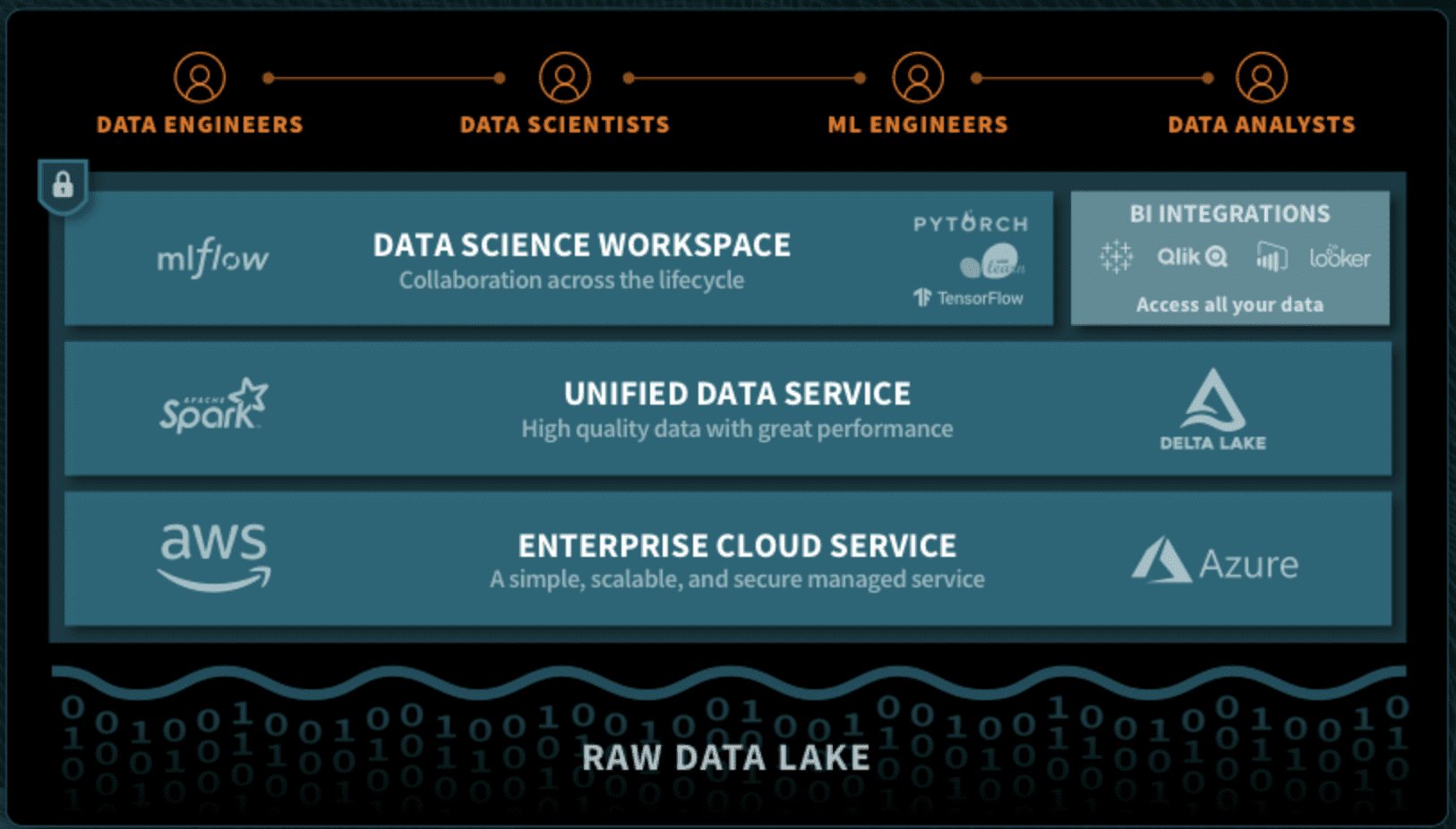
One of the main components of the Databricks Unified Data Service is Delta Lake, an open-source storage layer that brings enhanced data reliability, performance, and lifecycle management to your data lake. With improved data management, organizations can start to think “beyond the data lake” and leverage more advanced analytics techniques and technologies to extend their data for downstream business needs including data privacy protection and CCPA compliance.
Start building a CCPA-friendly data lake with Delta Lake
Delta Lake provides your data lake with a structured data management system including transactional capabilities. This enables you to easily and quickly search, modify, and clean your data using standard DML statements (e.g. DELETE, UPDATE, MERGE INTO).
To get started, ingest your raw data with the Spark APIs that you’re familiar with and write them out as Delta Lake tables. Doing this also adds metadata to your files. If your data is already in Parquet format, you also have the option to convert the parquet files in place to a Delta Lake table without rewriting any of the data. Delta uses an open file format (parquet) so there are no worries of being locked in as you can quickly and easily convert your data back into another format if you need to.
Once ingested, you can easily search and modify individual records within your Delta Lake tables. The final step is to make Delta Lake your single source of truth by erasing any underlying raw data. This removes any lingering records from your raw data sets. We suggest setting up a retention policy with AWS or Azure of thirty days or less to automatically remove raw data so that no further action is needed to delete the raw consumer data to meet CCPA response timelines.
How do I delete data in my data lake using Delta Lake?
You can find and delete any personal information related to a consumer by running two commands:
- DELETE FROM data WHERE email = ‘consumer@domain.com’;
- VACUUM data;
The first command identifies records that contain the string “consumer@domain.com” stored in the column email, and deletes the data containing these records by rewriting the respective underlying files with the consumer’s unique personal data removed and marking the old files as deleted.
The second command cleans up the Delta table, removing any stale records that have been logically deleted and are outside of the default retention period. With the default retention period of 7 days, this means that files marked for deletion will linger around until you run the VACUUM command at least 7 days later. You could easily set up a scheduled job with the Databricks Job Scheduler to run the VACUUM command for you in an automated fashion. You might also be familiar with Delta Lake’s time travel capabilities, which allows you to keep historical versions of your Delta Lake table in case you need to query an earlier version of the table. Note that when you run VACUUM, you will lose the ability to time travel back to a version older than the default 7-day data retention period.
After running these commands, you can now safely state that you have removed the necessary consumer data and records from your data lake.
How else does Databricks help me with CCPA consumer rights requests?
Once a user’s personal information has been removed from the data lake, it is also important to remove this personal information from the tools used by your data teams. Often times these tools reside locally on the data scientist’s or engineer’s laptop. A better more secure solution is to use Databricks with its hosted Data Science Workspace where data teams can prep, explore and model data collaboratively in a shared notebook environment. This improves team productivity while creating a secured, centralized environment for the entire analytics workflow.
To help you meet CCPA compliance requirements, Databricks provides you with privacy protection tools to permanently remove personal information, either on a per-command or per-notebook level.
After you delete a notebook, it is moved to trash. If you don’t take further action, it will be permanently deleted within 30 days – allowing you to be confident it has been deleted within the prescribed timelines for both CCPA and GDPR.
If for any reason you need to do this more quickly, we also offer the ability to permanently delete individual items in the trash:
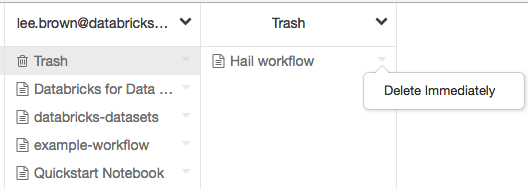
deleting all items in a particular user’s trash:

or purging all deleted items in a workspace on command, which includes deleted notebook cells, notebook comments or MLFlow experiments:

You also have the option to purge Databricks notebook revision history, which is useful to ensure that old query results are permanently deleted:

Getting Started with CCPA Compliance for Data and Analytics
With the Databricks Unified Data Analytics Platform and Delta Lake, you can bring enhanced data security, reliability, performance, and lifecycle management to your data lake while delivering on all your analytics needs. Organizations can now quickly find and remove individual records from a data lake to meet CCPA access requests and compliance requirements without hindering their business.
Learn more about Delta Lake and the Databricks Unified Data Analytics Platform. Sign-up for your free Databricks trial now.
--
Try Databricks for free. Get started today.
The post Make Your Data Lake CCPA Compliant with a Unified Approach to Data and Analytics appeared first on Databricks.