Friday, 25 October 2019

Height Warnings And AI Autonomous Cars

By Lance Eliot, the AI Trends Insider

[Ed. Note: For reader’s interested in Dr. Eliot’s ongoing business analyses about the advent of self-driving cars, see his online Forbes column: https://forbes.com/sites/lanceeliot/]

Watch out for that low hanging bridge!

If you live in Boston, you are likely familiar with the notion of getting “storrowed” (there’s even a hashtag for it).

On Storrow Drive, there are numerous warning signs and blinking lights that forewarn you about a bridge that has only an 11-foot clearance, and yet somehow drivers ram into it anyway.

This can be somewhat explained, according to local lore, the confusion about ramming it is due to the aspect that when new students show-up for college in Boston, they often rent a vehicle that either is higher than 11 feet, or pile stuff on top of vehicles that end-up being higher than 11 feet.

They then use Storrow Drive to get to their university and sadly either ignore, disbelieve, or don’t notice the warning signs about the low bridge height.

As an old saying goes, when a movable object strikes an immovable one, the moving object is going to likely lose out.

Though the Bostonian bridge story gets some occasional attention, perhaps the big winner for offending low bridges goes to the 11 foot 8 inch bridge nicknamed The Can-Opener.  It’s a railroad bridge located in Durham, North Carolina and more formally known as the Norfolk Southern–Gregson Street Overpass.

Believe it or not, there is a crash into that maniacal bridge at least once per month.

That’s a disturbingly high frequency.

You might be thinking that someone ought to do something about The Can-Opener, such as raising the bridge up (overly expensive, some say, since it would involve moving the railroad tracks too), or possibly lower the street (some say it’s too expensive since there are major sewer lines at a shallow depth).

In lieu of being able to adjust the height, they’ve put up numerous warning signs.

Nonetheless, trucks and especially rented trucks seem to have a magnetic attraction to trying to smash into The Can-Opener.

There doesn’t seem to be a federal mandated height maximum requirement for commercial vehicles, and the states are able to set their own height maximum restrictions, which some suggest leads to these kinds of troubles.

Typically, the maximum height allowed for a commercial vehicle is around 13 ½ feet to 14 feet or so.

Most passenger cars are around 5 to 6 feet in height.

This leaves usually plenty of room to spare for getting under most bridges and overpasses.

There are some SUV’s though that push over the 6 foot size and include the rather tallish Hummer H2 which is 79 inches in height.

Fortunately, most of these top-height passenger vehicles will still by-and-large be low enough to make it under any reasonable positioned bridge or overpass.

Stories About Car Heights

A good friend of mine used to work for Sears when he was in college and his job involved helping people tie things down to the tops of their cars.

He tells rather shocking stories of people that bought large pieces of furniture and insisted that it had to be tied down to the top of their cars so they could haul it home.

Though he never had anyone come back and say that the height got them in trouble, he tells me that there were circumstances that likely would have had potential troubles if they had encountered The Can-Opener.

I remember one time I was traveling in someone’s SUV and they drove into an underground parking structure.

The designers of the parking structure must have not been very savvy since there were all sorts of pipes and plumbing hanging from the already low ceiling. The person driving the SUV had a ski rack on top of the SUV, and he was quite sure that it would clear the distance.

As he squeezed into a parking spot, we heard a loud and foreboding scraping sound.

Sure enough, we got out of the SUV and could see that he had wedged the ski rack abutting one of the low hanging pipes.

I suppose that if you are going to indeed hit an immovable object like the underside of a bridge, you’d at least be somewhat better off if the thing that hits is something added to the top of your vehicle.

Smashing up that dining room chair that’s tied to the roof of your car is likely better than smashing the actual roof of your vehicle.

If you watch some of the YouTube videos of trucks ramming into the lower parts of a bridge or overpass, the instances that involve the whole truck structure hitting and nearly exploding from the impact are the most excruciating to watch and lead to the most damage.

Presumably, for a typical passenger car, and any such top oriented close-call shavings will be as a result of something piled on top of the car, and not hopefully take off the entire roof of the car.

Drivers Ignore Warning Signs

For those of you that always carefully look for the roadway warning signs about heights, I applaud you, but I’d bet that most people don’t pay attention to those signs.

If you are driving a typical passenger car, you likely never look at the height warning signs and consider them as nothing more than a billboard that can be ignored.

When you rent a truck or put stuff onto the top of your car, presumably you should have the presence of mind to suddenly become aware of height. Not everyone though thinks that way. As a result, they fall into the rut of always ignoring the warning signs about heights and get themselves into some tight pickles.

You could also nearly excuse some of the instances by the aspect that there are warning signs about heights that are at times themselves hard to spot.

Perhaps at one point earlier on, the warning sign was highly visible, but after a while there are trees that grow near them or other roadway obstacles that can obscure those height warnings.

I’ve seen graffiti on those signs. I’ve seen other roadway signs placed near to the height warning sign and it becomes a visually cluttered indication of the many things that you are supposed to be forewarned about.

In essence, it can sometimes be tricky to be able to readily see and read a height warning sign, even when you are purposely and intently trying to do so.

Of course, situations like the Boston and the Durham examples are exceptions since they’ve gone out of their way to make sure there are plenty of such signs.

Those signs even include blinking lights. Probably the next step would be a bullhorn that blares out something like “low bridge ahead, watch out!”  I’m sure that those young students heading to college as a freshman would welcome such a warning (versus imagine the mess they must deal with before even starting class in terms of trying to deal with having rammed into a bridge with a rental truck!).

Judging Heights

If you are lucky enough to spot a height warning sign and can make sense of it, presumably you would use the added awareness to judge whether your car can fit under the height stated.

I’d bet there are some instances of human drivers that aren’t exactly sure whether they’ll be able to get their vehicle to fit under the height and rather than being cautious they take a chance anyway. Some of those chances likely turn out to be a bad bet and they end-up hitting the obstruction.

Supposing though that you do realize that you are cutting it close or that you won’t fit, and so you opt to avoid going under the bridge or overpass.

This can itself present another problem, since you need to figure out an alternative path to get to wherever you are going.

Plus, you need to figure out soon enough before you reach the bridge or overpass such that you can legally and without being unsafe be able to make a driving maneuver to avoid the obstruction. In some of the online videos it seems apparent that the driver realized at the last moment what was going to happen and was unable to avoid hitting the bridge or overpass because they were already going too fast to stop in time or be able to undertake a maneuver to avoid the hit.

AI Autonomous Cars And Heights

What does this have to do with AI self-driving driverless autonomous cars?

At the Cybernetic AI Self-Driving Car Institute, we are developing AI systems for self-driving cars. One of the so-called “edge” problems involves having the AI be able to deal with height restrictions and circumstances such as avoiding striking a low hanging bridge or overpass.

I mentioned that this is an edge problem.

Allow me to explain.

An edge problem is considered a type of problem that is not considered at the core of an overall problem and instead is at the periphery. It is something that is identified as a problem but given less priority and attention than the core ones. In the case of an AI self-driving car, focusing on the general driving task is at the core, while providing attention to something like the height aspects is considered an edge because it is less likely to occur and somewhat of a rarity for a car.

That being said, it is something that those developing AI for self-driving trucks must consider at the core due to the higher likelihood of a truck encountering a height related issue.

Thus, whether developed for the purposes of a car or truck, it is a feature that has value and needs to ultimately be considered “solved” in that the AI must have a means to contend with height related considerations.

For more about edge problems in AI self-driving cars, see my article: https://aitrends.com/selfdrivingcars/edge-problems-core-true-self-driving-cars-achieving-last-mile/

For the levels of AI self-driving cars, see: https://aitrends.com/selfdrivingcars/richter-scale-levels-self-driving-cars/

There is another circumstance involving AI self-driving cars wherein height comes to play.

If an AI self-driving car is towing something, such as a U-Haul rented storage carrier, the towed item might involve height related considerations.

Though the self-driving car itself might not have any particular height related difficulties, the items being towed might be high enough to raise up to a low hanging bridge or overpass. Since the towed item is connected to the self-driving car, it’s up to the AI to presumably be aware of what it is towing and therefore take into account changes needed in the driving task due to the towed item.

It’s not an excuse to pretend that the AI was only responsible for the self-driving car per se.

For a true level 5 self-driving car, which is considered the topmost ranking of an AI self-driving car, the assumption is that the AI can drive the car as a human would. In that sense, it would normally be an expectation that a human driving a car that’s towing something is as responsible for the actions of the car as they are of the items towed. If the human fails to properly tie down the towed items or fails to connect them securely to the car, it’s all on the human for having not done so. Likewise, if the human hits a bridge with the towed item, it’s the driver’s fault, whether a human driver or the AI.

For aspects about AI self-driving cars that are towing items, see my article: https://aitrends.com/selfdrivingcars/towing-and-ai-self-driving-cars/

In terms of accidents involving AI self-driving cars, see my article: https://aitrends.com/ai-insider/accidents-contagion-and-ai-self-driving-cars/

As an overall framework of the AI driving tasks, here’s the major steps that the AI undergoes while at the wheel of a self-driving car (so to speak):

  • Sensor data collection and interpretation
  • Sensor fusion
  • Virtual world model updating
  • AI action planning
  • Car controls command issuance

For more about my framework, see: https://aitrends.com/selfdrivingcars/framework-ai-self-driving-driverless-cars-big-picture/

Determining Heights

Let’s start with the aspect of the AI needing to know the height of the self-driving car, which would encompass the self-driving car plus anything piled on top of it, plus anything being towed by the self-driving car.

There’s no easy automatic way right now for the AI to become aware of the height aspects.

There aren’t usually sensors on an AI self-driving car that will allow it to determine its own height and nor the height of something being towed. In the future, there might be such sensors added onto AI self-driving cars. For the moment, this being an edge problem doesn’t tend to warrant the cost and effort of including such sensors onto an AI self-driving car.

If there isn’t any such sensor already built-in, how else can the AI self-driving car ascertain the height of itself and whatever it might be towing?

One means would be to ask about the height. The AI could ask a human. If there is a human that will either be occupying the AI self-driving car during the journey, or a human that is setting the AI along on a journey (but not going to riding in the self-driving car), the AI could ask about the height aspects.

You might assume that the human(s) involved would be wise enough to forewarn the AI about any height related considerations.

I’d dare say that the human(s) might assume that the AI is already somehow able to figure out the height related aspects, and so the human(s) involved might be later shocked when they find out that their clothes and furniture spilled onto the highway because the towed storage shed bashed into the ceiling of a bridge. Probably would be best to have the AI inquire prior to a journey.

Even if the AI asks about the height, it doesn’t imply necessarily that the human(s) will accurately reply.

In that manner, the AI is either going to be stuck with assuming that the human indication is correct or might need to assume that the human is maybe off-base a bit and become extra cautious. If a human says that the height is around 9 feet, it might be prudent for the AI to assume that it is really more like 10 feet and therefore avoid any height circumstances involving 10 feet rather than only those at 9 feet.

Indeed, you might opt to default that if the human indicates there is any added height at all, the rule-of-thumb for the AI might be to avoid any kind of height restricted situations, though this is a rather extreme precaution and would likely cause the driving path of the self-driving car to become quite convoluted.

For aspects of human interaction with AI self-driving cars, see my article: https://aitrends.com/features/socio-behavioral-computing-for-ai-self-driving-cars/

Using V2V And V2I To Discover Heights

Another approach to potentially figuring out the height of an AI self-driving car would be for the AI to try and communicate with other AI self-driving cars around it.

Another AI self-driving car might be able to discern the height related aspects, doing so by using its sensors such as its cameras, radar, sonic, and LIDAR. This could then be relayed to the self-driving car via V2V (vehicle-to-vehicle) communications. Thus, one AI self-driving car asks another nearby one to take a look, which after inspecting the height then is reported back to the asking AI self-driving car. Kind of a buddy system.

This brings up another facet of the height related problem.

At some point, once there are lots of AI self-driving cars on the roadways, it could be that via the use of V2V that the AI systems are trying to help each other out. While on a freeway, if there’s a car stalled in the middle of the freeway, those AI self-driving cars nearest to the stalled car can convey to other self-driving cars that are coming up upon the scene to be wary of the stalled car. In a similar manner, AI self-driving cars that are coming upon a low hanging bridge or overpass can potentially forewarn other approaching AI self-driving cars about the situation.

In the case of the Storrowed in Boston, there would be AI self-driving cars that might not yet know about the low overhang and meanwhile others that do (having driven that way before).

The ones that knew about it, either due to having driven there before or upon detecting it or having been previously informed about it, could warn other AI self-driving cars that are nearby and that are headed toward the potential obstruction. The AI of the receiving self-driving cars would then need to ascertain whether the awareness about the low hanging circumstance applied to them or not.

We are also heading toward V2I, which is vehicle-to-infrastructure communication.

There will be Internet of Things (IoT) types of devices along and throughout the roadway infrastructure and they will serve to warn drivers about various roadway conditions. These warnings might include that there’s road construction up ahead, or maybe that an intersection is blocked and to avoid it, and so on. It is anticipated that road signs are likely to be augmented with IoT, thus rather than having to only be able to visually spot a road sign, the road sign will transmit an electronic signal and thus cars can be aware of what the road sign depicts (including speed limits, cautions, and of course height warnings).

For my article about how AI self-driving cars can detect road signs, see: https://aitrends.com/selfdrivingcars/making-ai-sense-of-road-signs/

For more about IoT and AI self-driving cars, see my article: https://aitrends.com/selfdrivingcars/internet-of-things-iot-and-ai-self-driving-cars/

Another consideration about AI self-driving cars is that they are likely to be on our roadways quite a bit.

It is anticipated that many of the AI self-driving cars will be operating nearly non-stop, running 24×7.

This is due to the belief that doing so makes economic sense and why not leverage the ability to have an electronic driver that never sleeps. From a height perspective, it implies that with these AI self-driving cars continually roving around there’s perhaps a heightened chance (pun!) of them encountering height related driving circumstances.

Thus, again another reason to have the AI prepared for such a situation.

For my article about non-stop running of AI self-driving cars, see: https://aitrends.com/selfdrivingcars/non-stop-ai-self-driving-cars-truths-and-consequences/

GPS And Maps Not Necessarily Cure-All

You might be saying to yourself that the GPS and electronic maps ought to be letting the AI know about any height restrictions on the roadways.

Currently, GPS mappings are somewhat inconsistent in having marked or indicated the height related aspects of a driving situation. It definitely is another source of input about heights and the AI should be considering it.

Nonetheless, it is not always guaranteed to be available and the AI needs to be finding alternative ways to further figure out the height of obstructions.

The other day, I was driving through a rather tony neighborhood that had large trees at the sides of the streets and the trees had grown over the street to make a spectacular kind of shroud. It was breathtaking. But, there had been recent rains and high-winds, which caused some of the heavy branches to slightly break and bend downward.

Driving along the street required some pretty careful weaving from one side of the street to the other, hoping to avoid hitting the dangling branches.

A true AI self-driving car should have been able to be equally deft in maneuvering through those streets.

There would not have been any GPS mapping warnings. There weren’t any street signs warning about the height issues. It was instead entirely in-the-moment of trying to figure out the height issues.

Notice also that I drove “illegally” by going onto the other side of the street, momentarily, cautiously, only when safe to do so. I mention this point about driving “illegally” because there are some AI pundits that have claimed that AI self-driving cars should never drive illegally, which I’ve debunked as an unreasonable expectation.

For my article about the illegal driving of AI self-driving cars, see: https://aitrends.com/selfdrivingcars/illegal-driving-self-driving-cars/

For aspects of how AI needs to be a good defensive driver, see my article: https://aitrends.com/selfdrivingcars/art-defensive-driving-key-self-driving-car-success/

Conclusion

In recap, the AI needs to discover the height of the self-driving car and which would include any towed items.

It needs to be aware of height related restrictions, doing so via using its own sensors to try and identify height related concerns, along with trying to spot and read height warning signs, and possibly use GPS mappings, V2V, and V2I too.

The AI should route around any height concerns, if feasible. If the AI is taken by surprise and comes upon a height problem, it needs to devise rapidly an action plan to safely maneuver to avoid the crash.

If somehow a crash nonetheless occurs, the AI would need to become aware that a hit has occurred and take further action as appropriate.

As humans, we take for granted our ability to deal with height related driving issues. It is just the daily aspects of driving a car.

Most of the time, we don’t encounter height related problems. But, we are overall generally ready for it. Some humans regrettably aren’t paying attention or at times ignore or disbelieve when they get themselves into a height driving predicament. For AI systems that control self-driving cars, we’re all going to want and expect that the AI is on the alert and able to contend with height aspects.

As you can perhaps discern, it’s a bit of a “tall order” for the AI to do so.

Copyright 2019 Dr. Lance Eliot

This content is originally posted on AI Trends.
Lazarus Recognized as AI World Startup Award Winner

By AI Trends Staff

BOSTON—Among the phrases used to describe the AI business solution being offered by startups at AI World 2019 “machine learning automation” is used quite frequently. It’s an automation services play in many cases. Companies wanting to get started in AI or get to the next step in the journey to operating AI applications, need help. Getting the data to a stage where machine learning can be employed is required.

Some startups have an employment skew, offering to help companies find the needed data science or other AI team, or offering a remote workforce. Some startups focus on operations, because once the AI application is set up and the client wants to run it, challenges associated with deployment and operations arise. All of these are markets poised to grow dramatically in the coming months and years.

But among the 18 AI startups on display at the 2019 AI World Conference and Expo, judges chose to recognize Lazarus as the 2019 AI World Startup Awards winner.

Lazarus uses patient health data to provide Clinical Decision Support, including early cancer detection. By using its clinical decision support tools, physicians are said to be able to improve their diagnostic accuracy from 76% all the way up to 93%. The company uses deep learning and accesses millions of patient records. The business model is to sell tests and subscriptions for physicians and hospitals, and sell anonymous datasets to insurance companies and research companies.

Lazarus, 2019 AI World Startup Awards winner

CEO and Founder Ariel Elizarov told AI Trends that the company has four hospitals running pilots involving 27 primary care physicians. “”Physicians are overwhelmed with the amount of data they have to process. Our value proposition is to make primary care doctors into specialists for five minutes,” helping them make more accurate diagnoses.

The field of entries was rich, and in addition to the winner, the judges recognized four startups worth of honorable mention.

AI.Reverie has a strong team, led by founder and CEO Daeil Kim, who led the development of a photo-realistic simulation platform for training AI. The idea is to leverage the power of synthetic data to improve the performance of mission critical vision algorithms. The firm recently announced a strategic partnership and investment from In-Q-Tel, the not-for-profit strategic investor that works to deliver innovative technology to US intelligence and defense agencies. The company’s services include the creation of virtual worlds with animation and the ability to run simulations that produce synthetic data.

Daivergent is a Public Benefit Corporation founded in November 2017,  which hires remote workers with autism and developmental disabilities to execute projects. The firm offers: dedicated project managers with experience in data and technology fields; a US-based workforce, sourced from universities and agencies in the US; handling of requests of any scale; and performance guarantees. The Daivergent platform has a remote user base of 850 candidates and 18 corporate clients. The firm offers employees online training in programming languages including Python and SQL, graphic design, 3-D modeling and marketing, to help bolster career growth. The company works closely with agencies including AHRC in New York City, a nonprofit providing workshops, day treatment programs and job training for people with intellectual and developmental disabilities.

Roborus offers AI-based kiosks that employ facial recognition to automatically identify customers in cafes, restaurants, and retail shops. The software platform uses face recognition technology to classify customers’ data such as facial ID, gender, age, and seven different moods. The machine learning system can provide guests with personalized services and is able to, for example, recommend specific menu items based on customer profile. The software gathers and analyzes data such as number of visits, consumption patterns and average spending, helping clients to enhance marketing efforts and increase sales.

Kyndi offers an Explainable AI product and Intelligent Process Automation software platform for use by government, pharmaceutical, and financial services organizations. The product addresses the “black box” of Deep Learning, which restricts their use in regulated industries. The Kyndi platform scores the provenance and origin of each document it processes. Its Explainable AI software can be used with robotic process automation (RPA) tools to analyze text and automate inefficient workflows.

XPRIZE Foundation Highlights Startups Using AI To Tackle The World’s Diverse Issues

By Benjamin Ross

BOSTON—Day one of the fourth annual AI World Conference & Expo wrapped up with a panel discussing how startups can successfully achieve innovation through artificial intelligence (AI).

The panel, moderated by the XPRIZE Foundation’s Director of the IBM Watson AI XPRIZE, Devin Krotman, included Eleni Miltsakaki, Founder and CEO of Choosito; Ellie Gordon, Founder and CEO of Behaivior AI; and Daniel Fortin, President, AITera Inc. Each of the companies represented are participating in the IBM Watson AI XPRIZE challenge in which companies identify challenges facing humanity and apply AI in tackling that problem.

Currently the challenge has thirty-two competitors, with semi-finalists being announced late 2019, and finalists and winners being announced early 2020. Winners will be determined by a panel of expert judges.

“The path to successful AI innovation for a startup is a very bumpy one,” Krotman said. “But I take comfort in the fact that [these companies] are working on diverse products that will help us get there.”

Devin Krotman, XPRIZE Foundation’s Director of the IBM Watson AI XPRIZE

The Startups

Choosito

Choosito is a startup that builds AI for personalized learning. Miltsakaki says the aim is to solve the lack of functional literacy among the 100 million children around the world. Choosito’s solution is to build a virtual librarian, a tool that will understand a given child’s language and use the availability of free and open educational resources to provide content the child will understand.

“The big challenge is, how can we provide educational experiences at low cost and at scale in a way that even children that don’t have access to formal education in rural communities—and even children currently stranded in refugee camps—can gain an education?” said Miltsakaki.

Miltsakaki says there are a wide range of problems that pop up when a startup uses AI. Cost plays a major role, especially when you’re trying to develop a novel use for the technology. “I want to emphasize the ‘novelty’,” Miltsakaki said. “Because you’re not going to address the world’s humanitarian challenges by using off-the-shelf technology.”

Miltsakaki says it’s also important to understand the people you’re working with. Creating a “one size fits all” solution does nothing for the people Choosito wants to help.

“You need to understand these people in order to understand how you can deal with their problem,” said Miltsakaki. “You need to understand how people learn, what each child’s situation is in different parts of the world in order to understand how you can actually provide a tool that knows exactly what they know and what they don’t know… You really need to be in the field in order to understand the challenge.”

Understanding the people you’re trying to help also means understanding how they learn. Miltsakaki says it’s not enough to simply provide children with access to the material. She hopes the virtual librarian will be able to “make a recommendation of content that will actually help a child move their knowledge further.”

To do this, Choosito tries to map out what goes on inside a child’s brain while they’re learning. “People think sometimes that having access to a search engine and content that’s available on the web means that you have access to information. That is not true,” Miltsakaki said. “If you don’t understand what’s there, then there’s no information. In order to have information that you can do something with, you need to be able to understand the content. For these children in the world that have no access to anything, if you put a search engine in front of them with content from the web, then you’ve done absolutely nothing.”

Behaivior AI

Ellie Gordon’s startup is focusing on understanding its audience as well, though it tackles a completely separate issue. Behaivior AI is developing a system that can predict and prevent addiction relapses and overdoses, using wearables and AI for timely interventions.

The focus for Behaivior AI is on opioid addiction, a problem declared as a public health emergency by the U.S. Department of Health and Human Services (HHS) in 2017. The company is currently doing clinical studies with people in recovery for opioid use disorder, and Gordon says they’ve had early success with lower relapse rates, better treatment adherence, and better mindfulness.

Gordon says the opioid crisis presents a difficult challenge in the fact that addiction itself is a complicated disease. “There are a lot of factors—neurological, behavioral, environmental, etc.—that impact the success of someone who is trying to stay on track with their recovery,” said Gordon.

Because of the complex nature of addiction, Gordon says it’s difficult—nearly impossible—for a human care team to pinpoint all the factors that relate to a certain case. “But when you use AI, you can create a full care team that is pulling in all these different data points, and then looking for patterns, both on the individualized and on the aggregate level, that can help bring an understanding to what is going on in someone’s body, what they’re feeling and what their needs are.”

Cost is also a challenge, says Gordon. Oftentimes the success rate of addiction recovery depends on the socio-economic status of the patient. Behaivior AI wants to find a way to democratize the process.

“One methodology we were interested in was continuous monitoring and continuous access to resources,” Gordon said. “We decided to incorporate wearables that people could keep on them all the time, and incorporate that into their outpatient protocols.”

Collecting physiological data, smart phone data, self-report data, and clinician reports, Behaivior AI tries to nudge people toward positive behavioral change.

“We’re reviewing the higher-level predictors of high-risk craving states, and then using those factors to determine what metrics be measured for our final product,” Gordon said. “We know the predictive levels of some things, but there are others we haven’t been able to incorporate into our clinical studies that we’re really excited to be looking at.”

AITera Inc.

Daniel Forton’s startup is focused on using AI to create a cleaner world, specifically building an application to help engineers that have the responsibility to clean contaminated soil and water.

Data is the core of AI and is a crucial element for such a monumental task, Forton says. AITera Inc. collects ecological data from thousands of sources, such as government and organization databases. The question is, are they receiving the right data and who owns it? The answers to these questions often reveal a level of bias, he says.

“If I’m going into an EPA database and I’m looking into the solutions that have been established in a certain case, [the EPA] will give you the last technology they used that fixed a problem, but they don’t tell you that they’d been trying seven other technologies prior to that,” said Forton. “Likewise, the owner of the data is usually the owner of the site that needs to be decontaminated, such as oil and gas companies, and they don’t want to share that data.”

Fortunately, AITera has been able to work with different agencies in order to acquire all the data, but Forton says it takes time.

“When we jumped into a project in 2015, it took three years to get some corpus that is meaningful,” Forton said. “We thought we’d go faster the second time, but it still took us another three years to build the corpus and remove the bias we’ve seen in the data.”

Forton says we need to work collectively to share data, making sure the data is properly curated. He says the XPRIZE Foundation gives his company the opportunity for that collaboration.

MIT’s Pentland Outlines Rules For Data And AI

By Allison Proffitt

BOSTON—AI is data; data is AI. They’re really the same, Alex Pentland told a packed opening plenary session on the second day of the AI World Conference and Expo. “The winner is the person who has the most data. That’s probably not you, but you have friends who have data. They probably aren’t going to just give it to you; you have to figure out how to collaborate.”

Pentland directs the MIT Connection Science and Human Dynamics labs. He’s working on getting AI into the mainstream “peacefully”, he said. That is, no riots in the street, no mass unemployment, no cyber security onslaughts.

His group at MIT, sponsored by Ernst and Young, IBM, MasterCard, Orange, and others, builds pre-standards open source code—Kerberos, the network authentication protocol, for example—and tackles the big questions: How to ensure compliance, control risk, ensure privacy, and security? “Privacy is coming,” he warned, “not just in Europe and California, but everywhere.”

Pentland minces no words when it comes to security. “If you create a data lake, you should be fired,” he said. “You’ve just told the bad guys where to find the data!” He likened the approach to a medieval army packing a castle with all the arms and resources available, surrounding the castle with a moat, “and then someone leaves the gate open.” Seventy percent of all cyber attacks happen from human error, he said. If you put all your resources in one place you are doomed.”

Instead he highlighted a few key rules for using data as efficiently and securely as possible.

First, put a communications layer over your resources—an API—and share answers, not data, he advised. It sounds expensive and difficult, but really it’s pretty simple, he said. If someone wants something from you, take their request, process it yourself, and then give them the minimum answer possible.

The approach works just as well within large corporations. Getting data from one silo to another within a large organization can be impossible. But setting up an API that delivers answers is much easier. “This is a rapid accelerator!”

In addition, he recommended blockchain for tracking and auditing all of the data interactions: what was the query, who paid for it, what were their credentials, what was returned, etc. If you do this, Pentland said, you’ll be able to detect cyber attacks much more rapidly. The key thing with cyber attacks is moving data where it shouldn’t be—transactions that shouldn’t be happening. “If you have an unalterable log of all of the transactions, you can detect things that don’t fit very, very quickly.”

In fact, audit the data continually to look for cyber attacks, policies going wrong, and to assess the performance of your AI. “One of the weak things about most AI is that it doesn’t generalize very well. So if conditions change a little bit, it may run off the rails. You have to audit it continually,” Pentland explained. “You want to have a transaction record that says what it is that your AI is doing, and is that what you intended it to do?”

Finally, Pentland said you should never decrypt data. “You’ve heard of encryption at rest and encryption in transit,” he says, “but I’m telling you something more, which is don’t ever decrypt it. The moment you do someone will steal it.”

It turns out, data doesn’t need to be decrypted to be analyzed. There are a number of techniques that operate on encrypted data directly—some of which were developed by Pentland’s team. If your data stay encrypted, you don’t need a firewall, which means you can cache the data and realize 10x to 100x improvements in performance, he said.

In addition, Pentland argued that sharing encrypted data is not the same, legally, as sharing decrypted data. He asserts that encrypted data can be removed from a country when decrypted data couldn’t. Personal data, if encrypted, can be legally shared. “This changes the whole way you think about data,” he said

MasterCard uses the principle for fraud detection, he noted. Even though MasterCard can’t see the personal details about who is doing what, it can scan encrypted data for unusual repetitions or suspicious patterns and identify fraudulent activity.

“We are helping countries and companies around the world put up these sort of systems to modernize their data systems by providing this layer that gives access to more diverse sorts of data,” Pentland said. “It’s surprisingly easy to do. Not easy! But surprisingly easy.”

5 Real Applications Of Data Mining

Data mining, a process that involves identifying patterns and anomalies in large data sets, is widespread among many of today’s companies. Experts predict the big data market will reach $103 billion in revenue by 2027, far exceeding 2019's predicted $49 billion.

One of the main reasons why data mining is so pervasive is the wide variety of applications it has. Brands across nearly all industries can utilize it in multiple ways to improve decision-making and enhance overall operations. Here are five ways modern people and businesses are using data mining, and the impact it’s having. 

1. Fraud detection

Fraud is a growing issue for both businesses and their customers. 45% of business executives reported that they were significantly more concerned about fraud in 2018 than they were just one year earlier, and that concern has likely only increased since. And 27% of digital shoppers abandoned a transaction due to a lack of visible security.

But data mining is proving to be an effective way to combat fraud. A good example comes from a group of Iowa State graduate students who created a mathematical model to identify potential instances of fraud at self-checkout stations in grocery stores without having to inspect innocent customers. 

Part of the ...


Read More on Datafloq

How Big Data is Impacting the Fitness Industry

Big data is sinking its claws into almost every industry, creating a deeper understanding of how individuals behave and encouraging innovation in spheres we never considered possible. The fitness industry is just one example of how big data can transform and create boundless possibilities for both individuals and businesses. 

With information constantly being collected and uploaded to the cloud through wearable technology and fitness apps and websites, we’ve never had so much insight into the inner workings and actions of both individuals and industries. Fitness data is one of the biggest streams of information being amassed in this world today, so how is it transforming the industry?

Fitness and food tracking

Most of the data collected around the fitness industry come from wearable technology, specifically, fitness trackers. Devices like the Fitbit, Apple Watch, Garmin, and Nike Fuel are collecting personalized biometric fitness data and giving people direct access to their own health statistics. Fitness trackers can measure everything from caloric intake, heart rate, blood pressure, sleeping patterns, and blood oxygen levels to body weight, perspiration, and BMI. 

They’re not only in use when exercising, either. Fitness trackers are running constantly and collecting personalized data from hundreds of millions of people. Data from fitness trackers ...


Read More on Datafloq

Jenkins Performance: Avoiding Pitfalls, Diagnosing Issues, and Scaling for Growth - DevOps World | Jenkins World 2019

This is a speaker blogpost for a DevOps World | Jenkins World 2019 talk in Lisbon, Portugal

With Halloween upon us, there’s no better time to discuss Jenkinstein! Are you suffering from Jenkins performance issues? Are users complaining about a slow UI or even scarier, is Jenkins going down frequently?

Jenkinstein

Come join me at DevOps World | Jenkins World 2019 for "Jenkins Performance: Avoiding Pitfalls, Diagnosing Issues, and Scaling for Growth", a talk about JVM administration and best practices from the front lines of supporting thousands of Jenkins installations worldwide. During this talk we’ll cover how to prevent your Jenkins instance from becoming a Jenkinstein!

Topics we will be discussing:

  • JVM administration best practices

  • Horizontal scaling

  • Analyzing thread dumps, GC logs, and heap dumps

  • Real world data showing 3500% performance increases

  • Garbage collection

gc unhealthy

We’ll be discussing how you can forecast for growth, and baseline using key performance indicators like application throughput and latency, by analyzing spooky data like Garbage Collection logs!

Come join me for the presentation in Lisbon! There will be candy!

Slides

Thursday, 24 October 2019

The Tactile Internet — a New IoT?

The progress is constantly speeding up and the future is at our door — it is something that everyone keeps repeating even not thinking much of this future. But if you start thinking, you find evidence to this in every tool, in every method and technique present in all spheres of life.

We are only beginning to get used to the Internet of Things and the idea of the connected world; scientists sketch new applications and scholars write books on its impact on our mentality. But the IoT is already not the cutting-edge technology; the progress has already digested it and is promising to add tactile senses to our internet experience in the Tactile Internet paradigm.

The Tactile Internet has been defined by the International Telecommunication Union in August 2014 as an Internet network featuring low latency, an extremely short transit, a high availability, high reliability and a high level of security. This technology rests on cloud computing proximity (Mobile Edge-Cloud) and the virtual or augmented reality for sensory and haptic controls. It is believed to add a new dimension to human-machine interaction by delivering a low latency enough to build real-time interactive systems.

The new technology has been designed to operate in haptic virtual environment ...


Read More on Datafloq

Simplify Data Lake Access with Azure AD Credential Passthrough

Azure Databricks brings together the best of the Apache Spark, Delta Lake, an Azure cloud. The close partnership provides integrations with Azure services, including Azure’s role-based access control, Azure Active Directory(AAD), and cloud-based identity and access management service, and Azure’s cloud storage Azure Data Lake Storage (ADLS).

Even with these close integrations, data access control continues to prove a challenge for our users. Customers want to control which users have access to which data and audit who is accessing what. They want a simple solution that integrates with their existing controls. Azure AD Credential Passthrough is our solution to these requests.

Azure Data Lake Storage Gen2

Azure Data Lake Storage (ADLS) Gen2, which became generally available earlier this year, is quickly becoming the standard for data storage in Azure for analytics consumption. ADLS Gen2 enables a hierarchical file system that extends Azure Blob Storage capabilities and provides enhanced manageability, security and performance.

The hierarchical file system provides granular access control to ADLS Gen2. Role-based access control (RBAC) could be used to grant role assignments to top-level resources and POSIX compliant access control lists  (ACLs) allow for finer grain permissions at the folder and file level. These features allow users to securely access their data within Azure Databricks using the Azure Blob File System (ABFS) driver, which is built into the Databricks Runtime.

Challenges with Accessing ADLS from Databricks

Even with the ABFS driver natively in Databricks Runtime, customers still found it challenging to access ADLS from an Azure Databricks cluster in a secure way. The primary way to access ADLS from Databricks is using an Azure AD Service Principal and OAuth 2.0 either directly or by mounting to DBFS. While this remains the ideal way to connect for ETL jobs, it has some limitations interactive use cases:

  1. Accessing ADLS from an Azure Databricks cluster requires a service principal to be made with delegated permissions for each user. The credentials should then be stored in Secrets. This creates complexity for Azure AD and Azure Databricks admins.
  2. Mounting a filesystem to DBFS allows all users in the Azure Databricks workspace to have access to the mounted ADLS account. This requires customers to set up multiple Azure Databricks workspaces for different roles and access controls in line with their storage account access, thereby increasing complexity.
  3. When assessing ADLS, either directly or with mount points, users on an Databricks cluster share the same identity when accessing resources. This means there is no audit trail of which user accessed which data with cloud-native logging such as Storage Analytics

To solve this, we looked into how we could expand our seamless Single Sign-on with Azure AD integration to reach ADLS.

Getting Started with Azure AD Credential Passthrough

Azure AD Credential Passthrough allows you to authenticate seamlessly to Azure Data Lake Storage (both Gen1 and Gen2) from Azure Databricks clusters using the same Azure AD identity that you use to log into Azure Databricks. Your data access is controlled via the ADLS roles and ACLs you have already set up and can be analyzed in Azure’s Storage Analytics.

When you enable your cluster for Azure AD Credential Passthrough, commands that you run on that cluster will be able to read and write your data in ADLS without requiring you to configure service principal credentials for access to storage. In order to use Credential Passthrough, just enable the new “Azure Data Lake Storage Credential Passthrough” cluster configuration.

To use Credential Passthrough, just enable the new Azure Data Lake Storage Credential Passthrough cluster configuration.Passthrough is available on both High Concurrency and Standard clusters. Currently, Python and SQL are supported on High Concurrency clusters, which isolate commands run by different users to ensure that credentials cannot be leaked across different sessions. This allows multiple users to share one Passthrough clusters and access ADLS using their own identities.

On Standard clusters, Python, SQL, Scala and R are all supported and users are isolated by restricting the cluster to a single user.
Enable single user passthrough access to your Azure Data Lake through the Azure Databricks interface

Powerful, Built-in Access Control

Azure AD Passthrough allows for powerful data access controls by supporting both RBAC and ACLs for ADLS Gen2. Users can be granted to the whole storage account through RBAC or one filesystem/folder/file using ACLs. Passthrough will ensure a user can only access the data that they have previously been granted access to via Azure AD in ADLS Gen2.

Since Passthrough identifies the individual user, auditing is available by simply enabling ADLS logging via Storage Analytics. All ADLS access will be tied directly to the user via the OAuth user ID in Storage Analytic logs.

Conclusion

Azure AD Credential Passthrough provides end to end security from Azure Databricks to Azure Data Lake Storage. This feature provides seamless access control over your data with no additional setup.  You can safely let your analysts, data scientists, and data engineers use the powerful features of the Databricks Unified Analytics Platform while keeping your data secure!

Related Resources

Real-time distributed monitoring and logging in the Azure Cloud

How can you observe the unobservable? At Databricks we rely heavily on detailed metrics from our internal services to maintain high availability and reliability. However,…

Azure Databricks – Bring Your Own VNET

Azure Databricks Unified Analytics Platform is the result of a joint product/engineering effort between Databricks and Microsoft. It’s available as a managed first-party service on…

Spark + AI Summit 2019 Product Announcements and Recap. Watch the keynote recordings today!

Spark + AI Summit 2019, the world’s largest data and machine learning conference for the Apache Spark™ Community, brought nearly 5000 registered data scientists, engineers,…


--

Try Databricks for free. Get started today.

The post Simplify Data Lake Access with Azure AD Credential Passthrough appeared first on Databricks.

How Cloud and Artificial Intelligence Help Modernize ERP

Digital transformation is around every corner in this world. Every company and user is following it to stay ahead among the competitors, get new opportunities, get introduced to the new markets and visualize how they do business. For visualization, businesses require re-imagination of processes that connect the people, data, and systems distributed to the entire company and connected to each customer or user. Regardless of which technology is used by modern artificial intelligence businesses, their processes and the systems are still complex to use and not that much smart to make every business function with ease to transform the way of working of the people.

For achieving this, Microsoft brought Dynamics 365. The unification of CRM and ERP systems allows businesses to start small, transform certain functions and make growth.

Introduction of D365 AI solutions

Microsoft Dynamics 365 is already infused with AI technology. The solutions are intended for handling valuable complex scenarios end to end. Experts use cutting edge AI technologies for available enterprise scenarios and customize the present processes, data, and systems. The first and foremost solution is focused on customer service. This includes an intelligent assistant for customer service staff, intelligent virtual agents for customer care, and conversation management tools- three ...


Read More on Datafloq

Apple now has a chip design team in Bengaluru

This follows Apple’s $1-billion acquisition of Intel’s smartphone modem business in July.

India, US plan to revitalise defence tech sharing pact

Focus on startups and exports to identified third nations likely; identifying projects in field of space tech also on cards

Google touts quantum computing milestone

Quantum computing is a nascent and somewhat bewildering technology for vastly sped-up information processing.

Spark + AI in Amsterdam: European Summit Recap, Keynote Videos, & Announcements

Spark + AI Summit Europe 2019 came to Amsterdam this past week! Over 2,300 data scientists, data engineers, and global business leaders from 63 different countries descended upon the RAI Amsterdam Convention Centre, for the latest community and open source developments around Apache Spark™, Delta Lake, MLflow, Koalas, and more. Check out the keynote recordings to learn more about the latest announcements and community updates from this sold out event!

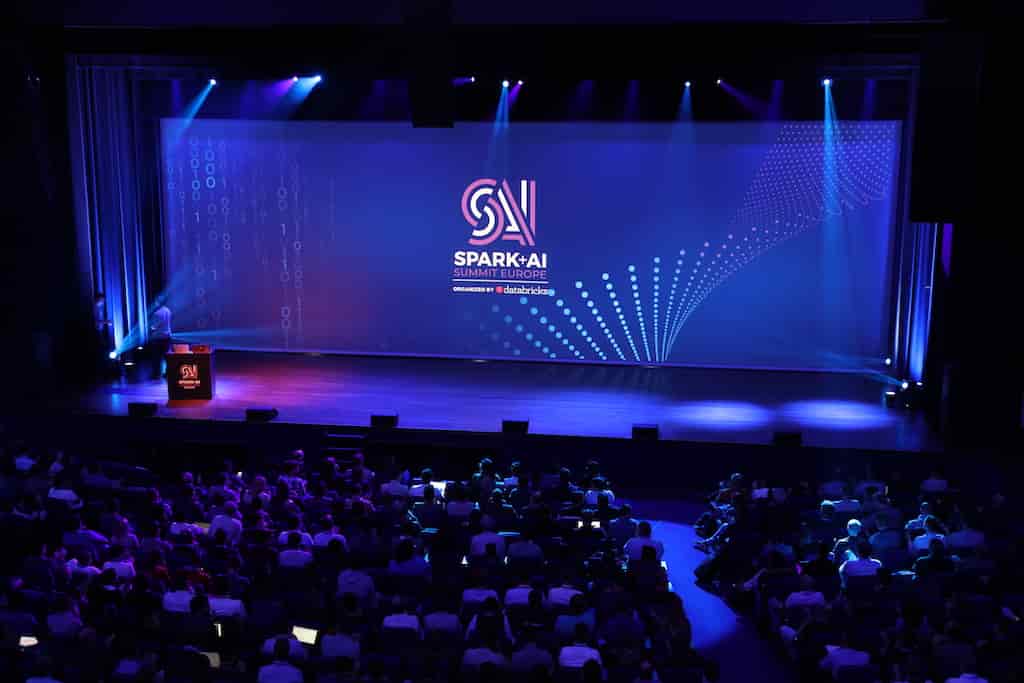
Main stage at Spark + AI Summit Europe 2019 in Amsterdam.

Open Source Updates: Delta Lake joins the Linux Foundation, Apache Spark™ 3.0 plans, MLflow Model Registry, and more

At Spark + AI Summit Europe 2019, we learned about some exciting new developments with several open source Apache Spark™ projects that the community has been eagerly awaiting.

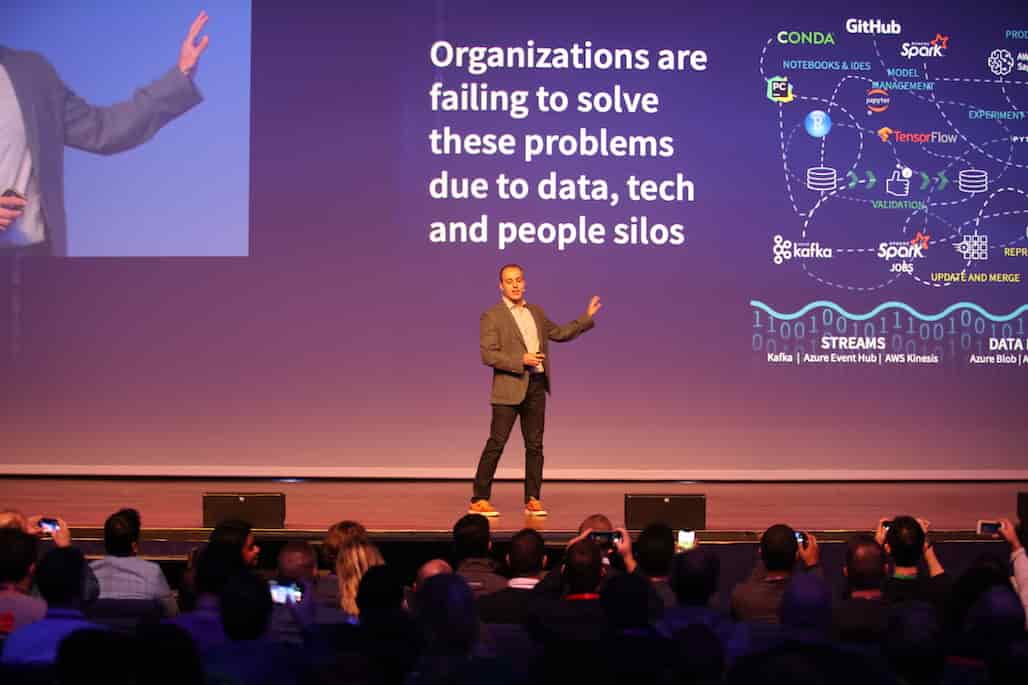
First up, we heard from Ali Ghodsi, CEO and Co-founder of Databricks, on the tough problems that data scientists, data engineers and business analysts face head on everyday. In his keynote address, entitled Unified Data Analytics: Helping Data Teams Solve the World’s Toughest Problems, Ali clearly lays out an expansive vision for the future of big data and AI that is not be missed.

Ali Ghodsi addressing the audience at Spark + AI Summit Europe 2019 in Amsterdam.

Delta Lake joins the Linux Foundation

In his keynote address, New Developments in the Open Source Ecosystem, Principal Software Engineer at Databricks Michael Armbrust shared plans for the continued growth of open source Delta Lake, highlighting the increasingly rapid adoption of this promising technology. Michael was pleased to report that over 3,700 organizations are already using Delta, and more than 2 billion gigabytes (2 exabytes, you read that right) of data are processed with it each month.

Databricks' Michael Armbrust speaking onstage at Spark + AI Summit Europe 2019 in Amsterdam.

To top it off, in a surprise announcement, Michael told the crowd in Amsterdam that Delta Lake is joining the Linux Foundation, to help continue to drive adoption of Delta Lake and growth of the open source community!

Punctuating Michael’s point, Senior Software Engineer Burak Yavuz walked the audience through a Delta Lake demo, expertly showcasing Delta’s capability and power.

Burak Yavuz demos Delta Lake onstage at Spark + AI Summit Europe 2019 in Amsterdam.

Apache Spark™ 3.0 upcoming enhancements

In addition to the exciting news about Delta Lake, Michael also shared several new developments about the upcoming release of Apache Spark™ 3.0, including significant performance improvements that are coming to the Spark SQL Optimizer. These improvements, which include partition pruning and the clever use of broadcast joins for certain merge operations, can provide up to 17x performance improvements for some queries. Finally, Michael introduced a new federated data catalog to Spark.

MLflow Model Registry update

Not to be outdone, Chief Technologist and Co-founder of Databricks Matei Zaharia discussed the importance of Model Registry to the MLflow ecosystem in his keynote address, entitled Simplifying Model Management with MLflow. In his keynote address to the crowd at RAI Amsterdam Convention Centre, the creator of Apache Spark™ explained how the MLflow Model Registry allows data teams to organize and productionize different versions of machine learning models, by offering a collaborative repository where named ML models can be saved and versioned.

Databricks CTO and Co-founder Matei Zaharia presents to the crowd in Amsterdam at Spark + AI Summit Europe 2019.

The Model Registry also makes it possible for data engineers and data scientists to implement flexible CI/CD pipelines, which Databricks Software Engineer Corey Zumar was kind enough to demo for the crowd. Learn more about the MLflow Model Registry here.

Corey Zumar speaks to a packed house at AI Summit Europe 2019 in Amsterdam.

Koalas community growth and adoption

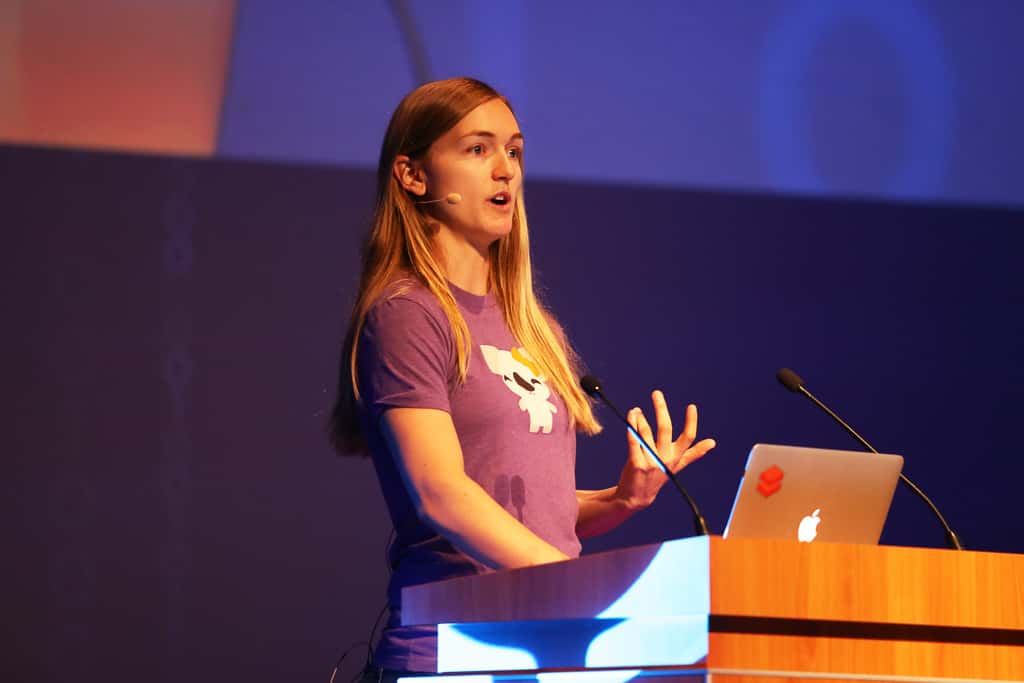
We also heard from Databricks’ own Principal Consultant Brooke Wenig on the continuing success of the Koalas open source project, which aims to bring the power of Apache Spark™ to pandas, the popular Python data analysis library. Open source community members have downloaded Koalas over 10,000 times per day, and the project has experienced over 100% month-over-month growth since its inception. We were also treated to a live demonstration, showing how easy it is to transition from single node data science on pandas to multi node data science on Spark using Koalas. Learn more about this exciting open source project here.

Brooke Wenig speaks behind a podium onstage at Spark + AI Summit Europe 2019 in Amsterdam.

Keynotes: Katie Bouman on creating the first black hole image, Gaël Varoquaux on the “secret weapon” of scikit-learn’s success, and much more

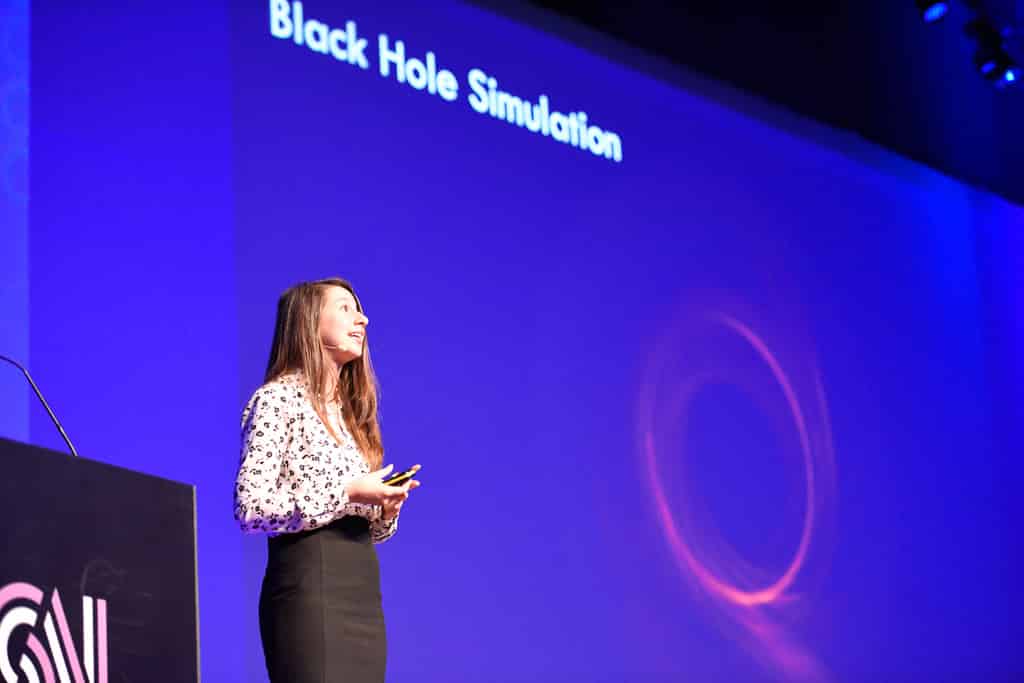
This year’s Spark + AI Summit Europe featured a keynote speech from none other than Katie Bouman, Assistant Professor of Computing and Mathematical Sciences at Caltech. In her keynote speech, Imaging the Unseen: Taking the First Picture of a Black Hole, Katie shared with us the process that she and her team used to photograph the celestial majesty from the Event Horizon Telescope in space.

Katie Bouman presents to the crowd onstage at Databricks' Spark Summit 2019 in Amsterdam.

We were also lucky enough to hear from Gaël Varoquaux, Creator of scikit-learn and Faculty Researcher at Inria. In Gaël’s keynote, Democratizing Machine Learning: Perspective From a scikit-learn Creator, he explained the simple principles, including one that he calls a “secret weapon,” that have been key to scikit-learn’s runaway success.

Gaël Varoquaux speaking onstage in front of microphones at Spark + AI Summit 2019 in Amsterdam.

Oriol Vinyals, Principal Scientist at Google DeepMind and former member of the Google Brain team, shared a fascinating story with us in his talk Project AlphaStar: mastering the real-time strategy game StarCraft II with AI.

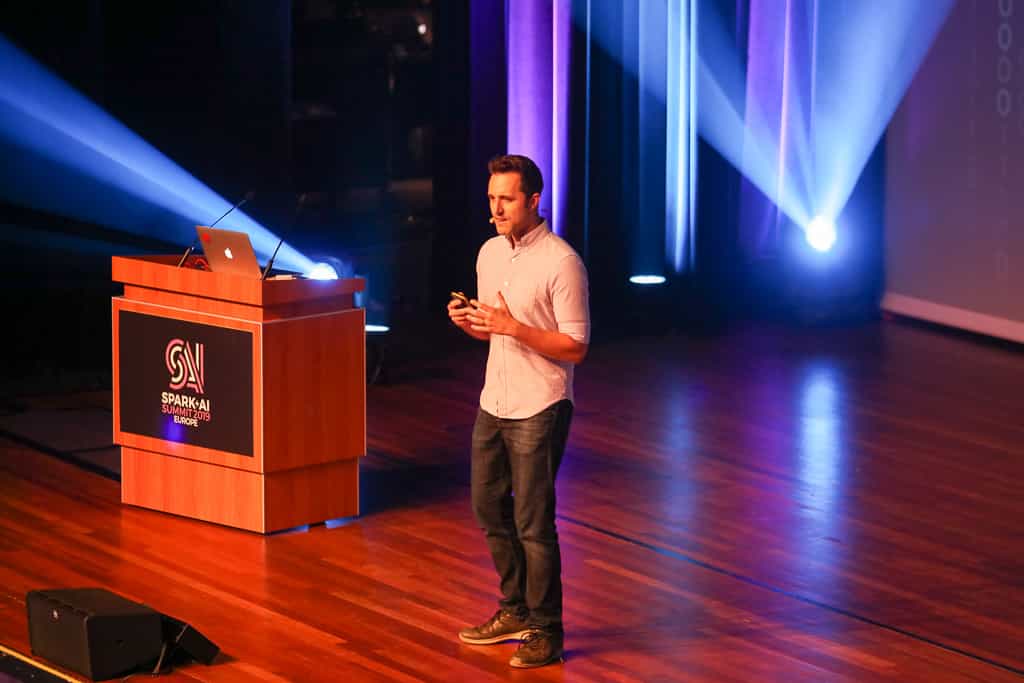
Oriol Vinyals speaks behind the podium onstage, which reads "Spark + AI Summit 2019 Europe."

Customer Keynotes

The lively audience in Amsterdam was also treated to talks from other legends and luminaries, including:

A view of the convention center theater from the balcony above, with attendees from Spark + AI Summit Europe in nearly every seat.

Women in Unified Analytics: Panel discussions and networking at Spark + AI in Amsterdam

This year’s Spark Summit also gathered Women in Unified Analytics and allies, providing an opportunity for women in big data, data science, machine learning and AI to connect, learn, and network. Female leaders from Microsoft, Lloyds Bank, Wehkamp, Centrum Wiskunde & Informatica, ARM, Depop, and more, met together for tech talks and panel discussion. They covered topics including technology trends, diversity & inclusion, ethical AI, and career development for women.

Photo of four women from the Women in Unified Analytics group at the Spark + AI Summit.

Spark + AI Summit Europe Community Sessions: Spark tuning workshops, technical tutorials, big data case studies, and more

In addition to the Keynote presentations, at this year’s Spark + AI Summit Europe, attendees were treated to over 140 different community sessions and instructor-led trainings. These community sessions featured speakers from companies like: KTH, Socialbakers, Airbnb, Eventbrite, Getyourguide, H&M, CERN, La Poste, Klario, Facebook, Societe Generale, Canal+, Nielsen, and more. These technical sessions covered all sorts of use cases and best practices, with hands-on tutorials on topics including deep learning, structured streaming, Apache Spark™ tuning, Delta Lake, MLflow, and more.

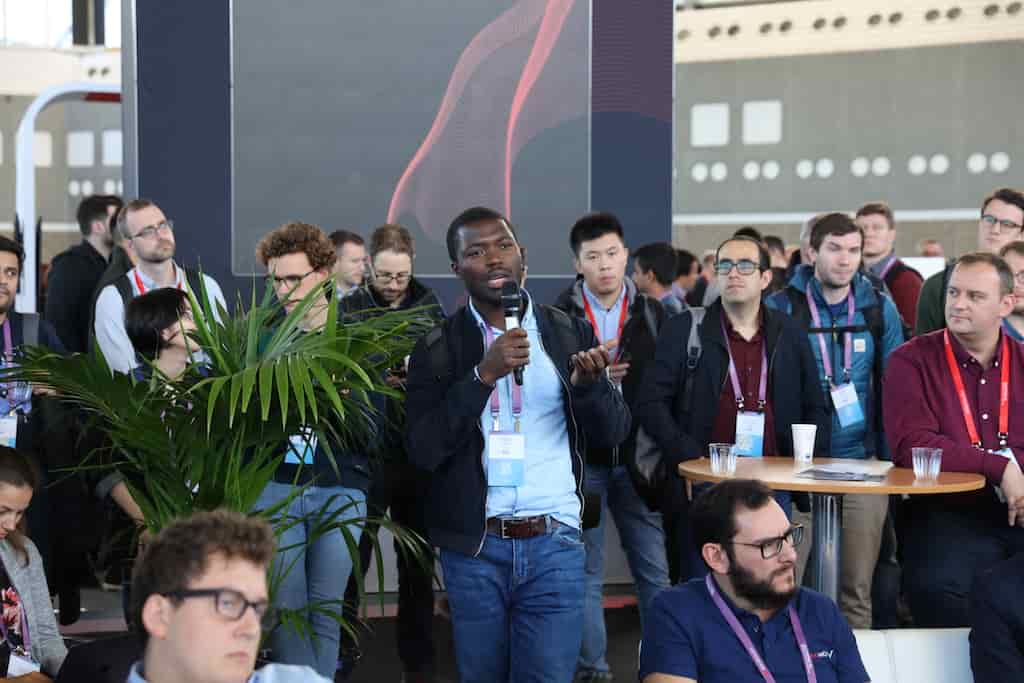
An attendee from the audience speaks into a microphone with other attendees all around him at a Spark + AI Summit training session.

What’s Next for Spark + AI Summit

Spark + AI Summit Europe 2019 keynote videos are now available! To see the newest product announcements and thought leadership, follow @Databricks on Twitter or subscribe to our newsletter. You can also learn Apache Spark, Delta Lake, and MLflow today on our free Databricks Community Edition, or build a production data application by trying Databricks today for free.

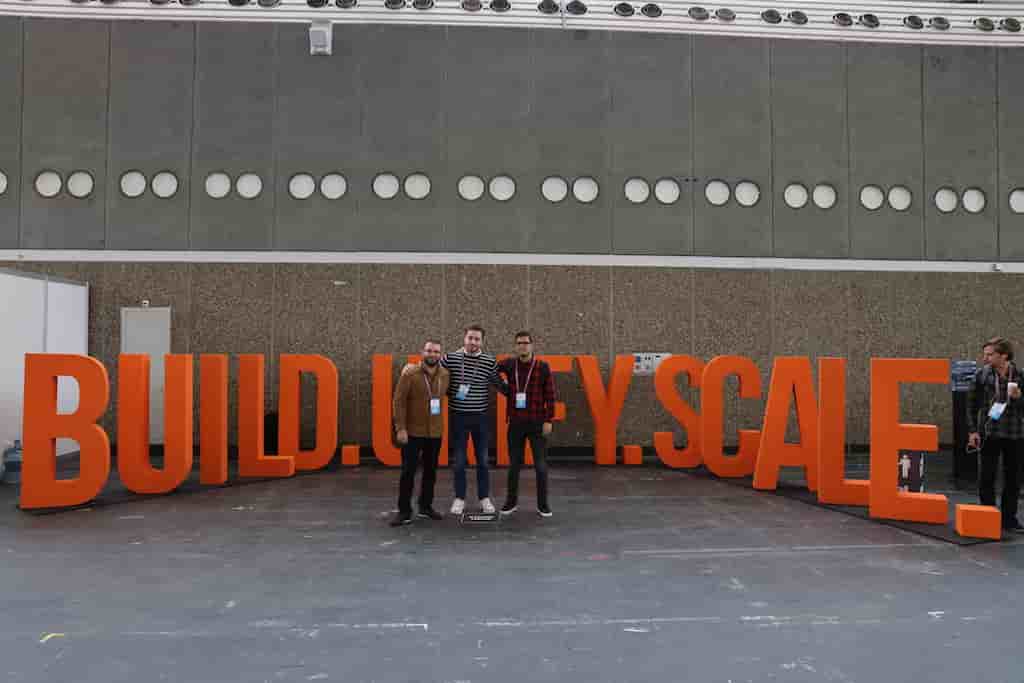
Three attendees pose in front of large orange physical letters that spell out "Build. Unify. Scale." behind them at Spark + AI Summit 2019.

As always, thanks for your support, and we look forward to seeing you again stateside, at the upcoming Spark + AI Summit in San Francisco on June 23-25, 2020!

Related Links

Announcement: Introducing the MLflow Model Registry

Announcement: Delta Lake Now Hosted by the Linux Foundation to Become the Open Standard For Data Lakes

Video: Spark + AI Summit Europe Keynote Videos

--

Try Databricks for free. Get started today.

The post Spark + AI in Amsterdam: European Summit Recap, Keynote Videos, & Announcements appeared first on Databricks.

Wednesday, 23 October 2019

How AI Democratizes Education: Being Equal Before the School

Much is heard about making the learning process more personalized with the help of all recent technological developments. Artificial Intelligence is seen as one of the most promising means to enhance, or even revolutionize education. The Artificial Intelligence Market in the US Education Sector report, for example, expects AI in the US education to grow by 47.5% from 2017–2021.

Sure enough, personalization might be the Holy Grail of educators, but it remains only one side and one aspect of the educational process. Let’s look at the new AI-driven education from the perspective of democratization of the learning process.

AI indeed opens vast opportunities for more and diverse students to obtain better education.

Global access for all students

Education has no limits, and AI can help to eliminate boundaries by facilitating the learning of any course from anywhere across the globe and at any time. Using AI systems, software, and support can help make global classrooms available to all including those who speak different languages, cannot attend school due to illness or who require learning at a different level. In this way, AI can help break down silos between schools and between traditional grade levels.

Facilitating vernacular learning

Somewhat related to the previous aspect, vernacular learning means learning in the ...


Read More on Datafloq

How Will Smart Technology Help You In Your Old Age?

Did you know that 32% of homes in America have already installed some sort of smart home technology? The technology includes such things as smart thermostats, which allow you to control your home’s temperature remotely; doorbells with video capabilities; and Alexa adding items to your grocery list. 

These pieces of tech are making life a little bit easier for everyone who owns them. In fact, people who have already adopted the technology into their homes say it saves them around 30 minutes per week (about a week and a half per year). Now, these same systems are being used to help senior citizens remain at home longer into retirement. 

What is Age-in-Place Technology? 

Aging in place is the idea that seniors can stay at home instead of being transferred to the care of a nursing home or assisted living facility as they age. Smart technology, similar to what many Americans are already using in their homes daily, can help seniors stay at home longer than ever before. 

Using technology as you get older doesn’t typically get easier, though. To solve that, developers have created specific tech that is simple to understand and, in many cases, also easy to read. Examples of this include the ...


Read More on Datafloq

View: India needs to expand its drone strategy

Instead of focusing only on expensive fighter planes, India should lay greater emphasis on low-cost drones.

Tuesday, 22 October 2019

No plans of dialling down on Uber Eats, says Uber's Manik Gupta

Earlier this month, ET reported that Uber’s food delivery service has seen significant churn in leadership, with two top executives — India chief Bhavik Rathod and head of central operations, Deepak Reddy — resigning.

WeWork board accepts SoftBank rescue deal: Source

SoftBank had offered a package worth nearly $10 billion to WeWork and its shareholders under a plan that would keep the company afloat and lead to the exit of its Chairman Neumann.

SaaS company Crediwatch raises $3.2M from VC firm Artis Labs

Artis Labs is an early-stage company that invests purely in artificial intelligence and machine learning companies. This is the fund’s first India investment.

Blockchain’s Shocking Impact on the Restaurant Supply Industry

Blockchain has already changed many markets, and there are many good reasons to believe that we’re only seeing the tip of the iceberg too. We’re already seeing the impacts of the technology in various sectors, including some that came as a bit of a surprise. Not many expected that blockchain would have such a noticeable impact on the restaurant supply chain industry, for example, yet here we are. It’s one of the most active adopters of the new technology, and it looks like this will continue in the near future too.

Exploring New Fields

Blockchain has a lot to offer to an industry like this. Problems with verifying long transaction chains are nothing new under the sun when dealing with the supply industry, and restaurants seem particularly susceptible to that for some reason. Blockchain has allowed many companies in the sector to reconcile the differences in their accounting and tracking and has created a much more comfortable environment for everyone involved.

Adapting to Current Trends

At the same time, it’s important to adapt the implementation of this technology to the way certain current trends in the market operate. There are many legacy systems and parts of the overall system which are still heavily in use but ...


Read More on Datafloq

Edu loans platform Credenc raises $2.5M funding led by Omidyar Network India

The company claims of receiving over 200 loan requests per day. Its evaluation process uses a proprietary AI model which tracks 15 million data points to predict the future income of students applying for loans.

Pseudo-Paralysis of AI Autonomous Cars

By Lance Eliot, the AI Trends Insider

[Ed. Note: For reader’s interested in Dr. Eliot’s ongoing business analyses about the advent of self-driving cars, see his online Forbes column: https://forbes.com/sites/lanceeliot/]

I was in the woods with my family one day and it was getting towards nightfall.

We were up on a mountain that was only reachable via an aerial tram.

We had been forewarned several times by the tram operator as we came up for our outdoor romp that we had to get back to the tramway by sunset or we would be stranded up there for the night. It was just a simple day hike for us and so we had not packed any camping gear. I realize this sounds like a story by someone that later regrets they had not brought their overnight gear, but in this case, we really genuinely were determined not to be there at night time, I swear it.

Anyway, we started to hike back toward the tramway with plenty of time to spare and could gauge how much sunlight we had left. The kids were enjoying the trip and there was a smattering of silvery snow on the ground. It was cold enough to have lightweight winter jackets on, but not so cold that you could see your breath. That being said, the temperature was dropping rapidly as darkness neared. We gradually picked up the pace and opted to move along more stridently, rather than stopping to look at every majestic tree and fallen pine cone.

Just as the tramway came into our sight, which was like reaching the pot of gold at the end of the rainbow, we also saw something else that was at the opposite extreme of delight, a wolf. Turns out that a full-grown wolf had edged out of the woods onto the path that led to the tramway.

He was facing us.

We were facing him.

I had no provision to be able to fight off the wolf, since I merely had the clothes on my back and nothing more. I was leading the way on this path and so saw the wolf before the rest of the family did so.

I signaled to my family to come to a stop. They at first thought I was kidding around, but they could see the seriousness and sternness of my facial expression. I whispered at them to quit goofing around and just stand still. The kids were very young, and so they were both frightened and yet also “excited” that something unusual was happening (I suppose if I was really brave, I would have wrestled with the wolf, right there in front of the kids, what a mountain man I would have been!).

Anyway, I was trying not to take my eyes off the wolf. Some say that you should stare down a wild animal, others say don’t make direct eye contact. It’s also said that it can be contextually based, as to the nature of the animal and the circumstances involved.

I knew this much, I wanted to know where the wolf was.

Would it dart towards us? Would it meander? Would it quietly go back into the woods? Were there more wolves and this was just one of them? Was there an entire wolf pack surrounding us and this was the first one to show itself? If I yelled, would it scare off the wolf? If I yelled, would it instead cause the wolf to attack? Why would a wolf come this close to the tram station? Was it a domesticated kind of wolf that was used to being around people? Etc.

The rest of the family was watching me and watching the wolf. We were all standing still, including the wolf. It was some kind of momentary standoff. The kids were squirming but generally as still as young children can be. I was concerned that even trying to talk about the wolf and the situation might somehow spark the wolf into action. We all remained silent. In the woods. On a mountain. Nearing sunset. With no one else left around.

I didn’t see anyone yet at the tram station. One thought was that if we all just stayed frozen in position, maybe the tram was on its way up for the last haul of the day, and when it arrived the wolf would dart away. Even if the tram arrived and we were all still stationary, I figured we were close enough to the tram station that we might be able to get the attention of the tram operator. Hopefully, the tram operator was prepared for and used to having wolves in this area, and would know what to do.

You could say I was paralyzed.

Of course, I wasn’t paralyzed in the sense that my arms weren’t broken or my legs were not working.

I was fine physically.

We all were. I’d dare say the wolf looked to be in good shape too. We were paralyzed in the manner of none of us moving, and none of us yet willing to make a move. It was a situation in which we were paralyzed in place, and “frozen” without any as yet identifiable viable move to best undertake.

Nor was I paralyzed in fear. Sometimes you lose your wits and become paralyzed. In this case, I had my wits, I had my fitness.

I’d like to think that the wolf was also looking us over and mulling over the same kinds of thoughts we were having.

Are those humans going to attack? Do they have food? Are they themselves food worthwhile to try and obtain? Will other humans come to their aid? Do they have a gun or other weapon? Are there more humans hidden in the woods? I realize that the wolf maybe wasn’t playing a game of chess with us, but in some manner, even if simplistic, it sure seemed like it too was trying to size up the situation and determine what to do next.

I refer to this as being “paralyzed.”

If you are uncomfortable that I use the word paralysis, which I realize many believe should only be used when you are truly physically debilitated, I can use instead the word pseudo-paralysis if that’s more palatable to you.

Suppose we do this, for the rest of this discussion, whenever you see me use the word paralysis, substitute instead the word pseudo-paralysis.

Hope that’s OK with you all.

In a moment, you’ll grasp why I’ve discussed the topic of paralysis and led you to a juncture of considering paralysis as a circumstance involving coming to a halt, being faced with seemingly difficult choices of what to do next, and remaining in a stopped position for some length of time.

I’ll quickly finish the story since I am assuming you are on the edge of your seat.

I didn’t want us to back-up since I thought it might cause the wolf to think we were weak and by retreating maybe it would come after us.

I didn’t want to go forward because I thought it would be perceived as an attacking threat.

I didn’t want to go sideways which would have led us into the woods and I figured that being among the trees would be more to the advantage of a cunning wolf than us day trip humans.

Seemed like quite a stalemate.

Fortunately, the wolf apparently grew tired of the standoff, and it wandered back into the woods.

We moved quickly over to the tram station and with great relief got onto the tram once it arrived.

AI Autonomous Cars And Paralysis

What does this have to do with AI self-driving driverless autonomous cars?

At the Cybernetic AI Self-Driving Car Institute, we are developing AI software for self-driving cars. This also includes considering scenarios in which the self-driving car might find itself becoming pseudo-paralyzed due to a predicament or particular situation.

First, let me clarify that I am not referring to a circumstance involving the self-driving car having a malfunction.

Similar to my story, I am referring to a situation for which the AI has to make a decision about which way to go, and there doesn’t seem to be a viable choice at hand. This is different than having a physical ailment of some kind. Just as I was physically able to move around while facing the wolf, I was “paralyzed” with respect to the situation and what action to take. For the moment, taking no action seemed prudent.

There will be circumstances that an AI self-driving car freezes up due to some kind of potential malfunction, for which I’ve covered extensively in my article about the Freezing Robot Problem: https://aitrends.com/ai-insider/freezing-robot-problem-and-ai-self-driving-cars/

Herein, let’s assume that the AI self-driving car is fully able and can go forwards, backwards, turn, and the like.

You might be wondering what kind of a situation could arise then that would cause a functioning AI self-driving to become pseudo-paralyzed.

Example Of Self-Driving Car Pseudo-Paralysis

One of the most famous examples involves the early days of AI self-driving cars and their actions when coming to a four-way stop.

An AI self-driving car arrived at a four-way stop sign just as other cars did. The other cars were driven by humans. Even though the proper approach would normally be that whichever car arrives first then goes forward first, the other human driven cars weren’t necessarily abiding by this. It’s a dog eat dog world, and I’m sure you’ve had other drivers that have opted to force themselves forward and abridge your “right” to go ahead before they do.

The AI self-driving car kept waiting for the other cars to come to a full and proper halt.

Those other cars kept doing the infamous rolling stop. Each time that the AI self-driving car perceived that maybe it could start to go, one of the other cars moved forward, which then caused the AI to bring the self-driving car to a halt. You might have seen a teenage novice driver get themselves into a similar bind. They sit at the stop sign, politely waiting for their turn, which never seems to arrive.

You could say that this is a form of paralysis.

Admittedly, the AI self-driving car was fully able to drive forward. It could even go in reverse. It was a fully functioning car.

The predicament or circumstance was that it was trying to abide by the laws of driving, and it was trying to avoid a potential accident with any other car.

Under that set of circumstances, it become pseudo-paralyzed.

Perhaps you can see now how my story about being in the woods and spotting the wolf relates to this – I was fully able to move, but the situation seemed to preclude doing so.

School Driving And Paralysis

There’s another example of an AI self-driving car paralysis that was recently reported about the real-world trials being undertaken by Waymo in Phoenix, Arizona.

Reportedly, one of their AI self-driving cars drove to the school of a family that was participating in the trial runs and waited for the school children to be released from the school.

You’ve maybe done this or seen this before, wherein cars sit waiting for the bell to ring and the school children to come flying out of the classrooms, and kids will pile into the waiting cars.

If you’ve not had an opportunity to be a human driver in the school setting of this kind, I assure you that it can be one of the most memorable times of your driving career (well, maybe not fondly memorable!).

I used to endure the same situation when I was picking up my children from school.

When the cars first arrived to the school, prior to the bell ringing, it is relatively quiet and everyone jockeys to find a place to temporarily park. Some leave their motor running; some turn off the car. Some read a book while waiting, some watch the school intently. Some actually get out of their cars, as though it is a taxi line at the airport, and converse with other fellow parents waiting likewise to pick-up their children.

That first part of the effort is relatively easy.

The main aspect is that you need to be careful about where you park, and that you don’t cut-off someone else or disturb what has become a kind of daily ritual with everyone seemingly knowing the “rules” about where to park and wait. It can be an unavoidable death sentence to anyone that decides to squeeze their car in front of everyone else that has already been waiting for the last twenty minutes or so. I’m sure the person would be dragged out of their car and beaten senseless.

Well, the real excitement happens when the kids burst out of the classrooms. Everyone starts their car engines as though it is the start of an Indy car race. The kids weave in and out of the parked cars to get to their parent’s car. Some kids take their time and end-up blocking other cars. Some kids run to their designated car but meanwhile get confused and maybe bounce off someone else’s car. The parents will try to maneuver their car closer toward their child. It becomes a free-for-all. Measured chaos, or worse.

Well, apparently, an AI self-driving car from Waymo found itself in such a situation.

The AI self-driving car reportedly became pseudo-paralyzed.

Whichever way it might go, there were nearby objects. Other cars were blocking it. Children were blocking it. Probably other parents were walking around trying to help the children, and they were blocking it too. No means to move. Notice that the AI self-driving car was fully functioning, and it could have driven in any desired direction, but the situation precluded doing so.

If the AI self-driving car had tried to move forward, it might have hit someone or something.

If it tried to back-up, it might have hit someone or something.

If it turned to the left or turned to the right, it might have hit someone or something. All told, it was a kind of stalemate.

Just like with the wolf, it became a wait and see what will happen in the environment that might allow for breaking out of the stalemate.

You might be saying that the AI was just trying to be cautious.

It could have run over the children or parents; it could have rammed into the other cars. Let’s concede that indeed it could have moved if it intended to do so.

Fortunately, the AI was apparently well-programmed enough that it realized those were not seemingly viable options in this case. The need to avoid hitting these surrounding objects had kept the self-driving car from moving.

One current criticism of AI self-driving cars is that they are perhaps overly cautious.

They are actually skittish, which can be a limiting factor when driving a car.

If you’ve seen a teenage novice driver trying to drive in a busy mall parking lot, you might know what I mean by skittish. The novice won’t drive down a parking lane because there are people walking to and fro. There are cars backing up. There are cars waiting in the parking lane and it becomes dicey to squeeze around them.

Skittish Autonomous Cars

Do we want our AI self-driving cars to be skittish?

This can be a “safe” way to drive, one might argue, but it also means that there will be lots of real-world driving situations that will inhibit the self-driving car and it will become possibly paralyzed. Imagine the frustration of other human drivers at the skittishly driven car – they honk their horn, and can be blocked by the paralyzed car and unable themselves to move along. Pedestrians can be confused too. Is that self-driving car going to move or not move?

There are some that even have been playing tricks on AI self-driving cars.

You can get some of the AI self-driving cars to come to a halt, simply by standing at the curb and waving your arms frantically as it gets close to you, while it is driving down the street. The AI self-driving car will likely slow down, and in some cases even come to a halt. This is partially because the AI developers have opted to establish a kind of protective virtual bubble around the self-driving car. If there is anything that nears the bubble or comes into the bubble, there’s a chance that the self-driving car will hit it, so the safest bet by the AI programmers seems to be have the self-driving car slow down or come to a stop.

This is considered an essential deployment of the “first, do no harm” principle of the AI being developed by most of the automakers and tech firms.

Driving the car is essential, but harming people or destroying things is a big no-no. Thus, make the protective virtual bubble as large and encompassing as you can. Don’t scrimp on the magnitude of the bubble. Make the bubble big so as to reduce the risks of causing injury or death to the smallest amount that you can.

Humans don’t typically drive this way.

Humans have seemed to be able to refine their driving practices to take things to a much closer margin. I realize you might say that’s why there are car accidents and people that get run over by cars. True. But, on the balance, there seems to have been a “societal dance” that by-and-large has been established of driving our cars and doing so within an inch of others, and meanwhile most of the time there aren’t injuries and deaths.

I recently went to a baseball game and parked in a very busy parking lot. The entire time in the parking lot, while driving around to find a parking spot, people were not only super close to my car, many people at times touched my car (transgressions!). When I finally found an open spot, I pulled into it, and was within a scant inch or so of the cars on either side.

Most of the AI self-driving cars would become “paralyzed” with that kind of closeness.

There’s going to be a delicate ratcheting up of the risk aspects to allow for closer movement. Human occupants in an AI self-driving car aren’t going to be satisfied that their AI self-driving car has come to a halt and is going to wait say thirty minutes for everyone else in a parking lot to get into or out of their cars and clear out the lot before the AI will instruct the self-driving car to move again. We’re going to expect that the AI can drive like a human can, which means being able to navigate these kinds of situations.

See my article about the foibles of human drivers and the AI self-driving car practices: https://aitrends.com/selfdrivingcars/ten-human-driving-foibles-self-driving-car-deep-learning-counter-tactics/

See my article about defensive driving for AI self-driving car practices: https://aitrends.com/selfdrivingcars/art-defensive-driving-key-self-driving-car-success/

Scenario Analysis

In the case of the AI self-driving car among the school children, what should the AI have done?

Let’s first consider the four-way stop sign scenario.

In that situation, the AI self-driving car likely should have played chicken with the other human driven cars and opted to move forward, showcasing that it was wanting to move along. The other human driven cars would inevitably have backed-down and allow the AI self-driving car to go ahead. It was the omission of a clear cut indication that the AI self-driving car was going to “aggressively” make its move that the other human driven cars figured they would just outdo or outrun it.

Some would say that if there’s a politeness meter related to the AI, it’s time to move the needle towards the impolite side of things. Human drivers can be quite impolite. They get used to other drivers being the same way. Therefore, if they see a polite driver, they figure the driver is a sheep. It is worthwhile to be the fox and treat the sheep like sheep, so the impolite driver figures. Right now, AI self-driving cars are perceived as the meek sheep. Easy to exploit.

Does this imply that the AI self-driving car should run amuck?

Should it barrel down a street?

Should it try to take possession of the roadway and make it clear that it is the king of the traffic?

No, I don’t think anyone is suggesting this, at least not now.

Also, let’s be frank, it’s harder to go the impolite route when right now all eyes are on AI self-driving cars and how they are driving.

The moment an AI self-driving car bumps or harms a human, or scrapes against another car, this is going to be magnified a thousand fold as a reason why AI self-driving cars are not to be trusted.

Suppose a human driver was on probation for having driven badly, and they were then on-notice that any tiny misdeed would have their license get revoked. Many of the AI developers are worried that the same thing is going to happen with the initial emergence of AI self-driving cars.

Let’s revisit the school children and picking up the kids at school. What do the parents do when they want to drive out of the morass of cars and kids? They usually edge forward, which is a signal to the other cars and the kids to get out of the way. This generally seems to work. It’s almost like being amongst a herd and you kind of make your own pathway while in the middle of the herd.

Rather than being paralyzed, these human drivers “push” their way out of the situation. Sure, some of them are momentarily “paralyzed” but they are overtly making their way through the crowded scene. This is somewhat akin to the practice suggested to alleviate the four-way stop paralysis too.

Time Factor Is Crucial

This brings up the importance of the time factor when referring to this pseudo-paralysis.

How much time has to be spent sitting still to declare a paralysis?

This is a hard thing to quantify across all circumstances and situations. If I’m in my car and waiting at a red light, I’ll need to do so for the time it takes for the light to turn green. Are me and my car paralyzed? I don’t think so. I’d suggest that we would all agree this is not quite the circumstance that we’re referring to when we discuss the paralyzed self-driving car.

Returning to the school children situation, suppose the AI self-driving car opts to be more aggressive. In doing so, it might bump into a child, or bump into another car. Obviously, that’s not desirable. You could say that the human parents could also though have done the same thing, they could have bumped into a child or bumped into a car. Fortunately, most of the time, they don’t. This is the kind of delicate maneuvering that a true AI self-driving car should strive to achieve.

See my article debunking the zero fatalities indications: https://aitrends.com/selfdrivingcars/self-driving-cars-zero-fatalities-zero-chance/

See my framework about AI self-driving cars: https://aitrends.com/selfdrivingcars/framework-ai-self-driving-driverless-cars-big-picture/

Let’s consider other scenarios that might lead to paralysis of an AI self-driving car, and consider what to do about it.

The AI self-driving car is driving along an open highway. A group of motorcyclists gradually come up to where the AI self-driving car is driving along. It’s doing 55 miles per hour. The motorcyclists were doing 80 miles per hour to catch-up with the AI self-driving car. Upon reaching the AI self-driving car, they all slow down to 55 miles per hour. They completely surround the AI self-driving car. What should the AI self-driving car do?

You’ve maybe seen YouTube videos of groups of motorcyclists that have done this to human drivers. Presumably, you would just keep driving and try to avoid a confrontation. Suppose though that the motorcyclists start to slow their speed. The AI self-driving car will presumably need to slow down, or else it will hit the motorcyclists ahead of it, and it cannot change lanes because the motorcyclists are there too. Now what?

If you say that the AI self-driving car should slow down, it then takes us to the next step, imagine that the motorcyclists are going to gradually come to a halt. They could essentially get the AI self-driving car to come to a halt, doing so on an open highway. Is that safe? Would you, the human occupants, inside the AI self-driving car want that to happen? Maybe you feel that the motorcyclists are trying to threaten you, and they are readily using the AI to let it happen.

For my article about robojacking of AI self-driving cars, see: https://aitrends.com/features/robojacking-self-driving-cars-prevention-better-ai/

Here’s another similar kind of scenario.

You are in an AI self-driving car.

Unluckily for you, you’ve wandered into an area that has a riot erupting.

The AI self-driving car has come to a halt, paralyzed, because there are rioters completely surrounding the self-driving car. The rioters bang on the self-driving car and are aiming to get in and harm you. What should the AI self-driving car do?

For more about ethical dilemmas and AI self-driving cars, see my article: https://aitrends.com/selfdrivingcars/ethically-ambiguous-self-driving-cars/

Avoidance Often Not Feasible

Some would say that the AI self-driving car should not allow itself to get into such a situation.

That’s not much of a helpful answer.

Sure, if there’s an obvious situation that you can avoid, it would be handy if the AI could possibly predict a situation and avoid it.

In the case of the school children, it’s reportedly been indicated that the AI developers advised that the AI self-driving car not go into the muddled area to pick-up the children, and instead find a less crowded area to park and wait. Though this seems perhaps sensible, I’d suggest it has downsides, such as maybe causing the children to walk further to get to the car, increasing their chances of getting hit or other calamity occur. Also, notably, it was not a solution devised by the AI, but instead relied upon the AI developers to suggest or devise.

The point being that having a skittish AI self-driving car that has to avoid situations that can lead to paralysis is certainly something to keep in mind, but it doesn’t seem to fully address the problem.

Also, we’d prefer that the AI is able to “reason” about what to do, rather than hoping or betting that the AI developers can find a workaround. In the real-world, the AI self-driving car has to do what a human driver might do, and not necessarily be able to “phone a friend” to get out of a jam.

Coping By Sharing

That being said, it is vital too that whenever AI self-driving cars find themselves in a paralyzing situation, the experience can be shared with other AI self-driving cars.

Most of the automakers and tech firms have setup a cloud-based system to allow for data collection and machine learning for their line of self-driving cars, known as OTA (Over The Air) capabilities. We find that having these particular kinds of experiences shared into the cloud can be handy as a means of getting others of the AI self-driving cars to avoid like situations or at least have some possibilities of what to do when such a circumstance arises.

For my article about OTA, see: https://aitrends.com/selfdrivingcars/air-ota-updating-ai-self-driving-cars/

For my article about common sense reasoning and AI self-driving cars, see: https://aitrends.com/selfdrivingcars/common-sense-reasoning-and-ai-self-driving-cars/

Another form of sharing among AI self-driving cars involves V2V (vehicle to vehicle communications).

This would be handy when an AI self-driving car has discovered a paralyzing situation, and it might forewarn other nearby AI self-driving cars about it. Besides perhaps staying away from the situation so as to avoid getting into a paralyzing predicament, it might also be possible that multiple AI self-driving cars might come to each other’s aid, and find a means to jointly get out of the situation. This could make use of swarm intelligence.

For my article about swarm intelligence and AI self-driving cars, see: https://aitrends.com/selfdrivingcars/swarm-intelligence-ai-self-driving-cars-stigmergy-boids/

There are other coping strategies for the AI self-driving car. It could potentially interact with the human occupants and maybe jointly identify a means to get out of the paralysis situation. This could be good, or  it could be bad. If the human occupant offers helpful insights, it could be good. If the human occupants say something like run them all down, it could be problematic as a solution to be considered viable by the AI system.

For my article about natural language processing and interacting with human occupants in AI self-driving cars, see: https://aitrends.com/selfdrivingcars/car-voice-commands-nlp-self-driving-cars/

Overall Aspects To Deal With

In quick recap:

  • Try to avoid paralyzing situations, if feasible
  • Seek to learn from paralyzing situations, doing so via OTA and cloud-based machine learning
  • Be able to recognize when a paralyzing situation is arising
  • Once in a paralysis, be considering ways out of it
  • Keep watch of the clock to gauge how long it is lasting
  • Tendency toward impoliteness or aggressiveness as a possible paralysis buster
  • Reduce the bubble size but simultaneously increase the driving capability
  • Potentially confer with other AI self-driving cars via V2V about such situations
  • Other

Currently, most of the automakers and tech firms aren’t giving much consideration to the paralysis predicament.

They tend to consider this to be an “edge” problem (one that is not at the core of the driving task per se). Many AI developers tell me that if the AI self-driving car has to wait until the school children disperse or the baseball parking lot becomes empty, it’s fine as a driving strategy, and meanwhile the human occupants can be enjoying themselves in the car during the waiting time. I don’t think this is reasonable, and furthermore it ignores the often adverse consequent aspects of having the self-driving car being in the paralyzed state.

For my article about edge problems in AI self-driving cars, see: https://aitrends.com/ai-insider/edge-problems-core-true-self-driving-cars-achieving-last-mile/

It’s time to make sure AI self-driving cars are able to cope with potentially paralyzing situations.

Conclusion

There is a famous saying that often times people fail at a task due to analysis paralysis.

They over-analyze a situation and thus get stuck in doing nothing.

You might claim that when I was in the woods and facing the wolf, I was overthinking things and had analysis paralysis. I don’t believe so. I was doing analysis and had ascertained that no action seemed to be the best course of action, for the moment, and remained alert and ready to take action, when action seemed suitable.

In the case of pseudo-paralysis for AI self-driving cars that I’ve been depicting here, I’m not herein been focusing on instances where the AI self-driving cars get themselves into an analysis infinite loop and suffer analysis paralysis.

Instead the situation itself is causing paralysis, as dictated by the desire to avoid injuring others, and so the need to remain alert and ready for making a move whenever suitable.

That’s the kind of paralysis we can overcome with better AI.

Copyright 2019 Dr. Lance Eliot

This content is originally posted on AI Trends.