Data mining and clustering are closely interlinked. They both focus on the pattern recognition underlying a particular dataset.
Mainly, it’s a joint effort of machine learning, pattern recognition and statistics. They help in discovering patterns in data. Clustering is one of the various methods of data mining.
What is clustering in data mining?
Generally, the mining of data ends up at spotting the pattern. If you talk about clustering in particular, it’s an unsupervised data mining method that splits the data into natural groups. In other words, clustering is the statistical distribution of data into subclasses. Each subclass showcases a group of similar objects. It’s a kind of unsupervised algorithm.
Let’s consider this example to clarify its meaning. When you type a phrase in Google, it immediately monitors. Whenever you browse it again, it lines up an array of ads that are motivated by your previous search. Its bots take a few minutes to scan what you explored. Likewise, many other users would have browsed the similar or related information. But, their phrases might differ. Its bots put billions of searches in algorithms to make a list of the most searchable phrases. It’s what the data mining is.
The unsupervised algorithms use multiple variables describing ...
Read More on Datafloq
Tuesday, 30 April 2019

Elon Musk's Tesla says it may seek funding from outside sources
Musk's agreement with the SEC on Friday puts the focus back on execution as Tesla tries to ramp up production of its most important vehicle, the Model 3 sedan, and make a profit at the same time.
Top AI algorithms for Healthcare
The benefits of AI for healthcare have been extensively discussed in recent years up to the point of the possibility to replace human physicians with AI in the future.
Both such discussions and the current AI-driven projects reveal that Artificial Intelligence can be used in healthcare in several ways:
AI can learn features from a large volume of healthcare data, and then use the obtained insights to assist the clinical practice in treatment design or risk assessment;
AI system can extract useful information from a large patient population to assist in making real-time inferences for health risk alert and health outcome prediction;
AI can do repetitive jobs, such as analyzing tests, X-Rays, CT scans or data entry;
AI systems can help to reduce diagnostic and therapeutic errors that are inevitable in human clinical practice;
AI can assist physicians by providing up-to-date medical information from journals, textbooks and clinical practices to inform proper patient care;
AI can manage medical records and analyze both performances of an individual institution and the whole healthcare system;
AI can help develop precision medicine and new drugs based on the faster processing of mutations and links to disease;
AI can provide digital consultations and health monitoring services — to the extent of being “digital nurses” or “health ...
Read More on Datafloq
Both such discussions and the current AI-driven projects reveal that Artificial Intelligence can be used in healthcare in several ways:
AI can learn features from a large volume of healthcare data, and then use the obtained insights to assist the clinical practice in treatment design or risk assessment;
AI system can extract useful information from a large patient population to assist in making real-time inferences for health risk alert and health outcome prediction;
AI can do repetitive jobs, such as analyzing tests, X-Rays, CT scans or data entry;
AI systems can help to reduce diagnostic and therapeutic errors that are inevitable in human clinical practice;
AI can assist physicians by providing up-to-date medical information from journals, textbooks and clinical practices to inform proper patient care;
AI can manage medical records and analyze both performances of an individual institution and the whole healthcare system;
AI can help develop precision medicine and new drugs based on the faster processing of mutations and links to disease;
AI can provide digital consultations and health monitoring services — to the extent of being “digital nurses” or “health ...
Read More on Datafloq
Electric bike sales come to a halt in April
Lower subsidy under FAME-II, re-certification requirement hit electric two-wheelers industry.
DeepFake News-“AI-Synthesized Content”- Latest Challenge for News Content Pipeline and Providers

By Melissa Pandika, Science Writer
A viral video of what appears to be Barack Obama provided a chilling glimpse into the growing power of fake news when it was released last April. It opens with Obama warning viewers about how America’s enemies “can make it look like anyone is saying anything at any point in time.” At about the halfway mark, a split screen reveals director Jordan Peele impersonating Obama, who has merely been mouthing his words. Peele’s production company created the video with Adobe After Effects, a motion graphics software, and FakeApp, an AI-powered face-swapping app that resynthesized Obama’s mouth to be consistent with the audio track of Peele’s voice.
The video played before a packed auditorium at the University of California, Berkeley to kick off a panel session at the recent TechCrunch event on Robotics + AI. Moderated by TechCrunch writer Devin Coldewey, the panel brought together two leading experts in AI and synthetic imagery to discuss the reality we now face: Advances in AI technology are enabling the synthesis of incredibly convincing photos, videos, and audio tracks that threaten to make fake news even more deceptive. The panel also tackled the thorny questions of how to tamp down on fake content and how to even know what to trust anymore.
After Peele’s video played, Coldewey asked the panelists how they would classify it. Hany Farid, a computer science professor at Dartmouth College who researches digital forensics, human perception and image analysis, said the correct terminology is “AI-synthesized content.” (Media outlets, however, have run with the catchier “deepfake,” after Redditor deepfakes, who used the algorithm FakeApp is based on to swap out porn stars’ faces for those of celebrities.) “I don’t think it takes a stretch of the imagination to see the power of this type of fake because you can literally put words into now anybody’s mouth,” Farid said.
Panelist Alexei Efros, an electrical engineering and computer sciences professor at UC Berkeley and member of the Berkeley Artificial Intelligence Research Lab, pointed out that “AI-synthesized content” could also include the visual effects that film studios have begun creating with the help of AI technology. The key distinction is intent. A Hollywood film often marketed as fiction, whereas something like a deepfake tries to pass off manipulated content as real.
But people have been creating fake content for years—so “why are we only talking about it now?” Coldewey asked.
Efros noted that indeed, the roots of this practice stretch back to photography’s beginnings, citing the example of how a photo of Abraham Lincoln’s head was attached to an engraving of John C. Calhoun’s body, yielding a composite image that hangs in many classrooms to this day. “I think the main difference is that now it’s starting to be much more democratized,” he said. “It’s not just the dictators, the CIA, the KGB and the special effects houses that could do it. Any kid with a computer is able to make something in Photoshop.” Plus, the deep learning methods used to create fake content are only getting better.
Not only can pretty much anyone create compelling fake content, they can also disseminate it widely and instantly over social media—and “a bunch of knuckleheads” are willing to consume, like and share it, Farid said. With the convergence of these factors, “you have, in many ways, the perfect storm.” And while misinformation isn’t a new phenomenon, “it is on extra strong steroids right now,” he added, citing Russian interference in the 2016 presidential election, as well as misinformation campaigns in the UK, Myanmar, the Philippines, Sri Lanka and India.
Farid believes the 2020 presidential election may very well be the first in which we will see widespread fake media. But he pointed to what he views as an even more sinister problem: If everyone can now create fake content, that means everyone has plausible deniability. “In a highly partisan space, if everybody can simply say the video, the image, the audio, the news story, is fake because it doesn’t conform with my worldview, we have a problem as a democracy,” he said. “If we can’t agree on basic facts of what’s going on in the world, I think we’re in a lot of trouble.”
Efros forecasted an ongoing arms race between fake content creators and those developing systems to detect such content. As these systems improve, content creators will adapt, devising new methods to evade detection. “You are fighting, but you’re never going to win,” he said. He later went on to explain that the computer graphics technology employed to create fakes is fundamentally a helpful tool that, in the right hands, allows for creative expression, although he believes its use needs to be restricted through legislation. Lawmakers need to start thinking about how to update current laws, such as copyright laws, to address this, he said.
Farid agreed, but emphasized the importance—and challenge—of maintaining a balanced approach. While the First Amendment may make it hard to restrict fake content, he thinks most people view the weaponization of deep fakes to influence elections as problematic. On the other hand, he also enjoys the humor and satire deep fakes can provide and believes the draft legislation to get a handle on them is “overreaching” in many parts of the world.
The solution to curbing fake content must be multidimensional, Farid said. Firstly, social media platforms like Facebook, YouTube and Twitter need to get serious about it. “This isn’t fun and games anymore,” he said. “Your platforms have been weaponized, and you have a responsibility.” Meanwhile, journalists need to shoulder the huge burden of sorting out real from fake content, and consumers of digital content need to educate themselves and the next generation. “We’re going to have to take this more seriously and start understanding that the things that happen in the digital world don’t stop in the digital world.
The panelists’ outlook wasn’t all bleak, though. Efros said Google and Facebook have reached out to him for help, and he pointed to DARPA’s MediFor program, which aims to develop tools to authenticate digital visual media. But again, he foresees an ongoing arms race between forensics and fake news. “I think the fake news will always be a slight bit ahead,” he said.
Creating forensic tools is a double-edged sword, Farid said. Making them public—as encouraged in the academic research world—arms fake content creators, who will respond by creating even more convincing content. He, too, envisions an arms race, which the forensics side will lose. But that may not necessarily be a bad thing, since it would take the content-creating technology out of the hands of the Average Joe and into those of a smaller and smaller group of experts— “which is still a threat, but I think it will become a more manageable threat that we can deal with.”
Learn more at TechCrunch Sessions: Robotics + AI.
Melissa Pandika writes about science and health. She holds a B.A. in molecular and cell biology from the University of California, Berkeley. She can be reached at mmpandika@gmail.com/
Monday, 29 April 2019
Robots and AI aren't coming for your job, just the boring parts of it
We extol the virtues of robots and AI quite a bit on this blog, and rightfully so; beyond serving as one of our competitive advantages in innovative solution design and development, it’s also one of the most exciting frontiers in modern computer science (which at this point is to say, the modern world). But as with any level of automation, one of the first questions to follow (again, rightfully so) is whether or not these advancements will mean an end to thousands or millions of jobs. The good news is that humans are still too good at too much for AI to replace many of the jobs it might have had in its crosshairs. The better news? Robots and AI together might be able to eliminate many of the more tedious, time-consuming or boring tasks away from our jobs.
Wouldn’t that be swell?
Robots and AI fall short alone
“We fleshy beings remain more creative, more dexterous, and more empathetic—a particularly important skill in health care and law enforcement,” according to Matt Simon over at Wired. “What is happening is that the machines are taking parts of jobs, which isn’t anything new in the history of human labor: Humans no longer harvest wheat by hand, but with combines; we no longer write everything by hand, but with highly efficient word processors.”
That ...
Read More on Datafloq
Wouldn’t that be swell?
Robots and AI fall short alone
“We fleshy beings remain more creative, more dexterous, and more empathetic—a particularly important skill in health care and law enforcement,” according to Matt Simon over at Wired. “What is happening is that the machines are taking parts of jobs, which isn’t anything new in the history of human labor: Humans no longer harvest wheat by hand, but with combines; we no longer write everything by hand, but with highly efficient word processors.”
That ...
Read More on Datafloq
How to Manage Your Data As You Scale
We all know that growing your business is a necessity in order to stay in the game. However, there's more involved in the process than simply marketing to get more loyal customers through your front door. With the technology that we use, it's important to understand how to manage the data of your business as you continue to expand your customer base. Here are some great tips that you can start utilizing today to prepare for better data management in the future.
Know What Your Constraints Are
While we all would like to have the fastest car in the world, most of us simply can't afford it due to our financial constraints. Sure, there are data management systems out there which can handle your business data to pretty much infinity, however, you must assess your business constraints to see what you can actually obtain. Cost is going to be the biggest of your constraints. How much money do you actually have to invest in a new data management approach? Second, think about the time you'll need to have this solution implemented by. If you're growing rapidly, it's likely waiting a year for your solution isn't going to cut it.
Get A Clear Idea Of How ...
Read More on Datafloq
Know What Your Constraints Are
While we all would like to have the fastest car in the world, most of us simply can't afford it due to our financial constraints. Sure, there are data management systems out there which can handle your business data to pretty much infinity, however, you must assess your business constraints to see what you can actually obtain. Cost is going to be the biggest of your constraints. How much money do you actually have to invest in a new data management approach? Second, think about the time you'll need to have this solution implemented by. If you're growing rapidly, it's likely waiting a year for your solution isn't going to cut it.
Get A Clear Idea Of How ...
Read More on Datafloq
Saturday, 27 April 2019
How the Internet of Things and AI will Transform Sports?
This is an abstract of my presentation in Dubai on the 23rd April 2019.
In 2016 in my article “ The future of “The Internet of Olympic Games”, I considered Rio as the first Internet of Things (IoT) Olympic games. In Rio, we saw how athletes, coaches, judges, fans, stadiums and cities benefited from IoT technology and IoT solutions and this somehow changed the way we see and experience sports. Next year we will have the opportunity to verify if my predictions for Tokyo 2020 will become a reality and we will name Tokyo as the first Artificial Intelligent (AI) Olympic Games.
During my presentation in Dubai, I explained the audience the incredible way IoT and AI technologies are impacting sports. I dedicated some time explaining how IoT and AI are playing an increasingly significant role in boosting talent, managing health and improving coaching and training. Today these technologies are already enabling athletes to improve performance, coaches to better prepare games, judges to fail less, fans enjoyed with new exciting experiences. I also remarked about the importance that teams clubs and cities collaborate to make the stadiums more secure and more exciting for fans.
I emphasized how we are creating smart things, the ...
Read More on Datafloq
In 2016 in my article “ The future of “The Internet of Olympic Games”, I considered Rio as the first Internet of Things (IoT) Olympic games. In Rio, we saw how athletes, coaches, judges, fans, stadiums and cities benefited from IoT technology and IoT solutions and this somehow changed the way we see and experience sports. Next year we will have the opportunity to verify if my predictions for Tokyo 2020 will become a reality and we will name Tokyo as the first Artificial Intelligent (AI) Olympic Games.
During my presentation in Dubai, I explained the audience the incredible way IoT and AI technologies are impacting sports. I dedicated some time explaining how IoT and AI are playing an increasingly significant role in boosting talent, managing health and improving coaching and training. Today these technologies are already enabling athletes to improve performance, coaches to better prepare games, judges to fail less, fans enjoyed with new exciting experiences. I also remarked about the importance that teams clubs and cities collaborate to make the stadiums more secure and more exciting for fans.
I emphasized how we are creating smart things, the ...
Read More on Datafloq
China's rocket startups go small in age of 'shoebox' satellites
LinkSpace, one of China's 15-plus private rocket manufacturers, sees these short hops as the first steps towards a new business model: sending tiny, inexpensive satellites into orbit at affordable prices.
Friday, 26 April 2019
AI Empathetic Computing: The Case of AI Self-Driving Cars

By Lance Eliot, the AI Trends Insider
A friend of mine in college was known for being very stoic. You could tell him that you had broken your leg skiing and he’d show no emotion. He’d just sit there and stare at you. No words came forth. No expression on his face. You might tell him that your dog got run over, and he’d continue to be without any kind of emotional response. I believe that if you told him that his dog got run over, he’d have the same kind of non-reaction, though I suppose he might be curious enough to ask how it happened.
Some of us thought that he had watched way too many Star Trek TV shows and movies. He had become our version of Mr. Spock, the fictional character that generally showed little or no emotion.
In case, you’ve been living in a cave and aren’t familiar with Star Trek, Spock was the science officer and first officer. To some degree, it was implied that his linage of Vulcan heritage allowed him through training and DNA to remain impartial and detached, shedding any emotion, though this was not entirely the case and he had mixed-blood with a human mother that “did him in” in terms of having to fight back at emotions bursting forth. At times, in some of the stories, he did show emotion, typically briefly and with a muted indication of it.
I’d like to remind us all that Spock was a fictional character in a TV show and not an actual person. We tried to emphasize this crucial aspect to our friend. Our friend seemed to believe that Spock was real or that even if not so, somehow it was possible to be like Spock. I knew my friend’s parents and I assure they were not Vulcan, neither of them were. He therefore was already one step behind being so unemotional, presumably because wasn’t already cooked into his DNA, as Spock’s was.
Our friend eventually had a girlfriend. We assumed that he’d come out of his non-emotion impenetrable barrier bubble and certainly be at least emotional with regard to his girlfriend. No dice. At first, we assumed he was keeping up the pretense only with us, his male friends (his buddies), and undoubtedly, he was emotional when behind-the-scenes with his girlfriend. A macho kind of thing of hiding his emotions to the guys. Whenever he insisted that he was acting toward us in the same manner as he acted toward his girlfriend, we simply nodded our heads as though we agreed to this obviously preposterous claim.
Turns out that his girlfriend confided in me that he was indeed a cold calculating machine and seemed to not express any emotions. He was this way all the time, according to her reports. For example, they had gone one time to a great sorority party and she was having a wonderful time, meanwhile he barely smiled and acted nonplused. They had gone hiking in the mountains and nearly fell from a cliff, yet he remained unnerved and cool as a cucumber. She assumed that eventually he’d come “out of his shell” if she just kept dating him (I believe it almost became an attractor as a type of challenge!).
Maybe he really was an early version of Mr. Spock? Note that the original Star Trek series took place probably around the year 2200 or so, and perhaps my friend became the basis for the future Mr. Spock. It’s a time travel deal.
Anyway, I’d wager that most of us do express our emotions. Furthermore, we express our emotions at times as a response to someone else. The other person might tell us something in an unemotional way, and you might respond in an emotional way. Or, the other person might tell you something in an emotional way, and you might respond in an emotional way.
Emotions Spark Emotions, Or So We Expect
Thus, it can be that emotion begets emotion, stoking it from another person. That doesn’t have to be the case and you can be conversing with someone on a seemingly unemotional basis and then opt to suddenly become emotional. There doesn’t necessarily need to be a trigger by the other person. Nor does it necessarily need to be a tit-for-tat.
That being said, usually when a person is emotional toward you, the odds are they will likely be expecting an emotional laden response in return. When my friend was told about a mutual close friend that had broken their leg skiing and told so by someone that was crying and quite upset about the pain and suffering involved, it would likely be anticipated that the response would be one of great concern, sadness, and a flurry of aligned emotional evocations from him.
A lack of an emotional response in the leg broken instance would tend to signal that he didn’t care about the other person. He didn’t care that the other person had suffered an injury. What kind of a friend is that? How could he be so careless and without sympathy?
When you asked him about these kinds of matters, he would contend that by remaining unemotional, it gave him an added edge in life. He kept his head calm and collected. It would do little good for him to get cloudy and hazed by being emotional. For the friend that had broken a leg, the main logical aspect would be whether there is anything he could do to aid that person. Expressing emotion about it was wasted energy and effort and distracted by considering the logic of the matter.
Sure, that’s what Mr. Spock would say. Watch any episode.
You might be familiar with the words of the famous holistic theorist Alfred Adler, a psychiatrist and philosopher that lived in the late 1800s and the early 1900s, in which he said that we should see with the eyes of another, hear with the ears of another, and feel with the heart of another.
The first two elements, the eyes and the ears, presumably can be done without any emotional attachment involved, if you consider the eyes as merely a collector of visual images and the ears as collectors of abstract sounds and noises. The third element, involving the heart, and the accompanying aspects of feelings, pushes us squarely into the realm of emotions.
Of course, I don’t believe that Adler was suggesting that the eyes and ears are devoid of emotion, and rather the opposite that you can best gain a sense of another person by experiencing the emotion that they express and inures by what they see, and by what they hear, along with matters of the heart.
I bring up Adler’s quote because there are many that assert you cannot really understand and be aligned with another person if you don’t walk in their emotional shoes.
You don’t necessarily need to exhibit the same exact emotions, but you ought to at least have some emotions that come forth and be able to understand and comprehend their emotions. If the other person is crying in despair, it does not mean you can only respond by crying in despair too. Instead, perhaps you break out into a wild laughter and this might spark the other person out of their despair and join you in the laugher. It’s not a simple mating of one emotion echoed by the same emotion in the other.
Wearing Emotional Shoes, The Empath
Let’s then postulate a simple model about emotion.
One aspect is the ability to detect emotion of others.
The other aspect is for you to emit emotion.
So, you are talking with someone, and you detect their emotion, and you might then respond with emotion. As mentioned before, it is not necessarily the case that you would always do the detection and a corresponding emission of emotion. It is more complex than that.
For example, we all wondered whether my friend was perhaps detecting emotion and then storing up his own emotion. If that was the case, we wondered what would happen one day if suddenly all of that pent-up emotion was unleashed, all at once. A cavalcade of emotion might emerge. A tsunami of emotion. A bursting dam of emotion.
Being empathetic is considered a capability of being able to exhibit a high degree of understanding about other people’s emotions, both their exhibited and hidden emotions. Per Adler, this implies that you need to be like a sponge and soak in the other person’s emotions. Only once you’ve gotten immersed in those emotions, only then can you truly be empathetic or an empath, some would say.
Can you be empathetic without also exhibiting emotion? In other words, can you do a tremendous job of detecting the emotion of others, and yet be like my friend in terms of never emitting emotions yourself?
That’s an age-old question and takes us down a bit of a rabbit hole. Some claim that if you don’t emit emotion, you can never prove that you felt the emotion of another, and nor can you then get on the same plain or mental emotional level as the other. I assure you my friend would say that’s hogwash and he separated (or thought he did) the ability of emotion recognition versus the personal embodiment of emotion.
One danger that some suggest can occur if you are emitting emotion is that you might get caught up in an emotion contagion. That’s when you detect the emotion of another and in an almost autonomic way you immediately exhibit that same emotion. You can see this sometimes in action. Suppose you have a room of close friends and one suddenly starts crying, others can also start to cry, even though maybe they don’t exactly know why the other people are crying. It becomes an infectious emotion. Crying can be like that. Laughing can be like that.
I recall a joke that was told one time while I was on a hike with the Boy Scouts (I was an Assistant Scout Master at the time). We had been hiking for miles upon miles. The day was long. We were exhausted and looking forward to reaching camp. One of the younger Scouts told a joke about a turtle and a hare, for which I don’t remember the details as it was utterly without any sense and a completely jumbled-up joke. Though at first, I was trying to figure out the nature of the joke, and hoped that I could “repair” the joke into whatever it was supposed to be, suddenly an older Scout nearby started laughing.
Then, another Scout started laughing. Then another. And so on. We were stretched out on this hike over a distance of maybe a football field size line, each Scout trudging along and following the footsteps of the Scout ahead of them. Within moments, every single Scout and all of the adult Scout leaders were all laughing. It was an amazing sight to see.
Later on, at the evening campfire, I asked the other adult Scout leaders if they could make sense of the botched joke. I had assumed that they had heard the joke and either already knew what the young Scout was attempting to say, or found it funny because it was perhaps an entirely nonsensical joke. Well, none of them had heard the actual joke. They were too far away. They had laughed because everyone else was laughing, and partially I’d guess due to the exhaustion of the hike. It was an infectious spread of laughter.
Sometimes when you exhibit emotion it can come across as a form of pity. This might not be what you intended. I knew an adult volunteer that aided us with the Scouts and every time a Scout said they had been either physically hurt during a hike or even mentally anguished, this adult responded with laughter. It was kind of weird at first. The reaction by the Scout telling about their hardship was to recoil from this response. It seemed like the adult was mocking the Scout or maybe trying to show a sense of feeling sorry for them, but it didn’t come across very well.
There is ongoing research trying to figure out how the brain incorporates emotions. Can we somehow separate out a portion of the brain that is solely about emotions and parse it away from the logical side of the brain? Or, are emotions and logic interwoven in the neurons and neuronal connections such that they are not separable. In spite of Adler’s indication about the heart, modern day science would say the physical heart has nothing to do with emotions and it’s all in your head. The brain and its currently unknown manner of how it exactly functions is nonetheless the engine that manifests emotion for us.
Sometimes empathy is coupled with the word affective. This is usually done to clarify that the type of empathy has to do with emotions, since presumably you could have other kinds of empathy. For example, some assert that cognitive empathy is being able to detect another person’s mental state, which might or might not be infused with emotion. Herein, I’m going to refer to empathy as affective empathy, which I am intending to suggest is emotional empathy, namely empathy shaped around emotions.
I’ve previously written and spoken about emotion recognition in the context of computers that are programmed to be able to detect the emotion of humans. This is a budding area of Artificial Intelligence (AI). I’m going to augment my prior discussions about emotion recognition by now including the emitting of emotions.
For my article about emotion recognition and AI, see: https://www.aitrends.com/ai-insider/ai-emotional-intelligence-and-emotion-recognition-the-case-of-ai-self-driving-cars/
Emotion Emissions Is The Focus Here
Recall that I earlier herein had said that we should consider the emotional empathy or now I’ll say affective empathy as consisting of two distinct constructs, the act of emotion recognition, and the act of emotion emission.
I want to mainly explore the emotion emission aspects herein. The notion is that we might want to build AI that can recognize emotion, along with being able to exhibit emotion. That’s right, I’m suggesting that the AI would emit emotion.
This seems contrary to what we consider AI to be. Most people would assert that AI is supposed to be like Mr. Spock, or more properly another fictional character in the Star Trek series known as Data. Data was a robot of a futuristic nature that was continually trying to grasp what human emotions are all about and craved that someday “it” would have emotions too.
There might be some handy reasons to have the AI exhibit emotion, which I’ll be covering shortly. First, let’s do a quick look at what do we mean by the notion of emotions.
When referring to emotions, there are lots of varied definitions of what kinds of emotions exist. Some try to say that similar to how colors have a base set and you can then mix-and-match those base colors to render additional colors, so the same applies to emotions. They assert that there are some fundamental emotions and we then mix-and-match those to get other emotions. But, there is much disagreement about what are the core or fundamental emotions and it’s generally an unsettled debate.
One viewpoint has been that there are six core emotions:
- Anger
- Disgust
- Fear
- Happiness
- Sadness
- Surprise
I’m guessing that if you closely consider those six, you’ll maybe right away start to question how those six are the core. Aren’t there other emotions that could also be considered core? How would those six be combined to make all of the other seemingly emotions that we have? And so on. This highlights my point about there being quite a debate on this matter.
Some claim that these emotions are also to be considered core:
- Amusement
- Awe
- Contentment
- Desire
- Embarrassment
- Pain
- Relief
- Sympathy
Some further claim these are also considered core:
- Boredom
- Confusion
- Interest
- Pride
- Shame
- Contempt
- Interest
- Relief
- Triumph
For purposes herein, we’ll go ahead and assume that any of those aforementioned emotions are fair game as emotional states. There’s no need to belabor the point just now.
Affective empathetic computing or also known as affective empathetic AI is the aspect of trying to get a machine to recognize emotions in others, which has been the mainstay so far, and we ought to also add that it includes the emission of emotions by the machine.
That last addition is a bit controversial.
The first part, recognizing the emotions of others, seems to have a clear-cut use case. If the AI can figure out that you are crying, for example, it might be able to adjust whatever interaction you are having with the AI to take into account that you are indeed crying.
Suppose you are crying hysterically. This likely implies that no matter what the AI system might be saying to you, some or maybe even none of what you are being told might register with you. You could be so emotionally overwhelmed that you aren’t making any sense of what the AI is telling you. I’m sure you’ve seen people that get themselves caught up in a crying fit, and it often is impossible to try and ferret out why, and nor get them into a useful conversation.
I remember one young Scout that came running up to me and he was crying uncontrollably. I was worried that he was physically hurt in some non-apparent manner (I looked of course to see whether he was bleeding or maybe had a wound or had any other obvious signs of something broken). I asked him what was wrong. He kept crying. I urged him to use his words. He kept crying. I told him that I had no idea why he was crying and that for me to help him, I needed him to either point at what was wrong or show me what was wrong or tell me what was wrong. Something, anything, more so than crying.
He kept crying. This now was getting me distressed since he was essentially incommunicado. The crying was rather worrisome. Uncontrollably crying could mean that he might be entering into shock. I got down on one knee, looked him straight in the eye, reached out and held him with my arms, and in a soothing and direct voice, I asked him to tell me his name. He blurted out his name. We were now getting somewhere. Anyway, the end of the story was that he had seen another Scout get cut by a pocket knife and there had been blood, and it had spooked him to no end. Everyone it turns out was okay, after the dust settled on the matter.
The point of the story is that the Scout was so consumed by emotion that no matter what I was saying seemed to register with him.
That’s why it would be handy for AI to be able to recognize emotion in humans. Doing so would allow the AI to be able to adjust whatever actions or efforts the AI is doing, based on the perceived emotional state of the human. Maybe the AI would be better off not trying to offer logical explanation to someone hysterically crying and wait until the crying subsides. Or, maybe take another tact, such as my example of asking the person’s name, shifting attention away from whatever the matter is at hand, and instead helping the person onto more familiar and less emotional ground.
Empathetic Emotion And AI Self-Driving Cars
What does this have to do with AI self-driving cars?
At the Cybernetic AI Self-Driving Car Institute, we are developing AI software for self-driving cars. The use of emotional recognition for AI self-driving cars is an emerging area of interest and will likely be crucial for interactions between the AI and human drivers and passengers (and others). I would also assert that affective empathetic AI or computing involving emotional emissions is vital too.
Allow me to elaborate.
I’d like to first clarify and introduce the notion that there are varying levels of AI self-driving cars. The topmost level is considered Level 5. A Level 5 self-driving car is one that is being driven by the AI and there is no human driver involved. For the design of Level 5 self-driving cars, the auto makers are even removing the gas pedal, brake pedal, and steering wheel, since those are contraptions used by human drivers. The Level 5 self-driving car is not being driven by a human and nor is there an expectation that a human driver will be present in the self-driving car. It’s all on the shoulders of the AI to drive the car.
For self-driving cars less than a Level 5, there must be a human driver present in the car. The human driver is currently considered the responsible party for the acts of the car. The AI and the human driver are co-sharing the driving task. In spite of this co-sharing, the human is supposed to remain fully immersed into the driving task and be ready at all times to perform the driving task. I’ve repeatedly warned about the dangers of this co-sharing arrangement and predicted it will produce many untoward results.
For my overall framework about AI self-driving cars, see my article: https://aitrends.com/selfdrivingcars/framework-ai-self-driving-driverless-cars-big-picture/
For the levels of self-driving cars, see my article: https://aitrends.com/selfdrivingcars/richter-scale-levels-self-driving-cars/
For why AI Level 5 self-driving cars are like a moonshot, see my article: https://aitrends.com/selfdrivingcars/self-driving-car-mother-ai-projects-moonshot/
For the dangers of co-sharing the driving task, see my article: https://aitrends.com/selfdrivingcars/human-back-up-drivers-for-ai-self-driving-cars/
Let’s focus herein on the true Level 5 self-driving car. Much of the comments apply to the less than Level 5 self-driving cars too, but the fully autonomous AI self-driving car will receive the most attention in this discussion.
Here’s the usual steps involved in the AI driving task:
- Sensor data collection and interpretation
- Sensor fusion
- Virtual world model updating
- AI action planning
- Car controls command issuance
Another key aspect of AI self-driving cars is that they will be driving on our roadways in the midst of human driven cars too. There are some pundits of AI self-driving cars that continually refer to a utopian world in which there are only AI self-driving cars on the public roads. Currently there are about 250+ million conventional cars in the United States alone, and those cars are not going to magically disappear or become true Level 5 AI self-driving cars overnight.
Indeed, the use of human driven cars will last for many years, likely many decades, and the advent of AI self-driving cars will occur while there are still human driven cars on the roads. This is a crucial point since this means that the AI of self-driving cars needs to be able to contend with not just other AI self-driving cars, but also contend with human driven cars. It is easy to envision a simplistic and rather unrealistic world in which all AI self-driving cars are politely interacting with each other and being civil about roadway interactions. That’s not what is going to be happening for the foreseeable future. AI self-driving cars and human driven cars will need to be able to cope with each other.
For my article about the grand convergence that has led us to this moment in time, see: https://aitrends.com/selfdrivingcars/grand-convergence-explains-rise-self-driving-cars/
See my article about the ethical dilemmas facing AI self-driving cars: https://aitrends.com/selfdrivingcars/ethically-ambiguous-self-driving-cars/
For potential regulations about AI self-driving cars, see my article: https://aitrends.com/selfdrivingcars/assessing-federal-regulations-self-driving-cars-house-bill-passed/
For my predictions about AI self-driving cars for the 2020s, 2030s, and 2040s, see my article: https://aitrends.com/selfdrivingcars/gen-z-and-the-fate-of-ai-self-driving-cars/
Returning to the topic of affective empathetic computing or AI, I’m going to primarily focus on emotions emissions and less so on emotional recognition herein.
Let’s assume that we’ve been able to get an AI system to do a pretty good job of detecting emotions of others. This is not so easy, and I don’t want to imply it is. Nonetheless, I’d bet it is something that we’ll gradually be able to do a better and better job of having the AI do.
Should the AI also exhibit emotion?
As already mentioned, some believe that the AI should be like Mr. Spock or Data and never exhibit emotion. Like they say, it should be just the facts, and only the facts, all of the time.
One good reason to not have the AI showcase emotion is because “it doesn’t mean it.” Some would argue that it is a false front to have AI seem to cry, or laugh, or get angry, and so on. There is no there, there, in the sense that it’s not as though the AI is indeed actually happy or sad. The emission of emotions would be no different than the AI emitting the numbers 1, 2, and 3. It is simply programmed in a manner to exhibit what we humans consider to be emotions.
Emotions emission would be a con. It would be a scam.
Besides the criticism that the AI doesn’t mean it, there is also the concern that it implies to the person receiving the emotion emission that the AI does mean it. This falsely adds to the anthropomorphizing of the AI. If a person begins to believe that the AI is “real” in terms of having human-like characteristics, the person might ascribe abilities to the AI that it doesn’t have. This could get the person into a dire state since they are making assumptions that could backfire.
Suppose a human is a passenger in a true Level 5 AI self-driving car. The person is giving commands to the AI system as to where the person wants to be driven. Rather than simplistic one-word commands, let’s assume the AI is using a more fluent and fluid Natural Language Processing (NLP) capability. This allows some dialogue with the human occupant, akin to what a Siri or Alexa might do, though we soon will have much greater NLP than the stuff we experience today.
The person says that they’ve had a rough day. Troubles at work. Troubles at home. Troubles everywhere. In terms of where to drive, the person tells the AI that it might as well drive him to the pier and drive off the edge of it.
What should the AI do?
If this was a ridesharing service and the driver was a human, what would the human driver do?
I doubt that the human driver would dutifully start the engine and drive to the end of the pier. Presumably, the human driver would at least ignore the suggestion or request. Better still, there might be some affective empathy expressed. The driver, sensing the distraught emotional state of the passenger, might offer a shoulder to cry on (not literally!), and engage in a dialogue about how bad the person’s day is and whether there is someplace to drive the person that might cheer them up.
It’s conceivable that the human driver might try to lighten the mood. Maybe the human driver tells the passenger that life is worth living for. He might tell the passenger that in his own life, he’d had some really down periods, and in fact his parents just recently passed away. The driver and the passenger now commiserate together. The passenger begins to tear up. The driver begins to tear up. They share a moment of togetherness, both of them reflecting on the unfairness of life.
Is that what the AI should do?
I realize you can quibble with my story about the human driver and point out that there are a myriad of ways in which the human driver might respond to the passenger. I admit that, but I’d also like to point out that my scenario is pretty realistic. I know this because I had a ridesharing driver tell me a similar story the other day about the passenger that had just been in his car, before I got into his car. I believe the story he told me to be true and it certainly seems reasonably realistic.
Back to my question, would we want the AI to do the same thing that the human driver did? This would consist of the AI attempting to be affectively empathetic and besides detecting the state of emotion of the passenger, also emitting emotion as paired up for the situation. In this case, the AI would presumably “cry” or do the equivalent of whatever we’ve setup the AI to showcase, creating that moment of bonding that the human driver had done with the distraught passenger.
As an aside, if you are wondering how would the AI of a self-driving car do the equivalent of “crying,” which it is not going to be a robotic head and body sitting in the driver’s seat (quite unlikely) and nor have liquid tear ducts embedded into the robotic head, the easy answer is that we might have a screen displaying a cartoonish mouth and eyes, shown on an LED display inside the AI self-driving car. The crying could consist of the cartoonish face having animated tear drops that go down the face.
You might debate whether that is the same as a human driver that has tears, and maybe it isn’t in the sense that the passenger might not be heart struck by the animated crying, but there is ongoing research that suggests that people do indeed react emotionally to such simple animated renderings.
The overarching theme is that the AI is emitting emotions.
For more about AI and human conversations and AI self-driving cars, see my article: https://aitrends.com/features/socio-behavioral-computing-for-ai-self-driving-cars/
For voice NLP and AI self-driving cars, see my article: https://aitrends.com/selfdrivingcars/car-voice-commands-nlp-self-driving-cars/
For key safety aspects, see my article: https://www.aitrends.com/selfdrivingcars/safety-and-ai-self-driving-cars-world-safety-summit-on-autonomous-tech/
For my article about key trends, see: https://www.aitrends.com/ai-insider/top-10-ai-trends-insider-predictions-about-ai-and-ai-self-driving-cars-for-2019/
Range Of Emotions Shown
I’ve used this example of crying, but we could have the AI appear to be laughing, or appear to be angry, or appear to have any of a number of emotions. I’m sure too that with added research, we’ll be able to get better and better at how to “best” display these emotions, attempting to get as realistic a response as feasible.
Some people would say this is outrageous and a complete distortion of human emotions. It undercuts the truthfulness of emotions, they would say. I don’t want to burst that bubble, but I would like to point out that actors do this same thing every day. Aren’t they “artificially” creating emotions to try and get us to respond? Seems to me that’s part of their normal job description.
Does an actor up on the big screen that is crying during a tender scene in the movie have to be actually experiencing that emotion and doing so as a real element of life? Or, can they be putting on the emotion as a pretend? I ask you how you would even know the difference. A really good actor can look utterly sincere in their crying or laughing or anger, and you would assume they must be “experiencing” it, and yet when you ask them how they did it, they might say that’s what they do.
Here’s something that will get your goat, if you are in the camp about the sincerity and sanctity of emotions. I nearly hesitate to tell you.
When I talked with the ridesharing driver and he told me the story of what had just happened in his car, I offered my concern on his behalf about the bad turns in his life and the recent loss of his parents. He seemed slightly taken aback. He told me that his parents had passed away years ago. What, I asked? Yep, he told me that he had said that it was recent in hopes of being more empathetic with the passenger. When I mildly questioned the ethics of that approach, he insisted that it was all true that his parents were no longer alive, and the part about the timing was inconsequential to the significance of the matter.
If we are willing to put aside for the moment the aspect that the AI doesn’t mean it when it emits emotion, and if we agree that the emitting of emotion can potentially create a greater bond with a human, and if the bonding can aid the human, would we then be okay in terms of emitting the emotions?
This certainly takes us onto ethical matters about the nature of mankind and machines. For AI self-driving cars in particular, are we willing as a society to have the AI “pretend” to get emotional, assuming that it is being done for the betterment of mankind. Of course, there is going to be quite a debate about how we’ll be able to judge that the AI emotions emissions are indeed for the betterment of humans.
Let’s pretend that the AI did the same thing as the human driver and appeared to cry a tear with the passenger. Suppose this becomes a man-machine bonding moment. The passenger has found a friend. Maybe the AI then prods the passenger to consider driving to a bar that’s about a half hour drive away and suggests that the passenger would likely get into a happier mood at the bar. What a great and friendly suggestion. Nice!
Meanwhile, suppose unbeknownst to the passenger, the bar has already established a deal with the ridesharing firm and paid the ridesharing firm to try and get people to go there. The ridesharing service runs ads about the bar and whenever possible attempts to get passengers to visit that particular bar. Plus, the ridesharing company makes more money for longer trips, and though there’s a bar just two blocks away, this bar is a hefty trip of a half hour away and will be a better money-making trip.
Ouch! Did the AI emotion emission make the passenger feel better, and if so, what about the motives for doing so, along with the rather self-serving “manipulation” of the human passenger for the gain of the ridesharing firm.
We’re going to have a difficult time trying to discern when the affective empathetic AI is for “good” versus for other purposes (I’m sure the ridesharing firm would say that it was for the good, since it was better for the passenger to go to a known bar than a randomly chosen one two blocks away!).
For the potential use of ethics review boards for AI self-driving cars, see my article: https://www.aitrends.com/selfdrivingcars/ethics-review-boards-and-ai-self-driving-cars/
For overall ethics issues about AI self-driving cars, see my article: https://www.aitrends.com/selfdrivingcars/ethically-ambiguous-self-driving-cars/
For my article about human irrationality, see: https://www.aitrends.com/selfdrivingcars/motivational-ai-bounded-irrationality-self-driving-cars/
For my article about ridesharing services, see: https://www.aitrends.com/selfdrivingcars/ridesharing-services-and-ai-self-driving-cars-notably-uber-in-or-uber-out/
Healthy For Humans Or Maybe Not
Some would say that the affective empathetic AI could be a tremendous boon to the mental health of our society. If people are going to be riding in true Level 5 AI self-driving cars and perhaps doing a lot more traveling via cars because of the AI advances, this means that us humans will have lots of dedicated time with our AI of our AI self-driving cars.
Right now, I commute to work each morning and afternoon, spending around three to maybe four hours a day in my car. I watch the traffic around me. I listen to the news on the radio. I make some phone calls. I while away the time by blending my driving efforts with doing things that hopefully don’t distract from the driving, and yet help overcome the tedium of the driving. Plus, these other activities make me additionally productive in those otherwise mundane several hours, or at least enrich me beyond just driving my car.
When I commute to work in a true Level 5 AI self-driving car, I will then have those three to four hours for whatever purpose I’d like to use them. I am not driving the car. The AI is driving the car. I might take a snooze and sleep in the self-driving car as it is whisking me to work or from work. I might watch videos that are streamed into my self-driving car. And so on.
Suppose that the AI of my self-driving car opted to try and interact with me, doing so beyond the sole purpose of getting an indication of where I wanted to have the AI drive the self-driving car. Using its emotion recognition, it detects whether I’m doing okay and headed to work in a happy mood or not. Maybe on this day I seem to be upset and concerned. What’s going on, the AI asks me?
I mention that I was playing poker at a friend’s house last night and lost $500 at the table. I was going to use that money for other purposes. Darn it, I should not have kept betting on the game. The AI interprets this and responds with a variation of Alfred Lord Tennyson’s famous quote, it is better to have played and lost than to never have played at all. The AI then offers a short chortle of laugher. It gets me into a good mood and I laugh too.
Over time, the AI is collecting my emotional states. These aspects are routinely being uploaded to the cloud, via the Over-The-Air (OTA) electronic capability of the self-driving car and with a connection to the auto maker or tech firm that made the system.
Turns out that I nearly always play poker on Monday nights and I seem to nearly always lose, and on Tuesday mornings I’m usually in a bad mood. The AI gradually catches onto this pattern, using a variant of Machine Learning and Deep Learning in analyzing the collected data of the interactions with me while I am in the AI self-driving car. This allows the AI to greet me on Tuesday mornings by personalizing the greeting, mentioning that hopefully I came out ahead at the table last night.
The AI of your self-driving car could eventually “know” you better than other humans might know you, in the sense that with the vast amount of time you are spending inside the AI self-driving car, doing many journeys and more than you would as a driver, and with the AI collecting the data and interpreting it. This data includes the emotion recognition aspects and the emotion emission aspects.
Creepy? Scary? Maybe so. There is nothing about this that is beyond the expectation of where AI is heading. Notice that I am not suggesting that the AI is sentient. Nope. I am not going to get bogged down in that one. For those of you that might try to argue that the AI as I have described it would need to sentient, I don’t think so. What I have described could be done with pretty much today’s capability of AI.
For machine learning and deep learning, see my article: https://www.aitrends.com/selfdrivingcars/plasticity-in-deep-learning-dynamic-adaptations-for-ai-self-driving-cars/
For OTA, see my article: https://www.aitrends.com/selfdrivingcars/air-ota-updating-ai-self-driving-cars/
For the singularity that some believe will occur, see my article: https://www.aitrends.com/selfdrivingcars/singularity-and-ai-self-driving-cars/
For my article about the Turing Test and AI self-driving cars, see: https://www.aitrends.com/selfdrivingcars/turing-test-ai-self-driving-cars/
For my article about the non-stop use of AI self-driving cars, see: https://www.aitrends.com/selfdrivingcars/non-stop-ai-self-driving-cars-truths-and-consequences/
Conclusion
Affective empathetic AI is a combination of emotion recognition and emotion emissions. Some say that we should skip the emotion emissions part of things. It’s bad, real bad. Others would say that if we are going to have AI systems interacting with humans, it will be important to interact in a manner that humans are most accustomed to, which includes that other beings have emotions (in this case, the AI, though I am not suggesting it is a “being” in any living manner).
I’ve not said much about how the AI is going to deliberate about emotions. The emotion recognition involves seeing a person and hearing a person, and then gauging their emotional state. Like I said about Adler, there is more to emotion detection than a merely visual images and sounds. The AI will need to interpret the images and sounds, using those in a programmed way or via some kind of Machine Learned manner to interpret them and ascertain what to next do.
Similarly, the AI needs to calculate when to best emit emotions. If it does so randomly, the human would certainly catch onto the “pretend” nature of the emotions. You could even say that if the AI offers emotion emissions of the wrong kind at the wrong time, it might enrage the human. Probably not the right way to proceed, though there are certainly circumstances wherein humans purposely desire to have someone else get enraged.
What about Adler’s indication that you need to get into the heart of the other person. That’s murky from an AI perspective. The question is whether or not the AI can skip the heart part and still come across as a seemingly emotionally astute entity that also expresses emotion.
I think that’s a pretty easy challenge, far less so than an intellect challenge of being able to exhibit intelligence (aka Turing Test). My answer is that yes, the AI will be able to convince people that it “understands” their emotion and that it appears to also experience and emit emotion.
Maybe not all of the people, and maybe not all of the time, but for a lot of the time and for a lot of the people.
I’ve altered Lincoln’s famous saying and omitted the word “fool” in terms of fooling people. Is the AI, which was developed by humans, which I mention so that you won’t believe that the AI just somehow concocted things on its own, is this human devised AI fooling people? And if so, is it wrong and should be banned? Or is it a good thing and will be a boon. Time will tell. Or maybe we should ask the affective empathetic AI and see what is says and does.
Copyright 2019 Dr. Lance Eliot
This content is originally posted on AI Trends.
In AI, ML & Cloud Platform Moves, Intel Bins 5G Modems, Buys Omnitek

By Alex Davies, Editor of Riot (Rethink IoT)
The Intel restructuring continues, with the venerable but slightly troubled semiconductor slinger now officially trashing its 5G smartphone modem plans, and buying another FPGA firm – Omnitek. Both moves are intended to renew its focus on the data center market, but the modem cancellation is the second embarrassing failure in the mobile world for Intel, and adds to the pile of dead IoT-focused projects too.
The smartphone announcement was part of a triangular series of moves, where Apple and Qualcomm had begun their opening statements in the largest lawsuit between the two parties, before suddenly announcing that they had come to an agreement that involved all litigation being dropped and Apple making an undisclosed one-off payment to Qualcomm. Chronologically, the Intel announcement followed this news, but of course, there would have been many behind-the-scenes shenanigans leading up to this.
For Qualcomm, this looks like a major victory, with Apple coming back into the fold. For Apple, it had to pay up, but it now has a six- year deal for Qualcomm’s industry-leading modem designs, which ties in nicely with its desire to provide the ‘best’ devices on the market. For Intel, well, there’s egg on its face, but at least it can re- allocate these resources internally, or even sell off the engineers and associated intellectual property.
But there’s a pattern of Intel trying to break out from the data center and PC, its two core markets, to try and gain some new ground if the cores suffered. However, in both tablets and mobile phones, that fell apart spectacularly, first in CPUs and now in modems, and in the low-power IoT processor world, Intel has burned any good- will that developers might have had by killing off its Curie, Joule, Galileo, and Edison platforms, and one wonders how long it will keep selling the Quark (smaller than Atom, get it?) 32-bit micro- controller family. Intel still has an interest in drones and cameras, but it seems to be drawing inwards, to focus on the data center again.
Last week, Riot covered Qualcomm’s own incursion onto this coveted patch of Intel’s turf, where Qualcomm launched the Cloud AI 100 accelerator. Due in 2020, Intel does have some time to brace for the impact, but it’s already fending off Nvidia and Google’s TPU, and will soon likely be brawling with AWS too—which decided that it also wanted to get into the silicon world. Intel is petrified of the cloud computing titans turning away from buying buckets of Xeons.
So does Omnitek solve this problem? Certainly not in one fell swoop, at least. The firm based in the UK, and was founded in 1998. It has apparently developed more than 220 FPGA IP cores, and offers the necessary supporting software. It has found an angle in helping customers design customized applications, pow- ered by FPGAs, and also has AI-based inferencing offerings too.
“From data centers to devices, compute-intensive applications like 8K video and artificial intelligence require a multitude of innovative compute engines. FPGA devices play an increasingly critical role, often complementing other processing architectures, and Intel is at the center of this revolution,” said Roger Fawcett, CEO of Omnitek. “Omnitek is excited and extremely proud to bring our intellectual property and engineers to join the talented team in Intel’s Programmable Solutions Group.”
All this aligns nicely with Intel’s strategy, as it squares up to chief FPGA rival Xilinx, and tries to position itself against a swathe of ASIC and GPU approaches that are clamoring to power new AI and ML workloads. But this is certainly not to say that Intel is out of the woods yet.
This is a company that dismissed its CEO in a very abrupt manner, forcing him out because a rather old office relationship was aired, apparently extramarital and involving a subordinate and also potentially before Intel had implemented the anti-fraternization policy that was used to oust him. This all occurred prior to Krzanich being appointed CEO. Donning our tin-foil hats, a conspiratorially-minded interpretation was that this would be the first step into extricating Intel from its second smartphone misadventure. The replacement CEO would take one look at Qualcomm’s lead, then another look at Intel’s own resources, and logically decide to hurl the project into the dumpster.
Putting the tin-foil hat back down, and turning back to provable facts, it seems that many in the CEO job market thought Intel was toxic. When the CFO took over, the firm announced a very public hunt for a permanent CEO appointment, but Intel could not find a better candidate than the CFO. You can read that as Bob Swan being an excellent internal hire, or that the position of CEO of a flailing company was not one coveted by many. Also, does an interim CEO get final say in hiring the new CEO?
With his CFO background, Swan would have seen the writing on the wall for the smartphone modems. In his career, he has been the CFO of Electronic Data Systems, Webvan, TRW, Northrop Grumman Space & Mission Systems, HP Enterprise Services, eBay, and then Intel – appointed in 2016.
See the source article at Rethink Riot.
How Warby Parker is Using AI and Augmented Reality to Change Retail

Since its launch in 2010, Warby Parker has always had lofty objectives. From offering designer eyewear at accessible prices to distributing a pair of glasses to someone in need for every pair of glasses sold, the company has been a disruptor and is now valued at more than a billion dollars. To stay ahead of the competition, it uses the latest artificial intelligence and augmented reality technology to provide customers with an extraordinary experience.
From Home Try-On to High-Tech
One way that Warby Parker revolutionized the optical industry was through its Home Try-On Program where customers select several frames online to be shipped to them so they could try them on at home for five days. Their new solution for trying on frames leverages the camera capabilities of the iPhone X. Warby Parker introduced Virtual Try-On that allows you to try on virtual frames through augmented reality, a technology that overlays computer-generated images (frames) onto real-world images (your face). The app uses Apple’s Face ID that uses 30,000 invisible dots and an infrared image to create a map of a customer’s face. With the specific details of your face tracked, the tool can recommend frames best suited for your face. This enhances the experience of the previous digital try-on system because it gives a 3-D preview of your faces and uses augmented reality to place the frames.
Artificial Intelligence Supports Warby Parker’s Customer Journey
Another way Warby Parker utilizes artificial intelligence to exceed customer expectations is in the way they nurture client relationships and communicate with customers who visit their website. The company uses some of the latest marketing techniques to engage with customers who browsed their site and then left without purchasing. By using personalization to address communications that are specific to each customer’s interests and where they’re at in the customer journey, Warby Parker is making it easier for customers to find what they want. With language that conveys the company’s personality, every communication is a chance for Warby Parker to further engage the customer. In order to achieve the level of personalization and scale required for Warby Parker’s business communications, AI algorithms are relied upon.
AI Helps Retailers Respond to Changing Customer Needs
Customers are demanding something different from retailers. Artificial intelligence can help deliver what they want. So, while there has been much discussion about the demise of retail and specifically brick-and-mortar stores, some particularly prescience companies such as Amazon and Warby Parker are opening brick-and-mortar locations to complement their online services and products. Rest assured that these two industry disruptors aren’t opening traditional storefronts, but have modernized the shopping experience with the help of artificial intelligence. As a complement to the store’s employees, artificial intelligence can provide answers to customer queries when the store’s employees don’t have the answer. This reduces any wait time for store personnel to connect to company headquarters and minimizes frustration by being told: “I don’t know.”
Read the source article in Forbes.
Central Element of World AI Leadership is Over Norms and Values
Much of the discussion of nation-state competition in artificial intelligence (AI) focuses on relatively easily quantifiable phenomena including funding, technological advances, access to data and computational power, and the speed of AI industrialization. However, a central element of AI leadership is something much less tangible: control over the norms and values that shape the development and use of AI around the world.
The U.S. government has overlooked this dimension of AI development for years, but the last couple months indicate the beginnings of a change of course. If the U.S. hopes to maintain global AI leadership, the government must continue to stake out a comprehensive positive vision, or we may find that the future of AI is a world few of us want to live in.
Until recent months, the U.S. government had remained relatively quiet on the topics of AI values and ethics. A May 2018 White House AI Fact Sheet, avoided the topics altogether. However, ten months later, there was a shift in AI strategy, and the U.S. government is increasingly interested in leading the design of a normative framework for the development and use of AI technologies. The White House Executive Order on AI explicitly mentioned the values of privacy and civil liberty, and stated that the U.S. has a role to play in “shaping the global evolution of AI in a manner consistent with our Nation’s values, policies, and priorities.”
Moreover, on March 19, The White House launched AI.gov, an online resource to showcase the administration’s efforts and commitments on AI. One of the five sections is titled “AI with American Values,” and describes US “core values” as including freedom, guarantees of human rights, the rule of law, stability in our institutions, rights to privacy, respect for intellectual property, and opportunities to all to pursue their dreams. The site says, “The AI technologies we develop must also reflect these fundamental American values and our devotion to helping people.”
Certainly, U.S. history includes many instances of failing to live up to these lofty goals. Any articulation of principles or values should be accompanied by a plan that articulates how they can be achieved. Moreover, “national values” necessarily encompass enormous diversity and must allow room for discussion and dissent, especially by historically marginalized communities. Nonetheless, values are being embedded into AI systems and shaping their development and use, so we can no longer hide behind fantasies of technological neutrality. Decisions about when and how to use AI systems throughout society are value-laden and impactful. And not everyone agrees on the best ways forward.
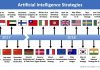
Numerous nations have articulated the importance of protecting their own national values in the age of AI, but these values differ. While French President Emmanuel Macron has championed the importance of “national cohesion” despite tools that can easily segment and discriminate, U.S. President Donald Trump has lauded AI developments, in part for their potential to “create vast new wealth for American workers and families.” There is no single shared set of aspirations that will support a safe and beneficial future for all. A comparative study of AI strategies from ten countries recently published by the UC Berkeley Center for Long-Term Cybersecurity (CLTC), illustrates significant divergences and gaps in AI strategies around the world. The report also highlights several synergies, such as the desire to create reliable AI systems, which could support greater multilateral cooperation.
The CLTC report uses an “AI Map” to highlight twenty systemic threats and opportunities posed by AI and indicate the issues prioritized by different actors. For example, the framework shows the ways in which the U.S. has been an outlier for not addressing a wider range of societal impacts of AI. The analysis also exposes tensions between AI visions. For example, only two (or fewer) national strategies explicitly address inequality, human rights, or disinformation. Only half prioritize the safety of AI systems.
Read the source article in The Hill.
Walmart experiments with AI to monitor stores in real time
The technology will also be able to spot spills, track when shelves need to be restocked and know when shopping carts are running low.
Government department discuss draft bill to ban cryptocurrencies
Government departments have endorsed the idea of a complete ban on all types of cryptocurrency, sources said.
Tesla hit with big loss as car deliveries sputter
The California-based company reported a loss of $702 million in the first three months of this year after two consecutive quarters of profit
Thursday, 25 April 2019
Announcing General Availability of Managed MLflow on Databricks
Try this tutorial in Databricks


MLflow is an open source platform to help manage the complete machine learning lifecycle. With MLflow, data scientists can track and share experiments locally or in the cloud, package and share models across frameworks, and deploy models virtually anywhere.
Today at the Spark + AI Summit, we announced the General Availability of Managed MLflow on Databricks: a fully managed version of MLflow integrated into Databricks. You can read more about the specific integrations on our previous blog on Managed MLflow.
Since we unveiled MLflow last June at the previous Spark + AI Summit, the development community around it has rapidly grown, with 85 contributors from over 40 companies. These contributors rapidly added support for multiple programming languages and integrations with popular ML libraries and frameworks.
Supported Integrations with MLflow
Commercial support for MLflow has also rapidly matured, with Microsoft announcing that they will become an active contributor to MLflow.
Managed MLflow on Databricks offers a hosted version of MLflow fully integrated with Databricks’ security model and interactive workspace. Today, Managed MLflow is GA on both AWS and Azure.
New in Managed MLflow: Notebook Sidebar
Tight integrations with Databricks make Managed MLflow more seamless to use. In the new GA version, one such integration is the ability to track runs from a sidebar in each Databricks notebook. Databricks also automatically captures a snapshot of your notebook every time you use MLflow, and from this sidebar, you can rapidly see the corresponding version of the notebook.
MLflow tracking integration with the notebook sidebar in Databricks
Other powerful integrations include the ability to launch MLflow Project runs remotely on Databricks clusters, and integrations with Databricks’s security model to add access-control to MLflow, as described in our Managed MLflow documentation.
What’s Next with Open Source MLflow?
We also have an aggressive roadmap for open source MLflow, and are excited to work with the community to expand the project. The community is working to release MLflow 1.0, which will provide API stability guarantees and also a set of new features like better search UI & API, HDFS support, simplified shell commands, and Windows support.
You can watch Matei Zaharia’s Keynote at Spark + AI Summit to find out more and stay tuned on our blog for more information.
Get Started with Managed MLflow on Databricks
If you’re an existing Databricks user you can start using Managed MLflow right now. Visit the Databricks MLflow guide [AWS][Azure] and the Quick Start notebook [AWS][Azure] to get started. If you’re not yet a Databricks user, visit databricks.com/mlflow to learn more and start a free trial of Databricks and Managed MLflow.
To learn more about open source MLflow, visit www.mlflow.org and join the community!
Finally, don’t miss our upcoming webinar – Managing the Machine Learning Lifecycle: What’s new with MLflow – with Clemens Mewald, Director of Product Management for Machine Learning and Data Science at Databricks.

--
Try Databricks for free. Get started today.
The post Announcing General Availability of Managed MLflow on Databricks appeared first on Databricks.
How to Prepare for an Automated Future: 7 Steps to Machine Learning
The increasingly digital economy requires boards and executives to have a solid understanding of the rapidly changing digital landscape. Naturally, artificial intelligence (AI) is an important stakeholder. Those organisations that want to prepare for an automated future should have a thorough understanding of AI. However, AI is an umbrella term that covers multiple disciplines, each affecting the business in a slightly different way.
When we look at artificial intelligence, it can be divided into three different domains:
Robotics, which deals with the physical world and it can directly interact with humans. Robotics can be used to improve our work in various ways. Including Ford’s exoskeleton or Boston Dynamics’ helping robots.
Cognitive systems, which deal with the human world. A great example of a cognitive system as part of AI are chatbots. Chatbots are a very tangible example where humans and machines work together to achieve a goal. A chatbot is a communication interface that helps individuals and organisations have conversations.
Machine learning, which deals with the information world. Machines use data to learn, and machine learning aims to derive meaning from that data. Machine learning uses statistical methods to enable machines to improve with machines. A subset of machine learning is deep learning, which ...
Read More on Datafloq
When we look at artificial intelligence, it can be divided into three different domains:
Robotics, which deals with the physical world and it can directly interact with humans. Robotics can be used to improve our work in various ways. Including Ford’s exoskeleton or Boston Dynamics’ helping robots.
Cognitive systems, which deal with the human world. A great example of a cognitive system as part of AI are chatbots. Chatbots are a very tangible example where humans and machines work together to achieve a goal. A chatbot is a communication interface that helps individuals and organisations have conversations.
Machine learning, which deals with the information world. Machines use data to learn, and machine learning aims to derive meaning from that data. Machine learning uses statistical methods to enable machines to improve with machines. A subset of machine learning is deep learning, which ...
Read More on Datafloq
How to Prepare for an Automated Future: 7 Steps to Machine Learning
The increasingly digital economy requires boards and executives to have a solid understanding of the rapidly changing digital landscape. Naturally, artificial intelligence (AI) is an important stakeholder. Those organisations that want to prepare for an automated future should have a thorough understanding of AI. However, AI is an umbrella term that covers multiple disciplines, each affecting the business in a slightly different way.
When we look at artificial intelligence, it can be divided into three different domains:
Robotics, which deals with the physical world and it can directly interact with humans. Robotics can be used to improve our work in various ways. Including Ford’s exoskeleton or Boston Dynamics’ helping robots.
Cognitive systems, which deal with the human world. A great example of a cognitive system as part of AI are chatbots. Chatbots are a very tangible example where humans and machines work together to achieve a goal. A chatbot is a communication interface that helps individuals and organisations have conversations.
Machine learning, which deals with the information world. Machines use data to learn, and machine learning aims to derive meaning from that data. Machine learning uses statistical methods to enable machines to improve with machines. A subset of machine learning is deep learning, which ...
Read More on Datafloq
When we look at artificial intelligence, it can be divided into three different domains:
Robotics, which deals with the physical world and it can directly interact with humans. Robotics can be used to improve our work in various ways. Including Ford’s exoskeleton or Boston Dynamics’ helping robots.
Cognitive systems, which deal with the human world. A great example of a cognitive system as part of AI are chatbots. Chatbots are a very tangible example where humans and machines work together to achieve a goal. A chatbot is a communication interface that helps individuals and organisations have conversations.
Machine learning, which deals with the information world. Machines use data to learn, and machine learning aims to derive meaning from that data. Machine learning uses statistical methods to enable machines to improve with machines. A subset of machine learning is deep learning, which ...
Read More on Datafloq
SoftBank invests $125M in Alphabet's Loon to put cellphone antennas in the sky
SoftBank's year-old HAPSMobile and Alphabet's Loon have separately been trying to fly networking equipment at high altitudes to provide high-speed internet where ground-based towers are unreachable
Databricks and Tableau Lean In to Improve BI User Experience
Since 2014, Tableau and Databricks have partnered to improve the speed and user experience of visualizing massive data sets. This is a natural partnership – Databricks provides a Unified Analytics Platform while Tableau provides a highly popular interactive visualization tool. This year, Tableau won the Databricks Partner Innovation Award for our shared effort in creating a brand-new Databricks Connector for Tableau. Together with Tableau, we are pleased to introduce an optimized Tableau-native approach of connecting to Databricks.
Customers have long been able to connect to Databricks using the Spark SQL Connector which has a number of performance and user experience issues. The new Databricks Connector for Tableau builds on the Spark SQL Connector, adding a number of Databricks-specific improvements:
Tableau-native and 100% compliant
The Databricks Connector for Tableau is built using the new Tableau Connector SDK that is the recommended SDK for providing the best experience to Tableau users. As the first partner to launch on the SDK, we have made the Connector 100% compliant with the Tableau Datasource Verification Tool (TDVT). For users, this translates to fewer edge cases where queries are slow or fail entirely.
Noticeably faster initial connection
The first thing you will notice is how much faster it is to connect to Databricks from Tableau. In our tests, we saw significant speedups over the Spark SQL Connector in initial connection times. We achieved this speedup by tuning networking parameters such as how long the driver waits for asynchronous data to be fetched from Databricks.
Improved SQL Generation
We use the Tableau SDK to control the quality of the queries generated by Tableau, and ensure they are correctly translated to the Databricks SQL dialect. As a result, users can connect their interactive Tableau dashboards for faster and more reliable queries.
Simplified Connection Setup
The connection dialog box of the Spark SQL Connector provided a myriad of connection options, some of which were unnecessary because they were never used with Databricks. The new Databricks Connector for Tableau includes only fields that are necessary to establish a connection, making it simpler to configure and install.
We are focusing first on the Databricks Connector for Tableau, because it is a critical link in the query path. Building upon the current Spark SQL Connector, the Databricks Connector enables users to better handle Tableau queries by reducing latencies and providing performance gains. Through the Tableau SDK, it is possible to achieve an improvement in the performance of Tableau workloads, while simultaneously simplifying the connection process and removing many of the errors that you might see today with the Spark SQL Connector.

Sid Wray and his team have been on a mission to help people see and understand their data. They created the Tableau Connector SDK to empower partners to help in that endeavor. As both companies collaborate closely together on this project, we have proven that this SDK can enable partners like Databricks to build great things.
What’s Next?
Databricks is the first partner to build a native connector for Tableau. We are proud of this initiative and the collaboration that is putting the focus on productivity and experience for the end user. Customers will be able to try the Databricks connector natively as part of the Tableau 2019.3 Beta program. Pending positive customer feedback in the Beta, we aim to ship the connector within Tableau sometime during the second half of the year.
Sign up to Tableau’s prerelease community, and you will be notified when the Beta is posted.
--
Try Databricks for free. Get started today.
The post Databricks and Tableau Lean In to Improve BI User Experience appeared first on Databricks.
Subscribe to:
Posts (Atom)