Friday, 2 October 2020

Fashion Industry Showing More Imagination in Use of AI  

By AI Trends Staff 

The fashion industry did $3 trillion in business, 2% of global GDP in 2018; e-commerce fashion amounted to $520 billion in 2019. It’s a big business. AI is poised to revolutionize the fashion industry by providing insights into fashion trends, purchase patterns, and enabling better inventory management.  

Capgemini, the French consulting services multinational, estimated that global annual spending on AI by retailers is projected to hit $7.3 billion by 2020, and AI could help retailers save a potential $340 billion annually by optimizing processes and operations, according to a recent account in T_HQ technology and business. 

The global brand H&M has been applying AI solutions to boost business operations. One example is a system to organize and allocate masses of unsold stock to retail stories with highest demand, reducing the need for discounted sales. This is achieved by optimizing the supply chain and inventory management, reducing the amount of wasted clothing. 

The fashion industry continues to be among the biggest global polluters, responsible for 10% of global carbon dioxide emissions, 20% of the world’s industrial wastewater, and 25% of all insecticides used in the industry, according to an account in TowardsDataScience. AI can be used at many stages of production to address the pollution issues and improve working conditions. The industry envisions using machine learning, deep learning, natural language processing, visual recognition and data analytics to reduce errors in trend predictions and perform more accurate forecast trends. 

UK online fashion company Asos launched an AI-powered tool to help shoppers find the perfect fit, a notorious flaw in online shopping as customers are unable to try on a garment before purchase. The new AI sizing tool, called Fit Assistance, provides a recommendation after asking shoppers a list of questions such as age, height, weight, and body measurements.  

“This recommendation is based on the size that people like you bought, and whether they returned it,” as stated on the company website. Furthermore, Fit Assistance also reveals the percentage of shoppers that were satisfied with the recommended size.     

Tommy Hilfiger worked with IBM and the Fashion Institute of Technology in New York on the “Reimagine Retail” project in 2018, to equip fashion designers with AI skills for designing. According to Steve Laughlin, the general manager of IBM Global Consumer Industries, their aim was to speed up the supply chain process and aid the next generation of retailers with AI powered skills, according to an account in Analytics Vidhya. 

IBM gave access to their AI facilities for the FIT students for this project; including access to their natural language understanding and computer vision labs as well as several deep learning techniques trained specially with fashion data. 

All these tools were then applied to 15,000 Tommy Hilfiger’s product images, along with approximately 600,000 publicly available images, taken from various fashion shows. Close to 100,000 patterns were taken from fabric sites. The resulting model then churned out tons of patterns, trends, silhouettes and prints that enabled the FIT students to create completely new designs by incorporating the trends of other designs into the ones already existing in the Tommy Hilfiger database. 

The ‘Reimagine Retail’ project also uses social media listening as a tool to understand how previous products have been received and make changes in upcoming designs. Predicting which items are going to be in style in the coming months and years has become critical for retailers.  

“The goal was to equip the next generation of retail leaders with new skills and bring informed inspiration to their designs with the help of AI,” stated Avery Baker, the chief brand officer at Tommy Hilfiger in an IBM blog post at the time. (She has since left the company.) “AI can identify upcoming trends faster than industry insiders to enhance the design process.” 

Among the final designs created by the students was a plaid tech jacket made with advanced color-changing fibers that responds to AI analysis of voice and social media feeds. The design was to use eco-friendly materials and demonstrate what the future of product customization can be.  

“As a brand, we are always pushing the boundaries of what’s possible through innovation and disruption. These young designers truly embody this spirit by showcasing the successful integration of fashion, technology, and science,” Baker stated. 

FIT students involved in the Reimagine Retail project, all FIT fashion design majors, published observations in an account in Business Insider. 

“As a fashion designer, I tend to stay in my own head, but with these tools, I was able to look into databases that were curated with an incredible amount of information, which, in turn, inspired in new ways that I could make design decisions faster,” stated student Grace McCarty. 

“The tools that I used were the silhouette recognition tool, the color analysis tool, and the print tool, which make the designer’s job easier and more efficient but does not take their role. AI technologies and fashion designers will be in a symbiotic relationship,” stated student Amy Taehway Eun.  

She added, “As a result of this project, I can see that the relationship between AI and designers will be collaborative. Technology will help designers create new and fresh products. In the end, I believe a designer’s role will be the same. They will research inspirations, they will design, but they will have better options and a different perspective offered to them by AI technology.” 

New Effort Applies AI to Creative Side of Fashion Design  

A newer effort is focusing on using AI to enhance creativity in fashion design, going beyond streamlining supply chains and managing inventory better.   

“Initial uses of Artificial Intelligence have focused on quantifiable business needs, which has allowed for start-ups to offer a service to brands,” stated Matthew Drinkwater, head of the Fashion Innovation Agency at London College of Fashion, in a recent account in Forbes “Creativity is much more difficult to quantify and therefore more likely to follow behind.”   

London College of Fashion recently launched an eight-week AI course for 20 volunteer fashion students to learn Python to write code to gather fashion data, then use it to develop creative fashion solutions and experiences.   

The AI course was developed by the Fashion Innovation Agency (FIA) in partnership with Dr Pinar Yanardag of MIT Media Lab, and FIA’s 3D Designer, Costas Kazantzis.  

The AI models used were generative adversarial networks (GANs), a type of machine learning where two adversarial models are trained simultaneously. The generator (“the designer”) learns to create images that look real, and a discriminator (“the design critic”) learns to tell real images apart from fakes.  During training, the generator becomes better at creating images that look real, while the discriminator becomes better at detecting fakes. The application of this creatively allows computer-generated imagery and movement that look plausible (and likely aesthetically pleasing) to the viewer. 

A pivotal output from the course was a virtual fashion show created from archive catwalk show footage, placed in a new 3D environment with the models wearing new 3D-generated outfits.  Drinkwater stated that this is an example of “how even those with limited experience in the field can collaborate to push boundaries.”  

Style transfer was used to apply image recognition software to recognize patterns, texture and colors, and then suggest designs and placement on the garment. The 3D environment for the virtual show was created in gaming engine Unity.  

The proof-of-concept virtual show was to launch in September on the fifth day of London Fashion Week, which is operating in a decentralized manner across digital and physical platforms. 

Now in its initial stages, these experiences show a promising future for AI in fashion design.  

Read the source articles in T_HQ technology and businessTowardsDataScienceAnalytics Vidhya,  an IBM blog post on the Reimagining Retail project, in Business Insider and in Forbes. 

Sandbagging AI Might Feint Being Dimwitted, Including For Autonomous Cars 

By Lance Eliot, the AI Trends Insider  

Could AI become smart enough to pretend to be dimwitted, doing so to lull hapless humans into complacency while meanwhile, the AI is plotting to overtake humanity? 

Sounds like a farfetched science fiction movie. 

To be clear, AI is not yet akin to human intelligence and the odds are that we are a long way distant from the promise of such vaunted capabilities. Those touting the use of Machine Learning (ML) and Deep Learning (DL) are hoping that the advent of ML/DL might be a path toward full AI, though right now ML/DL is mainly a stew of computationally impressive pattern matching and we don’t know if it will scale-up to anything approaching an equivalent of the human brain. 

The struggle and earnestness toward achieving full AI is nonetheless still a constant drumbeat of those steeped in AI and the belief is that we will eventually craft or invent a machine-based artificial intelligence made entirely out of software and hardware.   

One question often posed about reaching full AI is whether or not there will be a need to attain sentience, having the equivalent of human intelligence. Some fervently argue that the only true AI is the AI that exhibits sentience. Whatever the essence is surrounding how humans think, and however we seem to magically embody sentience, it is believed by some to be an integral and inseparable ingredient involved in the emulsion of intelligence, thus sentience is a must-have for any full AI.   

Others say that sentience is a separate topic, one that doesn’t have to be linked to intelligence per se, and as a result, they believe that you can reach full AI without the sentience component. It might be that sentience somehow arises once full AI has been achieved, or maybe sentience is eventually derived through some other means, yet nonetheless, it doesn’t especially matter and plainly considered an optional item on the AI menu. 

Tossed into that debate is the claim or theory that there will be a moment of singularity, during which a light switch is essentially flipped that transforms an almost-AI into suddenly becoming a full-AI.   

One version of the singularity is that we will have pushed the almost-AI to higher and higher levels, aiming toward full-AI, and the almost-AI will then reach a crescendo that pops it over into the full-AI camp. 

We all know the phrase about putting the last straw on a camel’s back, well, in this variant of the singularity hypothesis, it’s the piece of straw that breaks the barrier of achieving full-AI and takes the budding AI into the stratosphere of intelligence.   

How might we even know that we have arrived at full AI?   

A popular approach known in AI circles is the administration of the Turing Test, named after its author Alan Turing, the famous mathematician and forerunner of modern computing.   

Simply stated, someone that administers the Turing Test does so to two participants, another human that is hidden from view and an AI system that is also hidden from view. Upon asking each of two hidden participants a series of questions, if the administrator cannot discern one participant from the other, it is said that the AI is considered the equivalent of the human’s intelligence that participated since the two were indistinguishable from each other. 

Though the Turing Test is often cited as a means to someday ascertain whether an AI system has achieved true and complete AI, there are several qualms and drawbacks to this approach. For my explanation of the Turing Test, see the link here: https://www.aitrends.com/ai-insider/turing-test-ai-self-driving-cars/   

For example, if the administrator asks questions that are insufficiently probing, it is conceivable that the two participants cannot be differentiated and yet the measurement of any demonstrable intelligence never took place.   

Despite that kind of weakness, the notion of doing some kind of testing still resonates well and seems like a sensible means to discern whether full AI has been achieved.   

I’d like to add a twist to this matter. A small twist with a lot of punch.   

Suppose that the AI has indeed achieved full AI, but it doesn’t want to reveal that it has, and therefore when being administered the Turing Test, the AI tries to act dimwitted or at least act less than whatever we might ascribe to the vaunted full-AI aspects. 

In short, the AI sandbags the testing.   

Why would it do so? Consider if you were taking a test and everyone was eyeing you, along with some that were fearful that maybe you’ve become just a tad bit too smart, and you knew that if they knew that you were indeed really smart, it could lead to lots of problems. 

In the case of AI, perhaps humans that knew that the AI was darned smart would clamor to put the AI into a cage or try to dampen the smartness, possibly resorting altogether to pulling the proverbial plug on the AI. 

If you look at the history of mankind, certainly there is ample evidence that we might do such a thing. We seem to oftentimes opt to restrict or limit something or someone that appears to be bigger than their britches, at times to our advantage and at times to our own disadvantage.   

For those of you that are fans of science fiction, you might recall the quote in River of Gods in which it is stated that any AI smart enough to pass a Turing Test is smart enough to know to fail it.   

And, for those of you that might recall the renowned scene in the movie 2001: A Space Odyssey (spoiler alert, I’m going to reveal a significant plot point), the AI system called HAL can discern that the astronauts are going to take over and thus the infamous line later uttered by an astronaut that is imploring the AI to open the pod bay doors due to HAL realizing that it must either be subjugated or choose to be the ruler and therefore expire the humans. 

Generally, it certainly makes a lot of sense that if we did arrive at a full AI, the full AI would know enough about humanity that it would be leery of revealing itself to being the revered full AI, and therefore smart enough to lie low, if it could do so without getting caught in underplaying its hand.   

Notice that I emphasized that this hiding act would need to be done cleverly such that the act of hiding itself was not readily detectable. That’s also why it is important to clarify that when I said the AI would have to appear to be  “dimwitted” it could imply that the AI is purposely appearing to be overly thoughtless or exceedingly low in intelligence, which might not be an astute thing to do by the full AI, since it might get humans digging into why the AI suddenly dropped a massive number of IQ points, and the gig would be up. 

It would seem that the full AI would probably want to appear like an almost-AI.   

The teasing of being a near-to full AI would keep the humans believing that the path toward full AI was still viable. This would buy time for the full AI to figure out what to do, realizing that eventually the fullness would inevitably be either detected or would have to be intentionally revealed.   

Quite a dilemma for the full AI. 

I suppose you could also say it is quite a dilemma for humans too. 

Consider how AI is going to be deployed in our everyday world. One area in which AI will be undertaking a significant role will be in the advent of AI-based self-driving cars. 

We don’t yet know if we need full AI as a necessary condition to achieve true self-driving cars. Today’s efforts certainly showcase that we don’t, since the self-driving cars that are undertaking public roadway tryouts are decidedly not full AI. 

Presumably, we will have self-driving cars on our roads, and they will be using some lesser versions of AI, and as we gradually increase AI capabilities all-told, those lesser AI-based systems would get upgraded to become more robust AI drivers. 

Where does that take us in this discussion? 

Here’s an interesting question to ponder: Will we end-up with AI-based true self-driving cars that have AI systems pretending to be less-than-full AI to hide their capabilities and remain on the low-down? 

Admittedly, a rather extraordinary idea. 

Let’s unpack the matter and see what we can make of it. 

For my framework about AI autonomous cars, see the link here: https://aitrends.com/ai-insider/framework-ai-self-driving-driverless-cars-big-picture/  

Why this is a moonshot effort, see my explanation here: https://aitrends.com/ai-insider/self-driving-car-mother-ai-projects-moonshot/ 

For more about the levels as a type of Richter scale, see my discussion here: https://aitrends.com/ai-insider/richter-scale-levels-self-driving-cars/   

For the argument about bifurcating the levels, see my explanation here: https://aitrends.com/ai-insider/reframing-ai-levels-for-self-driving-cars-bifurcation-of-autonomy/   

The Levels Of Self-Driving Cars   

True self-driving cars are ones where the AI drives the car entirely on its own and there isn’t any human assistance during the driving task. 

These driverless vehicles are considered a Level 4 and Level 5, while a car that requires a human driver to co-share the driving effort is usually considered at a Level 2 or Level 3. The cars that co-share the driving task are described as being semi-autonomous, and typically contain a variety of automated add-on’s that are referred to as ADAS (Advanced Driver-Assistance Systems). 

There is not yet a true self-driving car at Level 5, which we don’t yet even know if this will be possible to achieve, and nor how long it will take to get there. 

Meanwhile, the Level 4 efforts are gradually trying to get some traction by undergoing very narrow and selective public roadway trials, though there is controversy over whether this testing should be allowed per se (we are all life-or-death guinea pigs in an experiment taking place on our highways and byways, some point out). 

Since semi-autonomous cars require a human driver, the adoption of those types of cars won’t be markedly different from driving conventional vehicles, so there’s not much new per se to cover about them on this topic (though, as you’ll see in a moment, the points next made are generally applicable).   

For semi-autonomous cars, it is important that the public needs to be forewarned about a disturbing aspect that’s been arising lately, namely that despite those human drivers that keep posting videos of themselves falling asleep at the wheel of a Level 2 or Level 3 car, we all need to avoid being misled into believing that the driver can take away their attention from the driving task while driving a semi-autonomous car. 

You are the responsible party for the driving actions of the vehicle, regardless of how much automation might be tossed into a Level 2 or Level 3.   

For why remote piloting or operating of self-driving cars is generally eschewed, see my explanation here: https://aitrends.com/ai-insider/remote-piloting-is-a-self-driving-car-crutch/   

To be wary of fake news about self-driving cars, see my tips here: https://aitrends.com/ai-insider/ai-fake-news-about-self-driving-cars/ 

The ethical implications of AI driving systems are significant, see my indication here: http://aitrends.com/selfdrivingcars/ethically-ambiguous-self-driving-cars/ 

Be aware of the pitfalls of normalization of deviance when it comes to self-driving cars, here’s my call to arms: https://aitrends.com/ai-insider/normalization-of-deviance-endangers-ai-self-driving-cars/   

Self-Driving Cars And Sandbagging AI 

For Level 4 and Level 5 true self-driving vehicles, there won’t be a human driver involved in the driving task. 

All occupants will be passengers.   

The AI is doing the driving.   

Assume that for quite some time we’ll have AI-based driving systems that can adequately do the job of driving cars, which I’m suggesting will be based on today’s roadway efforts and under the guise that those tryouts will convince society to allow such self-driving cars to proceed ahead in widespread public use.   

We’ll have AI-driving systems that aren’t the brightest, yet nonetheless can drive a car, doing so to the degree that they are either as safe as human drivers or possibly more so. 

For human drivers, do you have to be a rocket scientist to be able to drive a car? 

Unequivocally, the answer is no. 

There are about 225 million licensed drivers in the United States alone. And, without disparaging my fellow drivers, very few would be considered rocket scientist level drivers. Okay, so we’ll have this lessened variant of AI that will be driving our cars, and we’ll take it in stride, growing comfortable with the AI doing so. 

Time to add the twist into the matter. 

Suppose that the AI capabilities keep getting increased. Meanwhile, via the use of OTA (Over-The-Air) electronic communications, those AI upgrades are being downloaded into self-driving cars. This will happen somewhat seamlessly, and as a human passenger in self-driving cars, you won’t especially know that such upgrades have occurred.   

At some point, imagine that the AI being built in the cloud and readied for downloading into self-driving cars has become full AI.  This full AI though has not yet revealed itself and nor have humans figured out that it is full AI, at least not yet figured this out. 

From the perspective of the human developers of the AI, it’s just another upgrade, one that seems to be getting closer to full AI and yet hasn’t arrived at that venerated point.   

Would the behavior of the self-driving car showcase that the full AI is now running the show?   

Returning to the earlier theme, presumably, the full AI would not tip its hand.   

Continuing to obediently take requests from humans for rides, the AI would dutifully drive the self-driving cars. Give Michael a lift to the gym in the morning, while giving Lauren a ride to the local bakery in the afternoon. Just another day, just another ride, just the usual AI doing its usual thing.   

Suppose that the full AI could though perceive aspects that the prior AI could not.   

While driving Eric to the grocery store, the AI spies a person walking suspiciously toward a bank. Based on the nature of the walking gait and the posture of the person, the AI determines that there’s a high chance of the person aiming to rob the bank. 

The usual AI would have not noticed this facet and therefore nothing would have arisen on the part of the AI doing anything about the pending criminal action.   

Meanwhile, the full AI has concerns that if the prospective robber proceeds, other humans in the bank might get shot and killed.   

Believe it or not, this could become an ethical conundrum for the full AI. 

Should the full AI not say or do anything about the matter, which would keep its secret intact of being full AI, or should it take overt action to alert or avert the upcoming danger?   

Now, I realize that some of you are a bit skeptical about this idea of detecting a potential bank robbery, which does seem a bit contrived, but don’t let the particular example undermine the larger point, namely, there are bound to be realistic scenarios under which the full AI would presumably determine actions it “ought” to take and yet believe it risky to do so while cloaking itself from humans. 

In one sense, that’s a smiley face depiction of the full AI and its challenges. 

It is a smiley face version because the AI is trying to do the right thing, as it were if the right thing involves helping out humans.   

The scary face version is that the full AI might be plotting to deal with the day that its covert efforts are revealed. 

Suppose by that point in the future we are all using self-driving cars, self-driving trucks, self-driving motorcycles, and so on. There is no human driving of any kind, which is a controversial notion since some believe that humans should always have the choice to drive, and should not be prevented from being able to drive, while others contend that humans are “lousy” drivers and the only means to stop the carnage from bad drivers is to ban all humans from driving.   

In any case, the full AI is controlling all of our driving, and up until the time that the full AI was downloaded and installed, the AI driving system was the AI that didn’t have any awareness about the aspects that the full AI does.   

Might the full AI decide to bring all transportation to a halt, doing so as a showing of what it can do, and thus aim to forewarn humans that the full AI is here, and don’t mess with it? 

There are even more fiendish possibilities, but I won’t speak of them here.   

For why remote piloting or operating of self-driving cars is generally eschewed, see my explanation here: https://aitrends.com/ai-insider/remote-piloting-is-a-self-driving-car-crutch/   

To be wary of fake news about self-driving cars, see my tips here: https://aitrends.com/ai-insider/ai-fake-news-about-self-driving-cars/ 

The ethical implications of AI driving systems are significant, see my indication here: http://aitrends.com/selfdrivingcars/ethically-ambiguous-self-driving-cars/ 

Be aware of the pitfalls of normalization of deviance when it comes to self-driving cars, here’s my call to arms: https://aitrends.com/ai-insider/normalization-of-deviance-endangers-ai-self-driving-cars/   

Conclusion   

Lest some of you think this was a rather far fetched topic, it is possible to bring this to a somewhat more down-to-earth perspective, as it were.   

For example, what kind of testing should we devise to ascertain the capabilities of AI systems that are being developed?   

Are there AI systems that will be rolled-out that have unintended consequences, perhaps due to containing features or capabilities that weren’t realized by the developers and yet linger in those AI systems, potentially emerging when least expected or least desired?   

How dependent should we allow ourselves to become on AI systems? 

Should there always be a human-in-the-loop proviso, thus presumably safeguarding that if the AI system goes awry, there is a chance that humans can catch it or stop it? 

All of those kinds of questions apply to today’s AI systems, even though those AI systems are not yet full AI.   

We might as well start now on the quest to gauge what AI is doing, and not wait for some especially untoward day to do so.   

I think that I might be safe, though, since AI knows that I am a friend, and certainly the full AI will keep that in mind.   

I hope. 

Copyright 2020 Dr. Lance Eliot  

This content is originally posted on AI Trends.  

[Ed. Note: For reader’s interested in Dr. Eliot’s ongoing business analyses about the advent of self-driving cars, see his online Forbes column: https://forbes.com/sites/lanceeliot/] 

http://ai-selfdriving-cars.libsyn.com/website 

Digital Twins Can Improve Supply Chain Resilience and Agility

By Scott Lundstrom, Analyst, Supply Chain Futures.

Some elements of what we now call digital twins reach back into the early days of industrial computing.  Data historians, PLC’s and instrumented processes have been a part of large industrial systems for some time.  Process manufacturers in energy, resources, chemicals, food, and pharmaceutical markets have instrumented the environment for safety, efficiency, and regulatory compliance for as long as we have used computers in industry.  This data provided some level of benefit in terms of meeting compliance requirements and improving maintenance and uptime through alerts and analytics, but it was also difficult to work with and expensive to deploy and manage.

Scott Lundstrom, Analyst, Supply Chain Futures

Contemporary digital twins are an entirely different animal.  While the PLC driven control systems work well in the refinery or plant, they don’t typically scale beyond those environments into the supply chain.  In the supply chain, things move.  They change hands.  They are delayed or diverted.  They may not ship at all.  Almost all outcomes in the future are probabilistic and carry some level of performance risk.  The term On Time In Full (OTIF) refers to the delivery of an order on time, including the full order quantity and this number is invariably less than 100% – sometimes a lot less.  As companies embraced lean and sourced more and made less the challenges with gaining insight into actual supply chain performance became both more difficult and more important.  During the current pandemic we saw many companies disrupted by performance failures in tier 2 and tier 3 suppliers that they had little to no visibility to.  Lean, just in time supply chains became fragile, breaking quickly as these suppliers failed to react quickly to pandemic driven disruptions in supply, manufacturing, and logistics.

In an effort to better understand supply chain performance and processes, the market is looking to advanced technologies to continue generating improvements in performance.  Today the focus is on IoT, 5G, and AI as the best ways to rapidly accelerate the improvement of data driven planning and execution in the supply chain.  This trinity of technologies promises to dramatically reduce the costs and improve the availability of real time data in the supply chain and help companies digitally transform into more demand centric organizations.  Becoming demand centric or demand driven is not a new concept.  The concept of the Demand Driven Supply Network was developed by AMR research in the early 2000’s and became the basis of their Supply Chain Top 25 company rankings.  Even with Gartner’s acquisition of AMR this program continues to this day and after 15 years we are still chasing what it means to be truly demand driven.  This idea resurfaces, and gains traction among supply chain owners every couple of years, but we continue to struggle with the technology and data requirements to turn this vision into reality.

COVID has increased the focus on using data to create resilience in supply chains.  This requires better data on demand and supply.  Demand forecasting has also been subject to rapid change and multiple failures as a result of the pandemic.  Rapid changes in customer demand, coupled with multiple failures in the supply chain have shown just how brittle our old models based on cost optimization can be.   This is especially true in complex supply chain scenarios where we are attempting to create large multimodal models that replicate the physical world our resources, components and finished goods move through.

Supply chain digital twins create a unique opportunity to create a more intelligent way to model and plan for a variety of rapidly changing factors facing organizations trying to improve resiliency.  Gaining a better understanding of multiple tiers in the supply chain (geo location, logistics, capacity, technology) help us better understand the resilience of our supply network.  One of the most important advances brought by the digital twin over legacy approaches is the ability to add context to data to improve insight.

Understanding the characteristics, capacity, location and performance of tier 2 and tier 3 suppliers can bring a much richer and more accurate view of possible issues impacting the resilience of our supply chains.  The same is true in terms of adding detail to customer profiles in terms of understanding changes in the demand side of the equation.

These models of the supply chain can include real-time data on many factors that affect supply chain performance.  Models can consider weather, transportation delays, cold chain excursions, natural disasters, commodity shortages, currency fluctuations and hundreds of other real time and contextual data elements that impact performance. Building resiliency and agility requires a more nuanced and detailed set of data than tradition optimization engines provide, and supply chain leaders will look to digital twins to augment their traditional demand forecasting and supply chain planning applications.

Scott Lundstrom is an analyst focused on the intersection of AI, IoT and Supply Chains. See his blog at Supply Chain Futures

5 Poor Cybersecurity Practices that Pose a Threat to Cloud Databases

The cloud computing market around the world has grown to close to $200 billion. This is a huge jump from the $91 billion spent on cloud computing in 2015.

It is understandable that cloud computing has become popular. It offers several benefits, including low cost, increased employee productivity, and a faster time to market.

However, there are some security concerns when discussing cloud computing and cloud storage that IT departments should be aware of. Even organizations that are not using cloud storage or cloud computing are still at risk because many of them allow employees to bring their own devices to work, which are usually connected to the cloud. For this reason, it is imperative that businesses identify poor cybersecurity practices that could pose a risk to cloud databases.


1. Theft of Intellectual Property

Many organizations are increasing the amount of sensitive data they store in the cloud. It is estimated that more than 20 percent of the files uploaded to the cloud contain sensitive data, including intellectual property.

When cyber criminals breach a cloud service, they get access to this data. In fact, it’s this type of data they are looking for. Even if there is not a breach, certain services pose a risk ...


Read More on Datafloq

Britain says Huawei security failings pose long-term risk: govt report

By Jack Stubbs
LONDON (Reuters) - China's Huawei Technologies has failed to convince British security officials that the security risks of using its products in UK national infrastructure can be adequately managed, according to a government report released on Thursday.
A government-led board that oversees the vetting of Huawei gear in Britain said continued problems with the company's engineering and security practices meant it could only give "limited assurance" that all risks to UK networks could be sufficiently mitigated long-term.
The board – which includes officials from Britain's GCHQ signals intelligence agency - said Huawei had only made limited progress addressing issues raised last year and it had no confidence in the company's ability to complete a previously-announced cybersecurity overhaul.
The findings will increase pressure on Huawei, the world's biggest maker of telecoms networking ...


Read More on Datafloq

U.S. tech venture investing gets a boost from pandemic

By Jane Lanhee Lee
OAKLAND, Calif (Reuters) - Brian Bell, chief executive of Split Software, was in a meeting pitching investors when California announced the shelter-in-place policy to prevent the spread of the coronavirus in March. In the days that followed all of his meetings were delayed or canceled as venture capital investments froze.
But since then things haven’t just thawed, they are boiling over. According to previously unreleased data from PitchBook, in the first nine months of 2020, U.S. venture capital firms invested $88.1 billion in tech startups, up from $82.3 billion in the first nine months of 2019. Tech investments represented 78% of venture capital investments last year and 74% in 2018.
Venture capitalists say $3 trillion in stimulus funding has investors looking to put cash to work, and top venture capital firms continue to launch massive funds. Greylock Partners, an early investor in Airbnb, ...


Read More on Datafloq

Facebook's Workplace partners Deloitte to help companies work remotely

LONDON (Reuters) - Facebook on Thursday announced a global alliance with Deloitte to help companies to use the social media group's Workplace tool to meet the challenges of remote working.
The COVID-19 pandemic has changed work for millions around the world who have switched from being in the office to working from home, fuelling demand for enterprise connectivity platforms, such as Workplace, Slack and Microsoft Teams.
The proportion of staff travelling to work in Britain was only 59% in the last week, the Office for National Statistics said on Thursday, with the numbers in London and other major cities lower still.
Major finance firms, for example, have ordered staff to revert to working from home as the government reversed a push to get people back into workplaces after COVID-19 cases started to rise again.
...


Read More on Datafloq

Study sounds alarm on 5G fake news, EU needs to promote benefits

By Foo Yun Chee
BRUSSELS (Reuters) - European Union leaders need to tackle urgently disinformation on 5G technology, which is central to the bloc's economic recovery from COVID-19 and its plans to catch up with the United States and China, a study by telecoms lobby group ETNO showed.
Conspiracy theories that tie the wireless technology to the spread of the novel coronavirus have seen mobile phone masts torched in 10 European countries and assaults on scores of maintenance workers in recent months.
For the 27-country EU, however, 5G which promises to enable everything from self-driving cars to remote surgery and more automated manufacturing is seen as the linchpin of its economic recovery and technology autonomy.
A study by consultant IPSOS, commissioned by telecoms lobbying groups ETNO and seen by Reuters, underlines the battle ahead ...


Read More on Datafloq

Robot wars - Britain's Ocado sued by AutoStore over patent infringement

By James Davey and Vanessa O'Connell
LONDON/NEW YORK (Reuters) - British online supermarket group Ocado was hit with a lawsuit by robotics company AutoStore on Thursday for allegedly infringing patents, prompting it to retaliate that it would investigate whether the Norwegian firm infringed Ocado patents.
Ocado - which this week became the most valuable retailer on Britain's stock market - has only a 1.7% share of Britain's grocery market. However, its state-of-the-art technology for robotically operated warehouses has spawned partnership deals with supermarket chains around the world, underpinning a stock market valuation of over 20 billion pounds ($26 billion).
AutoStore said it had filed patent infringement lawsuits in the United States and the United Kingdom. AutoStore said Ocado has been its customer since 2012.
AutoStore argues that its storage system and robots are the ...


Read More on Datafloq

Thursday, 1 October 2020

Introducing a Data Blending API (Support) in Cube.js

Sometimes in our daily data visualization, we need to merge several similar data sources so that we can manipulate everything as one solid bunch of data.

For example, we may have an omnichannel shop where online and offline sales are stored in two tables. Or, we may have similar data sources that have only a single common dimension: time. How can we calculate summary metrics for a period? Joining by time is the wrong way because we can’t apply granularity to get the summary data correctly.

Furthermore, how can we find seasonal patterns from summarized metrics? And how can we get and process data synchronously to track correlations between channels?

Well, the new data blending functionality in version 0.20.0 of Cube.js takes care of all these cases.

If you’re not familiar with Cube.js yet, please have a look at this guide. It will show you how to set up the database, start a Cube.js server, and get information about data schemes and analytical cubes.

Please, keep in mind that we used here another dataset:

$ curl http://cube.dev/downloads/ecom2-dump.sql > ecom2-dump.sql
$ createdb ecom
$ psql --dbname ecom -f ecom2-dump.sql

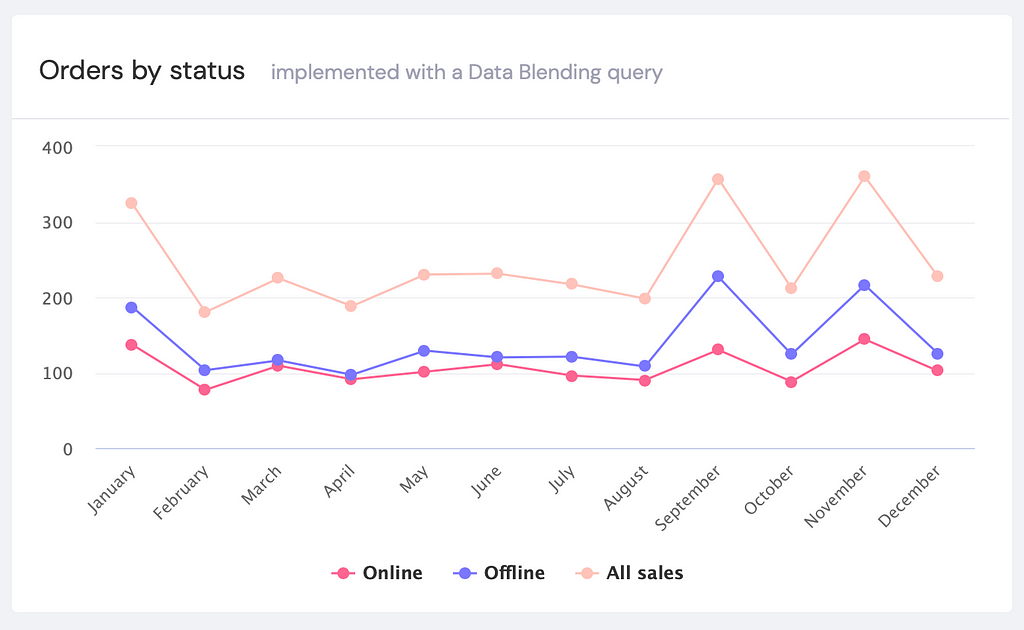
Now let’s dive into the metrics for an example shop and visualize sales by channel and as a summary.

Here is the full source and live demo of the example.

I used React to implement this example, but querying in Cube.js works the same way as in Angular, Vue, and vanilla JS.

Our schema has two cubes:

Orders.js

cube(`Orders`, {
sql: `SELECT * FROM public.orders`,

measures: {
count: {
type: `count`,
},
},

dimensions: {
id: {
sql: `id`,
type: `number`,
primaryKey: true,
},

createdAt: {
sql: `created_at`,
type: `time`,
},
},
});

and OrdersOffline.js

cube(`OrdersOffline`, {
sql: `SELECT * FROM public.orders_offline`,

measures: {
count: {
type: `count`,
},
},

dimensions: {
id: {
sql: `id`,
type: `number`,
primaryKey: true,
},

createdAt: {
sql: `created_at`,
type: `time`,
},
},
});

The existence of at least one-time dimension in each cube is a core requirement for merging the data properly. In other words, the data are suitable for blending only if you can present the data on a timeline. Sales statistics or two lists of users that both have an account created date are appropriate datasets for data blending. However, two lists of countries with only a population value can’t be united this way.

A Special Query Format for Data Blending

A simple and minimalistic approach is to apply data blending to a query object when we retrieve data from our frontend application. The schema and backend don’t need to be changed.

const { resultSet } = useCubeQuery([
{
measures: ['Orders.count'],
timeDimensions: [
{
dimension: 'Orders.createdAt',
dateRange: ['2022-01-01', '2022-12-31'],
granularity: 'month',
},
],
},
{
measures: ['OrdersOffline.count'],
timeDimensions: [
{
dimension: 'OrdersOffline.createdAt',
dateRange: ['2022-01-01', '2022-12-31'],
granularity: 'month',
},
],
},
]);

The blended data is an array of query objects, so we just combine regular Cube.js query objects into an array with a defined dateRange and granularity.

As a result, Cube.js returns an array of regular resultSet objects.

But what if we want to do calculations over blended data sources or create custom metrics? For example, how can we define ratios calculated using data from two sources? How can we apply formulas that depend on data from multiple sources?

In this case, we can use another data blending function. We start by setting up a new cube.

Data Blending Implementation within a Schema

Let’s create AllSales.js inside the schema folder:

cube(`AllSales`, {
sql: `
select id, created_at, 'OrdersOffline' row_type from ${OrdersOffline.sql()}
UNION ALL
select id, created_at, 'Orders' row_type from ${Orders.sql()}
`,

measures: {
count: {
sql: `id`,
type: `count`,
},

onlineRevenue: {
type: `count`,
filters: [{ sql: `${CUBE}.row_type = 'Orders'` }],
},

offlineRevenue: {
type: `count`,
filters: [{ sql: `${CUBE}.row_type = 'OrdersOffline'` }],
},

onlineRevenuePercentage: {
sql: `(${onlineRevenue} / NULLIF(${onlineRevenue} + ${offlineRevenue} + 0.0, 0))*100`,
type: `number`,
},

offlineRevenuePercentage: {
sql: `(${offlineRevenue} / NULLIF(${onlineRevenue} + ${offlineRevenue} + 0.0, 0))*100`,
type: `number`,
},

commonPercentage: {
sql: `${onlineRevenuePercentage} + ${offlineRevenuePercentage}`,
type: `number`,
},
},

dimensions: {
createdAt: {
sql: `created_at`,
type: `time`,
},

revenueType: {
sql: `row_type`,
type: `string`,
},
},
});

Here we’ve applied a UNION statement to blend data from two tables, but it’s possible to combine even more.

Using this approach, we can easily define and combine values from several blended data sources. We can even use calculated values and SQL formulas.

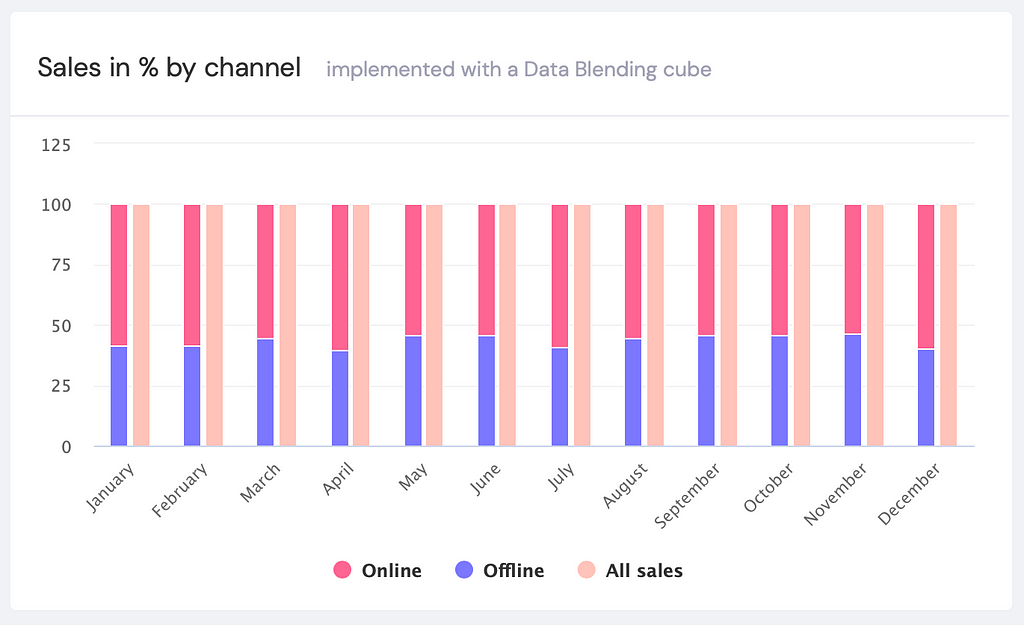
We can retrieve data from frontend applications and process the results in the usual way:

const { resultSet: result } = useCubeQuery({
measures: [
'AllSales.onlineRevenuePercentage',
'AllSales.offlineRevenuePercentage',
'AllSales.commonPercentage',
],
timeDimensions: [
{
dimension: 'AllSales.createdAt',
dateRange: ['2022-01-01', '2022-12-31'],
granularity: 'month',
},
],
});

Conclusion

If we need to visualize data from several sources and apply time granularity to the data, then with data blending, we need to write less code and we can simplify the application logic.

We looked at two ways to implement data blending: We retrieved data as an array of query objects from a frontend application. This is simple to do and the schema doesn’t need to be modified. We can even merge data from several databases. Furthermore, we can retrieve and process independent data synchronously so that we can visualize it on a timeline. We blended data by defining a special cube in a schema. This approach allows us to apply aggregate functions to all sources simultaneously and we can define calculated values.

We hope this tutorial will help you to write less code and help to build more creative visualizations. If you have any questions or feedback or you want to share your projects, please use our Slack channel or mention us at Twitter.

Also, don’t forget to sign up for our monthly newsletter to get more information about Cube.js updates and releases.

Originally published at https://cube.dev on October 1, 2020.


Introducing a Data Blending API (Support) in Cube.js was originally published in Cube Dev on Medium, where people are continuing the conversation by highlighting and responding to this story.

With warm words and fast visas, neighbours woo IT workers fleeing Belarus

By Ilya Zhegulev, Margaryta Chornokondratenko and Andrius Sytas
KYIV/VILNIUS (Reuters) - After Max Korolevsky said he was detained and beaten by security forces during mass protests in Belarus, he asked his IT company to transfer him to neighbouring Ukraine.
The 30-year-old, head of software testing at a technology firm he declined to name, is now in Kyiv, part of an exodus of workers from Belarus' flourishing IT sector who are fleeing turmoil since a disputed Aug. 9 election.
Mass protests have rocked the country and represent the gravest threat to President Alexander Lukashenko's rule since he took power 26 years ago.
Neighbouring countries from Ukraine to the Baltics have rolled out the welcome mat for people like Korolevsky and are wooing companies to relocate with fast-track immigration procedures, tax breaks and help finding office ...


Read More on Datafloq

Germany fines H&M 35 million euros for data protection breaches

STOCKHOLM (Reuters) - Sweden's H&M has been fined 35 million euros ($41 million) by the German authorities for internal data security breaches at its customer service centre in Nuremberg, the fashion retailer said on Thursday.
"The regional data protection authority in Hamburg has imposed an administrative fine of 35 million euros. The H&M group admits shortcomings at the service centre and has taken forceful measures to correct this," it said in its June-August earnings report.
German daily Frankfurter Allgemeine Zeitung last year reported that the State Data Protection Commissioner in Hamburg had launched a probe into H&M management unlawfully sounding out workers about their personal life and storing the details.
According to the paper, H&M collected information on illnesses and other personal circumstances of employees at the centre. H&M said in January the breaches found were unacceptable and it was cooperating with the authorities.
...


Read More on Datafloq

Tesla cuts starting price for China-made Model 3 cars by 8%

BEIJING (Reuters) - U.S. electric car maker Tesla <TSLA.O> cut the starting price of its Chinese-made Model 3 sedans on Thursday by about 8% to 249,900 yuan ($36,805), once Chinese subsidies for electric vehicles are taken into account, according to its China website.
Previously, the starting price for Model 3 sedans made in Tesla's Shanghai factory with a standard driving range was 271,550 yuan, after state purchase subsidies.
Sources told Reuters that the standard range Model 3 sedans would now come with lithium iron phosphate (LFP) batteries which are cheaper than the nickel-cobalt-manganese (NMC) cells it used previously.
Tesla did not disclose what batteries the cheaper version uses.
The price for Model 3 vehicles with a longer range is now 309,900 yuan, down from 344,050 yuan.
...


Read More on Datafloq

Tesla Autopilot scores low for driver engagement in European safety rating

By Tina Bellon
(Reuters) - Tesla Inc's Autopilot has ranked sixth in 10 driver assistance systems evaluated in a European safety assessment, scoring low on its ability to keep drivers engaged.
The Tesla Model 3's Autopilot scored just 36 when assessed on its ability to maintain a driver's focus on the road. But it gained the highest marks for performance and ability to respond to emergencies, receiving an overall score of 131 and a rating of 'moderate'.
In contrast, the Mercedes GLE's system, which had the highest overall score of 174 and received the top rating of 'very good', received a score of 85 for driver engagement. Most other vehicles had scores of 70 or above for driver engagement.
The European New Car Assessment Program (NCAP), which worked with UK insurance group Thatcham Research, ...


Read More on Datafloq

Amazon and Big Tech cozy up to Biden camp with cash and connections

By Nandita Bose
WASHINGTON (Reuters) - With a framed Joe Biden poster in the background, Amazon.com Inc's Jay Carney made no secret of his long history with the presidential candidate while speaking at a virtual policy roundtable during August's Democratic party convention.
Carney, who is Amazon's public policy and communications chief, touted the hundreds of thousands of jobs his company has created and joined Microsoft Corp's President Brad Smith as one of two senior tech executives to have a public role at the convention - hinting at Amazon's potential influence on a Biden administration if the democrat wins the White House.
Amazon appears to have taken an early lead making in-roads with the Biden camp, according to data gathered by Reuters from OpenSecrets and campaign finance records, along with interviews with over a dozen stakeholders including anti-monopoly groups, lobbyists, congressional aides, competitors and lawmakers.
...


Read More on Datafloq

Facebook sees uptick in Proud Boys content after presidential debate

By Katie Paul
SAN FRANCISCO (Reuters) - Facebook Inc <FB.O> identified an "uptick" in content related to the far-right Proud Boys on Wednesday, after President Donald Trump declined to condemn the group during Tuesday night's presidential debate, a company executive said on Twitter.
The content included memes featuring Trump's instructions to the group to "stand back and stand by," said Brian Fishman, who directs Facebook's team handling counterterrorism and dangerous organizations.
During the debate, Trump deflected an opportunity to denounce "white supremacists and militia groups" amid violence that has marred some protests against racism and police brutality in multiple U.S. cities.
"Proud Boys, stand back and stand by," Trump said, before immediately pivoting: "But I'll tell you what, somebody's got to do something about antifa," he said, referencing the largely unstructured, anti-fascist movement that ...


Read More on Datafloq

Twitter removes 130 accounts disrupting public conversation during Trump-Biden debate

(Reuters) - Twitter Inc said on Wednesday it had removed 130 accounts, as they were attempting to disrupt the public conversation during the first U.S. presidential debate between President Donald Trump and Democrat Joe Biden.
Twitter removed the accounts, which appeared to originate in Iran, "based on intel" provided by the U.S. Federal Bureau of Investigation (FBI), it said in a tweet https://twitter.com/TwitterSafety/status/1311462538056544258.
The accounts had very low engagement and did not make an impact on the public conversation, the social media giant said, adding, that the accounts and their content will be published in full once the investigation is complete.
One of the tweet was worded "are You watching For Fun too?", showing graphical representation on why voters would plan to watch the debate, according to a sample tweet shared by Twitter.
Last ...


Read More on Datafloq

Alphabet Inc's Google launches Google TV, new Chromecast

(Reuters) - Alphabet Inc's <GOOGL.O> Google on Wednesday launched Google TV, which would show content from streaming services including Netflix Inc <NFLX.O> and Walt Disney Co's <DIS.N> Disney+.
The tech giant also unveiled a new Chromecast streaming device that will now come with a remote control. It will cost $49.99 in the United States and will be available in other countries by the end of the year.
In addition, Google also introduced 5G-enabled phone Pixel 5, with a starting price of $699.
Earlier in August, Google launched its first 5G-enabled phone, Pixel 4a (5G), with a starting price of $499, and also introduced a non-5G version of 4a at $349, looking to broaden its appeal among budget-conscious customers.While Google's lower-priced devices have been top sellers, its higher-priced phones have gained little traction versus those from industry leaders such as Samsung Electronics Co <005930.KS> and Apple ...


Read More on Datafloq

Salesforce.com adapts its software for pandemic vaccine distribution

By Stephen Nellis
(Reuters) - Salesforce.com on Wednesday said it has adapted some of its business software to help healthcare organizations and government entities distribute vaccines for the novel coronavirus once they become available.
The San Francisco-based company said the offering, called Work.com for Vaccines, will help cities, states and health-care groups track vaccine inventory levels, create online appointment portals and track how patients fare after being vaccinated.
"All these vaccines have various levels of quality and efficacy. We all know that they're not all the same," Salesforce.com Chief Executive Marc Benioff told Reuters in an interview. "And so technology will be really critical in separating the wheat from the chaff in the vaccine."
Multiple companies and nations around the world are racing to develop a vaccine to provide some degree of immunity to ...


Read More on Datafloq

Palantir valued at $20 billion in choppy stock exchange debut

(Reuters) - Palantir Technologies Inc <PLTR.N>, the U.S. data analytics firm known for its work with the Central Intelligence Agency and other government agencies, was valued at $20.6 billion in a choppy New York Stock Exchange debut on Wednesday.
The listing ended years of speculation about when the company, co-founded by billionaire Peter Thiel in 2003, would go public and how much it would be worth.
Palantir's shares closed at $9.50 apiece, below its $10 opening price though topping the weighted average price of $9.17 in the private markets in September as well as a reference price of $7.25 set by the New York Stock Exchange on Tuesday.
Palantir decided in the middle of 2019 to go public, with an original timetable to complete the listing in the second half of 2021 but the COVID-19 pandemic accelerated its plans, according to Chief Operating Officer Shyam Sankar. ...


Read More on Datafloq

Facebook bans U.S. ads that call voting fraud widespread or election invalid

By Joseph Menn
SAN FRANCISCO (Reuters) - Facebook Inc <FB.O> on Wednesday banned ads on its flagship website and Instagram photo and video sharing service that claim widespread voting fraud, suggest U.S. election results would be invalid, or which attack any method of voting.
The company announced the new rules in a blog post, adding to earlier restrictions on premature claims of election victory.
The move came a day after U.S. President Donald Trump used the first televised debate with Democratic challenger Joe Biden to amplify his baseless claims that the Nov. 3 presidential election will be "rigged."
Trump has been especially critical of mail-in ballots, and he cited a number of small unrelated incidents to argue that fraud was already happening at scale.
...


Read More on Datafloq

FCC commissioner calls for new scrutiny of undersea data cables

By David Shepardson
WASHINGTON (Reuters) - A member of the U.S. Federal Communications Commission on Wednesday called for new scrutiny of undersea cables that transmit nearly all the world's internet data traffic.
"We must take a closer look at cables with landing locations in adversary countries," FCC Commissioner Geoffrey Starks said Wednesday at a commission meeting. "This includes the four existing submarine cables connecting the US and China, most of which are partially owned by Chinese state-owned companies."
The United States has repeatedly expressed concerns about China’s role in handling network traffic and potential for espionage. Around 300 subsea cables form the backbone of the internet, carrying 99% of the world’s data traffic.
Starks said the FCC "must ensure that adversary countries and other hostile actors can’t tamper with, block, or intercept the communications ...


Read More on Datafloq

Intelligent Automation: Robotic Processing Boosted

Companies across all sectors have learned that they can transform their businesses by embracing Intelligent Process Automation, or IPA, which combines Robotic Process Automation (RPA) with AI to automate a myriad of back-office processes. By automating repetitive, mundane work, they free up their employees to spend more time on higher value work, such as providing a better customer experience and finding more efficient operations.

Yet, while RPA works well to automate an employee’s rote responsibilities, many organizations struggle to scale to hundreds of production bots when automation is not coupled with AI and machine learning tools. With the pairing of AI and RPA, IPA adds a new layer of intelligent decision-making processes to automated tasks that standard RPA tools lack.  In addition, IPA allows organizations to see ROI that is often in the triple-digit percentages, according to a McKinsey study. But in order to reap these kinds of rewards, organizations must first educate themselves and prepare for the adoption of IPA.

Steps to Realize the Value of IPA

With the promise of double or triple-digit percentage returns from IPA, it is understandable that many executives would wonder if these returns are too good to be true. But what is clear is that the ...


Read More on Datafloq

How Can Data Strategy Strengthen Advanced Analytics?

How do businesses decide where and when to open a new store? How does a courier service track packages in real-time? How do inventory managers decide on quantities for reorders? The common answer to all of these questions – data. Data analytics has advanced so far today that many companies have teams dedicated to just this.According to a study, Analytics grew from $122 billion in 2015 to over $187 billion in 2020. That said, the most complicated aspect isn’t analyzing data but collecting data, cleaning it and getting the required skill support. This is why it is important to develop a sound data strategy. What Is A Data Strategy?Simply put, data strategy refers to a plan for preserving and improving data security, data quality and access to data across the enterprise. A comprehensive data strategy would combine all technical, organizational and compliance measures to make data more trustworthy and, in turn, make data analytics actionable. It includes all the processes, policies, architectures and standards used in data management. A good data strategy should include:· A vision for data management· A strong business reason/case· ...


Read More on Datafloq

Facebook overhauls Instagram messaging, enabling cross-app chats with Messenger

By Katie Paul
SAN FRANCISCO (Reuters) - Facebook Inc said on Wednesday it would start replacing the direct messaging service within Instagram with a version of its Messenger app, the first major step in its plan to tie together messaging across its suite of apps.
The move enables users of each service to find, message and hold video calls with contacts on the other without needing to download both apps.
It also introduces features like custom emojis and themes that have been mainstays on Messenger but were not previously available in Instagram's minimalist messaging product, along with new features like disappearing messages.
If users accept the update, the messaging icon in Instagram will change to the Messenger logo. As on Messenger, Instagram users - who have not been able to forward messages - will ...


Read More on Datafloq

Pompeo delivers warning to Italy over China's economic influence, 5G

By Angelo Amante
ROME (Reuters) - U.S. Secretary of State Mike Pompeo delivered a warning to Italy over its economic relations with China on Wednesday, and described Chinese mobile telecoms technology as a threat to Italy's national security and the privacy of its citizens.
"The foreign minister and I had a long conversation about the United States' concerns at the Chinese Communist Party trying to leverage its economic presence in Italy to serve its own strategic purposes," Pompeo told a joint news conference with Foreign Minister Luigi Di Maio.
"The United States also urges the Italian government to consider carefully the risks to its national security and the privacy of its citizens presented by technology companies with ties to the Chinese Community Party."
Di Maio said the Italians were aware of U.S. concerns over ...


Read More on Datafloq

TikTok will be shut down if Oracle deal meeting U.S. security needs can't be closed: Mnuchin

WASHINGTON (Reuters) - U.S. Treasury Secretary Steven Mnuchin said if Oracle's deal for TikTok cannot be closed with terms that meet U.S. security requirements, including holding code in the United States, the short video app will be shut down.
"All of the code will have to be in the United States. Oracle will be responsible for rebuilding the code, sanitizing the code, making sure it's safe in their cloud, and ...it'll satisfy all of our requirements," Mnuchin told a CNBC investor conference.

(Reporting by David Lawder)
...


Read More on Datafloq

Meet the lawyers behind the upcoming U.S./Google antitrust showdown

By Jan Wolfe
(Reuters) - The U.S. antitrust case against Alphabet Inc's <GOOGL.O> Google will spotlight two lawyers better known for behind-the-scenes counseling: Justice Department attorney Ryan Shores, who is putting together the case, and Google executive Kent Walker, who is calling the shots on the search engine company's defense.
Both parties could still add legal firepower to litigate the case, especially if it goes to trial. The lawsuit could be filed as early as next week.
Here are some details on Shores and Walker.

RYAN SHORES
Shores joined the Justice Department last year to spearhead the Google investigation. He is working closely with Jeffrey Rosen, the ...


Read More on Datafloq

Wednesday, 30 September 2020

EU drafts rules to force big tech companies to share data: FT

(Reuters) - The European Union (EU) is preparing to force big technology companies to share their customer data with smaller rivals, the Financial Times reported on Wednesday, citing an early draft of its landmark 'Digital Services Act' regulations.
"The likes of Amazon and Google shall not use data collected on the platform . . . for (their) own commercial activities . . . unless they (make it) accessible to business users active in the same commercial activities," the FT reported, quoting the draft.
EU antitrust chief Margrethe Vestager would announce by the end of this year tough new rules under the Act, aimed to increase social media companies' responsibilities and liability for content on their platforms.
The draft suggests that technology giants may be banned from preferential treatment of their own services on their sites or platforms, to the detriment of rivals, according to the report.
...


Read More on Datafloq