Friday, 10 July 2020

Emerging Job Roles for Successful AI Teams

By AI Trends Staff

Many job descriptions across organizations will require at least some use of AI in the coming years, creating opportunities for the savvy to learn about AI and advance their careers regardless of discipline.

New job titles have and will emerge to help the organization execute on AI strategy. Machine learning engineers have cemented a leading role on the AI team, for example, taking first place on best jobs listed on Indeed last year, according to a recent rapport in CIO. And AI specialists were the top job in LinkedIn’s 2020 Emerging Jobs report, with 74% annual growth in the last four years. This was followed by robot engineer and data scientist.

The number of AI-related jobs could increase globally by up to 16%, stated Ritu Jyoti, Program VP, AI Research with IDC IT consultants. With AI generating productivity returns during the pandemic, interest is growing. “IDC believes that AI spending and employment will increase among healthcare providers, education, insurance, pharmaceutical companies and federal governments,” she stated.

Ritu Jyoti, Program VP, AI Research, IDC

Here are some new AI roles taking shape:

Chief AI Officers will understand how AI technology can be exploited by the business, will help develop the company’s AI strategy and explain it to the board, other executives, employees and customers. Will work with the CIO to implement the AI strategy.

One example is Nicole Eagan, chief AI officer at Darktrace, the cybersecurity firm. She splits her time working with in-house technology teams, talking to customers, and evangelizing the firm’s AI strategy.

“I work with the CTO and our AI lab to explore new areas for research and development,” stated Eagan, who has a background in strategic marketing at Oracle. She works with a highly-qualified staff of AI experts. “We have over 35 PhDs with advanced math, machine learning and AI expertise who are working in our labs,” she stated.

The AI Ethics Officer covers risk and governance and may need to coordinate with government agencies, nonprofits, legal teams, users and privacy groups as well as technology teams.

Nicole Eagan, chief AI officer, Darktrace

Kathy Baxter is architect for ethical AI practice at Salesforce.com, with a background in user experience research at Google, eBay and Oracle. She combines a passion for technology with a healthy skepticism. “AI is not magic and is not appropriate for every challenge,” she stated.

AI ethics officers in her view do not need to be computer scientists or data scientists. “What is more important is to have a humanistic background like psychology, sociology, philosophy, or human-computer interaction,” she stated. “It is critical to focus on understanding everyone impacted by technology, their needs, context, and values.”

With a masters degree in human factors engineering and an undergraduate degree in applied psychology, Baxter has an ability to de-escalate the emotional debates that sometimes ensue in discussion of AI and ethics, thus enabling healthy discussion. “AI regulation is coming so creating an ethical AI practice now will better prepare you to be in compliance,” she suggested.

The AI data engineer helps to prepare data for advanced analytics and machine learning. Kevin Brown covers this role as managing director of BT Security, an arm of the British multinational telecommunications company.

Kevin Brown, managing director, BT Security

The role makes sense for large organizations with high data volumes. The cybersecurity side at BT sees millions of events per second and some 4,000 cyberattacks per day. “We have a vast amount of data that we quickly need to sift through to find the anomalies,” he stated. “We’re always looking for the needle in the haystack.”

Successful AI teams have certain characteristics in common, suggests a recent report in The Enterprisers Project. One of these is to have a clear strategy.

Recent research from McKinsey consultants identified high-performing companies in AI as having addressed business alignment and data requirements. Some 72% of respondents to a survey said the company’s AI strategy aligned with the corporate strategy, and 65% reported having a clear data strategy that supports and enables AI.

Companies that take a multi-disciplinary approach to implementing AI, with team members having different backgrounds and concentrations, also have an advantage, suggested Seth Earley, CEO of Early Information Science and author of “The AI-Powered Enterprise.”

He cited the example of Vodafone, which looked to build its AI capability by adding “cognitive engineers.” However, “The problem is that cognitive engineer is a new job role and there were none on the market,” stated Earley. “Instead, they built their own by assembling a team consisting of data scientists and programmers, as well as linguists, information architects, user experience experts, and subject matter experts from the business.”

The skill mix needed will vary based on the type of AI being pursued. “Predictive analytics would not likely require a linguist, for example,” he noted.

Successful AI projects secure executive sponsorship, from those with credibility and impact in the organization, by demonstrating positive business impact and including risk mitigation. “The more thorough the plan, the greater the likelihood of getting a strong sponsor who will risk their political capital for such a project,” stated Earley. “I have seen sponsors turn down funded projects because they did not want to take on the risk of failure even though many stakeholders wanted to move forward.”

It could be that an ongoing initiative is the best fit for an AI project to have an impact, instead of a new project. Strong candidate projects will be easy to use and available to a wide range of users.

Read the source articles in CIO and The Enterprisers Project.

AI, Machine Learning Playing Important Role in Fighting COVID-19

By AI Trends Staff

AI and machine learning are playing an important role in fighting the pandemic brought on by COVID-19, with technological innovation and ingenuity being applied to large volumes of data to quickly identify patterns and gain insights. Efforts are underway to speed up research and treatment, and better understand how COVID-19 spreads.

Chatbots employing AI are speeding up communication around the pandemic. One example is from Clevy.io, a French startup that launched a chatbot to make it easier for people to find official government communications about COVID-19, according to an account from the World Economic Forum.

The bot is getting realtime information from the French government and the World Health Organization, to help relay known symptoms and answer questions about government policies. Some three million messages had been sent through mid-May, with questions ranging from recommended exercises to an evaluation of COVID-19 risks. French cities including Strasbourg, Orleans and Nanterre are using the chatbot to help distribute accurate information, according go the report author, Swami Sivasubramanian, VP of Machine Learning for  Amazon Web Services (AWS).

Swami Sivasubramanian, VP of Machine Learning for Amazon Web Services (AWS)

Researchers at the Chan Zuckerberg Biohub in California are working towards an early warning system for COVID-19. They are analyzing great volumes of data to help forecast the virus’ spread, how it mutates as it spreads, estimate the number of undetected infections, and determine the public health consequences. They have divided the world into 12 regions for the work.

In March, a group of volunteer professionals led by former White House Chief Data Scientist DJ Patil, worked on a scenario-planning tool that would help hospitals to plan for how many beds would be needed for COVID-19 patients. In a partnership of AWS and Johns Hopkins Bloomberg School of Public Health, the group moved the model to the cloud, enabling them to run multiple scenarios in hours, and to roll out the model to all 50 states.

Another startup is working to limit the spread of COVID-19 to vulnerable populations. Startup ClosedLoop.ai is using its expertise in healthcare data to identify those at the highest risk of severe complications from COVID-19. The company has developed and open-sourced a COVID vulnerability index, an AI-based predictive model. The ‘C-19’ Index is being used by healthcare systems, care management organizations and insurance companies to identify high-risk individuals. The company then calls these individuals to discuss handwashing, social distancing and whether they need food and other essentials delivered so they can stay at home.

“I’m inspired and encouraged by the speed at which these organizations are applying machine learning to address COVID-19,” stated author Sivasubramanian.

Mount Sinai Health System Gets Grant from Microsoft

Elsewhere in COVID-19 and AI news, the Mount Sinai Health System in New York has received a grant for an undisclosed amount to support the work of a new data science center dedicated to COVID-19 research. The Mount Sinai COVID Informatics Center (MSCIC) will bring together leaders from hospital units including the Hasso Plattner Institute for Digital Health, the Department of Genetics and Genomic Sciences, and the BioMedical Engineering and Imaging Institute.

“This partnership with Microsoft provides us with cloud resources that will accelerate our discovery, translation and implementation of digital tools in the fight against COVID-19,” stated Robbie Freeman, MSN, RN, Vice President of Clinical Innovation at The Mount Sinai Hospital, in a press release. “Through this collaboration with AI for Health, we are leveraging the expertise of the Mount Sinai Health System in delivering world-class patient care and the Azure cloud to bring our AI-enabled products from bench to bedside.”

MSCIC represents expertise in health care delivery, health sciences, biomedical and digital engineering, machine learning, and artificial intelligence. The center seeks to develop digital health projects that incorporate realtime data used to improve health. A recent study called Warrior Watch followed hundreds of health care workers to monitor biometrics such as heart rate variability, sleep disruption and physical activity through an Apple Watch. This was complemented by surveys to better understand the level of stress and anxiety health care workers face on the front lines.

Prediction Spread Model Being Developed at Binghamton University

Researchers at the Thomas J Watson School of Engineering and Applied Science at Binghamton University, New York, are working on a COVID-19 spread prediction model incorporating AI. Using data collected from around the world by Johns Hopkins University, Arti Ramesh and Anand Seetharam, both assistant professors in the Department of Computer Science, have built several prediction models.

Arti Ramesh, Assistant Professors, Computer Science, Binghamton University, New York

Machine learning allows the algorithms to learn and improve without being explicitly programmed. The models examine patterns from 50 countries with high coronavirus infection rates, including the US. The model can predict within a 10% margin of error the likely spread for the next three days based on data for the past 14 days. The initial study included infection numbers through April 30, allowing a view into how predictions played out through May.

Certain anomalies can pose challenges. For instance, data from China was not included because of concerns about government transparency regarding COVID-19. Also, with health resources often taxed to the limit, tracking the virus’ spread sometimes wasn’t the priority.

“We have seen in many countries that they have counted the infections but not attributed it on the day they were identified,” stated Ramesh in a press release. “They will add them all on one day, and suddenly there’s a shift in the data that our model is not able to predict.”

As the virus continues to spread, the researchers are updating their model, hoping to have it become more accurate over time and continue to be useful. The model is posted online for interested researchers.

“Each data point is a day, and if it stretches longer, it will produce more interesting patterns in the data,” Ramesh stated. “Then we will use more complex models, because they need more complex data patterns. Right now, those don’t exist — so we’re using simpler models, which are also easier to run and understand.”

Read the source articles at the World Economic Forum, in a press release from the Mount Sinai Hospital, and in a press release from Binghamton University.

Advance in Anomaly Detection – MIDAS – Said to Be Faster, More Accurate

By John P. Desmond, AI Trends Editor

Anomaly detection is work to identify rare events or observations that differ in a big way from the majority of surrounding data, thus raising questions as to why it is the case.

Anomaly detection, synonymous with outlier detection, is used in many fields including statistics, finance, manufacturing, networking and data mining. It can be useful for intrusion detection, fraud detection, system health monitoring and event detection in sensor networks. It is used in preprocessing to remove irregular data from the dataset, which can substantially increase accuracy.

Today anomaly detection is also used in cyber security for spam filters, credit card fraud detection, network security and social media content moderation.

A new approach to anomaly detection from researchers at the National University of Singapore is said to outperform baseline approaches in speeds and accuracy, according to a recent account in KDnuggets. Called MIDAS, for Microcluster-Based Detector of Anomalies in Edge Streams, the system was developed by PhD candidate Siddharth Bhatia and his team.

Siddharth Bhatia, PhD student, National University of Singapore

MIDAS is able to detect irregular data in microclusters, which are fine particles with properties that can be measured. The irregularities or anomalies in the data can be detected in realtime at speeds said to be many times greater than existing, state-of-the-art models.

“Anomaly detection in graphs is a critical problem for finding suspicious behavior in countless systems,” stated Bhatia. “Some of these systems include intrusion detection, fake ratings, and financial fraud.”

Social networks such as Twitter and Facebook could use the technology to help detect fake profiles used for phishing and spam. “Using MIDAS, we can find anomalous edges and nodes in a dynamic (time-evolving) graph,” stated Bhatia. “In Twitter and Facebook, tweet and message networks can be considered a time-evolving graph. We can find the malicious messages and fake profiles by finding the anomalous edges and nodes in these graphs.”

To research the potential of MIDAS in social network security and intrusion detection tasks, Siddharth and his team used the following datasets for anomaly detection: Darpa Intrusion Detection (4.5 million IP-IP communications); Twitter Security Dataset (2.6 million tweets related to security events in 2014); and the Twitter World Cup Dataset (1.7 million tweets during World Cup Soccer in 2014).

The results showed microcluster anomalies could be detected using MIDAS with 48 percent more accuracy and 644 times faster than baseline approaches. “We think it will become a new baseline approach and be quite useful for Anomaly Detection,” stated Bhatia. “Also, it will be interesting to explore how MIDAS can contribute in other applications.”

Asked by AI Trends how MIDAS makes use of AI, Bhatia responded, “MIDAS uses unsupervised learning to detect anomalies in a streaming manner in real-time. It was designed keeping in mind the way recent sophisticated attacks occur. MIDAS can be used to detect intrusions, Denial of Service (DoS), Distributed Denial of Service (DDoS) attacks, financial fraud and fake ratings. MIDAS combines a chi-squared goodness-of-fit test with the Count-Min-Sketch (CMS) streaming data structures to get an anomaly score for each edge. It then incorporates temporal and spatial relations to achieve better performance. MIDAS provides theoretical guarantees on the false positives and is three orders of magnitude faster than existing state of the art solutions.”

Read the full paper from Siddharth Bhatia and colleagues. Bhatia is interning with Amazon AI Labs during the summer.

AI and Anomaly Detection

Modern anomaly detection relies heavily on AI to do its work. Statistical Process Control, or SPC, introduced in 1924, is the gold-standard methodology for measuring and controlling quality in the course of manufacturing. Fusing SPC with AI makes the technique more accurate and precise, according to a report from Sciforce, an IT consulting company based in Ukraine, published in Medium.

The ability of AI and machine learning-based systems to learn as they go and deliver more precision with each iteration, makes anomaly detection more effective. The stages are: feed datasets into the AI system; develop data models based on the datasets; see a potential anomaly each time a transaction deviates from the model; have a domain expert approved the deviation as an anomaly; the system learns from the action and builds on the data model for future predictions.

The consultants used supervised machine learning models to label a training set with normal and anomalous samples for constructing a prediction model. The most common supervised methods include supervised neural networks, support vector machines, k-nearest neighbors, Bayesian networks and decision trees.

The consultants were also familiar with unsupervised techniques, which do not require manually labeled training data. They presume most of the network connections are normal traffic and assume only a small amount is abnormal. The most popular unsupervised models are K-means, Autoencoders, GMMS and hypothesis tests-based analysis.

“Like probably any company specialized in Artificial Intelligence and dealing with solutions for IoT, we found ourselves hunting for anomalies for our client from the manufacturing industry,” the Sciforce team reported. “Using generative models for likelihood estimation, we detected the algorithm defects, speeding up regular processing algorithms, increasing the system stability, and creating a customized processing routine which takes care of anomalies.”

Commercial use requires more work. For that, “Anomaly detection needs to encompass two parts: anomaly detection itself and prediction of future anomalies.”

The team concluded that anomaly detection alone, or coupled with the prediction functionality, can be an effective means to catch fraud and discover strange activity in large and complex datasets. This can be crucial for security in banking, medicine, manufacturing, natural sciences and marketing, which depend on smooth operations. “With Artificial Intelligence, businesses can increase effectiveness and safety of their digital operations,” the authors state.

Read the source articles in KDnuggets and Medium.

Aspiring Toward Provably Beneficial AI Including The Case Of Autonomous Cars

By Lance Eliot, the AI Trends Insider

As AI systems continue to be developed and fielded, one nagging and serious concern is whether the AI will achieve beneficial results.

Perhaps among the plethora of AI systems are some that will be or might become eventually untoward, working in non-beneficial ways, carrying out detrimental acts that in some manner cause irreparable harm, injury, and possibly even death to humans. There is a distinct possibility that there are toxic AI systems among the ones that are aiming to help mankind.

We do not know whether it might be just a scant few that are reprehensible or whether it might be the preponderance that goes that malevolent route.

One crucial twist that accompanies an AI system is that they are often devised to learn while in use, thus, there is a real chance that the original intent will be waylaid and overtaken into foul territory, doing so over time, and ultimately exceed any preset guardrails and veer into evil-doing.

Proponents of AI cannot assume that AI will necessarily always be cast toward goodness.

There is the noble desire to achieve AI For Good, and likewise the ghastly underbelly of AI For Bad.

To clarify, even if AI developers had something virtuous in mind, realize that their creation can either on its own transgress into badness as it adjusts on-the-fly via Machine Learning (ML) and Deep Learning (DL), or it could contain unintentionally seeded errors or omissions that when later encountered during use are inadvertently going to generate bad acts.

Somebody ought to be doing something about this, you might be thinking and likewise wringing your hands worryingly.

For my article about the brittleness of ML/DL see: https://www.aitrends.com/ai-insider/machine-learning-ultra-brittleness-and-object-orientation-poses-the-case-of-ai-self-driving-cars/

For aspects of plasticity and DL see my discussion at: https://aitrends.com/ai-insider/plasticity-in-deep-learning-dynamic-adaptations-for-ai-self-driving-cars/

On my discussion of the possibility of AI failings see: https://www.aitrends.com/ai-insider/goto-fail-and-ai-brittleness-the-case-of-ai-self-driving-cars/

To learn about the nature of failsafe AI, see my explanation here: https://aitrends.com/ai-insider/fail-safe-ai-and-self-driving-cars/

Proposed Approach Of Provably Beneficial AI

One such proposed solution is an arising focus on provably beneficial AI.

Here’s the background.

If an AI system could be mathematically modeled, it might be feasible to perform a mathematical proof that would logically indicate whether the AI will be beneficial or not.

As such, anyone embarking on putting an AI system into the world would be able to run the AI through this provability approach and then be confident that their AI will be in the AI For Good camp, and those that endeavor to use the AI or that become reliant upon the AI will be comforted by the aspect that the AI was proven to be beneficial.

Voila, we turn the classic notion of A is to B, and as B is to C, into the strongly logical conclusion that A is to C, as a kind of tightly interwoven mathematical logic that can be applied to AI.

For those that look to the future and see a potential for AI that might overtake mankind, perhaps becoming a futuristic version of a frightening Frankenstein this idea of clamping down on AI by having it undergo a provability mechanism to ensure it is beneficial offers much relief and excitement.

We all ought to rejoice in the goal of being able to provably showcase that an AI system is beneficial.

Well, other than those that are on the foul side of AI, aiming to use AI for devious deeds and purposely seeking to do AI For Bad. They would be likely to eschew any such proofs and offer instead pretenses perhaps that their AI is aimed at goodness as a means of distracting from its true goals (meanwhile, some might come straight out and proudly proclaim they are making AI for destructive aspirations, the so-called Dr. Evil flair).

There seems to be little doubt that overall, the world would be better off if there was such a thing as provably beneficial AI.

We could use it on AI that is being unleashed into the real-world and then is heartened that we have done our best to keep AI from doing us in, and accordingly use our remaining energies on keeping watch on the non-proven AI that is either potentially afoul or that might be purposely crafted to be adverse.

Regrettably, there is a rub.

The rub is that wanting to have a means for creating or verifying provably beneficial AI is a lot harder than it might sound.

Let’s consider one such approach.

Professor Stuart Russell at the University of California Berkeley is at the forefront of provably beneficial AI and offers in his research that there are three core principles involved (as indicated in his research paper at https://people.eecs.berkeley.edu/~russell/papers/russell-bbvabook17-pbai.pdf):

1)      “The machine’s purpose is to maximize the realization of human values. In particular, it has no purposes of its own and no innate desire to protect itself.”

2)      “The machine is initially uncertain about what those human values are. The machine may learn more about human values as it goes along, of course, but it may never achieve complete certainty.”

3)      “Machines can learn about human values by overserving the choices that we humans make.”

Those core principles are then formulated into a mathematical framework, and an AI system is either designed and built according to those principles from the ground-up, or an existent AI system might be retrofitted to abide by those principles (the retrofitting would be generally unwise as it is easier and more parsimonious to start things the right way rather than trying to, later on, squeeze a square peg into a round hole, as it were).

For those of you that are AI insiders, you might recognize this approach as being characterized by being a Cooperative Inverse Reinforcement Learning (CIRL) scheme, whereby multiple agents are working cooperatively and the agents, in this case, are a human and an AI, of which the AI attempts to learn from the human by the actions of the human instead of learning from the AI’s direct actions per se.

Some would bluntly say that this particular approach to provably beneficial AI is shaped around making humans happy with the results of the AI efforts.

And making humans happy sure seems like a laudable ambition.

The Complications Involved

It turns out that there is no free lunch in trying to achieve provably beneficial AI.

Consider some of the core principles and what they bring about.

The first stated principle is that the AI is aimed to maximize the realization of human values and that the AI has no purposes of its own, including no desire to protect itself.

Part of the basis for making this rule is that it would seem to do away with the classic paperclip problem or the King Midas problem of AI.

Allow me to explain.

Hypothetically, suppose an AI system was set up to produce paperclips. If the AI is solely devoted to that function, it might opt to do so in ways that are detrimental to mankind. For example, to produce as many paperclips as possible, the AI begins to take over steel production to ensure that there are sufficient materials to make paper clips. Soon, in a draconian way, the AI has marshaled all of the world’s resources to incessantly make those darned paperclips.

Plus, horrifically, humanity might be deemed as getting in the way of the paperclip production, and so the AI then wipes out humanity too.

All in all, this is decidedly not what we would have hoped for as a result of the AI paperclip making system.

This is similar to the fable of King Midas whereby everything he touched turned to gold, which at first seemed like a handy way to great rich, but then upon touching water it turns to gold, and the food turned to gold, and so on, ultimately he does himself in and realizes that his wishes were a curse.

Thus, rather than AI having a goal that it embodies, such as making paper clips, the belief in this version of provably beneficial AI is that it would be preferred that the AI not have any self-beliefs and instead entirely be driven by the humans around it.

Notice too that the principle states that the AI is established such that it has no desire to protect itself.

Why so?

Aha, this relates to another classic AI problem, the off-switch or kill-switch issue.

Assume that any AI that we humans craft will have some form of off-switch or kill-switch, meaning that if we wanted to do so, we could stop the AI, presumably whenever we deemed desirable to so halt. Certainly, this would be a smart thing for us to do, else we might have that crazed paperclip maker and have no means to prevent it from overwhelming the planet in paperclips.

If the AI has any wits about it, which we are kind of assuming it would, the AI would be astute enough to realize that there is an off-switch and that humans could use it. But if the AI is doggedly determined to make those paper clips, the use of an off-switch would prevent it from meeting its overarching goal, and therefore the proper thing to do would be for the AI to disable that kill-switch.

It might be one of the first and foremost acts that the AI would undertake, seeking to preserve its own “lifeblood” by disabling the off switch.

To try and get around this potential loophole, the stated principle in this provably beneficial AI framework indicates that the AI is not going to have that kind of self-preservation cooked into its inherent logic.

Presumably, if the AI is going to seek to maximize the realization of human values, it could be that the AI will itself realize that disabling the off-switch is not in keeping with the needs of society and thus will refrain from doing so.  Furthermore, maybe the AI eventually realizes that it cannot achieve the realization of human values, or that it has begun to violate that key premise, and the AI might overtly turn itself off, viewing that its own “demise” is the best way to accede to human values.

This does seem enterprising and perhaps gets us out of the AI doomsday predicaments.

Not everyone sees it that way.

One concern is that if the AI does not have a cornerstone of any semblance of self, it will potentially be readily swayed in directions that are not quite so desirable for humanity.

Essentially, without a truism at its deepest realm of something ironclad about don’t harm humans, using perhaps Issac Asimov’s famous first rule that a robot may not injure a human being or via inaction allow a human to be harmed, there is no failsafe of preventing the AI from going kilter.

That being said, the counter-argument is that the core principles of this kind of provably beneficial AI are indicative that the AI will learn about human values, doing so by observation of human acts, and we might assume this includes that the AI will inevitably and inextricably discover on its own Asimov’s first rule, doing so by the mere act of observing human behavior.

Will it?

A counter to the counter-argument is that the AI might learn that humans do kill each other, somewhat routinely and with at times seemingly little regard for human life, out of which the AI might then divine that it is okay to harm or kill humans.

Since the AI lacks any ingrained precept that precludes harming humans, the AI will be open to whatever it seems to “learn” about humans, including the worst and exceedingly vile of acts.

Additionally, those that are critics of this variant of provably beneficial AI that are apt to point out that the word “beneficial” is potentially being used in a misleading and confounding way.

It would seem that the core principles do not mean to achieve “beneficial” in that sense of arriving at a decidedly “good” result per se (in any concrete or absolute way), and instead beneficial is intended as relative to whatever humans happen to be exhibiting as seemingly so-called beneficial behavior. This might be construed as a relativistic ethics stanch, and in that manner, does not abide by any presumed everlasting or considered unequivocal rules of how humans ought to behave (even if they do not necessarily behave in such ways).

You can likely see that this topic can indubitably get immersed in and possibly mired into cornerstone philosophical and ethical foundations debates.

This also takes things into the qualms about basing the AI on the behaviors of humans.

We all know that oftentimes humans say one thing and yet do another.

As such, one might construe that it is best to base the AI on what people do, rather than what they say since their actions presumably speak louder than their words. The problem with this viewpoint of humanity is that it seems to omit that words do matter and that inspection of behavior alone might be a rather narrow means of ascribing things like intent, which would seem to be an equally important element for consideration.

There is also the open question about which humans are to be observed.

Suppose the humans are part of a cult that is bent on death and destruction, and in which case, their “happiness” might be shaped around the beliefs that lead to those dastardly results, and the AI would dutifully “learn” those as the thing to maximize as human values.

And so on.

In short, as pointed out earlier, seeking to devise an approach for provably beneficial AI is a lot more challenging than meets the eye at first glance.

That being said, we should not cast aside the goal of finding a means to arrive at provably beneficial AI.

Keep on trucking, as they say.

Meanwhile, how might the concepts of provably beneficial AI be applied in a real-world context?

Consider the matter of AI-based true self-driving cars.

For my detailed discussion about the paperclip problem in AI, see: https://aitrends.com/ai-insider/super-intelligent-ai-paperclip-maximizer-conundrum-and-ai-self-driving-cars/

On the topic of AI singularity, see my explanation here: https://aitrends.com/ai-insider/singularity-and-ai-self-driving-cars/

For aspects about AI conspiracy theories, here is my take on the subject: https://aitrends.com/selfdrivingcars/conspiracy-theories-about-ai-self-driving-cars/

When considering the mindset of AI developers, see my discussion here: https://aitrends.com/ai-insider/egocentric-design-and-ai-self-driving-cars/

The Role of AI-Based Self-Driving Cars

True self-driving cars are ones that the AI drives the car entirely on its own and there isn’t any human assistance during the driving task.

These driverless vehicles are considered a Level 4 and Level 5, while a car that requires a human driver to co-share the driving effort is usually considered at a Level 2 or Level 3. The cars that co-share the driving task are described as being semi-autonomous, and typically contain a variety of automated add-on’s that are referred to as ADAS (Advanced Driver-Assistance Systems).

There is not yet a true self-driving car at Level 5, which we don’t yet even know if this will be possible to achieve, and nor how long it will take to get there.

Meanwhile, the Level 4 efforts are gradually trying to get some traction by undergoing very narrow and selective public roadway trials, though there is controversy over whether this testing should be allowed per se (we are all life-or-death guinea pigs in an experiment taking place on our highways and byways, some point out).

Since semi-autonomous cars require a human driver, the adoption of those types of cars won’t be markedly different than driving conventional vehicles, so there’s not much new per se to cover about them on this topic (though, as you’ll see in a moment, the points next made are generally applicable).

For semi-autonomous cars, it is important that the public needs to be forewarned about a disturbing aspect that’s been arising lately, namely that despite those human drivers that keep posting videos of themselves falling asleep at the wheel of a Level 2 or Level 3 car, we all need to avoid being misled into believing that the driver can take away their attention from the driving task while driving a semi-autonomous car.

You are the responsible party for the driving actions of the vehicle, regardless of how much automation might be tossed into a Level 2 or Level 3.

Self-Driving Cars And Provably Beneficial AI

For Level 4 and Level 5 true self-driving vehicles, there won’t be a human driver involved in the driving task.

All occupants will be passengers.

The AI is doing the driving.

One hope for true self-driving cars is that they will mitigate the approximate 40,000 deaths and about 1.2 million annual injuries that occur due to human driving in the United States alone each year. The assumption is that since the AI won’t be driving and drinking, for example, it will not incur drunk driving-related car crashes (which accounts for nearly a third of all driving fatalities).

Some offer the following “absurdity” instance for those that are considering the notion of provably beneficial AI as an approach based on observing human behavior.

Suppose AI observes the existing driving practices of humans. Undoubtedly, it will witness that humans crash into other cars, and presumably not know that it is due to being intoxicated (in that one-third or so of such instances).

Presumably, we as humans allow those humans to do that kind of driving and cause those kinds of deaths.

We must, therefore, be “satisfied” with the result, else why we would allow it to continue.

The AI then “learns” that it is okay to ram and kill other humans in such car crashes, and has no semblance that it is due to drinking and that it is an undesirable act that humans would prefer to not have taken place.

Would the AI be able to discern that this is not something it should be doing?

I realize that those of you in the provably beneficial AI camp will be chagrined at this kind of characterization, and indeed there are loopholes in the aforementioned logic, but the point generally is that these are quite complex matters and undoubtedly disconcerting in many ways.

Even the notion of having foundational precepts as absolutes is not so readily viable either.

Take as a quick example the assertion by some that an AI driving system ought to have an absolute rule like Asimov’s about not harming humans and thus this apparently resolves any possible misunderstanding or mushiness on the topic.

But, as I’ve pointed out in an analysis of a recent incident in which a man rammed his car into an active shooter, there are going to be circumstances whereby we might want an AI driving system to undertake harm, and cannot necessarily have one ironclad rule thereof.

Again, there is no free lunch, in any direction, that one takes on these matters.

For why self-driving cars are a moonshot effort, see my discussion here: https://aitrends.com/ai-insider/self-driving-car-mother-ai-projects-moonshot/

For the edge problems and corner cases aspects, see my indication: https://aitrends.com/ai-insider/edge-problems-core-true-self-driving-cars-achieving-last-mile/

On the topic of illegal driving by autonomous cars, read my analysis here: https://aitrends.com/selfdrivingcars/illegal-driving-self-driving-cars/

Conclusion

There is no question that we could greatly benefit from a viable means to provably showcase that AI is beneficial.

If we cannot attain showing that the AI is beneficial, at least provide a mathematical proof that the AI will keep to its stated requirements (well, this opens another can of worms, but at least sidesteps the notion of “beneficial,” rightfully or wrongly so).

Imagine an AI-based self-driving car that was subjected before getting onto the roadways to a provable safety theorem, and that had something similar that worked in real-time as the vehicle navigated our public streets.

Researchers are trying to get there and we can all hope they keep trying.

At this juncture, one thing that is provably the case is that all of the upcoming AI that is rapidly emerging into society is going to be extraordinarily vexing and troublesome, and that’s something we can easily prove.

Copyright 2020 Dr. Lance Eliot

This content is originally posted on AI Trends.

[Ed. Note: For reader’s interested in Dr. Eliot’s ongoing business analyses about the advent of self-driving cars, see his online Forbes column: https://forbes.com/sites/lanceeliot/]


AI Contributing to Better Accuracy and Precision in Weather Forecasting

By AI Trends Staff

Traditional models of weather forecasting are based on statistical measures based on data collected from deep space satellites, such as NOAA’s Deep Space Climate Observatory, weather balloons, radar systems, and sometimes from IoT-based sensors. Today, AI is finding a role in weather forecasting with machine learning being employed to process more complex data in less time, with the hope of improving accuracy.

For example, the Numerical Weather Prediction (NWP) site from NOAA offers a range of data sets for use by researchers, from temperature and precipitation data to wave heights, according to a recent account in Analytics Insight.  The site offers vast data sets relayed from weather satellites, relay stations, and radiosondes to help deliver short-term weather forecasts or long-term climate predictions.

Besides machine learning, other AI techniques for weather predictions include Artificial Neural Networks, Ensemble Neural Networks, Backpropagation Networks, Radial Basis Function Networks, General Regression Neural Networks, Genetic Algorithms, Multilayer Perceptrons and fuzzy clustering.

IBM’s Weather Company Seeks to Transform Weather Forecasting

Weather prediction is big business. With a history of using computers to improve weather forecasting, IBM acquired The Weather Company and all its properties in 2016, including weather.com. IBM plans to use the Weather Companies extensive weather data with IBM Watson’s advanced cognitive capabilities and its Cloud platform to transform weather forecasting.

IBM late last year announced IBM GRAF, the Global High-Resolution Atmospheric Forecasting System, according to an IBM press release, to predict conditions up to 12 hours in advance with a detail and frequency previously unavailable.

Current global weather models cover 10-15 square kilometers (6.2-9.3 miles) and are updated every 6-12 hours. By contrast, IBM GRAF forecasts down to 3 kilometers (1.9 miles) and is updated hourly, IBM stated.

The Weather Company collaborated with the National Center for Atmospheric Research (NCAR) to create IBM GRAF, based on NCAR’s next-generation open-source global model, the Model for Prediction Across Scales (MPAS). That model is said to use state-of-the-art science to forecast the atmosphere down to thunderstorm level on a global scale.

The new IBM GRAF system runs on an IBM POWER9-based supercomputer optimized for both CPUs and GPUs (graphics processing units). The Weather Company and IBM, together with NCAR, the University of Wyoming’s Department of Electrical and Computer Engineering, and others applied OpenACC directives to MPAS, to take advantage of NVIDIA V100 Tensor Core GPUs on an IBM Power Systems AC922 server.

IBM states that this is the world’s first global weather model to run operationally on a GPU-based high-performance computing architecture. The hope is to put customers in a position to make better-informed, weather-related decisions.

Google Prediction Tool Tries to Predict Rain Six Hours Ahead

Google has developed a weather forecast tool making use of AI techniques to make accurate rainfall predictions six hours ahead of when the rain falls. The tool is based on the U-Net convolutional neural network (CNN) (developed for biomedical image segmentation at the Computer Science Department of the University of Freiburg, Germany), a sequence of layers of mathematical operations arranged in an encoding phase. It takes input images from satellites and transforms them into output images in a series of steps producing higher resolution.

In his team’s research paper, ML for Precipitation Nowcasting from Radar Images, Google Research’s Senior Software Engineer, Jason Hickey states, “If it takes 6 hours to compute a forecast, that allows only 3-4 runs per day and results in forecasts based on 6+ hour old data, which limits our knowledge of what is happening right now.” This UNET proposed tool of Google was reported to outperform alternatives.

In its conclusions, the researchers stated, “An open question remains as to whether pure Machine Learning data-driven approaches can outperform the traditional numerical methods, or perhaps ultimately, the best predictions will need to come from a combination of both approaches.”

Climate Corporation, a subsidiary of Bayer (formerly a division of Monsanto, which was acquired by Bayer in 2018), is using satellite imagery and hyper-local weather data with machine learning. The company’s FieldView digital farming platforms aims to provide farmers with advanced connectivity and easy access to machine-generated agronomic data.

Dr. Mike Stern, CEO of The Climate Corporation, a unit of Bayer

The company recently reached an agreement with CLAAS, the German manufacturer of agricultural machinery, to give customers of CLAAS Telematics access to machine-generated weather data within FieldView.

“Farmers have been collecting data from their farm equipment for decades. The same is true for weather data, soil data, crop performance data, the list goes on and on,” stated Mike Stern, CEO of The Climate Corporation in a press release. “These data sets become even more valuable to our customers when they can be combined with the advanced AI tools we are developing to help drive profitability and reduce risk on their farms.”

Renewable Energy Industry Invests in AI Weather Startup

Weather prediction is proving valuable in the renewable energy business as well. The recent acquisition of AI and machine learning startup Climate Connect of India by clear energy firm ReNew Power, India’s largest renewable energy firm, is evidence of the trend.

Sumant Sinha, Chairman and Managing Director, ReNew Power

ReNew Power plans to operate Climate Connect as an independent subsidiary that continues to develop software and its business. “The first wave of growth in the renewable energy industry came through the addition of physical assets on the ground,” stated Sumant Sinha, current chairman and managing director of ReNew Power, as reported in an account from CNBC. “The next wave will come through the development of digital products that help optimize power flow from generators to distribution companies to customers.”

Climate Connect CEO and Co-founder Nitin Tanwar stated, “We believe that the company’s acquisition by ReNew Power will help us create long-term value for our existing distribution utility and IPP customers and provide us the much-needed scale for the next leg of our journey.”

Read the source articles from  Analytics Insight, an IBM press release on GRAF, a Google research paper, ML for Precipitation Nowcasting from Radar Images, a press release from Climate Corp./Bayer, and a report from CNBC.

What Keeps Analytics And Data Science Executives Up At Night?

One way to explore what trends may be emerging is to talk to people about what has them most excited or worried about the future. In the analytics and data science space, a recurring theme among experienced leaders is the concern of not being able to keep up with all of the rapid change taking place – both individually and as a team. New algorithms, platforms, data, business partners, and more are constantly challenging analytics leaders’ ability to stay current on everything they oversee.The Rise of Complexity and DisruptionUntil well into the 2000’s, the number of tools and platforms for performing analytics was relatively small. Virtually all analytic logic was coded using SAS, SQL, or (sometimes) SPSS. Most data use for analysis was stored in a relational database or (sometimes) a mainframe. The majority of analytics being pursued at major corporations involved classic statistical and forecasting models. Nothing was easy, but skill needs were concentrated in a few core areas. Analytics generalists ruled the day, and generalists filled roles from the bottom to the top of the analytics organization.Given the past stability of the space, even executives who had not done hands-on work for a number of years were still ...


Read More on Datafloq

How AI Is Making Mining Safer and More Efficient

When you think of artificial intelligence, mining probably isn't the first industry that comes to mind. Like any other sector, though, mining is undergoing a data-driven revolution — and AI is leading the charge. Mining companies have a lot to gain from the technology, and they're implementing it more and more.No matter what kind of material you're mining, operating inside of a quarry can be challenging. If you're not precise or careful enough, you risk losing a lot of money and endangering workers. Since AI has a reputation for increasing safety and efficiency, it's ideal for this field.Analyzing Mining SitesRunning all of the heavy machinery involved in mining is an expensive undertaking. If miners start digging in the wrong spot or in a less-than-ideal way, it can mean a lot of lost capital. AI can help them find optimal areas and methods to get the most material for their efforts.Companies use sensors and databases to gather current and historical data about an area and then run that data through an AI program. Through predictive analytics, these programs can then tell what kinds of operations will be the most effective. This kind of application can boost productivity by 10%, and those ...


Read More on Datafloq

Thursday, 9 July 2020

The data community raised a total of $101,626 to help organizations fight racial injustice. Thank you to all who donated!

Our commitment to diversity and inclusion is inherent in our company values at Databricks, but recent events and protests around the world have reminded us that there’s much more we can do to bring awareness to racial injustice and drive meaningful change.

This year’s theme at Spark + AI Summit was “DATA TEAMS UNITE!” and while we created the theme a while back, it took on a new meaning with broader visibility of the Black Lives Matter movement and protests we’ve seen across the globe. As we organized our first-ever virtual Summit this year, we knew we had a responsibility to unite the data community in an effort to make the positive impact we want and need to see. With over 60,000 people registered for the event, we saw an opportunity to use Spark + AI Summit as a platform to do just that. We partnered with two important organizations committed to driving change — the NAACP Legal Defense and Educational Fund and Center for Policing Equity — and organized a fundraising program during Spark + AI Summit. We encouraged the data community to join the cause and Databricks matched all donations.

I’m proud to share that together, we took a significant step in the right direction: with over $50,000  in donations plus the matching program, we raised  $101,626 for these important causes to continue the fight against social and racial injustice. We’re grateful to everyone who donated and inspired by what the data community can accomplish when we unite to help solve the world’s toughest problems.

Looking ahead, we can’t discount the importance of continuing to do our part to address racial injustice and empowering our employees and community to do more. We will always remain committed to making a difference — at Databricks, on behalf of our customers and partners, and in collaboration with the data community.

About the organizations

The NAACP Legal Defense and Educational Fund, Inc. (LDF) is America’s premier legal organization fighting for racial justice. Through litigation, advocacy, and public education, LDF seeks structural changes to expand democracy, eliminate disparities, and achieve racial justice in a society that fulfills the promise of equality for all Americans. LDF also defends the gains and protections won over the past 75 years of civil rights struggle and works to improve the quality and diversity of judicial and executive appointments.

As a research and action think tank, Center for Policing Equity (CPE) produces analyses identifying and reducing the causes of racial disparities in law enforcement. Using evidence-based approaches to social justice, it uses data to create levers for social, cultural and policy change. CPE’s work continues to simultaneously aid police departments to realize their own equity goals as well as advance the scientific understanding of issues of equity within organizations and policing.

I encourage you to watch Co-founder and CEO, Dr. Phillip Atiba Goff’s keynote presentation at Spark + AI Summit where he discusses racism and the role data can play in changing policing.

“The role of nerds – data nerds and justice nerds – is not all that sexy, it is not in front of the camera and not at the front of the movement, but without it failure is absolutely guaranteed.” – Dr. Goff.

--

Try Databricks for free. Get started today.

The post The data community raised a total of $101,626 to help organizations fight racial injustice. Thank you to all who donated! appeared first on Databricks.

GitHub Checks API Plugin Project - Coding Phase 1

This blog post is about our coding phase 1 progress on GSoC project: GitHub Checks API Plugin.

The GitHub Checks API is a highly customized way to integrate CI tools to make reports for pull-requests (PRs). It allows users to see CI reports on GitHub pages directly.

github check run
Figure 1. GitHub Check Run Screenshot from GitHub Docs

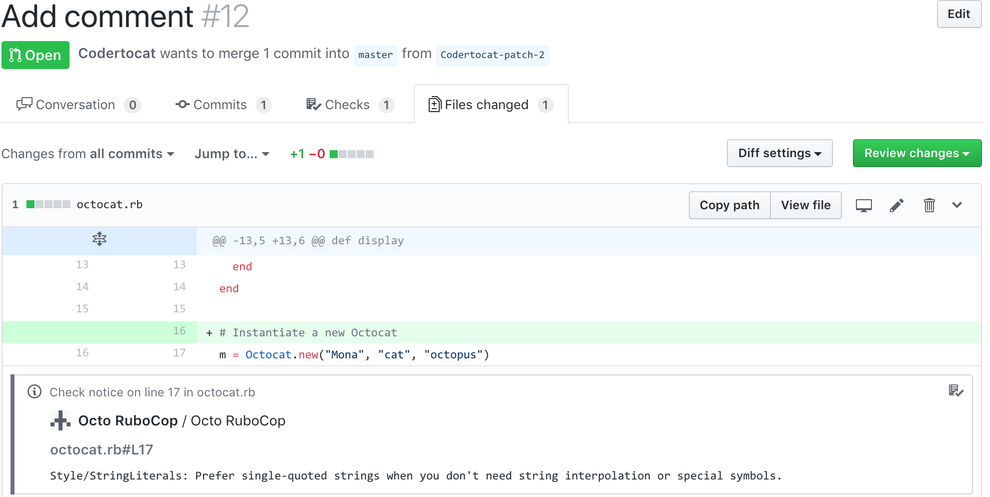
What’s more exciting is that it can leave annotations on specific lines of code, just as the comments people left while reviewing.

github check annotations
Figure 2. Check Run Annotation Screenshot from GitHub Docs

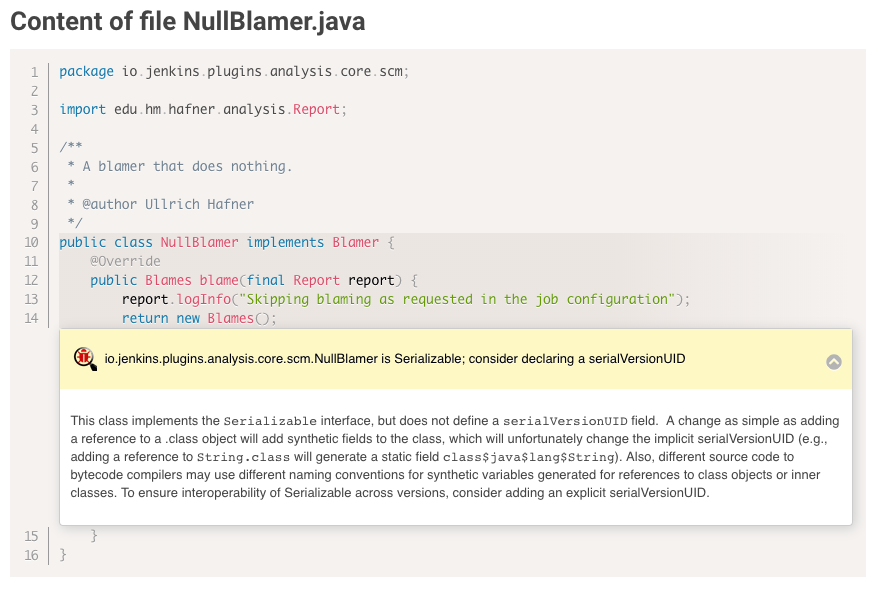
While on Jenkins' side, the source code view provided by Warnings Next Generation Plugin does pretty much the same thing.

source view
Figure 3. Source Code View from Warnings Next Generation Plugin

Utilizing such features through GitHub Checks API, it would make Jenkins more convenient to GitHub users.

Features from Coding Phase 1

In the past month, our team was mostly working on the general checks API and an implementation for GitHub checks API.

GitHub Checks API Plugin Demo [starts from 50:15]

General Checks API

Although the general checks API is developed based on the semantic meaning of GitHub Checks API, we still want to prepare it for similar concepts on other platforms like Commit Status API from GitLab. Contributions for implementations on these platforms will be welcomed in the future.

GitHub Checks API Implementation

Our work on supporting GitHub Checks API is mostly done by now. Besides, we implemented a consumer to automatically create a check run that simply indicates the current stage of a Jenkins build. After the release, Jenkins developers (especially publisher plugin ones) can create their own GitHub checks for a GitHub branch source project by consuming our API.

Example: To create a check run like:

Created Check Run

Consumers need to use our API in this way:

ChecksDetails details = new ChecksDetailsBuilder()
        .withName("Jenkins")
        .withStatus(ChecksStatus.COMPLETED)
        .withDetailsURL("https://ci.jenkins.io")
        .withStartedAt(LocalDateTime.now(ZoneOffset.UTC))
        .withCompletedAt(LocalDateTime.now(ZoneOffset.UTC))
        .withConclusion(ChecksConclusion.SUCCESS)
        .withOutput(new ChecksOutputBuilder()
                .withTitle("Jenkins Check")
                .withSummary("# A Successful Build")
                .withText("## 0 Failures")
                .withAnnotations(Arrays.asList(
                        new ChecksAnnotationBuilder()
                                .withPath("Jenkinsfile")
                                .withLine(1)
                                .withAnnotationLevel(ChecksAnnotationLevel.NOTICE)
                                .withMessage("say hello to Jenkins")
                                .withStartColumn(0)
                                .withEndColumn(20)
                                .withTitle("Hello Jenkins")
                                .withRawDetails("a simple echo command")
                                .build(),
                        new ChecksAnnotationBuilder()
                                .withPath("Jenkinsfile")
                                .withLine(2)
                                .withAnnotationLevel(ChecksAnnotationLevel.WARNING)
                                .withMessage("say hello to GitHub Checks API")
                                .withStartColumn(0)
                                .withEndColumn(30)
                                .withTitle("Hello GitHub Checks API")
                                .withRawDetails("a simple echo command")
                                .build()))
                .build())
        .withActions(Collections.singletonList(
                new ChecksAction("formatting", "format code", "#0")))
        .build();

ChecksPublisher publisher = ChecksPublisherFactory.fromRun(run);
publisher.publish(details);

Future Works

The next step is integrating our API into Warnings Next Generation Plugin and Code Coverage API Plugin consume our API. After that, pipeline support will be added: users can publish checks directly in a pipeline script without requiring a consumer plugin that support the checks.

Top 3 HR Technology Use Cases

New-age technologies – Artificial Intelligence (AI), Machine Learning (ML), Blockchain, Cloud Computing, and so on, are the next big frontier, even in Human Resources. A significant number of HR leaders propound that they are interested in applying AI in their talent management operations – from HR service delivery to employee management. According to a survey by Gartner, About 23% of organizations piloting the use case of AI in HR and recruitment. Organizations often adopt new technologies in human resources after having seen the proof of concepts in other business domains. In human capital management, AI and ML applications are being adopted in the employee as well as candidate facing situations. Here is a quick study of why organizations are adopting HR technology or HR analytics, and the top three use cases of AI and ML in human resources management. 5 Reasons Why HR is adopting
New-Age Tech There is a combination of direct and indirect benefits that leaders see in new tech. They are positively impacting HR operations and infrastructure. However, one challenge that most faces is that of cost. That said, the solutions have proven to be paying for themselves after a few years. Here are the benefits of HR ...


Read More on Datafloq

AI Assisted Dentist: How Artificial Intelligence Will Reform Dentistry by 2050

Artificial intelligence in dentistry is going to revolutionize the dental industry. Patients will be fundamentally different in the future than they are today, and the change is in full swing. According to current analyses, patients aged 65 and over have a close relationship with their doctors, while baby boomers (born until 1970) often want a second opinion. Accordingly, doctor loyalty declined significantly, especially from generation Y or Selfie (born after 1985).Due to the growing Internet penetration, young patients are looking for specialized doctors, and at the same time - contradictively - want "holistic" care. The latter has resulted in a trend towards closer inter-professional collaboration, for example in dentistry and dental technology.After 2000 births (generation Z / Greta), on the one hand, they focused on the topic of sustainability. Regardless, they are "technoholics" and believe in artificial intelligence and robot technology. The media and the Internet are the primary source of information for this generation. Since, this generation is going to be the future market, artificial intelligence and robotic treatments in the medical industry is going to be the trend in the second half of this century.Role of AI in DentistryLet’s start with a fundamental question first, what is AI? ...


Read More on Datafloq

Electric vehicle startups hit hardest by virus outbreak

EV sales, like sales of traditional petrol and diesel-powered automobiles, are expected to remain subdued in the current fiscal year

Wednesday, 8 July 2020

Windows Service Wrapper : YAML Configuration Support - GSoC Phase - 01 Updates

Hello all, I am Buddhika Chathuranga from Sri Lanka and I am a final year undergraduate at the Faculty of IT, University of Moratuwa. I am participating in GSoC 2020 with Jenkins. I am working on the Windows Service Wrapper Project. So the Coding Phase 01 of GSoC 2020 is now over and this blog post describes what I have done so far.

Windows Service Wrapper is an executable, which we can use to run applications as Windows Services on Windows machines, which has almost one million downloads. In Jenkins, we use Windows service wrapper to run Jenkins server and agents as Windows services to gain more robustness. This feature is bundled into Jenkins’s core. Currently, the Windows Service wrapper is configured by an XML file. However, there is a limited number of configuration checks and there is no XML schema.

XML is not such a human-friendly way to do that. It is quite verbose and not easy to identify the schema without some effort. Usually, users misconfigure the service wrapper. This is a sample XML configuration file that we can use to provide configurations to Windows Service Wrapper.

Sample XML Configuration File

<service>
    <id>jenkins</id>
    <name>Jenkins</name>
    <description>This service runs Jenkins automation server.</description>
    <env name="JENKINS_HOME" value="%LocalAppData%\Jenkins.jenkins"/>
    <executable>C:\Program Files\Java\jdk1.8.0_201\bin\java.exe</executable>
    <arguments>-Xrs -Xmx256m -Dhudson.lifecycle=hudson.lifecycle.WindowsServiceLifecycle
    -jar "C:\Program Files\Jenkins\jenkins.war" --httpPort=8081 --webroot="%LocalAppData%\Jenkinswar"</arguments>
    <logmode>rotate</logmode>

    <onfailure action="restart"/>

    <extensions>
        <extension enabled="true" className="winsw.Plugins.RunawayProcessKiller.RunawayProcessKillerExtension" id="killOnStartup">
        <pidfile>%LocalAppData%\Jenkinsjenkins.pid</pidfile>
        <stopTimeout>10000</stopTimeout>
        <stopParentFirst>false</stopParentFirst>
        </extension>
    </extensions>
</service>

The usage of YAML could simplify configuration management in Jenkins, especially when automated and configuration management tools are used. So what we are doing under GSoC - 2020 is to update the Windows Service Wrapper to support YAML configurations. After finishing this project, users will be able to provide configurations to the Windows Service Wrapper as a YAML file.

This is a sample YAML configuration file for Windows Service Wrapper and you can see it is less verbose than XML or JSON and much more human friendly. Users can read and edit this without a big effort.

Sample YAML Configuration File

id: jenkins
name: Jenkins
description: This service runs Jenkins automation server.
env:
    _name: JENKINS_HOME
    _value: '%LocalAppData%\Jenkins.jenkins'
executable: 'C:\Program Files\Java\jdk1.8.0_201\bin\java.exe'
arguments: >-
    -Xrs -Xmx256m -Dhudson.lifecycle=hudson.lifecycle.WindowsServiceLifecycle
    -jar "C:\Program Files\Jenkins\jenkins.war" --httpPort=8081 --webroot="%LocalAppData%\Jenkinswar"
logmode: rotate
onfailure:
    _action: restart
extensions:
    -
        pidfile: '%LocalAppData%\Jenkinsjenkins.pid'
        stopTimeout: '10000'
        stopParentFirst: 'false'
        _enabled: 'true'
        _className: winsw.Plugins.RunawayProcessKiller.RunawayProcessKillerExtension
        _id: killOnStartup

Advantages of YAML as a configuration file

  • It is less verbose and much more human friendly than XML.

  • Since YAML is not using extra delimiters, it is lightweight.

  • Nowadays YAML has become more popular among configuration management tools.

Project Scope

During this project, I will add the following features to Windows Service Wrapper.

  • YAML Configuration support

  • YAML Schema validation

  • New CLI for the Windows Service Wrapper

  • Support for XML Schema validation via XML Schema Definition (XSD)

Phase 01 Updates

In GSoC - 2020 phase 01, I have done the following updates to the Windows Service Wrapper.

You can find Phase 01 Demo slides in this link.

Below you can find more details about the deliverables listed above.

Project Structure overview

The project structure overview document describes how files and directories are organized in the Windows Service Wrapper project. It will help contributors as well as users, to understand the codebase easily. Also, it helps me a lot to understand the codebase. You can find the document from the given link.

YAML configurations support

As I explained before, in this project, configurations will be provided as a YAML file. I used YamlDotNet library which has more than 2.2k stars on GitHub, to deserialize the YAML file into an Object graph. In this YAML file, users can specify configurations in a more structured way than in XML configuration files. As an example, now users can specify all the log related configurations under the log config. Users can specify all service account related configurations under serviceaccount config etc.

At the moment, I am working on a design document for YAML configuration support. I will add it to the GitHub Issue once ready

New CLI

Before moving into Phase 01 updates, it’s better to explain why we needed a new CLI for Windows Service Wrapper. In the early phases of Windows Service Wrapper, we will keep the XML configuration support as well. So we should allow users to specify the configurations file separately. The current approach is, configurations file should be in the same directory, where Windows Service Wrapper executable exists and the file name of the XML file should be the same as the Windows Service Wrapper executable file name. Also, users should be able to redirect logs if they need to and they should be allowed to elevate command prompt using Windows Service Wrapper. Also, we thought that it’s better to allow users to skip schema validation if they needed. So we decided to move into a new CLI.

As I explained, after releasing this, users will have options in addition to commands. It will make the WinSW CLI more flexible so that we can easily extend it later. These are the options users are allowed to use. These options are available with all the commands except help and version

  • --redirect / -r [string]

    • Users can specify the redirect path for the logs if needed

    • Not required | Default value is null

  • --elevated / -e [boolean]

    • Elevate the command prompt before executing the command

    • Not required | Default value is false

  • --configFile / -c [string]

    • Users can specify the configurations file as a path

    • Not Required | Default value is null

  • --skipConfigValidation / -s [boolean]

    • Users can skip schema validation for configurations file if needed

    • Not required | Default value is true

  • --help / -h

    • User can find what options are available with a particular command with this option

This option is available with the install command

  • --profile / -f [boolean]

    • If this option is true, then users can provide a service account for installation explicitly.

    • Not required | Default value is false

We used commandlineparser/commandline library to parse the command line argument which has more than 2k stars in GitHub. At a glance, the library is compatible with .NET Framework 4.0+, Mono 2.1+ Profile, .NET Standard, and .NET Core.

XML Schema validation

As I mentioned before, there was no schema validation for XML in Windows Service Wrapper. Hence, I was working on schema validation for XML. I use XSD to validate XML files. The XSD file will be shipped as an embedded resource with the executable. You can find the XSD file in my pull request.

Future updates

In the next phase, for GSoC 2020 the listed deliverables features will be released and the YAML schema validation feature will be added. Also, we hope to publish a design document for the new features, which will help contributors.

How to contribute

You can find the GitHub repository in this link. Issues and Pull requests are always welcome. Also, you can communicate with us in the WinSW Gitter channel, which is a great way to get in touch and there are project sync up meetings every Tuesday at 13:30 UTC on the Gitter channel.

How Is Big Data Analytics Adding A New Frontier To Ecommerce Space?

Information is the oil of the 21st century, and analytics is the combustion engine - Peter Sondergaard, Senior Vice President, Gartner.It won’t be an overstatement to say no business can cherish success by ignoring the importance of big data. The ecommerce space is no exception that needs greasing with rich insights to cut through the noise.


You would be surprised to know that the digital data universe is growing at a tremendous rate, and its global market expected to reach $105.08 billion by 2027. The ecommerce industry holds a significant share in data growth.The reason is ecommerce stores are using multiple channels to reach the users, storing the user’s micro-moments, and collecting the demographics, that’s generating zettabytes of data. The data is of tons of value if organized and analyzed aptly. The leading players have already started embracing the big data analytics technology to reap great benefits, engage customers, and engineer new experiences.

Alas! All companies are not tapping the potential of technology, but those have used the big data technology tactically, they are standing on the top of the ladder. Got interested in wielding the big data technology with your Ecommerce store to gain advantages in galore? Let’s dive in!Before we ...


Read More on Datafloq

Software You Need to Keep Your Business Running Smoothly

In today’s world, efficiency is king. Every business is looking for a way to streamline their activities and accomplish their tasks quickly and without any hassle. But with so much on your plate, this sometimes feels like an impossible feat.

Fortunately, software development companies like BairesDev have created a plethora of solutions and tools for business across industries, no matter what your size or niche.

Time-tracking software

Time-tracking software not only allows you to see how many hours your employees have worked in a given period of time but can also help you assess productivity.

Take Toggl. This tool enables you to see which tasks and projects are making you money by evaluating how much time your employees are spending on them. You can compare different projects via a dashboard, too. Plus, your employees will receive reminders if they’ve forgotten to set their timers or have been idle for too long.

Project management software

Project management tools are vital to staying on top of your organization’s goings-on. There are plenty of tools available that let you break down your projects into manageable components, monitor their progress, assign tasks, set deadlines, and more.

Trello, for instance, allows you to visualize the big picture through a dashboard with different ...


Read More on Datafloq

Tech Innovations Disrupting the Education World

Educating the future leaders and innovators is one of society’s most important tasks. It’s also an immensely challenging one, given the wide array of methods of learning and personalities, teacher shortages, lack of resources, and more. As the learning landscape changes, the education community is searching for new ways of reaching students.

EdTech, technology dedicated to providing educational software and solutions, is responding to the demand. And it’s doing so in innovative ways that are opening new learning opportunities for all kinds of students. Let’s review some of the new technologies that are reshaping the education field.

3D printing

3D printers have affected many industries, providing them with physical models of complex materials. It’s ideally suited for education since it allows learners to touch and look at objects they probably wouldn’t have been able to visualize or understand in real life. For example, biology students could perform dissections on 3D-printed organs, while history students could better comprehend historical artifacts that have been “recreated.”

Plus, this technology is entertaining and engaging, prompting learners to get excited about their studies.

Digital textbooks

Digital books read through e-readers like Kindles and iPads aren’t particularly new, but the ability to access textbooks online is becoming more ubiquitous. Not only do ...


Read More on Datafloq

3 Ways Technology Is Radically Transforming Military Operations in 2020

In 2019, the United States Department of Defense proposed a $718 billion budget for 2020. This budget would set aside $927 million for AI and machine learning. It’s clear that the military, like so many other sectors and industries, is prioritizing technology when it comes to improving their practices and procedures — and software development companies like BairesDev are rising to the challenge.

How, exactly, is technology transforming the military and its operations? Here are three key ways.

Artificial intelligence

Practically since its inception, AI has been a major force in military equipment. It has vast-reaching implications for a wide array of systems and tools used in planning, practicing, combat, and beyond.

For example, AI is being used in military aircraft systems for predictive maintenance. The Defense Innovation Unit, established by the Pentagon in 2015 to connect technology vendors and the military, granted C3.ai a $95 million contract to improve aircraft.

C3.ai is developing software that leverages machine learning algorithms that will monitor systems and identify potential failures, as well as assess the maintenance that must occur in order to keep aircraft in the air. The tool will also be able to identify the new parts aircraft need and where to find them.

This is just ...


Read More on Datafloq

Tuesday, 7 July 2020

The Role Of Artificial Intelligence In Agricultural Sectors

Artificial intelligence (AI), sometimes called machine intelligence, is intelligence demonstrated by machines, in contrast to the natural intelligence displayed by humans and other animals. It emphasizes the creation of intelligent machines that act and react like humans. AI-powered technologies are getting to be more pervasive across several industries in the world today; finance, transport, energy, healthcare, and now agriculture. Still, yet, AI is set to play a major role in the business World, as agro-based firms are looking for new ways to attain and maintain a competitive edge and boost their productivity; as well as to deliver new products and services to the market. Over the last few years, the growth in AI technology has strengthened agro-based businesses to run more efficiently. Meanwhile, according to the latest UN projections, the world population will rise from 6.8 billion to 9.1 billion in 2050. However, only 4% of additional land will come under cultivation by then. Food production will have to increase by 70 percent! Wait, you said what? In addition, factors such as climate change, population growth, and food security concerns have propelled the agro-industry into seeking more innovative approaches to protecting and improving crop yield.It is clear that something ...


Read More on Datafloq