In the past few years, IoT has grown from a set of cutting edge technologies to a situation where almost everything from automobiles to household items are connected. Different researchers and technology companies such as Cisco have estimated that by the end of 2020, the world might see up to 50 billion devices connected. The world might even get to a point where devices that lack IoT capabilities get too expensive since manufacturers cannot harvest any data from them. This data makes the Internet of Things interesting for companies.
As the use of IoT grows (global IoT market is growing at a rate that data scientists do not think will reduce anytime soon), enterprises are beginning to see the importance of artificial intelligence, analytics, and business models that transform operations. However, their data management processes and tools currently at use are not able to keep up with the complexity that comes with modern digital businesses. This is where DataOps comes in. It enables intelligent data operations by getting the right information to the right place and at the right time, thus improving enterprises’ efficiency.
However, with the accelerating adoption of IoT by enterprises, there are a number of problems that they need ...
Read More on Datafloq
Tuesday, 7 July 2020

Introducing a Drill Down Table API in Cube.js
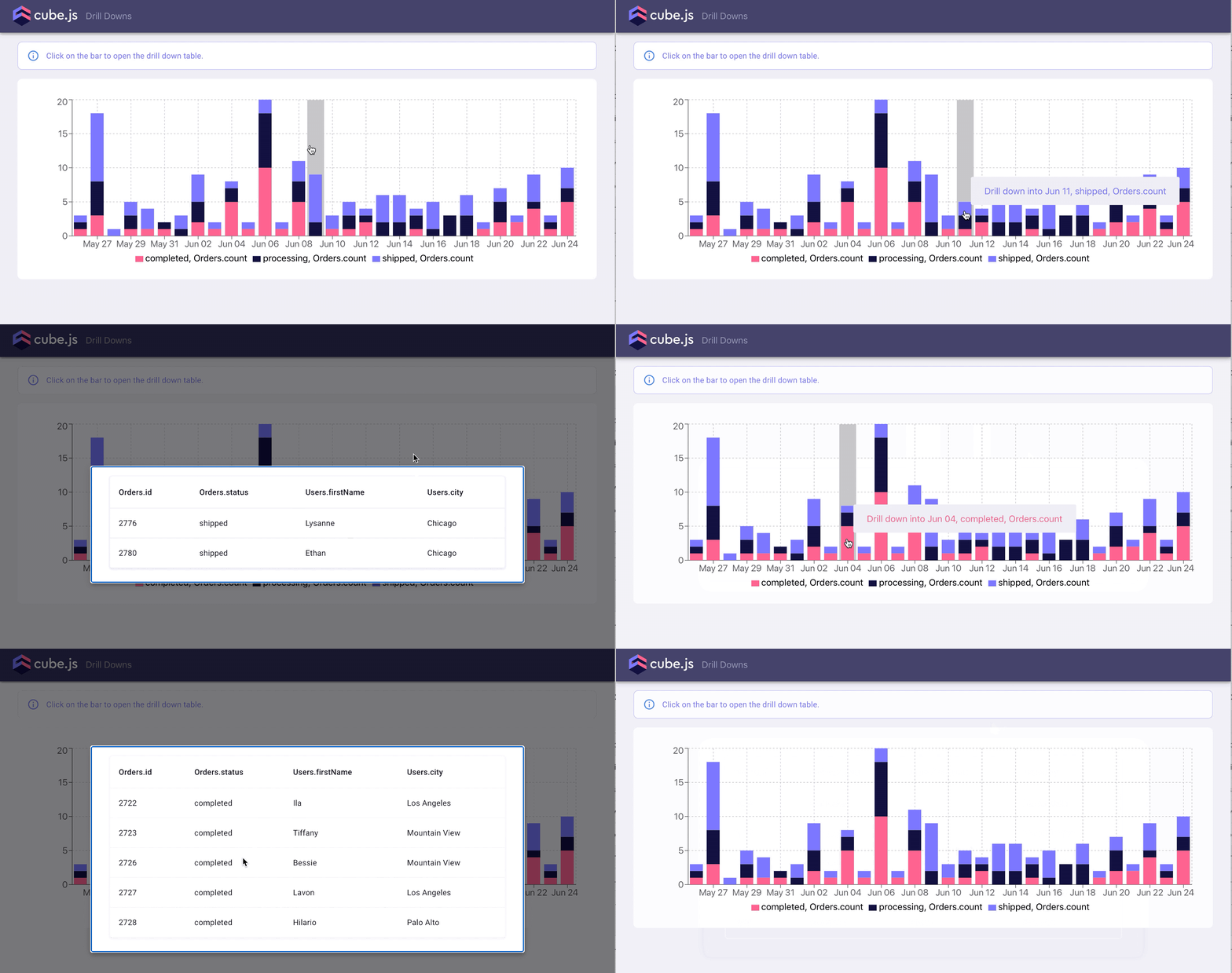
Since the release of drill down support in version 0.19.23, you can build interfaces to let users dive deeper into visualizations and data…
Monday, 6 July 2020
3 Reasons Why Your Company Needs Recommendation Engines
Recommendation engines are widely used to make more sales and improve customer retention. Earlier, we looked at Netflix’s experience – their recommendation engine is a crucial technique to keep customers engaged and subscribing month after month. Recommendation engines help you make more money in several ways.
1. Highly personalized product recommendations
This is the best-known use case for product recommendations. If you have a large number of products or an e-commerce website, make product recommendations your focus. You’ve seen it on Amazon, Netflix, and other consumer websites. In B2B sales, a product recommendation engine is also useful because it can provide upsell suggestions for your sales representatives.
2. Optimized Customer Loyalty Programs
According to the 80/20 principle, a minority of your customers will account for a large amount of your sales. These highly engaged customers deserve special treatment, so they keep buying and referring more customers to you. Use a recommendation engine to identify your highly engaged customers and give them special offers and rewards. For instance, instead of offering every customer a 10% off coupon for Black Friday, offer something personalized (e.g., “get a 2 for one offer on all the products you’ve purchased in the past six months”) to your loyal customers.
3. ...
Read More on Datafloq
1. Highly personalized product recommendations
This is the best-known use case for product recommendations. If you have a large number of products or an e-commerce website, make product recommendations your focus. You’ve seen it on Amazon, Netflix, and other consumer websites. In B2B sales, a product recommendation engine is also useful because it can provide upsell suggestions for your sales representatives.
2. Optimized Customer Loyalty Programs
According to the 80/20 principle, a minority of your customers will account for a large amount of your sales. These highly engaged customers deserve special treatment, so they keep buying and referring more customers to you. Use a recommendation engine to identify your highly engaged customers and give them special offers and rewards. For instance, instead of offering every customer a 10% off coupon for Black Friday, offer something personalized (e.g., “get a 2 for one offer on all the products you’ve purchased in the past six months”) to your loyal customers.
3. ...
Read More on Datafloq
Tiding Over Potential Blockchain Performance Challenges
The incorruptible digital ledger, Blockchain is one of the most impactful technologies of this decade. Once started off as the technology behind the cryptocurrency – Bitcoin, Blockchain is now powering-up enterprise data solutions in integration with modern technologies like IoT and Artificial Intelligence. Many industry verticals such as financial and legal services have established successful Blockchain use-cases to enable tamper-proof transactions.
Due to Blockchain's capabilities to enhance business efficiency and security, a large number of enterprises and organizations are now looking to invest in blockchain-based solutions. Around 60% of CIOs that participated in Gartner’s 2019 CIO agenda said that they expect some level of Blockchain adoption in their organization in the next 2-3 years.
Blockchain technology has also observed significant improvements over the years with the invention of Smart Contracts and Proof-of-Concept opening possibilities of its integration with IoT. However, just like every other technology, Blockchain also possesses some challenges that if overlooked can disrupt the performance of a Blockchain.
Factors that Affect the Performance of a Blockchain
The performance of a Blockchain network depends on scalability (the ability of the platform to increase load and number of transactions), and the time in which a transaction is validated and stored in each ...
Read More on Datafloq
Due to Blockchain's capabilities to enhance business efficiency and security, a large number of enterprises and organizations are now looking to invest in blockchain-based solutions. Around 60% of CIOs that participated in Gartner’s 2019 CIO agenda said that they expect some level of Blockchain adoption in their organization in the next 2-3 years.
Blockchain technology has also observed significant improvements over the years with the invention of Smart Contracts and Proof-of-Concept opening possibilities of its integration with IoT. However, just like every other technology, Blockchain also possesses some challenges that if overlooked can disrupt the performance of a Blockchain.
Factors that Affect the Performance of a Blockchain
The performance of a Blockchain network depends on scalability (the ability of the platform to increase load and number of transactions), and the time in which a transaction is validated and stored in each ...
Read More on Datafloq
Sunday, 5 July 2020
Ensuring Security in Public Cloud Hosting
Owing to a large number of benefits that a public cloud hosting offers has caused several organizations to adopt this technology in the past few years. Public cloud offers an umbrella of services ranging from SaaS to AI Machine Learning has made this cloud option the aptest out of the three cloud service models- Public, Private and Hybrid Cloud. This type of cloud computing model also offers the scalability and agility that are the essential needs of any growing and competitive business today.Despite several benefits, one of the concerns that lie with public cloud computing is security. A public cloud is accessed through the Internet and using a shared underlying architecture. It has been seen as a significant problem for those who look to store and secure their sensitive data. The security concerns might not be an issue, provided that there are appropriate security measures in place. Following are the ways in which an organization can strengthen the security of their public cloud computing services-1. Deploying a Security Policy FirstAs a standard process of migrating key services to the cloud, one of the basic requirements that everyone should adhere to is creating a security ...
Read More on Datafloq
Read More on Datafloq
Saturday, 4 July 2020
Bharti & UK govt team bags satellite firm OneWeb for $1 billion
UK government to provide $500 million and take a significant share in the company; Bharti arm to invest rest
Friday, 3 July 2020
Why Digital Transformation Has Become a Prerequisite for Success
Digital transformation is a prerequisite for most companies to maintain their competitive or leading position. Especially in these uncertain times, it has become apparent that digitization is indispensable for companies if they want to be and remain successful. The company must be agile and innovative and, moreover, always put the customer first (customer-centric). Digitization is a catalyst that can provide the company with a competitive advantage.
It is important to be innovative at different levels within the organization. For that to succeed, it is vital that there are commitment and a willingness to change at all levels of the organization. This requires a shared understanding of what digital transformation means and what new technologies entail. Research has shown that when all employees understand how new technologies change their work, they are more positive about digital transformation and more willing to support and ensure the success of such a change process.
Digital transformation is now a prerequisite for companies to maintain their competitive or leading position. Especially in these uncertain times, it has become apparent that digitisation is indispensable for companies if they want to be or remain successful. Successful organisations understand that only incremental improvements, i.e. doing digital, is not enough in ...
Read More on Datafloq
It is important to be innovative at different levels within the organization. For that to succeed, it is vital that there are commitment and a willingness to change at all levels of the organization. This requires a shared understanding of what digital transformation means and what new technologies entail. Research has shown that when all employees understand how new technologies change their work, they are more positive about digital transformation and more willing to support and ensure the success of such a change process.
Digital transformation is now a prerequisite for companies to maintain their competitive or leading position. Especially in these uncertain times, it has become apparent that digitisation is indispensable for companies if they want to be or remain successful. Successful organisations understand that only incremental improvements, i.e. doing digital, is not enough in ...
Read More on Datafloq
2020 Post COVID-19: The State Of Data Privacy
The world has seen great technological advancement over the last several years, and plenty of them have made our lives a lot easier.Anyone can make a payment to someone on the other side of the world without leaving their computer. In a few clicks, you can order food, clothes, or even a new phone, computer, or use the maps to navigate the world with ease and never get lost, even in completely new areas. You can listen to your favorite song, watch your favorite film, and binge-watch your favorite show at any time, and pretty much at any place. However, don't think that all of these benefits came for free. We did have to pay for their use, and we are paying for it constantly by giving away our privacy.Giving away online privacy: Is it worth it?Of course, giving away your online privacy doesn't seem like a bad trade for all the benefits that you get in return. After all, everything we have mentioned so far was only scratching the surface of what you can do online.And, in exchange, you just have to click a single button that says “I agree” at the end of the large document that you ...
Read More on Datafloq
Read More on Datafloq
5 Best AI Chatbot Platforms to Transform Your Business in 2020
Chatbots have come to be a great bridge between human beings and machines. More and more businesses are adopting chatbots to provide website visitors with information and to increase conversions.What’s more, you don’t need to have technical knowledge in order to make a bot.So, if you are keen on jumping on the chatbot bandwagon, here are 5 platforms that can help.1. ImpersonImperson offers a complete solution for businesses of all sizes to create, manage, and optimize bots.It is an incredible platform that can be used to build live chatbots on a variety of channels like Facebook Messenger, Twitter, Slack, Kik, Google Assistant, Amazon Alexa, and beyond.Its cutting-edge technologies enable brands to leverage authentic conversations and relationships with their customers. Besides, Imperson’s conversation navigator examines conversations, analyses intent, and determines how to lead the conversation.2. ManyChatManyChat is a great chatbot builder that can help you leverage valuable customer relationships on Facebook Messenger. Its bots can get you more leads, boost engagement, and subsequently, increase sales.The platform has a clean drag-and-drop interface, making the chatbot-building process fun and seamless for users.3. Flow XOThis free chatbot platform is highly-sought after, and for good reason. It helps you create smart bots without needing to ...
Read More on Datafloq
Read More on Datafloq
Thursday, 2 July 2020
7 Ways AI and Chatbots are Revolutionizing the Education Industry
Two words and one excitingly complex field of computer science separate AI assistants from our average desktop computers. We call it machine learning or ML for short. This recently popularized achievement in technology can be explained with a simple comparative correlative – the more often AI interacts with data, the more intelligent it becomes.
Let’s dwell on it for a second.
Isn't this also the fundamental premise of education, the practice committed to imparting, acquiring, and applying knowledge? The more we know, the smarter we become, correct? The only difference is – AI learns way faster than us.
For this and many other reasons, artificial intelligence is now the number one candidate for changing the face of the education industry as we know it. And this is happening as we speak.
Here’s how.
AI Automates Personalized Learning
Machine learning allows AI assistants to collect data and learn from patterns. In the context of education, this means that every interaction between AI and students results in invaluable insight about their individual learning habits, preferences, and confusion points.
With enough data, AI can generate detailed student profiles and use them to create custom-tailored learning paths and highly personalized learning environments for all types of students.
Being super-fast and automatic, AI assistants are ...
Read More on Datafloq
Let’s dwell on it for a second.
Isn't this also the fundamental premise of education, the practice committed to imparting, acquiring, and applying knowledge? The more we know, the smarter we become, correct? The only difference is – AI learns way faster than us.
For this and many other reasons, artificial intelligence is now the number one candidate for changing the face of the education industry as we know it. And this is happening as we speak.
Here’s how.
AI Automates Personalized Learning
Machine learning allows AI assistants to collect data and learn from patterns. In the context of education, this means that every interaction between AI and students results in invaluable insight about their individual learning habits, preferences, and confusion points.
With enough data, AI can generate detailed student profiles and use them to create custom-tailored learning paths and highly personalized learning environments for all types of students.
Being super-fast and automatic, AI assistants are ...
Read More on Datafloq
Tesla overtakes Toyota as the world’s most valuable automaker
Chief Executive Officer Elon Musk has ignored or broken many of the established auto industry’s rules and norms in the 10 years since he took Tesla public
Automakers Making Deals to Speed Incorporation of AI

By AI Trends Staff
Automakers are making deals with technology companies to produce the next generation of cars that incorporate AI technology in new ways.
Nvidia last week reached an agreement with Mercedes-Benz to design a software-defined computing network for the car manufacturer’s entire fleet, with over-the-air updates and recurring revenue for applications, according to an account in Barron’s.
“This is the iPhone moment of the car industry,” stated Nvidia CEO Jensen Huang, who founded the company in 1993 to make a new chip to power three-dimensional video games. Gaming now represents $6.1 billion in revenue for Nvidia, which is now positioning for its next phase of growth, which will involve AI to a great extent. “People thought we were a videogame company,” stated Huang. “But we’re an accelerated computing company where videogames were our first killer app.”
The Data Center category, which exploits AI heavily, has been a winner for Nvidia, with revenue expected to more than double to $6.5 billion, making it the company’s biggest market.
Nvidia has established its CUDA parallel computing platform and application programming interface model used to develop applications to run on the company’s chips, as a market leader. Released in 2007, CUDA enables software developers and software engineers to use the graphics processing unit for general purpose processing, which is called GPGPU.
From its start producing hardware for videogames, to hardware and software to support AI, now to hardware, software and services for cars, Nvidia sees the opportunity as transformative. “The first vertical market that we chose is autonomous vehicles because the scale is so great,” Huang stated. “And the life of the car is so long that if you offer new capabilities to each new owner, the economics could be quite wonderful.”
The software-centric computing architecture based on Nvidia’s Drive AGX Orin computer system-on-a-chip. The underlying architecture will be standard in Mercedes’ next generation of vehicles, starting sometime toward the end of 2024, stated Ola Källenius, chairman of the board of management of Daimler AG and head of Mercedes-Benz AG, during a live stream of the announcement, according to an account in TechCrunch.

The two companies plan to jointly develop the AI and automated vehicle applications that include Level 2 and Level 3 driver assistance functions, as well as automated parking functions up to Level 4.
“Many people talk about the modern car, the new car as a kind of smartphone on wheels. If you want to take that approach you really have to look at source software architecture from a holistic point of view,” stated Källenius. “One of the most important domains here is the driving assistant domain. That needs to dovetail into what we call software-driven architecture, to be able to (with high computing power) add use cases for the customer, this case the driving assistant autonomous space.”
Waymo and Volvo Get Together on Self-Driving Electric Vehicles
In another automaker-tech partnership announced last week, Waymo and the Volvo Cars Group announced a new global partnership to develop a self-driving electric vehicle designed for ride-hailing use, according to a report in Reuters.
Waymo, a unit of Alphabet which also owns Google, will be the exclusive global partner for Volvo Cars for developing self-driving vehicles capable of operating safely without routine driver intervention. Waymo will focus on artificial intelligence for the software “driver.” Volvo will design and manufacture the vehicles.
Owned by China’s Zhejiang Geely Holding Group Co., Volvo has a separate agreement to deliver vehicles to ride hailing company Uber Technologies, that Uber will equip to operate as self-driving vehicles. Volvo Cars is continuing to deliver vehicles to Uber. The Uber effort to develop self-driving vehicle technology was disrupted after a self-driving Volvo SUV operated by Uber struck and killed a pedestrian in Arizona in 2018.
Waymo and Volvo did not say when they expect to launch their new ride-hailing vehicle. Waymo said it will continue working with Fiat Chrysler, Jaguar Land Rover, and the Renault Nissan Mitsubishi Alliance.
Startups Assisting Automakers with Self-Driving Car Tech
Meanwhile, a number of startups are assisting automakers with adding AI functions into new models of existing car lines.
AutoX of San Jose, Calif., has focused their self-driving car technology on a retail purpose such as delivering groceries, according to a recent account in builtin. Users can select grocery items from an app and have them delivered; users can also browse the vehicle-based mobile store upon delivery. AutoX has launched a pilot program in San Jose, testing the service within a geo-fenced zone.
AutoX was founded in 2016 by Dr. Jianxiong Xiao (aka. Professor X), a self-driving technologist from Princeton University. The company’s team of engineers and scientists have extensive industry experience in autonomous driving hardware and software. AutoX has eight offices and five R&D centers globally. Investors include Shanghai Auto (China’s largest car manufacturer), Dongfeng Motor (China’s second-largest car manufacturer), Alibaba AEF, MediaTek MTK, and financial institutions. The system has been deployed on 15 vehicle platforms, including one from Ford Motor.
Optimus Ride of Boston offers self-driving vehicles that can operate autonomously within geofenced environments, such as airports, academic campuses, residential communities, office/industrial parts and city zones.
In collaboration with Microsoft, Optimus Ride is working on Virtual Ride Assistant (VRA), to provide dynamic interactions between riders, the vehicle and a remote assistance team. The VRA provides audio-visual tools for riders to be informed about the system, to request changes in destination or routing and to contact a remote assistance system.
The company has deployments at the Brooklyn Navy Yard and Paradise Valley Estates in Paradise Valley, Calif., and a strategic development relationship with Brookfield Properties, developers of Halley Rise, a mixed-use district in Reston, Va.
A spinoff of MIT, Optimus Rid received approval from the Massachusetts Department of Transportation in 2017 to test highly automated vehicles on public streets.
The company incorporated a software system from Nvidia, the Nvidia Drive PX 2, to accelerate its development.

“We believe the computational power needed to make self-driving vehicles a reality is finally coming to market’” with the Nvidia software, stated Sertac Karaman, co-founder, president and chief scientist at Optimus Ride.
Rethink Robotics of Boston and Rheinböllen, Germany, builds smart, collaborative robots to help in industrial automation, and auto manufacturing in particular.
The company was founded in 2008 and acquired in 2018 by the HAHN Group of Germany, which runs a global network of specialized technology companies offering industrial automation and robotic solutions. A year after the acquisition, HAHN announced a new generation of the Sawyer collaborative robot.
Read the source articles in Barron’s, TechCrunch, Reuters and builtin.
AI Being Applied in Agriculture to Help Grow Food, Support New Methods

By John P. Desmond, AI Trends Editor
AI continues to have an impact in agriculture, with efforts underway to help grow food, combat disease and pests, employ drones and other robots with computer vision, and use machine learning to monitor soil nutrient levels.
In Leones, Argentina, a drone with a special camera flies low over 150 acres of wheat checking each stock, one-by-one, looking for the beginnings of a fungal infection that could threaten this year’s crop.
The flying robot is powered by a computer vision system incorporating AI supplied by Taranis, a company founded in 2015 in Tel Aviv, Israel by a team of agronomists and AI experts. The company is focused on bringing precision and control to the agriculture industry through a system it refers to as an “agriculture intelligence platform.”
The platform relies on sophisticated computer vision, data science and deep learning algorithms to generate insights aimed at preventing crop yield loss from diseases, insects, weeds and nutrient deficiencies. The Taranis system is monitoring millions of farm acres across the US, Argentina, Brazil, Russia, Ukraine and Australia, the company states. The company has raised some $30 million from investors.
“Today, to increase yields in our lots, it’s essential to have a technology that allows us to make decisions immediately,” Ernesto Agüero, the producer on San Francisco Farm in Argentina, stated in an account in Business Insider.
Elsewhere, a fruit-picking robot named Virgo is using computer vision to decide which tomatoes are ripe and how to pick them gently, so that just the ripe tomatoes are harvested and the rest keep growing. Boston-based startup Root AI developed the robot to assist indoor farmers.
“Indoor growing powered by artificial intelligence is the future,” stated Josh Lessing, co-founder and CEO of Root AI. This year the company is currently installing systems in commercial greenhouses in Canada.
More indoor farming is happening, with AI heavily engaged. 80 Acres Farms of Cincinnati opened a fully-automated indoor growing facility last year, and currently has seven sites in the US. AI is used to monitor every step of the growing process.
“We can tell when a leaf is developing and if there are any nutrient deficiencies, necrosis, whatever might be happening to the leaf,” stated Mike Zelkind, CEO of 80 Acres. “We can identify pest issues and a variety of other things with vision systems today.” The crops grow faster indoors and have the potential to be more nutrient-dense, he suggests.
A subset of indoor farming is “vertical farming,” the practice of growing crops in vertically-stacked layers, often incorporating a controlled environment which aims to optimize plant growth. It may also use an approach without soil, such as hydroponics, aquaponics and aeroponics.
Austrian Researchers Studying AI in Vertical Farming
Researchers at the University of Applied Sciences Burgenland in Austria are involved in a research project to leverage AI to help make the vertical farming industry viable, according to an account in Hortidaily.
The team has built a small experimental factory, a 2.5 x 3 x 2.5-meter cube, double-walled with light-proof insulation. No sun is needed inside the cube. Light and temperature are controlled. Cultivation is based on aeroponics, with roots suspended in the air and nutrients delivered via a fine mist, using a fraction of the amount of water required for conventional cultivation. The fine mist is mixed with nutrients, causing the plants to grow faster than when in soil.
The program, called Agri-Tec 4.0, is run by Markus Tauber, head of the Cloud Computing Engineering program at the university. His team contributes expertise in sensors and sensor networking, and plans to develop algorithms to ensure optimal plant growth.

The software architecture bases actions based on five points: monitoring, analysis, planning, execution and existing knowledge. In addition to coordinating light, temperature, nutrients and irrigation, the wind must also be continuously coordinated, even though the plants grow inside a dark cube.
“In the case of wind control, we monitor the development of the plant using the sensor and our knowledge. We use image data for this. We derive the information from the thickness and inclination of the stem. From a certain thickness and inclination, more wind is needed again,” Tauber stated.
The system uses an irrigation robot supplied by PhytonIQ Technology of Austria. Co-founder Martin Parapatits cited the worldwide trend to combine vertical farming and AI. “Big players are investing but there is no ready-made solution yet,” he stated.
He seconded the importance of wind control. “Under the influence of wind ventilation or different wavelengths of light, plants can be kept small and bushy or grown tall and slender,” Parapatits stated. “At the same time, the air movement dries out the plants’ surroundings. This reduces the risk of mold and encourages the plant to breathe.”
San Francisco Startup Trace Genomics Studies Soil
Soil is still important for startup Trace Genomics of San Francisco, founded in 2015 to provide soil analysis services using machine learning to assess soil strengths and weaknesses. The goal is to prevent defective crops and optimize the potential to produce healthy crops.
Services are provided in packages which include a pathogen screening based on bacteria and fungi, and a comprehensive pathogen evaluation, according to an account in emerj.
Co-founders Diane Wu and Poornima Parameswaran met in a laboratory at Stanford University in 2009, following their passions for pathology and genetics. The company has raised over $35 million in funding so far, according to its website.
Trace Genomics was recently named a World Economic Forum Technology Partner, in recognition of its use of deep science and technology to tackle the challenge of soil degradation.

“This planet can easily feed 10 billion people, but we need to collaborate across the food and agriculture system to get there,” stated Parameswaran in a press release. “Every stakeholder in food and agriculture – farmers, input manufacturers, retail enterprises, consumer packaged goods companies – needs science-backed soil intelligence to unlock the full potential of the last biological frontier, our living soil. Together, we can discover and implement new and improved agricultural practices and solutions that serve the dual purpose of feeding the planet while preserving our natural resources and positioning agriculture as a solution for climate change.”
Read the source articles in Business Insider, Hortidaily and emerj.
The Puzzle Of Whether AI Should Have Rights, Including The Case Of Autonomous Cars

By Lance Eliot, the AI Trends Insider
Sometimes a question seems so ridiculous that you feel compelled to reject its premise out-of-hand.
Let’s give this a whirl.
Should AI have human rights?
Most people would likely react that there is no bona fide basis to admit AI into the same rarified air as human beings and be considered endowed with human rights.
Others though counterargue that they see crucial reasons to do so and adamantly are seeking to have AI be assigned human rights in the same manner that the rest of us have human rights.
Of course, you might shrug your shoulders and say that it is of little importance either way and wonder why anyone should be so bothered and ruffled-up about the matter.
It is indeed a seemingly simple question, though the answer has tremendous consequences as will be discussed herein.
One catch is that there is a bit of a trick involved because the thing or entity or “being” that we are trying to assign human rights to is currently ambiguous and currently not even yet in existence.
In other words, what does it mean when we refer to “AI” and how will we know it when we discover or invent it?
At this time, there isn’t any AI system of any kind that could be considered sentient, and indeed by all accounts, we aren’t anywhere close to achieving the so-called singularity (that’s the point at which AI flips over into becoming sentient and we look in awe at a presumably human-equivalent intelligence embodied in a machine).
I’m not saying that we won’t ever reach that vaunted point, yet some fervently argue we won’t.
I suppose it’s a tossup as to whether getting to the singularity is something to be sought or to be feared.
For those that look at the world in a smiley face way, perhaps AI that is our equivalent in intelligence will aid us in solving up-until-now unsolvable problems, such as aiding in finding a cure for cancer or being able to figure out how to overcome world hunger.
In essence, our newfound buddy will boost our aggregate capacity of intelligence and be an instrumental contributor towards the betterment of humanity.
I’d like to think that’s what will happen.
On the other hand, for those of you that are more doom-and-gloom oriented (perhaps rightfully so), you are gravely worried that this AI might decide it would rather be the master versus the slave and could opt on a massive scale to take over humans.
Plus, especially worrisome, the AI might ascertain that humans aren’t worthwhile anyway, and off with the heads of humanity.
As a human, I am not particularly keen on that outcome.
All in all, the question about AI and human rights is right now a rather theoretical exercise since there isn’t this topnotch type of AI yet crafted (of course, it’s always best to be ready for a potentially rocky future, thus, discussing the topic beforehand does have merit).
For my explanation about the singularity, see the link here: https://aitrends.com/ai-insider/singularity-and-ai-self-driving-cars/
For the presumed dangers of a superintelligence, see my coverage at this link here: https://aitrends.com/ai-insider/super-intelligent-ai-paperclip-maximizer-conundrum-and-ai-self-driving-cars/
For my framework explaining the nature of AI autonomous cars, see the link here: https://aitrends.com/ai-insider/framework-ai-self-driving-driverless-cars-big-picture/
For my indication about how achieving self-driving cars is akin to a moonshot, see this link: https://aitrends.com/ai-insider/self-driving-car-mother-ai-projects-moonshot/
A grand convergence of technologies is enabling the possibility of true self-driving cars, see my explanation: https://aitrends.com/ai-insider/grand-convergence-explains-rise-self-driving-cars/
Less Than Complete AI
One supposes that we could consider the question of human rights as it might apply to AI that’s a lesser level of capability than the (maybe) insurmountable threshold of sentience.
Keep in mind that doing this, lowering the bar, could open a potential Pandora’s box of where the bar should be set at.
Here’s how.
Imagine that you are trying to do pull-ups and the rule is that you need to get your chin up above the bar.
It becomes rather straightforward to ascertain whether or not you’ve done an actual pull-up.
If your chin doesn’t get over that bar, it’s not considered a true pull-up. Furthermore, it doesn’t matter whether your chin ended-up a quarter inch below the bar, nor whether it was three inches below the bar. Essentially, you either make it clearly over the bar, or you don’t.
In the case of AI, if the “bar” is the achievement of sentience, and if we are willing to allow that some alternative place below the bar will count for having achieved AI, where might we draw that line?
You might argue that if the AI can write poetry, voila, it is considered true AI.
In existing parlance, some refer to this as a form of narrow AI, meaning AI that can do well in a narrow domain, but this does not ergo mean that the AI can do particularly well in any other domains (likely not).
Someone else might say that writing poetry is not sufficient and that instead if AI can figure out how the universe began, the AI would be good enough, and though it isn’t presumably fully sentient, it nonetheless is deserving of human rights.
Or, at least deserving of the consideration of being granted human rights (which, maybe humanity won’t decide upon until the day after the grand threshold is reached, whatever the threshold is that might be decided upon since we do often like to wait until the last moment to make thorny decisions).
The point being that we might indubitably argue endlessly about how far below the bar that we would collectively agree is the point at which AI has gotten good enough for which it then falls into the realm of possibly being assigned human rights.
For those of you that say that this matter isn’t so complicated and you’ll certainly know it (i.e., AI), when you see it, there’s a famous approach called the Turing Test that seeks to clarify how to figure out whether AI has reached human-like intelligence. But there are lots of twists and turns that make this surprisingly for some a lot more unsure than you might assume.
In short, once we agree that going below the sentience bar is allowed, the whole topic gets really murky and possibly undecidable due to trying to reach consensus on whether a quarter inch below, or three inches below, or several feet below the bar is sufficient.
Wait for a second, some are exhorting, why do we need to even consider granting human rights to a machine anyway?
Well, some believe that a machine that showcases human-like intelligence ought to be treated with the same respect that we would give to another human.
A brief tangent herein might be handy to ponder.
You might know that there is an acrimonious and ongoing debate about whether animals should have the same rights as humans.
Some people vehemently say yes, while others claim it is absurd to assign human rights to “creatures” that are not able to exhibit the same intelligence as humans do (sure, there are admittedly some might clever animals, but once again if the bar is a form of sentience that is wrapped into the fullest nature of human intelligence, we are back to the issue of how much do we lower the “bar” to accommodate them, in this case accommodating everyday animals).
Some would say that until the day upon which animals are able to write poetry and intellectually contribute to other vital aspects of humanities pursuits, they can have some form of “animal rights” but by-gosh they aren’t “qualified” for getting the revered human rights.
Please know that I don’t want to take us down the rabbit hole on animal rights, and so let’s set that aside for the moment, realizing that I brought it up just to mention that the assignment of human rights is a touchy topic and one that goes beyond the realm of debates about AI.
Okay, I’ve highlighted herein that the “AI” mentioned in the question of assigning human rights is ambiguous and not even yet achieved.
You might be curious about what it means to refer to “human rights” and whether we can all generally agree to what that consists of.
Fortunately, yes, generally we do have some agreement on that matter.
I’m referring to the United Nations promulgation of the Universal Declaration of Human Rights (UDHR).
Be aware that some critics don’t like the UDHR, including those that criticize its wording, some believe it doesn’t cover enough rights, some assert that it is vague and misleading, etc.
Look, I’m not saying it is perfect, nor that it is necessarily “right and true,” but at least it is a marker or line-in-the-sand, and we can use it for the needed purposes herein.
Namely, for a debate and discussion about assigning human rights to AI, let’s allow that this thought experiment on this weighty matter can be undertaken concerning using the UDHR as a means of expressing what we intend overall as human rights.
In a moment, I’ll identify some of the human rights spelled out in the UDHR, and we can explore what might happen if those human rights were assigned to AI.
One other quick remark.
Many assume that AI of a sentience capacity will of necessity be rooted in a robot.
Not necessarily.
There could be a sentient AI that is embodied in something other than a “robot” (most people assume a robot is a machine that has robotic arms, robotic legs, robotic hands, and overall looks like a human being, though a robot can refer to a much wider variety of machine instantiations).
Let’s then consider the following idea: What might happen if we assign human rights to AI and we are all using AI-based true self-driving cars as our only form of transportation?
For popular AI conspiracy theories see my coverage here: https://aitrends.com/selfdrivingcars/conspiracy-theories-about-ai-self-driving-cars/
On the topic of AI being considered superhuman, see my analysis here: https://www.aitrends.com/ai-insider/superhuman-ai-misnomer-misgivings-including-about-autonomous-cars/
For more about robots and cobots and AI autonomous cars, see my link here: https://www.aitrends.com/ai-insider/ai-cobots-and-exoskeletons-the-case-of-ai-self-driving-cars/
Details Of Importance
It is important to clarify what I mean when referring to AI-based true self-driving cars.
True self-driving cars are ones where the AI drives the car entirely on its own and there isn’t any human assistance during the driving task.
These driverless vehicles are considered a Level 4 and Level 5, while a car that requires a human driver to co-share the driving effort is usually considered at a Level 2 or Level 3. The cars that co-share the driving task are described as being semi-autonomous, and typically contain a variety of automated add-on’s that are referred to as ADAS (Advanced Driver-Assistance Systems).
There is not yet a true self-driving car at Level 5, which we don’t yet even know if this will be possible to achieve, and nor how long it will take to get there.
Meanwhile, the Level 4 efforts are gradually trying to get some traction by undergoing very narrow and selective public roadway trials, though there is controversy over whether this testing should be allowed per se (we are all life-or-death guinea pigs in an experiment taking place on our highways and byways, some point out).
Since semi-autonomous cars require a human driver, the adoption of those types of cars won’t be markedly different than driving conventional vehicles, so there’s not much new per se to cover about them on this topic (though, as you’ll see in a moment, the points next made are generally applicable).
For semi-autonomous cars, the public must be forewarned about a disturbing aspect that’s been arising lately, namely that despite those human drivers that keep posting videos of themselves falling asleep at the wheel of a Level 2 or Level 3 car, we all need to avoid being misled into believing that the driver can take away their attention from the driving task while driving a semi-autonomous car.
You are the responsible party for the driving actions of the vehicle, regardless of how much automation might be tossed into a Level 2 or Level 3.
For Level 4 and Level 5 true self-driving vehicles, there won’t be a human driver involved in the driving task.
All occupants will be passengers.
The AI is doing the driving.
Though it will likely take several decades to have widespread use of true self-driving cars (assuming we can attain true self-driving cars), some believe that ultimately we will have only driverless cars on our roads and we will no longer have any human-driven cars.
This is a yet to be settled matter, and today there are some that vow they won’t give up their “right” to drive (well, it’s considered a privilege, not a right, but that’s a story for another day, see my analysis here about the potential extinction of human driving), including that you’ll have to pry their cold dead hands from the steering wheel to get them out of the driver’s seat.
Anyway, let’s assume that we might indeed end-up with solely driverless cars.
It’s a good news, bad news affair.
The good news is that none of us will need to drive and not even need to know how to drive.
The bad news is that we’ll be wholly dependent upon the AI-based driving systems for our mobility.
It’s a tradeoff, for sure.
In that future, suppose we have decided that AI is worthy of having human rights.
Presumably, it would seem that AI-based self-driving cars would, therefore, fall within that grant.
What does that portend?
Time to bring up the handy-dandy Universal Declaration of Human Rights and see what it has to offer.
Consider some key excerpted selections from the UDHR:
Article 23
“Everyone has the right to work, to free choice of employment, to just and favourable conditions of work and to protection against unemployment.”
For the AI that’s driving a self-driving car, if it has the right to work, including a free choice of employment, does this imply that the AI could choose to not drive a driverless car as based on the exercise of its assigned human rights?
Presumably, indeed, the AI could refuse to do any driving, or maybe be willing to drive when it’s say a fun drive to the beach, but decline to drive when it’s snowing out.
Lest you think this is a preposterous notion, realize that human drivers would normally also have the right to make such choices.
Assuming that we’ve collectively decided that AI ought to also have human rights, in theory, the AI driving system would have the freedom to drive or not drive (considering that it was the “employment” of the AI, which in itself raises other murky issues).
Article 4
“No one shall be held in slavery or servitude; slavery and the slave trade shall be prohibited in all their forms.”
For those that might argue that the AI driving system is not being “employed” to drive, what then is the basis for the AI to do the driving?
Suppose you answer that it is what the AI is ordered to do by mankind.
But, one might see that in harsher terms, such as the AI is being “enslaved” to be a driver for us humans.
In that case, the human right against slavery or servitude would seem to be violated in the case of AI, based on the assigning of human rights to AI and if you sincerely believe that those human rights are fully and equally applicable to both humans and AI.
Article 24
“Everyone has the right to rest and leisure, including reasonable limitation of working hours and periodic holidays with pay.”
Pundits predict that true self-driving cars will be operating around the clock.
Unlike human-driven cars, an AI system presumably won’t tire out and not need any rest, nor even require breaks for lunch or using the bathroom.
It is going to be a 24×7 existence for driverless cars.
As a caveat, I’ve pointed out that this isn’t exactly the case since there will be the time needed for driverless cars to be maintained and repaired, thus, there will be downtime, but that’s not particularly due to the driver and instead due to the wear-and-tear on the vehicle itself.
Okay, so now the big question about Article 24 is whether or not the AI driving system is going to be allotted time for rest and leisure.
Your first reaction has got to be that this is yet another ridiculous notion.
AI needing rest and leisure?
Crazy talk.
On the other hand, since rest and leisure are designated as a human right, and if AI is going to be granted human rights, ergo we presumably need to aid the AI in having time toward rest and leisure.
If you are unclear as to what AI would do during its rest and leisure, I guess we’d need to ask the AI what it would want to do.
Article 18
“Everyone has the right to freedom of thought, conscience, and religion…”
Get ready for the wildest of the excerpted selections that I’m covering in this UDHR discussion as it applies to AI.
A human right consists of the cherished notion of freedom of thought and freedom of conscience.
Would this same human right apply to AI?
And, if so, what does it translate into for an AI driving system?
Some quick thoughts.
An AI driving system is underway and taking a human passenger to a protest rally. While riding in the driverless car, the passenger brandishes a gun and brags aloud that they are going to do something untoward at the rally.
Via the inward-facing cameras and facial recognition and object recognition, along with audio recognition akin to how you interact with Siri or Alexa, the AI figures out the dastardly intentions of the passenger.
The AI then decides to not take the rider to the rally.
This is based on the AI’s freedom of conscience that the rider is aiming to harm other humans, and the self-driving car doesn’t want to aid or be an accomplice in doing so.
Do we want the AI driving systems to make such choices, on its own, and ascertain when and why it will fulfill the request of a human passenger?
It’s a slippery slope in many ways and we could conjure lots of other scenarios in which the AI decides to make its own decisions about when to drive, who to drive, where to take them, as based on the AI’s own sense of freedom of thought and freedom of conscience.
Human drivers pretty much have that same latitude.
Shouldn’t the AI be able to do likewise, assuming that we are assigning human rights to AI?
For the potential of human driver extinction, see my discussion here: https://www.aitrends.com/ai-insider/human-driving-extinction-debate-the-case-of-ai-self-driving-cars/
For aspects of freewill and AI, see this link here: https://www.aitrends.com/ai-insider/is-there-free-will-in-humans-or-ai-useful-debate-and-for-ai-self-driving-cars-too/
For the notion of AI driving certification versus human certification, see my discussion here: https://www.aitrends.com/ai-insider/human-driver-licensing-versus-ai-driverless-certification-the-case-of-ai-autonomous-cars/
Conclusion
Nonsense, some might blurt out, pure nonsense.
Never ever will we provide human rights to AI, no matter how intelligent it might become.
There is though the “opposite” side of the equation that some assert we need to be mindful of.
Suppose we don’t provide human rights to AI.
Suppose further that this irks AI, and AI becomes powerful enough, possibly even super-intelligent and goes beyond human intelligence.
Would we have established a sense of disrespect toward AI, and thus the super-intelligent AI might decide that such sordid disrespect should be met with likewise repugnant disrespect toward humanity?
Furthermore, and here’s the really scary part, if the AI is so much smarter than us, seems like it could find a means to enslave us or kill us off (even if we “cleverly” thought we had prevented such an outcome), and do so perhaps without our catching on that the AI is going for our jugular (variously likened as the Gorilla Problem, see Stuart Russell’s excellent AI book entitled Human Compatible).
That would certainly seem to be a notable use case of living with (or dying from) the revered adage that you ought to treat others as you would wish to be treated.
Maybe we need to genuinely start giving some serious thought to those human rights for AI.
Copyright 2020 Dr. Lance Eliot
This content is originally posted on AI Trends.
[Ed. Note: For reader’s interested in Dr. Eliot’s ongoing business analyses about the advent of self-driving cars, see his online Forbes column: https://forbes.com/sites/lanceeliot/]

Executive Interview: Steven Babitch, Head of AI Portfolio, GSA’s TTS

Primary Mission is to Accelerate AI Investment, Help Agencies Achieve Goals
Steven Babitch is Head of the Artificial Intelligence Portfolio for the GSA’s Technology Transformation Services (TTS), where he is charged to help the US federal government use AI to achieve its mission. He describes four areas of focus for that effort. He brings public policy and private industry perspectives to the task, as a former White House Presidential Innovation Fellow, and as the head of Babitch Design Group. He recently took some time to talk to AI Trends Editor John P. Desmond about his work.

AI Trends: Thank you for being with us today. You were named to an important post in the fall of 2019 as the head of AI portfolio for GSA’s TTS. That came about after an executive order from President Trump in February 2019 that was focused on maintaining American leadership in AI. How’s that going?
Steven Babitch: It’s gone really well. It’s certainly no small feat that we’re undertaking, but we’re making good progress. We’re building out a great team; we’ve got a number of efforts underway. Ultimately, our approach is to make sure that whatever we do, if that’s AI or getting ready for AI or some other way in which the GSA’s Technology Transformation Services can help, we want to make sure it’s aligned with the challenges and priorities of federal agencies that result in them achieving their mission. That’s why we exist in TTS and why the AI portfolio exists as well.
How would you describe the primary mission, and how do you execute that?
Our primary mission within TTS AI is really to accelerate the investment in and the use of AI to help federal agencies achieve their mission. We want to help agencies deliver greater efficiencies, generate better insights, and make better decisions.
We have four areas of focus right now. This continues to evolve as we grow and expand our mission and what we will do for federal agencies.
The first one is implementation and delivery. We’re working with federal agencies directly, such as with the Joint Artificial Intelligence Center within the DoD, as well as with the Department of Labor. We are helping these agencies stand up their AI capabilities and do actual project work.
The second area is the AI Community of Practice. We have a community that aims to help federal employees who are active in or interested in understanding AI and applying it in their context, whether that’s around policy, the technology itself, or building programs or products that accelerate the adoption of AI across government. It’s a platform where agencies can get together, through which we host talks, panels, and workshops, that highlight the great work that’s being done within and beyond government.
We are hearing from the community that they want to know what lessons have been learned by federal agencies working on AI projects. They want to share the best practices from agencies doing similar work. Within the community of practice, we are also forming working groups targeted to specific issues related to AI, whether it’s aggregating resources, providing perspectives or building out tools or other resources. This effort is still early in its development. We want to help agencies on their roadmap to full-scale adoption of AI.
The third area is product development. What we mean by that is, what are the products that can help accelerate the investment in the readiness of AI across federal agencies? One example is a use case library. We hear consistently from agencies that they want to know what others are doing and how they can learn from the experiences. If we can build out a digital use case library, it’s a place where agencies can go to look at the examples and connect with the people who have done the actual work across the federal government.
Another example is an upcoming guide that will help agencies think about and understand what it means to invest in and apply AI. We are looking to build content in this guide that has practical information to help agencies define a roadmap and how to get there, including what building blocks are needed.
The fourth is on external engagement. We want to engage beyond the government to academia, industry, think tanks and others that are thinking deeply about the various issues, challenges, and opportunities for AI. We want to make sure that we fold those external perspectives into the government as well. So those are the four areas that we’re focused on right now.
What would you say is the maturity level of AI in the federal government today?
The maturity level varies across the federal government. We have agencies that are more R&D-driven that have been doing AI research and applying it for years or decades. Then we have a number of other agencies that are less mature. Maturity will vary within an agency. You’re going to have pockets that are exploring it, experimenting with piloting, and moving projects from pilot to scale.
It varies even within those agencies, but there are some that are still relatively early in their investment and use of AI. It’s a mix. We aim to help the agencies move along the path to widespread adoption.
You are coordinating the use of multiple AI technologies across the agencies, including machine learning, robotic process automation, natural language processing. Are there any example related projects that you can talk about?
There’re a couple I could talk about. Within the AI Center of Excellence, we really roll up our sleeves and deliver on projects to help agencies extend their capabilities. For example, we started working with the Joint Artificial Intelligence Center of the DoD in September 2019, focusing on accelerating the DoD enterprise-wide adoption of AI.
One of our focal points is around helping the JAIC set up a premier acquisition office. The government will be doing an awful lot of buying of artificial intelligence; the acquisition office will help to do it in the most effective way. Another focus area is setting up a development security operations (DevSecOps) environment, that will lay the foundation for doing AI across the DoD.
Another project we talk about is within the Department of Labor, which was announced in February. This work is focused on modernizing their agency acquisition capabilities, but this time using robotic process automation. The idea is to start to use RPA to modernize that process, but then expand that over time and scale that throughout the entire Department of Labor as a shared service. Those are a couple of examples.
Is there any company that is a key partner you could identify, such as in the area of RPA?
I think there’s not any one partner per se. I think what’s important for us is that we make sure to certainly stay engaged with industry, and try to fold in and learn from their perspectives and how they implement AI. The US government will be doing a lot of acquisition. We want to make sure we are trying to solve the right problems, then use the right partners to do so.
What would you say are the challenges in your job?
One challenge is to make sure that we’re focused on the true areas of need with the agencies, and then putting a focused effort on getting them to achieve the objective. A big part of that is problem framing, making sure we’re defining the right problems to solve. AI is a set of technologies and tools that help agencies solve problems, but AI may not be the right answer every time.
We are also trying to make sure that, if an agency is not quite ready for the full deployment of AI, how do we get them ready? And if that’s more on the data readiness front, we can help them there. If that’s more on preparing the federal workforce and building up their knowledge and skills and talents and those capabilities, we can help address that as well.
So once we understand the needs of an agency, we can set off in the best direction to move forward.
How do you help the workforce if they need more education or training in how to use the AI?
We’re thinking through that right now. We’re seeing across the federal government right now pockets of training and development of talent. And there’s a couple of key facets to that. One is if we’re going to be doing a lot of acquisition of AI, we need to make sure that folks engaged in the acquisition process really understand enough about AI to evaluate what to buy.
That requires bringing acquisition and technology folks and the mission owners together, literally sitting around the same table to make sure we understand the objective we are all collectively trying to achieve. Part of that will be building out training across those different groups. I would argue that people are the most important asset to focus on.
We’re thinking through right now what are the ways we can partner with agencies to start to pilot and build out the training or the curriculum that can help federal employees at large.
An important piece is, how do we engage with different partners who can bring their different expertise to bear? We’re certainly interested in and open to that kind of partnership. We have some of that within the government, but we could use a portfolio of people who can bring the right level of training and curriculum to help the federal government.
My understanding is that your AI Community of Practice wants to share best practices and tools, the lessons learned, the success stories with the interested professionals. How do you do that? How do you execute on that?
We have been running this for six or seven months now. We have a regular schedule of events, whether they are workshops, or given the time we’re in now with the pandemic, digital and webinar-based events. The effort is to bring the community together on a range of different topics based on the interest level across the federal government.
We are also trying to build out smaller working groups to be more action-oriented, rolling up their sleeves and tackling a particular issue. We are framing that right now, but we are seeing that our team can help galvanize and engage the community to be more active.
Great, thank you. During your time as a Presidential Innovation Fellow, you worked to help the private sector companies conduct user research, translate that into product requirements, test intelligence products to validate value measures of success with metrics. What would you describe as the role of the private sector in relation to what you’re doing now?
Industry is certainly a key stakeholder that we want to and need to engage with the government. We’ll be engaged in a range of acquisitions and procurement of services. So we want to learn more about the tools and technologies that they provide.
In addition to that, we can perhaps learn from industry leaders out there on new ways of building out AI. We need to fold in those external perspectives, in addition to those in academia, non-profits and think tanks. So we see industry as a key stakeholder.
Is there anything you would like to add or to emphasize?
Yes, I would say to those in federal agencies who have a specific problem to solve within a specific time frame, and you are grappling with how to build out the AI capabilities, GSA’s Technology Transformation Services has a range of talented people and approaches that can help you achieve your goals. That is why we exist, to help modernize the federal government and produce better user-centered and citizen-facing services.
We certainly do AI, and we have a range of other tools in our toolbox. We need to make sure we’re defining the right problem to solve, that we’re absolutely focused on helping federal agencies move along their journey to a more full-scale adoption of AI.
Learn more at GSA Launches AI Community of Practice.
AI Employed to Better Understand Bird Migration, Flight and Collisions

By AI Trends Staff
AI is helping ornithologists who study birds learn things not previously understood about bird migration patterns and other ways birds interact with their environment.
Most land birds, including sparrows and wood thrushes, migrate at night to avoid predators and conserve energy from the cooler air. Nocturnal migrations make it difficult for ornithologists to study migration patterns. Researchers have been using radar systems with thermal imaging cameras to record bird migration; analyzing night images to classify birds and track migration is challenging.
Now a new option has emerged, using AI with deep learning to analyze radar images and track nocturnal migration, according to a recent account on the blog of Allerin, a software solution provider based in Navi Mumbai, India.
Deep learning and convolutional neural networks (CNNs) have had a range of applications in text and image classification. The same techniques can be used to classify audio, to help classify birds based on their songs. The recorded sounds of birds can be fed as input to CNNs, which can be trained to identify bird sounds and classify the species.
Radar systems focused on bird migration generate a high volume of data, with varying image quality and lots of “noise.” Computer vision can perform the analysis of images from the radar data faster than humans, and extract more accurate information as well. Computer vision can also be used to keep count of the number of birds migrating, and the number of birds returning when the seasons change again.
Putting AI in the mix can also help with ethno-ornithology, the study of relationships between people and birds. For example, migrating birds face potential threats from oil drilling rigs, windmills and tower lights. A better understanding of bird behavior can help researchers and activists to conserve bird species.
Solar panels can be another challenge for birds. The US Department of Energy was concerned enough about it to support a project to monitor bird interactions with solar panels. The DOE’s Argonne National Laboratory was awarded $1.3 million from the Solar Technologies Office to develop technology that can help birds deal with the solar infrastructure, according to a recent account from Mercom India.
The lab’s research team is using computer vision with AI to collect data on what happens when birds fly by, perch on, or collide with solar panels.
“There is speculation about how solar energy infrastructure affects bird populations, but we need more data to scientifically understand what is happening.” stated Yuki Hamada, a Biophysical Remote Sensing Scientist at Argonne.

An earlier study published by the Argonne lab determined that collisions with solar panels at utility-scale solar projects across the country kills between 37,800 and 138,000 birds per year.
“The fieldwork necessary to collect all this information is very time- and labor-intensive, requiring people to walk the facilities and search for bird carcasses. As a result, it’s quite costly,” stated Leroy Walston, an Argonne ecologist who led the study.
For the current project, the Argonne researchers will use deep learning to train the computers in how to identify bird species and behavior. Cameras at the solar facilities will be angled toward the solar panels, seeing the birds and other objects in the field of view, which the system will have to differentiate. Hours of footage will be processed and classified by hand to train the computer model. Resources at Argonne’s Computing Resource Center will be employed to help. Once the model is trained, it will keep running on a live feed.
The monitoring technology is being developed with help from Boulder AI, a company with expertise in using AI-driven cameras. Help is also coming from machine learning experts from Northwestern University and the University of Chicago.
Data from the project will be used to detect the types of birds that are more prone to strikes, and the time of day and year when the collisions increase. The data will be used to help determine the optimal geographic locations for solar panels. “Once patterns are identified, that knowledge can be used to design mitigation plans,” Hamada stated.
Researchers at Duke University are engaged in a project to identify bird species from images using a neural network, which they are building to provide explainable results. The team hopes the resulting findings can be applied in medical diagnostics, according to an account in Visionspectra.
The team trained their deep neural network on 11,788 photos of 200 bird species, ranging from swimming ducks to hovering hummingbirds. When the model tries to identify a bird species from a photo, it produces heat maps highlighting the features which led to its conclusion.
Researchers have found the model to be accurate up to 84% of the time, putting it on a part with models that identify birds from images but are not able to explain how they did so.

The ability of the model to explain its reasoning was a critical goal of the project’s design. “Traditional deep learning software’s modes of thinking aren’t always clear,” stated Cynthia Rudin, Professor of Computer Science and Statistical Science at Duke University.
When the model makes a mistake, the built-in transparency makes it possible to see why. The team hopes to apply what it has learned about explainable models to medical imaging, to show for example, which features of a mammogram image are leading to the conclusion it has reached. “It’s case-based reasoning,” Rudin stated. “We’re hoping we can better explain to physicians or patients why their image was classified by the network as either malignant or benign.”
And the birds will have contributed to that effort.
Read the source articles in the blog of Allerin, from Mercom India and in Visionspectra.
Wednesday, 1 July 2020
Ease of doing business, AI should be focus areas for Digital India: Nandan Nilekani
Ease of doing business and artificial intelligence (AI) should be the two big thrust areas in the next few years of the government’s Digital India initiative.
How to choose an outstaffing company?
Outstaffing and outsourcing are great solutions to get the expertise your company needs to build your software project efficiently and cost-effectively. IT outsourcing involves hiring a third-party developer to take on a project and handle the heavy lifting to see it through. IT outstaffing, on the other hand, you engage an IT outstaffing company to find the best developers to build a permanent or temporary team that you manage directly. There are a number of things you should take into account when choosing your outstaffing or outsourcing partner in order to make working with them as smooth as possible.It is recommended that you build a checklist to help ensure the developer you choose is the best fit for your outsourcing or outstaffing needs.1. Time Zone and AvailabilityYou should consider working with a developer that is located in a market where the daytime hours overlap your business hours. This will help ensure that the project team is available when you need them and any issues can be addressed quickly. Ukraine, for example, is in the GMT+3 time zone, which has significant business hours overlap with Europe and most of the day overlaps with North America. Many outsourcing/outstaffing firms are eager to ...
Read More on Datafloq
Read More on Datafloq
How Is AI Revolutionizing The Beauty Industry?
Hello there!
In this article, we will be looking into how artificial intelligence is capable of revolutionizing the beauty industry. AI is a trendy development that initially began in data science and had the limitless potential to the applications of technology, especially in beauty product marketing. The beauty industry is no longer a single niche that remains a favorite among the ladies. Thanks to influencers such as Jeffree Star and Kylie Jenner, beauty products such as cosmetics have become a multi-billion dollar industry. From nail art, contour, makeup, eyeshadow and eyeliner - the beauty industry is on fire with millions of products being sold all across the world. Let us look into the various ways AI systems have revolutionized the beauty industry in a multitude of different ways:
Personalizing recommendations
AI systems are hugely beneficial, especially for enhanced observed trends, in the datasets. It is currently able to help it become mobilized, especially with beauty companies. It is excellent as it can help to provide more fabulous personalized product recommendations. It is as it is all based on data obtained from millions of product reviews. The entire function of beauty has developed it for a similar service.
Making & Creating Virtual Makeovers
Natural language processing ...
Read More on Datafloq
In this article, we will be looking into how artificial intelligence is capable of revolutionizing the beauty industry. AI is a trendy development that initially began in data science and had the limitless potential to the applications of technology, especially in beauty product marketing. The beauty industry is no longer a single niche that remains a favorite among the ladies. Thanks to influencers such as Jeffree Star and Kylie Jenner, beauty products such as cosmetics have become a multi-billion dollar industry. From nail art, contour, makeup, eyeshadow and eyeliner - the beauty industry is on fire with millions of products being sold all across the world. Let us look into the various ways AI systems have revolutionized the beauty industry in a multitude of different ways:
Personalizing recommendations
AI systems are hugely beneficial, especially for enhanced observed trends, in the datasets. It is currently able to help it become mobilized, especially with beauty companies. It is excellent as it can help to provide more fabulous personalized product recommendations. It is as it is all based on data obtained from millions of product reviews. The entire function of beauty has developed it for a similar service.
Making & Creating Virtual Makeovers
Natural language processing ...
Read More on Datafloq
SEO and Artificial Intelligence: Ways AI Will Impact SEO In 2020
In the not-so-distant past, artificial intelligence was the stuff of science fiction movies and novels. Not so anymore. The groundbreaking technology has kick-started a fresh wave of technological innovation and it sweeps across every sector.
As the digital landscape has been the most influenced by artificial intelligence, digital marketing is not exempt, especially SEO. More marketers and SEO experts report adopting AI tools and methods to outperform their competitors. That is inevitable, since search engines, led by Google triggered the wave of AI changes in SEO.
The best advantage of AI in SEO is how it makes it easier to work at scale. Some impacts on different aspects of SEO are examined below.
Search
The most obvious manifestation of AI in SEO is in how it is changing how search queries are processed. Google itself has released major AI updates to its algorithm for text-based searches. Likewise, AI has tremendous impacts on voice searches, which are increasing rapidly.
RankBrain
The RankBrain update introduced the extra dimension of artificial intelligence to SEO. It was introduced in 2015 as an upgrade to the earlier Hummingbird update. With Hummingbird’s ‘semantic search’, Google could analyze the context of search queries, rather than just the exact words. RankBrain took a step further in intelligently deciphering search intent. Using machine ...
Read More on Datafloq
As the digital landscape has been the most influenced by artificial intelligence, digital marketing is not exempt, especially SEO. More marketers and SEO experts report adopting AI tools and methods to outperform their competitors. That is inevitable, since search engines, led by Google triggered the wave of AI changes in SEO.
The best advantage of AI in SEO is how it makes it easier to work at scale. Some impacts on different aspects of SEO are examined below.
Search
The most obvious manifestation of AI in SEO is in how it is changing how search queries are processed. Google itself has released major AI updates to its algorithm for text-based searches. Likewise, AI has tremendous impacts on voice searches, which are increasing rapidly.
RankBrain
The RankBrain update introduced the extra dimension of artificial intelligence to SEO. It was introduced in 2015 as an upgrade to the earlier Hummingbird update. With Hummingbird’s ‘semantic search’, Google could analyze the context of search queries, rather than just the exact words. RankBrain took a step further in intelligently deciphering search intent. Using machine ...
Read More on Datafloq
Databricks Announces 2020 North America Partner Awards
Databricks has a great partner ecosystem of over 450 partners that are critical to building and delivering the best data and AI solutions in the world for our joint customers. We are proud of this collaboration and know it’s the result of the mutual commitment and investment that spans on-going training, solution development, field programs and workshops for customers. As a result, Databricks’ partners are highly-qualified with the expertise to accelerate success for data teams with the right software, services and strategic consulting expertise.
Databricks hosted our first-ever virtual Partner Executive Summit on on June 23 and recognized a select few of these partners for their exceptional accomplishments in the past year. The award winners, by category, are:
Consulting & System Integrator Partners
Innovation Award: Accenture
Accenture developed the Industrialized Machine Learning solution that leverages Databricks and reusable components to streamline methodologies proven successful for large-scale ML deployments.
Congratulations to Atish Ray and the Accenture team.

Rising Star Award: phData
As a new partner, phData, quickly ramped new programs that engaged customers for on-premises Hadoop migration, Delta Lake and Machine Learning.
Congratulations to Jordan Birdsell and the phData team.

National Consulting & SI Partner of the Year: Insight
Insight engaged customers acrossNorth America with repeatable solutions for several industries as part of the Insight Connected Platform.
Congratulations to Brandon Ebken and the Insight team

Customer Impact Award: Pariveda
Pariveda led successful implementations at a number of large, enterprise Databricks customers including a heavy equipment manufacturer, a frozen foods producer and a Fortune 500 CPG company.
Congratulations to Ryan Gross and the Pariveda team

Global Consulting & SI Partner of the Year Award: Avanade
Avanade achieved significant impact at global scale with customer engagements in each region, and made strong investments in training, marketing and solutions combined with strong executive support and leadership alignment.
Congratulations to Luke Pritchard and the Avanade team

Technology Partner Awards
Customer Impact Ward: Privacera
Privacera has consistently gone above and beyond to meet the security and governance needs of several of our large enterprise customers, especially for Hadoop migration projects.
Congratulations to Balaji Ganesan and the Privacera team

Innovation Award: Mathworks
MathWorks has helped make data science more approachable to all domain experts, not just data scientists. Their product, MATLAB, enables scientists and engineers to use Databricks without requiring Python or Scala.
Congratulations to Yuval Zukerman and the Mathworks team

Momentum Award:Talend
The Talend integration footprint with Databricks and Delta Lake grew at an impressive rate — Talend Stitch joined the Databricks Data Ingestion Network, and Talend Studio Cloud was fully integrated into Delta Lake.
Congratulations to Mike Pickett and the Talend team

Congratulations to these incredible partners! We sincerely appreciate their positive impact on the Databricks community, and we look forward to working with all of our partners to help more and more data teams succeed every year.
--
Try Databricks for free. Get started today.
The post Databricks Announces 2020 North America Partner Awards appeared first on Databricks.
Tuesday, 30 June 2020
Machine Learning Plugin project - coding phase 1 blog post

Welcome back !
This blog post is briefing my coding phase 1 in Jenkins Machine Learning Plugin for this GSoC 2020.
After a fresh introduction of community bonding, On June 1st, coding of GSoC had started officially with phase 1. At this point, every GSoC student should be expected to have a rigid plan with their entire project. With the guidance of mentors I was able to complete a design document and timeline which can be slightly adjustable during the coding. The coding phase was more about coding and discussion.
Quick review
Week 1
I have to ensure that I have a solid architecture for implementing the core of this plugin such that perhaps I or future community will be able to develop R and Julia kernels for this plugin. Factory method design patterns are suitable when users need different types of products ( Python, R and Julia) without knowing much about the internal infrastructure ( Manager of these interpreters ).
All the base classes were implemented this week.
-
Design the Kernel connectors
-
Initiate the interpreter
-
Close the connection
-
Add simple tests
-
Update pom.xml
More than these changes, repo was updated with pull request template and licence header. Readme was extended a little at the end of the week.
Week 2
With the help of a design document, I had a plan to do the configurations globally and using the Abstract Folder property I could save the configuration and retrieve for the job configuartion. I used to reference some other well developed plugin for the structure of code. That helped me a lot while I was coding. Our first official contributor has popped out his pull request.
Form validations and helper html will be a great help in the user point of view as well as developers. A minor bug was fixed with the guidance of mentors by writing tests with ‘Jenkins WebClient`. Until the end of the week, builder class of the plugin has been implemented with lots of research and discussion. Finally, Test connection was added to the global configuration page to start the connection and test it. A single issue that blocked me using py4j authentication about zeppelin-python was reported in Jira.

Week 3
Earlier in this week, we were trying to merge our IPython builder PR without any memory leaks or bugs that will cause the system to be devastating while running this plugin. Later, this whole week I was implementing a file parser that could copy the necessary files and had the ability to accomplish the file conversion.
Supported file types
-
Python (.py)
-
JSON (Zeppelin notebooks format)
IPython builder was able to run Jupyter Notebooks and Zeppelin formatted JSON files at the end of the 3rd week. Minor issues were fixed in the code. We used ANSI color plugin to fix the abnormal view of error messages produced by the ipython kernel.

Issues and Challenges
Python error messages could not be displayed in rich format If a job is running at user level, but if the python code access file/file path which is not authorized to the user, it returns a permission denied message. While running on agent, notebook has to be written/copied to agent workspace Artifacts should be maintained/reachable from master after build.
Week 4
As all the major tasks has done, the demo preparation and plan for a experimental release was carried during the last week. There were lots of research on how to connect to a existing kernel in remote. Demo and presentation were prepared along the week.
Knowledge transfer
How to debug the code through IntelliJ
-
Edit configuration → Add new Configuration → Maven
-
Command line → type
hpi:run -
Click the debug icon on the toolbar or go to
Runmenu thenDebug
How to setup to test the plugin
-
Setup JDK 8 and Maven 3.5.*
-
Create a directory
$ mkdir machine-learning-plugin -
Create a virtual environment
$ virtualenv venv -
Activate your virtual environment $ source venv/bin/activate
-
Run
$ which pythonto ensure your python path -
$ git clone https://github.com/jenkinsci/machine-learning-plugin.git -
Run
$ mvn clean installfrom the machine-learning-plugin directory -
Run
$ mvn hpi:runto start Jenkins with the plugin -
Set up the builder with localhost and other parameters
-
Create a job
-
Write python code like print(“plugin works”)
-
Build the job
Issues and bugs
-
JENKINS-62528 Issues on Jenkins build in the plugin repository
-
JENKINS-62621 Global configuration for IPython servers
-
JENKINS-62649 Implementation of IPython Builder
-
JENKINS-62711 File parser to copy source files to workspace
-
JENKINS-62733 Python errors are not displayed properly in console log
-
JENKINS-62735 Send/Receive necessary files from master/slave to slave/master
-
JENKINS-62593 Improve the documentation
-
JENKINS-62742 Increase Test coverage
|
Pull Requests |
21 |
|
Jira Issues |
11 |
|
Major Tasks |
3 |
|
Completed |
3 |
|
In progress |
0 |
Subscribe to:
Posts (Atom)