Tuesday, 7 April 2020

Operationalizing machine learning at scale with Databricks and Accenture

Guest blog by Atish Ray, Managing Director at Accenture Applied Intelligence

While many machine learning pilots are successful, scaling and operating full blown applications to deliver business-critical outcomes remains a key challenge. Accenture and Databricks are partnering to overcome this, writes Atish Ray, Managing Director at Accenture Applied Intelligence, who specializes in big data and AI.

In 2019, machine learning (ML) applications and platforms attracted an average of $42 billion in funding worldwide. Despite this promise, scaling and operating full-blown ML applications remains a key challenge—especially in a business context, where many of the long-term benefits of industrialized ML are yet to be realized.

While ML is lauded for its ability to learn patterns of data, subsequently improving performance and outcomes based on experience, the barriers to scaling it are many and varied. For instance, a lack of good management of metadata end-to-end in an ML lifecycle could lead to fundamental issues around trust and traceability. The rapid evolution of skills and technologies required, and the potential incompatibility of traditional operating models and business processes, especially in IT, both pose hurdles in moving ML applications from pilot stage into production.

The good news is that recent advances in and availability of several AI and ML technologies have yielded the tools necessary to democratize and industrialize the lifecycle of an ML application. Increasing popularity and use of public cloud has enabled organizations to store and process more data at higher efficiency than ever before—a prerequisite for ML applications to scale and run most efficiently.

Innovations from open source communities supported by companies like Databricks have resulted in state-of-the-art products that allow scientists, engineers, and architects to collaborate together and rapidly build and deploy ML applications. And, what used to require a PhD in machine learning, has now been abstracted into a wide variety of software tools and services, which are democratized for use by a more diverse set of users.

Combine all of this with deep knowledge of an industry and its data, and it is clear there has never been a better time for organizations to deploy and operate ML at scale.

What makes the ML lifecycle a complex, collaborative process?

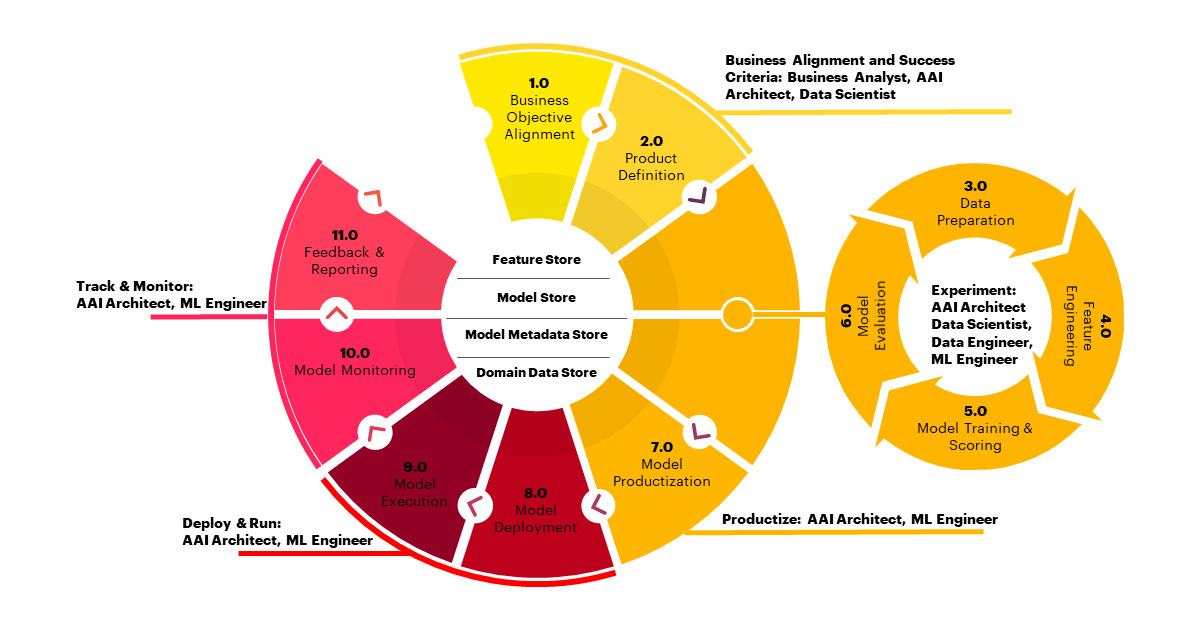
To monitor if ML delivers sustained outcomes to a business over a period of time, a deep understanding of the people, processes and technologies in each phase of the ML lifecycle is critical (Figure 1). From the outset, key stakeholders must be aligned on what exactly it is they need to achieve for the business.

End-to-end machine learning product life cycle

Figure 1: An end-to-end ML product life cycle

In a business context, one of the best practices is to begin by prioritizing one or two business challenges around which to build a minimum viable product or MVP supported by an initial foundation. Once this is established and the necessary data prepared, an experimentation phase takes place to determine the right model for any given problem.

After the model has been selected, tested, tuned and finalized, the ML application is ready to be operationalized. Traditionally, the work required to get to this point has been where data scientists focus the bulk of their time. However, in order to operationalize at scale, models may need to be deployed on certain platforms, such as cloud platforms, or integrated into user-facing business applications. 

Once this is all complete, the next step is to monitor and tune the performance of these learning models as they’re deployed into a production environment, where they are delivering specific outcomes such as making recommendations and predictions or monitoring certain types of operational efficiencies.

In one case, for example, an online ad agency in Japan was utilizing ML to create lists of target customers for ad delivery. They were successful in creating accurate models but were suffering from high operational cost of building models and evaluating the targeting outcomes. There was an urgent need to normalize and automate the process across measures.

To address this issue, Accenture implemented a reusable scripts tool to build, train, test and validate models. The scripts, which ran from a GUI frontend, were integrated with ML flow to enable deployment with ease, substantially reducing the DevOps time and effort needed to scale.

In another case, a large pharmaceutical retailer in the US was struggling to engage with its 80-million-plus member base through offers made with its loyalty program. It needed a way to increase uplift, yet apart from manual processes, there were no systems in place to build a reliable, uniform and reproducible ML pipeline to evaluate billions of combinations of offers for millions of customers on a continual basis.

Accenture developed and delivered a personalization engine with the Databricks platform to build, train, test, validate and deploy models at scale, across tens of millions of customers, billions of offers, and tens of thousands of products. An automated ML model deployment process and modernized AI pipeline were also deployed. The result was substantially reduced DevOps time and effort in deploying models, and the business was able to achieve an estimated 20% higher margin for pilot retail locations.

What are the technical building blocks for industrial ML?

Leveraging established building blocks by partnering with established experts—such as in the two cases outlined above—accelerates both the build and deployment of these types of programs, which can be iterated, incrementally scaled and applied to deliver increasingly complex business outcomes.

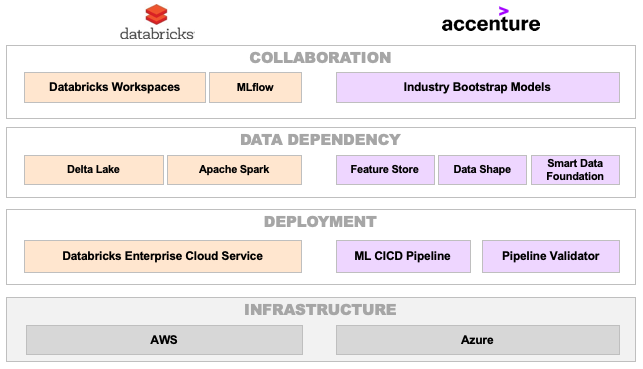
To help its clients build and operate these ML applications, Accenture has partnered with Databricks. Accenture is leveraging Databricks’ platform to establish the key technical foundation needed to address three core areas of industrial ML: collaboration, data dependency and deployment (Figure 2).

Databricks’ Unified Analytics Data Platform enables key technical components for each of the three fundamental areas, and Accenture has developed a set of additional technical components that co-exist and integrate with the Databricks platform. This also includes a package of reusable components, which accelerate collaboration, improve understanding of data and streamline operational deployments.

Ultimately, the objective of this partnership was to streamline the methodologies that have been proven successful for large-scale deployment.

The Databricks and- Accenture solution componentspartnership architecture, highlighting points of collaboration, data dependency, and deployment, and infrastructure.

Figure 2: Collaboration, data dependency and deployment

Based on extensive implementation experience, we know organizations that are industrializing ML development and deployment are addressing the three fundamental areas that we address here:

Collaboration

Comprehensive collaboration of analytics communities across organization boundaries, managing and sharing features and models, is key to success. As a collaborative environment, Databricks Workspaces provides a space in which data engineers and data scientists can jointly explore datasets, build models iteratively and execute experiments and data pipelines.  MLflow is a key component and open source project from Databricks to collaborate across the ML lifecycle from experimentation to deployment and allows users to track model performance, versions and reproducible results.

Accenture brings a toolkit of models and feature engineering for many scenarios, for example a recommendation engine, that bootstraps the full ML application lifecycle. It leverages industry knowledge of successful models and enables baseline production feedback to inform calibration efforts.

Data dependency

We cannot emphasize enough the importance of access to and understanding of usable datasets and associated metadata for driving successful outcomes. Our data dependency components capture standards and rules to shape data, and provide visual charts to help assess data quality.  This improves speed of data acquisition and curation, and further accelerates understanding of data and improves efficiencies of feature engineering.

The Databricks platform provides several capabilities to improve data quality and processing performance at scale.  Delta Lake, available as part of Databricks, is an open source storage layer that enables ACID transactions and data quality features, and brings reliability to data lakes at scale. Apache Spark delivers a highly scalable engine for big data and ML, with additional enhancements from Databricks for high performance.

Deployment

Whereas experimentation requires data science knowledge to apply the right solutions to the right industry problem, deployment requires well integrated, cross-functional teams. Our deployment components use a metadata-driven approach to build and deploy ML pipelines representing continuous workflow from inception to validation. By enabling standards and deployment patterns, these components make it possible to operationalize experiments.

The Databricks Enterprise Cloud Service is a simple, secure and scalable managed service that enables consistent deployment of high-performing ML pipelines and applications. What’s more, a governance structure for deployment and management of production models and drifts can also be enabled.  Integrated together, these components from Databricks and Accenture deliver significant acceleration to the deployment of a ML lifecycle on AWS and Azure clouds.

What are the key considerations before deploying ML at scale?

For those considering an industrialized approach to ML, there are a few key questions to consider first. They include:

  1. Are business stakeholders aligned on the business problems ML needs to solve and the expectations on key outcomes it needs to achieve?
  2. Are the right roles and skills in place to scale and monitor the ML application for deploying a successful experimentation?
  3. Is the necessary infrastructure and automation needs understood and made available for an industrialized ML solution?
  4. Does the data science team have the right operating model, standards and enablers needed to avoid significant deployment re-engineering once experimentation is done?

When it comes to industrialized ML, it can be tempting to start by building a very deep technical foundation that addresses all aspects of the lifecycle. More often than not, however, that approach risks losing sight of business outcomes and encountering challenges with adoption, spend and justification of approach.

Instead, we have experienced successful iterative development of these foundations in a business-critical environment, built through successive cycles delivering incremental business outcomes.

About Accenture

Accenture is a leading global professional services company, providing a broad range of services and solutions in strategy, consulting, digital, technology and operations. Combining unmatched experience and specialized skills across more than 40 industries and all business functions – underpinned by the world’s largest delivery network – Accenture works at the intersection of business and technology to help clients improve their performance and create sustainable value for their stakeholders. With more than 492,000 people serving clients in more than 120 countries, Accenture drives innovation to improve the way the world works and lives. Visit us at www.accenture.com.

This document is produced by consultants at Accenture as general guidance. It is not intended to provide specific advice on your circumstances. If you require advice or further details on any matters referred to, please contact your Accenture representative.

This document makes descriptive reference to trademarks that may be owned by others. The use of such trademarks herein is not an assertion of ownership of such trademarks by Accenture and is not intended to represent or imply the existence of an association between Accenture and the lawful owners of such trademarks.

Copyright © 2019 Accenture. All rights reserved. Accenture, its logo, and High Performance. Delivered. are trademarks of Accenture.

--

Try Databricks for free. Get started today.

The post Operationalizing machine learning at scale with Databricks and Accenture appeared first on Databricks.

Why Horizontal Integration Is Important In Data Analytics

Horizontal integration was initially a term used in the realm of business. According to Investopedia, it refers to a merger between multiple companies that offer the same level on the value chain, a measure of where in the scheme of production a particular business exists. Horizontal integration has found its way into the realm of data analytics and stands at the cutting edge of data analytics strategies that want to encapsulate all the data that they can gather together. For analytics, knowing all of the known values is the aim because with that data we can produce more precise results within that data set.A Case Study in Horizontal IntegrationThe United States army is currently the largest army in the world, based on reports by Military.com . Where better to test the return on investment in horizontal integration than in a field where up-to-date data can mean the difference between life and death? In recent years, the US military has invested heavily in horizontal integration of its IT systems. By combining multiple intelligence sources such as on-the-ground human covert-ops intelligence with things like remote sensing data via image intelligence and signals intelligence through the interception of radio communications, the military has ...


Read More on Datafloq

How To Prepare IT Networks For IoT

Companies everywhere have wised up to the value of the Internet of Things, and are rapidly coming to prepare their IT infrastructure for a futuristic market dominated by data and computing power. Nonetheless, many of today’s leading business leaders, especially those who aren’t particularly tech savvy, often find themselves unsure of where to start when it comes to retrofitting their own aged IT networks. So how exactly should you prepare your IT network for the IoT, and what common mistakes should you go out of your way to avoid? Follow these quick tips, and rely on the advice of seasoned experts, and you’ll find your company leveraging the IoT for greater success faster than the click of a mouse. Embracing the digital ageAdapting to a rapidly changing marketplace is never easy, and the frantic speed of today’s tech innovations only makes it worse. Company’s shouldn’t fear the IoT, however; embracing the digital age isn’t always as difficult or expensive as it may seem, and a modern IT network is vital for your business’ success in the contemporary era. The first thing executives and IT workers alike should come to value is data privacy and security. Today’s interconnected market is all-but ...


Read More on Datafloq

Monday, 6 April 2020

Sunday, 5 April 2020

Indian jugaad to help patients breathe

Improvise, not import. That seems to be the mantra for some docs and engineers who are coming up with cheap homegrown ventilators and Ambu bags. Here's a look at four such innovators

Friday, 3 April 2020

What's the Difference Between Product Data Management and Master Data Management?

The modern business world revolves around data. So much so that, as of 2018, 67.9% of Fortune 1000 companies had a Chief Data Officer (CDO), up from 12% in 2012. More and more companies are starting to realize the importance of gathering and analyzing data.As data processing becomes more prominent, you'll see terms like "product data management" and "master data management." Given how close these phrases are, you could easily assume they're the same thing. But you'd be mistaken for doing so.As you might've guessed from their titles, product data management and master data management are related. Both refer to ways of organizing information and making it useful to a business. But the data's scope and the specific processes involved differ between the two.Here's a closer look at what separates master and product data management.What Is Master Data Management?Master data management, or MDM, involves gathering and refining master data so businesses can make more informed decisions. Master data is a broad category that includes everything from employee information to consumer behavior. It also covers the context for this data and rules on how companies can use it.MDM compiles this master data from throughout the company into a "golden record." The ...


Read More on Datafloq

How Mobile Apps are Disrupting Insurance Ecosystem?

Insurance providers have acknowledged the power of mobile accessibility in today’s time. So, insurers realized the need of the hour is to leverage mobile application platforms to unlock new opportunities with Insurance Agent Apps, claims management application and other applications.The insurance industry has a competitive landscape with many emerging leaders in the market. Over time, many factors have been responsible for providing insurers with a new outlook to work smart rather than work hard. Most important one of them is the base of easy connectivity solutions provided by mobile apps. Mobile is the new oxygen that people need. There is no second-guessing to the fact that every individual is equipped with the know-how of mobile tech.The power of mobile apps for insurance transactions has gained relevance over time since now insurance is not a door-knocking affair anymore. Insurance agents are important beneficiaries of such apps as they float in the required documentation with ease along with an efficient policy management framework connecting with both the insurance companies and insured people.Other than the obvious advantage of better customer experience, one can easily figure out the other active areas that are served well by the insurance mobile applications like simplifying the complicated ...


Read More on Datafloq

Big Data Analytics - Will It Be Enough to Save Forex Traders During the COVID-19 Crisis?

As the novel coronavirus continues to devastate communities around the world, we are beginning to see an equally serious and equally devastating impact - that of the economic fallout sure to follow this once-in-a-lifetime health crisis. The disruption to international trade and commerce is not unprecedented, though at this stage there is no knowing how things will end up. The economic uncertainty that follows the COVID-19 outbreak will likely cost the global economy $1 trillion in 2020, the United Nation’s trade and development agency, UNCTAD, said earlier this week, and most economists and analysts are in agreement that a global recession is becoming unavoidable. Forex currency pairs are experiencing swift re-evaluations, equities are struggling, and market volatility is just about all we can depend on right now. At a time like this, people are wondering whether ‘Big Data’ - one of the hottest tech concepts to have been born this decade - will actually be able to provide any certainty to brokers and investors with respect to how to behave in increasingly volatile foreign exchange markets. Forex trading has always been associated with inherent risks and rewards, which is why it pays up big when a win does eventually come ...


Read More on Datafloq

The Rise of Digitalism: Will the Coronavirus Trigger the End of Liberalism?


“Don’t waste a crisis” – M.F. Weiner, 1976


A famous quote that has often been linked to Winston Churchill in the form “Never let a good crisis go to waste”. Whoever said it, there is a truth to it, and also now we see governments around the world using the crisis to make changes which could outlast the current crisis:


The ‘emergency law’ just accepted in Hungary will allow Viktor Orbán to rule by decree without time limits. The chances that this law will be reverted after the crisis is over are very small;
The Chinese government brought state surveillance to new levels, and experts said that “the Coronavirus has given the Chinese government a pretext for accelerating the mass surveillance”. Moving around in China and entering your house or workplace requires citizens to scan a QR code, to give their name, ID number and temperature, which enables the government to see your exact movements in the past weeks. This is way beyond George Orwell’s 1984. The chances of this surveillance tool being removed after the crisis are small.
The European Commission has apparently looked carefully at the Chinese government as they now also want to track telecom data to model the COVID-19 spread. ...


Read More on Datafloq

File Transfer Automation: Scripting vs. Managed File Transfer

File transfer is essential to many business processes. It provides a straightforward way for trading partners to share critical information. But many file transfer tasks are tedious and repetitive. As a result, many system administrators today use scripting to automate file transfer processes, such as FTP uploads or downloads. But scripting isn't the only choice. This article compares scripting with another option, managed file transfer, and shows how MFT is vastly superior.ScriptingScripting has become a popular method for automating file transfer because it's included at no extra cost as a part of most operating systems. Commercial and open-source operating systems offer built-in FTP client and server capabilities with scripting languages, such as bash, Shell, VBScript, and Windows PowerShell. You can then use a tool like Windows Scheduler to execute your scripts.But while you don't have to pay for scripting languages, you stand to incur a number of hidden costs from using them.1. You Need to Write Your Own ScriptsFor starters, your organization needs to have someone on staff or hire an outside consultant to write what can often be complicated scripts. That individual must have a programming background and familiarity with scripting languages.2. Limited FunctionalityBecause they are not full-fledged applications, ...


Read More on Datafloq

How Social Media Is Impacting Healthcare in 2020?

We live in a technologically advanced world and there is no fact denying it. Right from ordering things we need at the comfort of our homes to having technology besides us to ease even the most complicated of tasks. Technology has become an inseparable part of our lives. It is deeply integrated into our daily routines.Moreover, this technology that we have right now is accessed in most of its forms through digital mediums or the Internet. The wave of digitization has transformed our daily lives and made us look up to the Internet for even the most basic needs. Having said this, one of the fundamental needs of a human is to stay connected not just with each other but also with the happenings of the world.That’s where social media kicks in. Social media has a huge role to play in our daily lives. Right from helping us stay aware of the whereabouts of the society to expanding our exposure to people who are from the widest corners of life. Social media, like technology, has become an inseparable part of our lives. It is the quintessential social escape in today’s times, with people finding it difficult to stay off the ...


Read More on Datafloq

In battle against corona, doctors turn to low-cost, innovative ventilators

At Nagpur's New Era hospital, doctors have developed a tool with which eight patients can be put on one ventilator at the same time

India using defence tech in fight against Covid-19

India has been using spin offs from its available defence technology to quickly develop low cost, high volume equipment desperately needed in the fight against Covid-19.

Can Big Data Analysis Help to Solve the Coronavirus Pandemic?

Marketing and user experience studies are among those that have been conducted via big data analysis. More recently, a variety of companies in the insurance sector have relied on this information to help them make data-driven decisions.However, it now looks like computer scientists are applying this technique toward the fight on coronavirus. Media pundits have focused on the fact that tech startups are now connected with clinicians, academics and other more conventional research entities in the hopes of leveraging every outlet possible in order to fight infection.Analytics, however, are going far beyond merely providing actuarial statistics in this case, however.How Analytic Information can Stop Infection TrendsSome larger data centers are using information collected from otherwise standard analytic computer software packages to trace the paths of people who might now be infected but weren't known to be at the time. That can help to reduce the risk of running out of precious healthcare resources when new infections start to spring up.At the same time, these packages can help to predict certain types of shopping trends, which is becoming increasingly important to know as a result of the goods shortages that are ravaging the world's normal supply chains. When an algorithm predicts ...


Read More on Datafloq

Receptivity Of AI Autonomous Cars – How YIMBY Could Flip to NIMBY

By Lance Eliot, the AI Trends Insider

NIMBY.

You’ve likely heard or seen the acronym before.

Not In My Backyard (NIMBY).

That’s what some people say when there is something they believe to be untoward that is potentially going to be situated near to them.

It can be used in a rather literal sense, such as next door to your home there is going to be a shelter put in place and you object to the shelter being located in that particular spot. Or, it could be that the shelter will be somewhere in your neighborhood and you likewise believe it should not be located that close to where you live.

Keep in mind that you might actually welcome the notion of having shelters and you have no overarching objection to those facilities. Your carp is that it is being located in a place that you believe is inappropriate. You might have compelling reasons for your belief. Maybe there are school children that are in your neighborhood and you are worried about their safety as it relates to having a nearby shelter. Etc.

Oftentimes, people will indicate they favor something overall, and it is the specific placement that concerns them.

A frequent retort to that involves the suggestion that the person does not want to bear having the aspect near to them but seems willing to have someone else have to deal with the matter.

When respondent’s fill-in a poll or survey and say they are in favor of something, their response can change dramatically if the question indicates that the something will be in their backyard, so to speak.

Is it being two-faced or perhaps hypocritical to indicate that you favor something but not in your own backyard?

That’s the claim that some make against those that say yes to something and yet refuse to have it near to them.

This though seems a bit at times over-the-top because suppose the person genuinely believes that the matter should be dealt with and has other bona fide alternative suggestions about its placement. Suppose they advocated that the shelter should be built in an area more accommodating, and thus it is not just that the person doesn’t want it in their own backyard and could be that there are logical reasons to place it someplace else.

This is not to say that there aren’t some that are indeed perhaps being two-faced at times.

It could be that there is not a particularly valid justification to refuse having the matter located near to them.

They may fabricate a reason for their viewpoint on the matter.

They might even opt to avoid offering any rationale per se and instead just flatly insist that they don’t want the aspect located near to them.

The debate about locating something can be a mixture of rational discussion and heated emotion.

You might have some proponents of locating a matter in your neighborhood that have impeccably logical reasons to do so, and you might oppose it on purely emotional terms.

Or, maybe the proponents are the ones with the emotionally laden basis and you are the one with the rationally logical reasons against it.

Most times, it is likely that both sides have a combined mixture, namely they will vacillate between offering logical reasons and emotional responses, and it can be hard to separate those two elements when having a discussion or debate on the matter.

Consider the rise of nuclear power plants.

When nuclear power plants were first devised, there were many locales that welcomed having one built in their vicinity. It was considered by some to be a modernist element of society. It offered the creation of jobs in the locale where it was being placed. It was promoted as reducing energy costs and would therefore provide monetary savings to those that tapped into the power generated. And so on.

Eventually, there were various issues that arose about nuclear power plants and it became a kind of pariah to have one in your locale.

Nuclear power plants became the butt of jokes about how poorly run they were and the dangers they created. Some locales that had one were desperate to try to close down that nuclear power plant. Other locations that were approached to have a nuclear power plant built in their vicinity were quick to say NIMBY.

This illustrates too that the NIMBY is not confined to just being located next door to you or in your neighborhood and can include a much larger geographic factor.

The NIMBY might be that you don’t want something to be placed in your city, or maybe not in your county, or perhaps not in your state, and it could be that you enlarge the scope to not being in your country. I don’t want the Widget factory anywhere in the United States, you might contend, whereby the Widget factory is something you consider so untoward that you don’t want it within the borders of your country.

Another example would be nuclear waste.

Some people might say that there should not be nuclear waste stored anywhere in their country.

Others might be Okay with storing it someplace in their country, but not anywhere physically close to them.

The item involved does not necessarily need to be stationary.

In the case of nuclear waste, suppose there is a train that takes the nuclear waste from point A to point B.

During transit, the train is going to come through your city. Even though it might only be inside the confines of your city for presumably a short period of time, you might still have a NIMBY. You are maybe worried that the radiation could harm locals, or perhaps the train might derail and create a nuclear waste disaster in your town.

If we took a poll of the members of your town, it might not necessarily show that everyone feels the same way about the matter. There are likely to be some people that will be quite strongly voiced about the matter. They might be advocates in favor of the aspect and be outspoken for it, while there might be others that are on the opposite side and outspoken in opposition to it. Likely there will be some people that are on-the-fence and say they are open to learning more about it. There are bound to be some people that claim they don’t care either way and don’t want to get immersed in it at all.

I mention this to clarify that the NIMBY can be the viewpoint of just one person or it can be a group of people.

Furthermore, the NIMBY might not be unanimous among a group of people, depending upon how we choose the group.

If we ask just those that are in favor of the matter, presumably the vote would be unanimous in favor of it. If we ask the entire town, we’d perhaps have a segment that was the group in favor of it, we’d have the segment that was vitriolically opposed, we’d have the on-the-fence segment, and we’d have the don’t care segment.

All of these perceptions can change over time.

Consider Amazon’s efforts to find a place to put their second headquarters, often referred to as the HQ2. In some communities, there were advocates relishing that the HQ2 be placed in their city or town. There were some members of that city or town that were likely opposed, and others in the middle, and some that said they didn’t care either way.

Any of those positions on the matter were at times fluid and apt to change.

For some locales, they at first welcomed the HQ2 as a potential newcomer, and then later changed their minds and opposed it.

That’s how these things often go.

There is not a fixed-in-stone perspective and instead it will at times shift or transform as to whether people favor or disfavor a matter.

Now that I’ve covered NIMBY, time to mention its counterpart.

Don’t Neglect The YIMBY

YIMBY.

You might not have seen or heard YIMBY, and it certainly is less well-known than NIMBY.

YIMBY means Yes In My Backyard.

It is considered the counterpart to the NIMBY.

On one side of the location issues you might have those saying keep the matter out of their locale, those are the NIMBY, and you might have equally strong advocates that are insisting the matter should be in the locale, the YIMBY’s.

Note that YIMBY is not the only acronym used to refer to those that want something in their backyard, but it seems to be on its way to becoming the most prevalent.

How do people form their NIMBY or YIMBY perspectives?

Some people might carefully research a matter, studying it quite closely. They might seek the viewpoints of established experts in the matter. Their NIMBY or YIMBY might be based on gobs of rationale, and they can spit out the twenty reasons for their position.

There are others that might have heard second-hand about the topic or marginally know much about it, but they too might form NIMBY or YIMBY positions, albeit not quite as well articulated and supported. There are some that might go with their gut. There are some that might figure that if Joe or Samantha are NIMBY or YIMBY, and if they believe in that person, they might simply form their own viewpoint based on a sense of “trust” in that other person’s position.

The information that either supports the NIMBY or the YIMBY positions can be widely available and highly accurate. Or, it can be sparsely available and at times riddled with flaws. There can be disinformation that distorts the matter and creates confusion about what is “true” versus what is “false” regarding the matter. There can be a lack of information on the topic, which can create a vacuum into which fake information can arise.

You can become saturated with information that seems completely sensible and valid for both sides of the NIMBY and the YIMBY debate, but it is voluminous, maybe highly technical and somewhat unreadable or not readily digested. It can be overwhelming. You might not know how to sort out what seems viable in the morass.

The difficulty can be further exacerbated by the classic dueling-experts.

This involves having one seemingly fully qualified expert that offers a viewpoint that seems to completely support the NIMBY, and yet have another equally fully-qualified expert that takes the side that seems to support the YIMBY.

How are you to decide when two renowned experts are diametrically opposed to each other’s claims or rational?

Local leaders will often have a stake in the matter too.

Perhaps the item to be potentially located in your town or city is considered good for the town or city, and a local leader therefore believes it will have tremendous benefits for the community. They might believe this in their heart and soul. They might also see this as a means to extend or expand their local leadership aims. Of course, there are local leaders that might be on the opposite side too, namely they believe earnestly in their heart and soul that the matter would be damaging or undermining to the community.

In that sense, there is at times a kind of ROI (Return on Investment) analysis that often occurs. This could involve trying to identify all the benefits, perhaps trying to quantify them in terms of how it might improve lives or make money or have other desirable outcomes. This then might be balanced by the potential costs. Perhaps the matter poses risks for the community. Maybe it would require an expenditure of monies and there is concern that the matter won’t pencil out as a profitable choice.

The cost-benefit analysis could be extensively undertaken and involve lots of surveys and include notable experts that weigh-in on the matter. Sometimes there is no particular overt cost-benefit analysis undertaken and the matter is more one of viewed in disconnected bits and pieces. There might be conjecture rather than solid analysis. That’s not to suggest that a cost-benefit analysis could not also be spiked or biased, which could indeed happen. Doing a comprehensive cost-benefit analysis can be costly in itself and thus the effort to do so needs to be considered accordingly.

AI Autonomous Cars And Local Receptivity

What does this have to do with AI self-driving driverless autonomous cars?

There are some communities that are eager to have AI self-driving cars get underway on their public streets, those are the YIMBY’s.

There are other communities that aren’t yet in the mindset of the YIMBY, and vary from being NIMBY’s to perhaps the let’s wait-and-see types.

There are some communities that aren’t even in the game as yet, so to speak, in that so far, there’s not been any auto maker or tech firm with AI self-driving cars that has approached that community about their interest in allowing AI self-driving cars on their roadways.

For my article about the public perception of AI self-driving cars, see: https://aitrends.com/selfdrivingcars/roller-coaster-public-perception-ai-self-driving-cars/

Let’s consider the various aspects about this YIMBY versus NIMBY in terms of the advent of AI autonomous cars.

I’d like to first clarify and introduce the notion that there are varying levels of AI autonomous cars. The topmost level is considered Level 5. A Level 5 self-driving car is one that is being driven by the AI and there is no human driver involved. For the design of Level 5 self-driving cars, the automakers are even removing the gas pedal, brake pedal, and steering wheel, since those are contraptions used by human drivers. The Level 5 self-driving car is not being driven by a human and nor is there an expectation that a human driver will be present in the self-driving car. It’s all on the shoulders of the AI to drive the car.

For self-driving cars less than a Level 5 or Level 4, there must be a human driver present in the car. The human driver is currently considered the responsible party for the acts of the car. The AI and the human driver are co-sharing the driving task. In spite of this co-sharing, the human is supposed to remain fully immersed into the driving task and be ready at all times to perform the driving task. I’ve repeatedly warned about the dangers of this co-sharing arrangement and predicted it will produce many untoward results.

For my overall framework about AI self-driving cars, see my article: https://aitrends.com/selfdrivingcars/framework-ai-self-driving-driverless-cars-big-picture/

For the levels of self-driving cars, see my article: https://aitrends.com/selfdrivingcars/richter-scale-levels-self-driving-cars/

For why AI Level 5 self-driving cars are like a moonshot, see my article: https://aitrends.com/selfdrivingcars/self-driving-car-mother-ai-projects-moonshot/

For the dangers of co-sharing the driving task, see my article: https://aitrends.com/selfdrivingcars/human-back-up-drivers-for-ai-self-driving-cars/

Let’s focus herein on the true Level 5 self-driving car. Much of the comments apply to the less than Level 5 or Level 4 self-driving cars too, but the fully autonomous AI self-driving car will receive the most attention in this discussion.

Here’s the usual steps involved in the AI driving task:

  • Sensor data collection and interpretation
  • Sensor fusion
  • Virtual world model updating
  • AI action planning
  • Car controls command issuance

Another key aspect of AI self-driving cars is that they will be driving on our roadways in the midst of human driven cars too. There are some pundits of AI self-driving cars that continually refer to a Utopian world in which there are only AI self-driving cars on the public roads. Currently there are about 250+ million conventional cars in the United States alone, and those cars are not going to magically disappear or become true Level 5 AI self-driving cars overnight.

Indeed, the use of human driven cars will last for many years, likely many decades, and the advent of AI self-driving cars will occur while there are still human driven cars on the roads. This is a crucial point since this means that the AI of self-driving cars needs to be able to contend with not just other AI self-driving cars, but also contend with human driven cars. It is easy to envision a simplistic and rather unrealistic world in which all AI self-driving cars are politely interacting with each other and being civil about roadway interactions. That’s not what is going to be happening for the foreseeable future. AI self-driving cars and human driven cars will need to be able to cope with each other.

For my article about the grand convergence that has led us to this moment in time, see: https://aitrends.com/selfdrivingcars/grand-convergence-explains-rise-self-driving-cars/

See my article about the ethical dilemmas facing AI self-driving cars: https://aitrends.com/selfdrivingcars/ethically-ambiguous-self-driving-cars/

For potential regulations about AI self-driving cars, see my article: https://aitrends.com/selfdrivingcars/assessing-federal-regulations-self-driving-cars-house-bill-passed/

For my predictions about AI self-driving cars for the 2020s, 2030s, and 2040s, see my article: https://aitrends.com/selfdrivingcars/gen-z-and-the-fate-of-ai-self-driving-cars/

Returning to the topic of YIMBY versus NIMBY and AI self-driving cars, I’d like to take a look at the present and likely future state of this matter.

YIMBY To The Rescue

First, right now, there is much more of a YIMBY that a NIMBY when it comes to AI self-driving cars.

There is an exciting allure about AI self-driving cars. It is exhilarating and offers great promise.

There is a kind of prestige associated with this new technology.

Most things associated with AI are hot right now, and this applies to self-driving cars too.

A community might be eager to try out these futuristic AI self-driving cars.

We’ve seen plenty of sci-fi movies about how the world will eventually have self-driving cars, and why not be one of the first communities to have them.

Your community might become known globally for being the first, or at least one of the first, as a showcase for the advent of AI self-driving cars.

Imagine if your community had been the birthplace of the Kitty Hawk and the origins of man-made flight.

In one sense, it is a somewhat easy decision to make in terms of YIMBY, because the investment by the community is minimal and the ability to change their viewpoint is highly flexible and can quickly be changed.

Unlike putting in a factory that might require a fixed asset and lots of local monies, the agreement to allow AI self-driving cars can be done nearly without spending a dime by the community.

No special facilities are needed, no costly investments to be made locally.

The auto maker or tech firm might need to establish a base in the community to house the AI self-driving cars, along with the AI developers and those maintaining the self-driving cars. This is a relatively small investment and offers some advantages to the community such as jobs and taxes to be paid, but overall it is not likely going to be much of either one. The odds are that the automaker or tech firm will bring into the community the needed skilled specialists and not much local hiring is likely.

Having the AI self-driving cars in the community might be an attraction for other purposes.

Perhaps the community can become more well-known, if it today is more of a sleeper kind of locale that not many know about.

Or, maybe it is known for tourism but not for industry. The advent of AI self-driving cars in that locale might create a perception to others that the locale is well-suited for industry. It now has the hottest technology in terms of AI and self-driving cars. It might be seen by other tech firms as a place to also locate their businesses, regardless of whether being into AI self-driving cars or not.

A prestige factor that can have a multiplier effect on a community.

Having AI self-driving cars might spur the community in other indirect ways.

Perhaps the educational system becomes inspired and it rallies teachers, administrators, and students to be interested in tech and STEM (Science, Technology, Engineering and Mathematics). Businesses might opt to invest in tech, having nothing to do with AI self-driving cars per se and more akin to becoming avid tech adopters.

Local leaders might be elated to have AI self-driving cars in their community as it shows a measure of positive outlook and progressiveness. No Luddites here, they might say. This could attract other investments into the community by businesses that see the local leadership as supportive of new innovations. An influx of new residents might arise as they perceive the locale to be betting on the future rather than mired in the past.

There are also the potential benefits from a new form of ridesharing.

Communities that are first to adopt AI self-driving cars might enjoy the presumed benefits of the increased mobility that AI self-driving cars promises. Pundits believe that we are heading towards a mobility as an economic kind of society, which perhaps these initially adopting communities will experience sooner than other communities.

For my article about ridesharing and AI self-driving cars, see: https://aitrends.com/selfdrivingcars/ridesharing-services-and-ai-self-driving-cars-notably-uber-in-or-uber-out/

For my article about the non-stop use of AI self-driving cars, see: https://aitrends.com/selfdrivingcars/non-stop-ai-self-driving-cars-truths-and-consequences/

For driving controls aspects, see my article: https://aitrends.com/ai-insider/ai-boundaries-and-self-driving-cars-the-driving-controls-debate/

For the aspects of autonomy and self-driving cars, see my article: https://aitrends.com/ai-insider/reframing-ai-levels-for-self-driving-cars-bifurcation-of-autonomy/

NIMBY Is A Possibility Too

We’ve so far discussed the basis for the YIMBY perspective for a local community that opts to either invite in AI self-driving cars or that is approached about allowing for AI self-driving cars in that locale.

What about the NIMBY perspective?

Some might assert that the existing driving regulations don’t allow for AI self-driving cars and stand pat that the law is the law.

For communities that are willing to change their driving laws to allow for AI self-driving cars, which might also involve aspects of the state driving laws and federal regulations, this could be somewhat of a cost to undertake.

The cost would also possibly involve “political” capital in that the push to put in place laws that are more conducive to AI self-driving cars might be seen by some as wrong or ill-conceived, and later harm or cause the ouster of local leaders by voting against them or otherwise not welcoming their ongoing tenure.

There is also the specter of class action lawsuits against AI self-driving cars and the automakers and tech firms, for which this might dampen enthusiasm for AI self-driving cars depending upon the outcomes, and if so it could undermine those local leaders that had earlier been a proponent of self-driving cars.

For state and local laws about AI self-driving cars, see my article: https://aitrends.com/selfdrivingcars/savvy-self-driving-car-regulators-spotlight-assemblyman-marc-berman-need-goldilocks-set-legal-provisions-ones-just-right/

For federal regulations about AI self-driving cars, see my article: https://aitrends.com/selfdrivingcars/assessing-federal-regulations-self-driving-cars-house-bill-passed/

For class action lawsuits about AI self-driving cars, see my article: https://aitrends.com/ai-insider/first-salvo-class-action-lawsuits-defective-self-driving-cars/

For the zero fatalities myth, see my article: https://aitrends.com/selfdrivingcars/self-driving-cars-zero-fatalities-zero-chance/

For safety aspects of AI self-driving cars, see my article: https://aitrends.com/selfdrivingcars/safety-and-ai-self-driving-cars-world-safety-summit-on-autonomous-tech/

There is a risk to the community that an AI self-driving car might cause or be involved in a car crash, or perhaps strikes a pedestrian, or runs over a dog, or in some manner gets entangled in a matter that causes injury or harm or property damage such as running into a wall or a light post.

There is ongoing debate about the nature and severity of this kind of risk.

One of the most notable examples was the Uber self-driving car incident that occurred in Phoenix, which I’ve extensively discussed and analyzed. The matter involved a self-driving car that ran into a pedestrian that was walking a bike across the street, doing so at nighttime and not in a marked crosswalk. Uber opted to temporarily suspend their trials and performed an internally sponsored review.

For my analysis of the Uber incident in Phoenix, see my article: https://aitrends.com/selfdrivingcars/initial-forensic-analysis/

For my subsequent analysis of the Uber incident, see my article: https://aitrends.com/selfdrivingcars/ntsb-releases-initial-report-on-fatal-uber-pedestrian-crash-dr-lance-eliot-seen-as-prescient/

For the dangers of relying upon back-up drivers, see my article: https://aitrends.com/selfdrivingcars/human-back-up-drivers-for-ai-self-driving-cars/

For idealism about AI self-driving cars, see my article:  https://aitrends.com/selfdrivingcars/idealism-and-ai-self-driving-cars/

What’s Going To Happen

Building trust and faith about AI self-driving cars is a matter that takes a lot of time and attention to undertake.

It is like filling up a pool or tub and the water takes quite a while to pour into it. Meanwhile, losing trust and faith can happen very quickly, almost like pulling out the plug and the water suddenly drains out.

I’ve predicted that early adopting communities will be quick to change their minds about AI self-driving car adoption if the instances of injury, death, or damages should arise.

This change of heart and mind can occur in an instant, particularly if the incident is severe enough.

Mitigating factors about why or how the incident occurred might help to soften the blow to the YIMBY, but it will certainly take off the glow and likely cast suspicion, plus a tight leash will be the potential consequence such that if another such matter arises, even if one less severe, it could cause the YIMBY to flip over to a NIMBY.

There is also the aspect of portraying AI systems, such as AI self-driving cars, as a danger overall to society. Some might liken an AI self-driving car to a kind of Frankenstein, suggesting it is a monster that needs to be caged or curtailed. Some are worried that once we’ve opened the door to AI self-driving cars, it will become a widespread takeover of our freedom and liberty, and who knows where the rampant AI will stop, if ever. These conspiracy theorists are on the look for the smallest signs of such a potential.

There are those that believe AI is headed towards a singularity.

Perhaps AI will develop and become a sentiment being, of which, the assumption by some is that it will squash humans like a bug. There is also the infamous paperclip AI dilemma, namely that a so-called super-intelligent AI system might try to maximize an aspect such as making paper clips, doing so at the cost of inadvertently destroying the rest of mankind in the unbridled quest to make paper clips.

For conspiracy theories about AI, see my article: https://aitrends.com/selfdrivingcars/conspiracy-theories-about-ai-self-driving-cars/

For the Frankenstein aspects of AI, see my article: https://aitrends.com/selfdrivingcars/frankenstein-and-ai-self-driving-cars/

For my article about the paperclip takeover by AI, see: https://aitrends.com/selfdrivingcars/super-intelligent-ai-paperclip-maximizer-conundrum-and-ai-self-driving-cars/

For my article about the singularity, see: https://aitrends.com/selfdrivingcars/singularity-and-ai-self-driving-cars/

Another possibility for the NIMBY is the potential for the loss of jobs.

This might seem counter-intuitive since the advent of ready mobility by AI self-driving cars is considered by some to be a sure sign of boosting a local economy and providing more jobs. The other side of the coin is that transportation jobs are potentially going to dry up, at least in terms of the driving of vehicles. Presumably, no more human driven ridesharing and so the Uber and Lyft of today that provide income for human drivers will no longer be doing so (it will be AI systems instead driving the ridesharing self-driving cars).

This lack of the need for human drivers could extend to buses, trucks, and other forms of transportation. All of those human drivers could be out of work. The counter-argument is that there might be other newer jobs that arise to replace those human driver jobs, especially if the volume of transport rises. In other words, there might be so much more transportation taking place that it might open avenues for other kinds of jobs.

For my article about the future of jobs, see: https://aitrends.com/selfdrivingcars/future-jobs-and-ai-self-driving-cars/

For my article about impacts on personal rapid transit, see: https://aitrends.com/selfdrivingcars/personal-rapid-transit-prt-and-ai-self-driving-cars/

How does the NIMBY or YIMBY of AI self-driving cars compare to other kinds of “backyard” disputes?

The adoption of AI self-driving cars into a community is unlike the placement of a nuclear power plant, since the nuclear power plant is a relatively permanent kind of measure and has other massive consequences if something goes severely haywire. In theory, a community that discovers the advent of AI self-driving cars to be a danger to their community can readily stop or boot-out the AI self-driving car adoption, doing so at relatively small cost and effort (though there could be follow-up lawsuits asserting that the community made an unwise choice to begin with and is partially or fully to blame for the incident).

Come communities have embraced a closed track or proving grounds approach that can be used for the development and testing of AI self-driving cars.

This is a quite different kind of decision about AI self-driving cars in comparison to allowing AI self-driving cars to roam the public roadways in a community. A proving ground involves the setting aside of a relatively permanent piece of land and having fixed improvements built onto that land. In a manner of speaking, this might be more akin to the HQ2 example, though obviously on a much smaller scale. The risk factor is low in terms of danger to the community since the testing of the AI self-driving cars would presumably be primarily tethered to the closed track.

For my article about the closed tracks for AI self-driving car testing, see: https://aitrends.com/selfdrivingcars/proving-grounds-ai-self-driving-cars/

AI self-driving cars as a roaming element in community is more akin to a transitory backyard admittance.

It would seem unlikely to have the same kinds of sustaining benefits that say an HQ2 might provide, and nor the large-scale dangers of a nuclear power plant. For AI self-driving cars, the benefits are relatively low for the community in that kind of comparison, while at the same time, the investment by the community is also quite low. Overall, it is somewhat easy to start and somewhat easy to stop the advent of roaming AI self-driving cars in a community.

The risks to the community obviously involve the potential for serious harm if an AI self-driving car does something untoward, though presumably confined to one incident (after which, the community would likely halt or unwind the arrangement).

Are the members of the community willing to accept that kind of risk?

It is hard for them to likely know what the risk level is.

For example, the AI self-driving cars might be used in a confined geo-space. In that case, the risk of a haywire AI self-driving car is presumably only going to occur in that geographical area of the community, if something untoward does occur. There is the use of back-up human drivers to try to reduce the risks of the AI self-driving car getting involved in an incident, though this does not eliminate the risks and I’ve spoken and written extensively about the false assumptions about the use of back-up human drivers as a fail-safe (nor too will using remote operators provide any heightened reduction of such risk).

For the dangers of relying upon back-up drivers, see my article: https://aitrends.com/selfdrivingcars/human-back-up-drivers-for-ai-self-driving-cars/

For the drawbacks of remote operators, see my article: https://aitrends.com/selfdrivingcars/remote-piloting-is-a-self-driving-car-crutch/

For the crossing of the Rubicon about AI self-driving cars, see my article: https://aitrends.com/selfdrivingcars/crossing-the-rubicon-and-ai-self-driving-cars/

For the invasive curve about AI self-driving cars, see my article: https://aitrends.com/selfdrivingcars/invasive-curve-and-ai-self-driving-cars/

For the concerns about fake news about AI self-driving cars, see my article: https://aitrends.com/selfdrivingcars/ai-fake-news-about-self-driving-cars/

Conclusion

For a community considering allowing AI self-driving cars to roam their streets, it is quite a toss-up right now as to whether to be on the YIMBY or the NIMBY camp.

We are still in the early days of AI self-driving car adoption.

Their use on public streets is generally being relatively constrained by the auto makers and tech firms. This likely though will begin to widen and expand as the developers become more confident about the safety of their AI self-driving cars. Doing so will likely increase the chances of something untoward happening.

One bad apple in the barrel can spoil the entire barrel. This suggests that if an AI self-driving car does serious injury or death, it could be that the public becomes distrustful of all AI self-driving cars, regardless of whom the auto maker or tech firm might be. It could be a broad stroke casting of aspersions across all AI self-driving cars.

An admonishment voiced by some pundits in the AI self-driving car camp is that society has to be willing to weigh the potential for injury or harm via AI self-driving cars against the daily injury and harm from human drivers.

This is a rationalist’s position that you should be willing to accept some amount of injury or death via AI self-driving cars if it will in-the-end reduce the number of injuries and deaths being caused by human driven cars. Though this might be the case, using such logic is rather hard to stomach from an emotional perspective. People accept the notion that human drivers cause injury and harm, and this is bad, and something should be done about it, but offering a solution that will produce injury or harm, even if less so than human drivers, involves a kind of strict adherence to numbers logic that is nearly unimaginable by most.

The media is a factor in this matter too.

For now, the media has been relatively supportive of the advent of AI self-driving cars, typically offering gee-whiz kinds of coverage. That being said, the media loves the man-bites-dog story. The media will readily turn against AI self-driving cars if an incident occurs that gets the media riled up. Nothing more the media tends to relish than a love them or hate them kind of situation, which will surely attract eyeballs. Don’t be surprised if the media swings overnight from AI self-driving cars as the do-all and best thing since sliced bread to becoming the worst malady to ever be made by mankind.

NIMBY or YIMBY.

YIMBY or NIMBY.

Probably the most predictable aspect is that we’ll see communities vacillating from one posture or another when it comes to the initial tryout of AI self-driving cars, and only time will tell which backyard, if any, will be putting out a “Welcome Here” sign or putting up a “Stay Out” sign instead.

Copyright 2020 Dr. Lance Eliot

This content is originally posted on AI Trends.

[Ed. Note: For reader’s interested in Dr. Eliot’s ongoing business analyses about the advent of self-driving cars, see his online Forbes column: https://forbes.com/sites/lanceeliot/]

AI Helping Customer Analytics Dive Deeper into Customer Experience

By AI Trends Staff

Corporate marketers are using AI to more deeply analyze the customer experience, and to augment analytics with new approaches and new tools. Here is a review of recent trends in the use of AI by corporate marketers:

Corporate marketers surveyed in August 2019 indicated high interest in rolling out more AI capability, according to the CMO Survey as recently reported in Forbes. The corporate marketers surveyed had increased their use of AI and machine learning in marketing toolkits by 27% over the previous six months. The surveyed marketers projected a 57% increase in use of the AI tools in the coming three years.

Companies with $1 billion or more in revenue and high rates of their sales via the internet were projected to spend more on AI, and they are able to hire needed data scientists to help engage customers. Adoption rates of AI by marketers varied by industry, with the highest projections in transportation, technology and education; the lowest in manufacturing, mining and energy.

The top applications of AI by marketers focus on deriving more value from customers, namely: AI for content personalization (57%); use of predictive analytics (57%) and targeting customer decision-making (50%). Other applications were to optimize advertising and media buying, fine-tuning marketing content and timing, and implementing conversational AI in customer service.

The founder and director of The CMO Survey is Christine Moorman, a Professor of Business Administration at the Fuqua School of Business, Duke University. Her advice to marketers for what to consider when pursuing AI projects included points on using analytics and finding talent.

Christine Moorman, founder and director of The CMO Survey, and a Professor of Business Administration at the Fuqua School of Business, Duke University

“AI is only valuable if marketers use resulting marketing analytics,” she stated. The CMOs reported using marketing analytics to help make decisions 39% of the time, meaning they were mostly unused. It was an improvement, with 29% reporting it was more than they did in 2013.  Moorman challenged them to do better.

“Companies will have to work harder to build AI-driven data and decisions into their standard operating procedures so that they systematically produce a real payoff,” she stated.

Finding the qualified people to make the AI team is a challenge for marketers as it is for managers throughout business. “A gap in talent makes the use of AI challenging,” Moorman stated. Only 2% of respondents said their companies have the right talent to leverage the marketing analytics needed for AI applications. The options are to get lucky in hiring, buy services from a large technology firm, or adjust the AI plan to fit the available talent, she suggested.

Customer Experience Can be Enhanced with Data Unification Tools

Customer experience (CX) can help a company grow when successful, and be a high source of risk when it does not work well. Insights from data are a primary way CX can be improved; however, customer behavior can be chaotic, so interpreting the data is a challenge. “The rules are undefined and the success criteria are ambiguous. CX is the nightmare dataset for an AI developer,” stated Will Thiel, co-founder and principal product architect behind Pointillist, in a recent piece posted on the Pointillist blog.

Will Thiel, Co-founder and Principal Product Architect, Pointillist

A successful application of  AI in customer experience relies on three building blocks: data unification, real-time delivery of insights, and business context, advised Thiel, whose company provides solutions for data unification, more effective customer segmentation and more personalized engagement using AI.

A new generation of data unification tools makes the task of data unification reasonably priced, fast and fairly pain-free. “The tedium of pulling together dozens of data sources is now just background noise,” he suggested.

To deliver insights from every touch point of a customer, customer journey analytics platforms are offering many API options and development kits to help create touchpoint integration.

The way customers interact with a site is distinct for each company. “Customer journeys are as unique to individual businesses as fingerprints,” Thiel stated. For AI to have value, it must know the significance of each customer behavior event in shaping customer behavior. It must know which key performance indicator is affected by customer behavior, whether related to revenue, profitability, customer lifetime value, customer satisfaction or other factors.

“With proper business context, an AI can find touchpoints and tactics which actually shape the customer behaviors behind the business’s primary measures of performance,” Thiel suggests.

A company making good use of AI in analytics is Sephora with its Visual Artist product, he suggests. Visitors can try on cosmetic products such as lipsticks, eyeshadows and highlighters to match their skin tones. ‘Using AI, the tool can map and identify facial features and apply the product to the user’s face,” Thiel stated. “Sephora has thoughtfully considered the entire customer journey. Sephora has surged ahead in AI usage.” Naturally Visual Artist ties into the company’s inventory of products seamlessly, able to make personalized recommendations and offers in real time.

Augmented analytics is helping to advance the field further. Gartner rates it in the top 10 of technology trends in data and analytics. Augmented analytics is defined as the use of enabling technologies such as machine learning and AI to assist with data preparation, insight generation and insight explanation, suggested a recent account in RT Insights. Related tools can assist expert and “citizen data scientists” by automating many aspects of AI model development, management and deployment.

Augmented analytics can be used to help create algorithms to help the users do something they could not do without the tools. In one example, a bank had been targeting older customers for wealth management services. Using augmented analytics, the bank found that clients aged 20 to 35 were likely to transition into wealth management, so also made good targets.

Read the source articles in Forbes, at the CMO Survey, at the Pointillist blog and in RT Insights.

Retailers Pursuing AI to Help Negotiate Prices, Enhance Operations

By AI Trends Staff

Retailers are not only using AI to enhance the online shopping experience. Walmart has an agreement to pilot AI technology from Pactum to help it negotiate prices with its vendors. Walmart has hundreds of thousands of vendors, so AI can be helpful to keep track of things.

“Inefficient contracting has been estimated to cause firms to lose between 17% to 40% of the value on a given deal, depending on circumstances, according to research by KPMG,” Pactum CEO Martin Rand stated in a press release, reported by The Motley Fool.

AI is being helpful to retailers in many areas. Sucharita Kodali, a principal analyst with Forrester in eBusiness and channel strategy, stated in an account from the National Retail Federation that the many possibilities AI can leave retailers’ heads spinning. “Retailers don’t know what is possible or what is most valuable,” she stated. “Many are chasing an AI strategy, when they should be looking to solve problems first by whatever means work best.”

Sucharita Kodali, Principal Analyst, eBusiness and Channel Strategy, Forrester Research

The best payback comes from gaining insights from customer data, including website behavior. “Optimization of data, data visualization, finding exceptions — is by far the most valuable” pursuit of AI by retailers, she stated.

Others quoted in the piece see AI in retail as being in an early stage. Brian Kilcourse, managing partner for retail market intelligence firm RSR Research, sees a lot of progress. Retailers “are starting to understand some business use cases that are going to drive AI adoption. They’ve probably been using some AI in the past without realizing that they’re doing it, personalizing the offers to consumers in the digital space,” he stated. Or they may have used predictive analytic offerings from SaaS vendors such as Salesforce, Demandware and SAP Hybris, Kilcourse stated.

In the view of Doug Stephens, founder of retail consultant firm Retail Prophet, AI is in the “very, very early days. We’re really only scratching the surface.”

Brian Kilcourse, Managing Partner, Retail Market Intelligence, RSR Research

Coronavirus Lesson: Anticipate Disruption

Dealing with the effects of the coronavirus spread has taught retailers the importance of being able to deal with disruption.

“Retailers are starting to see that they need to be able to model demand throughout their supply chain and to be able to deal with disruption more than they ever have before,” stated Kilcourse. “Having said that, retailers — except for the top ones — are struggling to find talent for an internal team to bring that kind of data science on board. There is a great push to find solution providers with AI embedded. It basically democratizes the capabilities that AI brings to the table.”

At a time when suppliers try to reduce the number of days in the supply chain, to better respond to shifting demands, was when the virus hit.

“When you have a disruption, you have to look elsewhere and really fast,” Kilcourse stated. “Coronavirus is just one perfect storm of an example. It may be a political action, a pandemic or weather. Retailers are realizing they need to not just respond quickly, but they also need to be modeling scenarios so they can be ready for these disruptions when they occur.”

Meanwhile, technology marches on. For example, Avatars are taking on more human qualities. A recent demonstration of a technology developed by IBM Watson and Soul Machines, Stephens of Retail Prophet recounted, created an avatar that “looks incredibly lifelike and human.” The avatar and a customer had a three-minute conversation about choosing a credit card. “Ultimately, the AI made a precise recommendation based on the questions asked,” Stephens stated. “It was far and away much more advanced than anything I’d seen.”

Pactum Value Proposition is to Support All Players in Business Partnerships

Pactum, based in Mountain View with engineering and operations in Estonia, features a team of AI experts whose resumes include Skype, Monsanto, e-Residency and Starship. Investors include: Jann Tallinn, co-founder of Skype and Kazaa; Taavet Hinrikus, co-founder of TransferWise; Ott Kaukver, CTO of Twilio; and Sten Tamkivi, CPO at Topia.

The company’s value proposition has been seconded by Jeanne Brett, Professor at the Kellogg School of Management of Northwestern University. “Organizations that have massive numbers of supplier contracts forgo value for their suppliers and themselves when they impose the same contract terms regardless of local conditions, or the different services a supplier can provide,” she stated in a press release on the company’s raising of $1.15 million in pre-seed funding published in Bloomberg in September 2019.

“In order for a business to successfully scale on a global level, it’s important to be able to build and maintain partnerships on a local level,” stated Sten Tamkivi in the release. “Each marketplace includes thousands of partners, each with different requirements, languages and cultures. Pactum AI supports personalized deals with millions of partners within minutes, enabling global businesses to solidify their relationships and ensure local communities feel supported.”

Read the source articles in The Motley Fool, from the National Retail Federation and from Bloomberg.

AI in the Forefront of Evolving Data Privacy Protections

By AI Trends Staff

Several large US banks recently tightened their third-party data sharing practices, a win for consumer privacy in an era when AI systems are helping with privacy regulation compliance.

The trend is expected to grow in 2020, according to an account in BankingDive. A recent security upgrade at PNC Financial Services Group in Pittsburgh kept data aggregators from gaining access to customer account numbers and routing numbers last fall. More recently, JP Morgan Chase announced it will ban third-party apps from accessing customer passwords. The bank plans to issue tokens for access to a limited amount of data in a secure form.

“Due to the evolving nature of privacy legislation and increasing fines for data mismanagement, the banking industry is beginning to take data privacy much more seriously,” stated Ray Walsh digital privacy expert at ProfPrivacy.com. “This will improve privacy and security levels for consumers, which is highly positive.”

Ray Walsh, Digital Privacy Expert, ProfPrivacy.com.

Then comes a warning: “However, it may also be exploited by banks to restrict the number of services consumers can freely attach their account to, perhaps forcing consumers to use similar native services provided by their bank instead.”

The PNC security upgrade prevented customers from connecting to the Venmo payment platform, owned by PayPal. Instead, customers were directed to Zelle, a payment system owned by a consortium of large banks, including PNC.

Karen Larrimer, PNC’s head of retail banking and chief customer officer, was quoted as saying, “We want customers to be able to use whatever fintech app they want to use. We want to enable that. What we are really looking to do at PNC is protect the security of our customer accounts and nothing more.”

The European Union has taken a different approach, in viewing customer data as belonging to the customer and not proprietary to the bank. The EU Payments Services Directive mandates that financial institutions allow third-party operators to access customer data — with the customer’s permission. Experts expect the US will eventually follow the EU in the shift in thinking about customer privacy.

The European Union was expected to go further, by proposing the creation of a single market in data, aimed at challenging the dominance of Facebook, Google and Amazon, according to a report in Reuters. Journalists there were able to review the 25-page proposal.

“Currently a small number of big tech firms hold a large part of the world’s data. This is a major weakness for data-driven businesses to emerge, grow and innovate today, including in Europe, but huge opportunities lie ahead,” stated a paper laying out the proposal.

The paper had been expected to be presented at a European Union meeting scheduled in February. New rules would be required, covering cross-border data use, data interoperability and standards related to manufacturing, climate change, the auto industry, healthcare, financial services, agriculture and energy. Other rules in the coming months will open up more public data on geospatial, the environment, meteorology, statistics and companies’ data across the bloc for companies to use for free. The document also proposed scrapping rules that hinder data sharing.

AI Seen Playing Increasing Role in Ensuring Privacy

Meanwhile, privacy officers are under pressure to get the company’s data act together, and they are turning to AI to help. The 2019 Gartner Security and Risk Survey conducted in the spring of 2019 showed that over 40% of privacy compliance technology will rely on AI by 2023, up from 5% in 2019, according to a recent account in CMSWiRe.

Three principles can guide developers of AI systems to help protect individual privacy, suggested Ben Hartwig, chief security officer at InfoTracer:

  • Enable the AI system to be easily perceived by the consumer;
  • Allow the consumer to opt out of the system;
  • Delete data at the consumer’s request.

“Our loss of privacy is another example of how digital technologies such as AI can work to our detriment,” he stated.

Geoff Webb, VP of strategy at PROS

Geoff Webb, VP of strategy at PROS, sees several areas where we will see AI taking a central role in privacy and data governance, now and in the future, including:

Privacy Concierge: AI bots provide a “privacy concierge” function in which they recognize, route and service privacy data requests;

Data Classification: For businesses that need to observe privacy regulations, AI can play the role of a central manager, sweeping through data stores throughout the business, analyzing how the data needs to be classified. “The AI ‘data bridge’ is a natural fit for privacy and compliance tasks,” Webb suggested.

Preserving data privacy is likely to be costly. Data needs to be prepared for the effort. These five steps can help assure data quality, according to Darya Shmat, business development manager at the Itransition Group.

  • Cleaning data at the point of capture.
  • Properly labeling data when used for supervised machine learning.
  • Implementing a numbering system for cross-referencing between databases.
  • Maintaining a cleaned “golden copy” of data aggregated from external sources.
  • Updating data to prevent its decay over time.

“I see more use cases for AI in compliance emerging right now,” Shmat said. “Natural language processing seems by far most helpful in terms of taking some administrative burden off compliance managers, but intelligent face recognition technologies have made a leap forward too in identity management.”

Read the source articles in BankingDive. Reuters and CMSWiRe.

AI Community of Experts Making Contributions to Coronavirus Fight

By John P. Desmond, AI Trends Editor

Since the White House issued a “call to action” to AI researchers to help fight the coronavirus spread, researchers have stepped up in multiple ways. Here is an update:

Lots of data is available. The Covid-19 Open Research Dataset (CORD-19) is a collection of research studies published in both peer-reviewed journals and non-peer-reviewed pre-print websites such as bioRxiv and medRxiv. Currently, it consists of over 13,000 full-text papers and abstracts for another 16,000 papers and is expected to be updated with new research as it becomes available, according to an account in Forbes. The account was written by Kashyap Kompella, the CEO of the technology industry analyst firm RPA2AI Research.

He summarized the key scientific questions about Covid-19 that need answers based on available literature. We need to know more about:

  • Virus Transmission, Incubation And Stability, including seasonality, incubation period, asymptomatic transmission, persistence of virus on different surfaces and effectiveness of protective gear.
  • Medical Care, including challenges, solutions and best practices related to management of surge capacity, addressing shortages, Telemedicine and home care
  • Risk Factors And Effective Mitigation Measures such as impact of pre-existing diseases, impact of behavioral factors such as smoking and susceptibility of groups such as pregnant women and …
  • Virus Origins, Genetics and Evolution, including variations of the virus over time and geography, the different strains that may be in circulation, animal hosts and livestock infections.
  • Non-pharmaceutical Interventions, including methods and barriers to prevent community spread, impact assessment of measures such as school closures, travel bans, physical distancing and prohibition of large gatherings.
  • Vaccines And Therapeutics, including effectiveness of drugs in development, clinical effectiveness studies, approaches to distribute new therapeutics.
  • Diagnostics And Surveillance, including screening policies and protocols, early detection, sampling methods, guidance at national, state and local levels and the trade-offs involved in rapid testing between speed, accuracy and accessibility.
  • Ethical Considerations, including norms of social science research, impact and needs of caregivers and identifying drivers of fear, stigma and misinformation during outbreaks.
  • Information Sharing and Collaboration, including data-collection standards, communication methods, coordination of local and Federal, private, public, non-commercial and academic communities.

The dataset is available for download on AI2’s Semantic Scholar website. The machine learning and data science website Kaggle, a subsidiary of Google, has details about the specific pieces of the puzzle that AI experts can help put together.

Optimistic Readings from Smart Thermometers from Kinsa Health

An optimistic case that the US may be turning the corner on the virus is being made by personal temperature readings compiled by Kinsa Health, the company offering a smart, AI-enabled,  internet-connected thermometer that uploads readings to a central server, according to an account in The New York Times.

Kinsa has more than one million thermometers in circulation and has been getting up to 162,000 daily temperature readings since Covid-19 began spreading in the country. Since 2018, when the company had 500,000 thermometers distributed, its predictions were routinely two to three weeks ahead of those of the Centers for Disease Control and Prevention.

Sheldon Fernandez, CEO, DarwinAI

To identify clusters of coronavirus infections, Kinsa adapted its software to detect spikes of “atypical fever” that do not correlate with historical flu patterns, thus are likely to be from the coronavirus. The company’s AI software employs neural networks and deep learning to create its real-time illness signal and forecast, according to the Kinsa website.

“I’m very impressed by this,” stated Dr. William Schaffner, a preventive medicine expert at Vanderbilt University. “It looks like a way to prove that social distancing works.” States that closed restaurants and bars and asked people to stay in their homes, saw dramatic results.

Dr. William Schaffner, Professor, Preventive Medicine, Vanderbilt University

In Manhattan, schools were closed on March 16. Bars and restaurants were closed the next day. A stay-at-home order took effect on March 20. By March 23, new fevers in Manhattan were below their March 1 levels, the Kinsa data showed.

“People need to know their sacrifices are helping,” stated Inder Singh, founder of Kinsa.

Team at DarwinAI, U of Waterloo Working to Detect Coronavirus from X-Rays

A team at DarwinAI of Waterloo, Ontario, Canada has collaborated with researchers at the University of Waterloo to develop a convolutional neural network to help detect Covid-19 from chest x-rays. Called Covid-Net, the network is combined with Covidx, a dataset with chest radiography images from patient cases.

Inder Singh, Founder and CEO, Kinsa

The network was announced in an account from DarwinAI CEO Sheldon Fernandez published by Medium on March 22. A week later, Fernandez announced that the response was dramatic, and many contributions were made to the dataset so that it then included 16,756 chest x-rays across 13,645 patient cases. The original dataset had 5,941 x-day images across 2,839 patient cases.

Groups making their x-ray data available included the Radiological Society of North America, the RSNA Pneumonia Detection Challenge project, and Dr. Joseph Paul Cohen and his team at MILA involved in the Covid-19 image data collection project. (MILA is a research institute in Montreal.) The AI team for the City of London also contributed feedback to help improve the Covidx dataset.

In response to queries about the work from AI Trends, Fernandez stated:

“A key aspect behind the rapidity with which COVID-Net was developed was DarwinAI’s Generative Synthesis platform. The system, which uses AI to build AI, can accelerate machine learning development by orders of magnitude by automatically generating a highly efficient neural network based on data.

“Moreover, the platform’s explainability features – the ability to illuminate AI’s ‘black box’ and provide insight into how neural networks reach their decisions – was key in allowing researchers to fine-tune COVID-Net to differentiate the virus from other pneumonias.

“Although much work remains, DarwinAI’s explainability technology will be a key component in transforming the early prototype into a production-ready application.”

The company is working on that. DarwinAI also hopes to enhance its Covid-Net dataset to include 500 chest x-ray images of Covid-positive patients.

Read the source articles in  Forbes, The New York Times and in  Medium. Access the Covid-19 Open Research Dataset at AI2’s Semantic Scholar.

Thursday, 2 April 2020

Common Applications of AI in Healthcare Industry

Many of the industries have faced disruption due to the influx of new technologies in the current era, including the healthcare industry. With the advent of automation, machine learning, and artificial intelligence (AI), doctors, medical practitioners, insurance companies and business verticals related to healthcare have been impacted. This emphasizes due diligence on part of a healthcare app testing company to introduce modern testing techniques to make robust and quality apps to render good healthcare facilities.Most of the healthcare organizations have invested in AI technology to improve their services and it was expected that by 2020, these organizations would be spending an average of $54 million on AI-powered solutions. So, talking about these solutions, let’s see which are the most common applications that will be using AI in the near future:Medical Records ManagementThe first step in healthcare is compiling and analyzing information (like medical records and other medical histories), data management is one of the most widely used apps powered by AI and automation. Automation robots collect, store, re-format and trace data to provide faster access.Performing Repetitive JobsAI is used in robots to analyze tests, X-rays, CT scans, data entry, and other repetitive tasks can all be done faster and more ...


Read More on Datafloq

Mylab partners with Serum’s Adar Poonawalla to ramp up production of Covid-19 test kits

Poonawalla said global innovation is the need of the hour to curb this pandemic that has affected millions across the world

Crypto-Candidacy: A Look at Cryptocurrency in American Politics

Regardless of the side you sit on in the undeniable political divide, 2020 is set to be a significant year for American politics. These are turbulent times, and there remains a lot of uncertainty as to what shape US leadership will take. There’s certainly a dearth of trust, and election years are often a time when it’s useful to look at our political system a little more closely. Over the last few elections, technology has played a role in proceedings from queries to the accuracy and validity of computer polling to the interference from foreign hackers. Since the last election, cryptocurrency has found greater footing in our economic spaces, and as money plays a vital role in any election, it behoves us to examine what kind of impact crypto and associated technologies such as blockchain can have. As we move rapidly towards November, it’s time to examine the key areas in which cryptocurrency and its associated technologies could have influence. What kind of advantages can these technologies represent, and where do the dangers lie? Donor LimitsThe U.S electoral system certainly has its problems, and one of the perennial examples surrounds donations. Millions of dollars of campaign funding come into ...


Read More on Datafloq

Wednesday, 1 April 2020

Mylab bags Rs 1 crore from Action Covid Team Grants

The Pune-based molecular diagnostic company is the first homegrown firm to receive the validation for its Covid-19 test kits by the Drug Controller General of India.

Qure.ai partners with Italy's San Raffaele Hospital

The tool helps quantify how much of the patient’s lungs have been affected, thus enabling clinicians to monitor disease progression more effectively.

IISc engineers begin work on ventilator prototype

IISc said the prototype is expected to be ready within the next couple of weeks.

How to Find a Girl?

How to find a girl? It is a mission that many men set themselves, but that does not always succeed. And the reasons may be different: you may be out of practice, or you may not know how to do it. But you don't have to worry: the sea is full of fish, so you just have to put yourself in a good mood, commit yourself a bit, and above all don't miss the best tips on how to find a girlfriend or anyway the right woman for you. But how do you do it? Where to start? Let's see together then ... All the secrets and ways to find a girlfriend First of all you have to work on yourself: women don't like the so-called "an unemployment guy", just as they don't like insecure men. The first piece of advice, therefore, is to learn to be yourself: it might sound like stupid advice, but it isn't. The sooner you learn to feel comfortable and like yourself for who you are, the sooner you will be noticed by a woman. How to find a girl on the Internet? Let's start with the fashion of ...


Read More on Datafloq

How Technology Has Revamped Real Estate

We could go on and on about how the technology in the world around has consistently evolved at a rapid pace. We’ll save that clichéd sermon for the progress of the technology around us has been for everyone to see. What’s more noteworthy is how this rapid advancement of technology has affected our lives. At the risk of sounding repetitive and redundant — technology has transformed virtually all aspects of not only our lives as individuals but also had a profound effect on the businesses we operate and engage in. Take real estate, for example, though this industry, by no means, is the only one to have experienced change because of technology, it has seen some significant changes over the past few years.Perhaps the first and the most obvious example would be of the house-hunting process; it no longer involves people getting in touch with countless agents, spending weeks looking for a property to rent or purchase. Today, they simply log on to a website, put in their requirements, and voilá! But that was just the beginning of an entirely new age in the real estate industry; today, many new technologies and advanced solutions have come to play a crucial ...


Read More on Datafloq

How Cloud Communication Proves Itself a Reliable Communication Technology?

Every business wants to get customers’ attention, loyalty, and trust in their services because all these factors bring growth and help to reach on heights.But to ensure these factors in your business, you need to have a good communication solution as communication plays a vital role in creating a loyal customer base.We all have seen a rapid change in communication solutions with upcoming technologies. Earlier people used traditional PBX to interact with their customers. Now, technologies are continuously growing, and businesses are shifting from traditional solutions to advanced communication solutions. Not just because of one or two features, an advanced solution like cloud communication services offer a variety of features that help you in getting more customers.Still, some businesses have doubts about whether they should opt for cloud communication services or not. So, to clear all the doubts & to justify why you should make a switch to cloud services and how these services can transform the business results, let’s take a look below:1. Enables Remote WorkingCloud communication solution has changed the idea of business communication. You can organize meetings with participants connecting from different locations..A Cloud communication solution facilitates remote working. That really helps businesses to increase their reach ...


Read More on Datafloq