Lance’s note to his readers: I recently did an exhilarating podcast with Princeton’s Alain Kornhauser, along with noted syndicated tech journalist Fred Fishkin, covering a variety of current trends and news about autonomous cars, you might find it informative and engaging: https://soundcloud.com/smartdrivingcar/smart-driving-cars-episode-110
By Lance Eliot, the AI Trends Insider
And now, let’s get into the topic of human driver licensing versus the controversial topic of whether or not there should be AI self-driving driverless autonomous car driver certification or licensing.
As they say, on with the show.
Rites of passage. In some countries and locales, you need to hunt down a lion to undertake a rite of passage. Here in California, it seems like our mainstay rite of passage is getting your driver’s license or driver’s permit. Up until getting a vaunted license to drive, you are considered somewhat inessential and possibly even an annoyance, since you need to either harangue someone to give you a lift or you need to find an alternative form of transportation other than a car.
For my children, it was exciting to see them earn their driver’s permit. After years of chauffeuring them around, which was a delight to do and I miss it sorely, there was a great sense of pride that they could now drive a car. They could pretty much go where they wanted and when they wanted, though subject to a personal curfew and a state-based curfew (legally, for the first twelve months, teens cannot drive after 11 p.m. and before 5 a.m., though exceptions such as for work are allowed).
Some teenagers complain about the gauntlet they need to confront when seeking to become a licensed driver. I’d heard scuttlebutt among some teenagers at my children’s school that maybe there was a kind of conspiracy going on, in which adults were scheming to keep kids from driving cars. Rumors were that only a tiny percentage of teens that passed the licensing requirements would actually get anointed with a license.
I mulled over this theory and found out that by-and-large most teens do get their driver’s licenses (assuming they take things seriously), and in terms of the licensing roadblocks trying to keep them from doing so, well, it sure seems prudent to make sure that anyone licensed to drive is properly qualified and ready to do so. That’s not a conspiracy, that’s just plain sensible, I’d say.
Historians believe that Karl Benz in 1888 was the first person to ever receive a driver’s license. Just three years earlier, he had patented what some suggest was the first practical automobile, and after some complaints by those that were annoyed by the stink and smell of his motorcar that he personally drove around, the government decided to establish the need to first obtain a written permit to drive a car. He dutifully got his permit and continued to drive his Motorwagen. In case you are wondering, yes, Karl Benz is the same person as named in the now popular Mercedes Benz moniker.
Nearly twenty years later, the United States put in place a driver’s licensing law that first took hold in New York. It was on August 1, 1910 that the first such licenses were granted, though it was only needed by professional drivers such as chauffeurs. A few years later, starting in 1913, New Jersey opted to force all drivers to become licensed and included the need to pass a mandatory test before you would be granted the license.
A driver’s license has become more than just a signification that you are licensed to drive a car. As many college students can attest, having a driver’s license is the key to survival when being a partying and bar hopping university student. No driver’s license, no means to get that keg of beer for your frat or sorority. Or so it would seem, yet the reality is that there is a vast underground market of fake ID’s that are readily available. In any case, the point is that a driver’s license is often used as a form of identification, not necessarily solely for proof of being able to drive a car.
When you consider the act of driving a car, it becomes apparent that there are two major elements of certification about the matter. There is the aspect of ensuring that the human driver is ready, able, and formally certified to drive, which is achieved by the driver’s license or permit, plus there is the need to make sure that the car itself is also properly certified.
You likely don’t put much thought toward the fact that the car you are driving had to meet various federal regulatory guidelines in order to be on the public roadways. Per the Federal Motor Vehicle Safety Standards (FMVSS), all cars on our roads are supposed to satisfy a rather hefty number of federally mandated requirements. The requirements encompass the full scope of car elements, including the car design, the construction of the car, the performance of the car, it’s safety, its durability, and so on.
Those brakes on your car, yep, they come under FMVSS standards number 106 and other provisions. Even something that might seem to be trivial, such as the windshield wipers, those too come under the FMVSS regulations (item number 104). There are various international standards and other countries also have their standards. If you are an auto maker, you face a rather long list of requirements that your car needs to meet, often times varying by country and forcing you to make some tough decisions about how you design and develop your car, along with whether it is worth the trouble to sell your car in places that might have regulations you aren’t interested in meeting.
In the United States, we have chosen to use the federal government to certify cars, and in contrast chosen to have the states themselves certify the human drivers of those cars. Does it have to be that way? Nope. It’s custom and tradition.
We could certainly decide to have the feds certify cars and certify drivers, doing both, if that’s what we wanted to do as a society. The states though have historically held onto the driver certification aspects. You could assert that it makes sense to have the states certify drivers since each state also comes up with their own driving regulations. The tricky part is that the federal transportation laws regulate travel between the states and in the end, it has fortunately turned out that most states tend to have by-and-large similar regulations, easing the driving across the vast landscape of the United States.
If you are wondering whether perhaps states opt to regulate cars and also regulate drivers, the basis for having the feds regulate cars themselves is to again foster an across the United States ease of using your car. Imagine if every state had idiosyncratic rules about the design and make-up of a car. It could be a nightmare for you when taking a family trip that took you through numerous states. Upon entering each state, you might be violating some car regulation in that state and find yourself never making it across those states unimpeded.
There is also the case to be made that by having one entity, the federal government, regulating cars the matter is simplified for the auto makers (else they’d need to be negotiating endlessly and/or trying to comply with each of the 50 different states individually). One could also claim that there is an economy of scale to be had by embodying all of the car regulations into the hands of the federal government. The states seem to be generally satisfied with the arrangement and aren’t necessarily going out of their way to try and change the status quo on that aspect.
Overall, it seems to be a pretty workable approach. The federal government certifies the cars that are allowed onto our roadways. The states certify the human drivers of those cars. I suppose it is the yin and yang of the arrangement.
Pertinent Aspects Of Human Driver Licensing
Let’s dig a bit more deeply into how the states tend to certify drivers.
I’m going to focus on the licensing of human drivers for conventional cars. I mention this point because there are other kinds of driver licensing needed to drive trucks, or buses, or to drive a motorcycle, and to drive other non-car types of vehicles.
Most of the driver’s licensing requirements are about the same, though the type of vehicle can cause the driver licensing steps to differ, and some would say become more stringent too for when driving a bus or similar multi-person vehicle of a larger size (this seems sensible, since one could argue a bus is a more complicated vehicle and also one that holds the lives of a multitude of passengers at once).
There are about nine major steps when getting a driver’s license. Again, keep in mind that the number of steps and their specific actions will differ by state. I’ve just tried to come up with the major steps and do so to generally cover the gamut of what takes place. As they say, your mileage may vary depending upon which state you live in.
First, you need to achieve a minimum age to seek out getting a driver’s license, which is typically around the age of 16 or 17. Why do we do this? The belief is that only someone that has reached the mid-teens is cognitively ready to drive a car. You need to be able to mentally contend with the driving act, along with the roadways and the crazy antics of other drivers, plus be on the watch for pesky pedestrians. There’s a lot of cognitive work involved.
You also need to be able to appropriately deal with the physical driving aspects, such as being able to use the brakes, the accelerator pedal, and the steering wheel. This requires not just physical size to reach those driving controls, but also a dexterity and a command of your body agility to do so. Your mind has to be able to tell your arms and hands to steer, and your arm and hands need to respond promptly and accurately.
The age requirement is really a surrogate for whether or not you as a human seem ready to tackle the serious and life-or-death decisions that need to be made when driving a multi-ton car on our roads. Admittedly, I’ve seen some 16- or 17-years old’s that are driving a car and for which I would not have trusted them to do something as simple as rake leaves or chew gum. Thus, it is not just the age per se that decides whether you can drive, and there are other steps involved that hopefully wean out those that aren’t ready for the task.
As an aside, my children, now past their teens, interestingly look upon teens in a suspicious manner as drivers. With several years now of driving under their own belts, they have expressed amazement at times that we as a society seem to let many teens drive among us. I’m pretty sure they would support moving up the driving age to at least 18 or even more. Seems that one’s perspective changes over time on such matters, I suppose.
In any case, once you’ve reached the minimum age, you can formally apply to get a driver’s license. You don’t have to do so, in the sense that if you want to wait until you are older to drive, you can wait until then to apply.
I recall debates with other parents that were insistent they did not want their own children to start driving until at least 17 or possibly waiting until the age of 18. The rationale was that it was safer for their own child and they were trying to do the right thing by deferring them driving until a riper age (the offspring did not necessarily see things this way, as you might imagine).
You need to then show proof of residency in the state that you are applying for a driver’s license. This makes sense due to my earlier point about the states being in the driver’s seat when it comes to the licensing of human drivers. States generally will only license those that live in their own state. There are various exceptions related to out-of-state drivers and other complications, but the norm is you need to be a resident in the state for which you are seeking a driver’s license.
Often, you need to show proof that you have taken a driver’s education (driver ed) course. When I was in high school, the school provided a driver’s ed class that the students could take. We even had car simulators that we used in a lab. These were pod-like contraptions that had a steering wheel and the brake and accelerator pedal. There was a film shown on a large screen at the front of the room that portrayed a driver’s view of driving on a freeway or street or wherever. You were supposed to drive your fixed-in-place pod as though you were abiding by what was shown on the screen.
Today’s teenagers would likely recoil in shock and horror at the primitive nature of these simulators. You could actually steer however you wanted, and it had no impact whatsoever on what the film that was showing at the front of the room. The only way that you could get caught messing around was the instructor had a master panel that displayed the actions of each student in their simulator. If you were ramming on the brakes when you were supposed to be accelerating, the instructor could see via red and green lights on their display board what you were doing, and you’d hear the instructor yell out your name (you didn’t want that to happen, I assure you).
One day, we were all properly steering and using our pedals, which after a while became second nature and you went along with it, no whining, no complaining, just do what the instructor expected you to do. I remember this particular day well because of what happened next. The room was usually relatively quiet as all the students sat in their pods and concentrated on following along what was being shown on the front screen. Unbeknownst to us, this particular film involved a car that was going to crash into the back of a truck.
Keep in mind that the crashing of the car would simply be that the film at the front of the room would suddenly turn a corner visually and you’d smash into a truck. There was nothing physical about it for those of us in our pod simulators. No tactile feedback of any kind. Well, the instructor decided that maybe we should have some kind of feedback. Just when the film showed us all ramming into the truck, he had arranged for a bunch of metal trash cans to be stacked up at the back of the room, behind us all, and he kicked over those metal clanking cans. I dare say everyone’s heart stopped. We thought somehow, we had actually hit that truck!
Some states don’t require any driver’s ed, some do. Some require it depending upon the age at which you apply. Of those states that do require driver’s ed, some allow a wide variety of means to fulfill the requirement, while other states are specific about what the content must be, how many hours long it is, and so on.
Another step that you normally must undertake is agreeing to the rules of the road and acknowledging that you are being granted a privilege to drive in that state. This is something we often don’t give much attention toward.
Driving Is A Privilege, Not A Right
Many people seem to think that you have a right to drive a car, as though there is an amendment to the constitution that says every person has the constitutional right to drive. Kind of funny to think that the founders of our constitution might have envisioned a day in which cars would be roaming our land and they might have snuck something such as: We, the People of the United States, in Order to form a more perfect Union, do declare that all shall have the right to drive a car.
Anyway, the state can revoke your privilege to drive. This is handy as a means of trying to enforce the rules of driving. Abide by the rules, and you are allowed to legally drive. Don’t abide by the rules, and you’ll lose those driving privileges you were granted. Obviously, it then becomes crucial that drivers know what the rules are, else they can hardily be expected to follow them.
For most of the states, you need to pass several kinds of tests to be able to get your driver’s license.
There is usually a vision test. This is to make sure that you can see the road and ably navigate the world in which you are driving. When you ponder the nature of the driving task, it is very visually oriented. We depend almost entirely on what we see. Sure, you are supposed to be listening too, such as hearing the sound of an approaching siren of a police car, but overall it is sight that preoccupies our senses when driving a car.
There is usually a written test that questions your knowledge about driving of a car. Most such written tests involve identifying various street signs and roadway infrastructure situations. There are also questions about the rules or laws in that state about driving, which ties back to the earlier step about agreeing to abide by the rules or laws. In theory, the driver’s written test will help ensure that you have studied the rules and laws. To pass the written test, you need to score a certain minimum number right, and it is typically a timed test. If you fail, there are often a limited number of retries allowed right away, and then a waiting period to take the written test again.
These written knowledge tests are often only 20 to maybe 50 questions in size. Can you really test to make sure that a person taking the test knows all of the various street signs (hundreds of those), various traffic or roadway infrastructures (hundreds of those), and the entire body of rules and driving laws (thousands of those), doing so with just a few handfuls of written questions? It does seem suspect.
Admittedly, it is just a random selection of questions and hopefully is sufficient to detect whether someone knows much or not about the whole matter. Regrettably, there are ways to study just for the test, and for which avoids having to know the larger body of elements, but anyway it seems to be sufficient and somehow does the trick. I know adults that take the test and carp that they had to read the DMV (Department of Motor Vehicles) booklet about our driving regulations, insisting that they’ve been driving for decades and must ergo know the rules subliminally (therefore not needing to take the test, while the counter-argument is that you should readily pass the test if the rules are so well-ingrained in you).
There is usually a driver’s roadway test. This involves getting into your car and having a human passenger that is your tester, grading you as you drive around the local area of the test. I’ve often wondered whether these testers enjoy this job or live in continual fear of it. You are putting your life into the hands of a complete stranger. In the case of an as yet licensed driver, you already know that the driver is not yet versed in driving and the odds of something going afoul is sizable. Seems like you would need to have nerves of steel.
The driving or roadway test often involves executing stipulated driving actions. You might need to do several right turns, and several left turns. You might need to showcase a U-turn. You are expected to be obeying all the road signs and paying attention to those road signs. You are likely to be asked to drive in a neighborhood and then onto a busy street or highway. The whole thing is nerve wracking for the driver since they are betting their entire dream of getting a license on a few minutes of driving time.
I remember how nervous my own children were. Not because they didn’t feel like they could drive well, but simply due to the notion of someone eagle-eye watching your every move and dissecting the littlest wrong movement. The situation does not lend itself to calm driving. There is also the random element of the tester and their personality and perspective. I’ve seen circumstances of a “cool” tester that purposely tries to put the driver at ease, while there are other “harsh” testers that seem to go out of their way to intimidate and unnerve the driver.
I remember that in my own case I happened to get one of those harsher testers. I know it sounds like sour grapes, but I swear to you its true that the tester was over-the-top in terms of being deriding. I did pass the driving roadway test, but I lost a point. When I was making a right turn onto a highway, I judged that it was safe to do so, eyeing oncoming traffic and waiting until a good moment presented itself. The tester deducted a point because they felt that though I made a safe choice, in their judgment they would have waited longer. I didn’t dispute the matter, since I had passed, though it has stuck in my craw all these years.
Driver Licensing And Also Certifying The Car
Back to the steps about getting certified as a driver, once you’ve done all of the aforementioned steps, you do a few other paperwork things and ultimately are granted the driver’s license. In some states, there is an initial probationary period, during which the tiniest infraction can get your driver’s license revoked. In some states, you are able to drive before you take the tests, doing so on a probationary basis, though this usually requires that a licensed driver be in the car with you whenever you are driving.
If it’s been a long time since you got your driver’s license, I’m guessing that the aforementioned steps bring back either fond memories or memories you’d just as soon forget.
Recall that I’ve mentioned that there is the car driver certification and there is the car certification. In terms of the car certification, though a car might be certified to be on our roadways, this does not mean that the car is “perfect” in terms of how it works and will perform on the roads. When buying a car or leasing one, most people will often seek out reviews of the brand and model of car, helping them to be aware of the strengths and weaknesses of the car.
You can be a good driver that is driving a “lousy” car. Or, you can be a bad driver that is driving a “good” car. It’s a duality.
The duality is important to keep in mind. Today, as you know, cars don’t yet drive themselves (more on this in a moment). Humans drive cars. If a car is unsafe, the driver can be at the whim of what the car can or cannot do. A seasoned race car driver, presumably an expert-level driver, can be undermined by a car that is not performing well. Likewise, a car that is well-tuned and operating at top shape, can be undermined by the acts of a poor driver, one that is either not versed in the driving of that car brand or model, or one that is distracted while driving, or drunk, etc.
Whenever there is a car accident, you cannot immediately leap to a conclusion that it was caused by the driver per se, since it could be that the car itself failed and there was no action feasible by the driver to avoid getting into the accident. You need to consider the car and what its condition was, along with the driver and their condition. Keep this duality in mind as I progress further into this discussion.
AI Autonomous Cars And The Question Of AI Needing A Driver’s License
What does this have to do with AI self-driving cars?
At the Cybernetic AI Self-Driving Car Institute, we are developing AI software for self-driving cars. One of the most vital and somewhat vexing questions that we face as a society involves the certification of AI self-driving cars.
Allow me to elaborate.
I’d like to first clarify and introduce the notion that there are varying levels of AI self-driving cars. The topmost level is considered Level 5. A Level 5 self-driving car is one that is being driven by the AI and there is no human driver involved. For the design of Level 5 self-driving cars, the auto makers are even removing the gas pedal, brake pedal, and steering wheel, since those are contraptions used by human drivers. The Level 5 self-driving car is not being driven by a human and nor is there an expectation that a human driver will be present in the self-driving car. It’s all on the shoulders of the AI to drive the car.
For self-driving cars less than a Level 5, there must be a human driver present in the car. The human driver is currently considered the responsible party for the acts of the car. The AI and the human driver are co-sharing the driving task. In spite of this co-sharing, the human is supposed to remain fully immersed into the driving task and be ready at all times to perform the driving task. I’ve repeatedly warned about the dangers of this co-sharing arrangement and predicted it will produce many untoward results.
For my overall framework about AI self-driving cars, see my article: https://aitrends.com/selfdrivingcars/framework-ai-self-driving-driverless-cars-big-picture/
For the levels of self-driving cars, see my article: https://aitrends.com/selfdrivingcars/richter-scale-levels-self-driving-cars/
For why AI Level 5 self-driving cars are like a moonshot, see my article: https://aitrends.com/selfdrivingcars/self-driving-car-mother-ai-projects-moonshot/
For the dangers of co-sharing the driving task, see my article: https://aitrends.com/selfdrivingcars/human-back-up-drivers-for-ai-self-driving-cars/
Let’s focus herein on the true Level 5 self-driving car. Much of the comments apply to the less than Level 5 self-driving cars too, but the fully autonomous AI self-driving car will receive the most attention in this discussion.
Here’s the usual steps involved in the AI driving task:
- Sensor data collection and interpretation
- Sensor fusion
- Virtual world model updating
- AI action planning
- Car controls command issuance
Another key aspect of AI self-driving cars is that they will be driving on our roadways in the midst of human driven cars too. There are some pundits of AI self-driving cars that continually refer to a utopian world in which there are only AI self-driving cars on the public roads. Currently there are about 250+ million conventional cars in the United States alone, and those cars are not going to magically disappear or become true Level 5 AI self-driving cars overnight.
Indeed, the use of human driven cars will last for many years, likely many decades, and the advent of AI self-driving cars will occur while there are still human driven cars on the roads. This is a crucial point since this means that the AI of self-driving cars needs to be able to contend with not just other AI self-driving cars, but also contend with human driven cars. It is easy to envision a simplistic and rather unrealistic world in which all AI self-driving cars are politely interacting with each other and being civil about roadway interactions. That’s not what is going to be happening for the foreseeable future. AI self-driving cars and human driven cars will need to be able to cope with each other.
For my article about the grand convergence that has led us to this moment in time, see: https://aitrends.com/selfdrivingcars/grand-convergence-explains-rise-self-driving-cars/
See my article about the ethical dilemmas facing AI self-driving cars: https://aitrends.com/selfdrivingcars/ethically-ambiguous-self-driving-cars/
For potential regulations about AI self-driving cars, see my article: https://aitrends.com/selfdrivingcars/assessing-federal-regulations-self-driving-cars-house-bill-passed/
For my predictions about AI self-driving cars for the 2020s, 2030s, and 2040s, see my article: https://aitrends.com/selfdrivingcars/gen-z-and-the-fate-of-ai-self-driving-cars/
Returning to the topic of the certification of AI self-driving cars, let’s consider key aspects on this controversial and as yet unsolved problem.
Should We Be Certifying Or Licensing AI Systems For Driving Purposes
First, take a look at Figure 1.
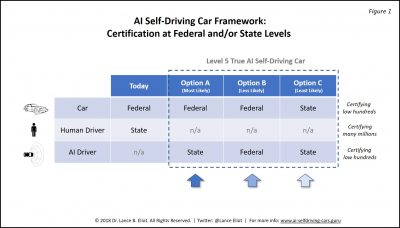 Today, as I already mentioned, the federal government certifies the car, while the state government certifies or licenses the human driver. I’ve earlier provided various reasons why this makes sense, beyond just the tradition of the matter.
Once we have true AI self-driving cars at a Level 5, who should be certifying or licensing the AI driver?
It’s a serious question. I say that it is serious because sometimes people laugh when I ask the question. There laughter stems from the notion that the AI is a kind of robot, though not one you necessarily see in the self-driving car (it’s not a walking-talking physical robot), and they find it hard to imagine that you would give a driver’s license test to a robot.
Yes, go ahead for a moment and make-up your own stories on this. There you are at the DMV, waiting patiently to take the written test to get your driver’s license, and standing in front of you is this six-foot-tall robot, clutching the DMV study booklet, also waiting in line to take the test. The robot looks furtively around.
Glancing at you, the robot whispers to you in a small mechanical sounding voice and asks you what the roadway sign is for a washed-out road. You are torn about whether to give the answer to the robot. Maybe if you help this robot to pass the test, you are helping to put something onto our roadways that you believe shouldn’t be driving on our streets. On the other hand, your worried that if you don’t answer the question, the muscular robot might pick you up by your neck and toss you outside the DMV. Yikes, those robots!
Returning to reality, let’s dispense with the robot imaginary for now.
Assume that an auto maker or tech firm has developed an AI self-driving car. The AI does the driving. There is no human driver for this brand of car. Any humans that get into the AI self-driving car are there strictly as passengers. They can tell the AI where they want to be driven, they can even offer suggestions to the AI about the driving act, yet nonetheless it is the AI that will be driving the self-driving car.
How do you as a human passenger know that the AI can readily, properly, and appropriately drive that AI self-driving car?
And, it’s not just the human passengers that care about this. If I am driving a car on the streets of Los Angeles, and there are AI self-driving cars driving on those same streets, how do I know that the AI can readily, properly and appropriately drive those self-driving cars?
Pedestrians on the streets of Los Angeles want to also know that the AI self-driving car coming down the road is being driven by an AI that can readily, properly and appropriately drive that self-driving car.
We have lots of humans that need to be reassured that the AI of the self-driving car “knows” what it is doing, including passengers in that AI self-driving car, and human drivers of other nearby cars, and human pedestrians that are nearby the AI self-driving car, and so on.
If you like, you could even extend this concern to non-humans, such as dogs and cats that might be running out into the street. Will the AI recognize them and drive in an evasive and safe manner as a human driver might?
You can further extend this to non-human’s non-animals, such as other AI systems that are driving other AI self-driving cars. Allow me to explain this point.
You’ve got auto maker X that makes model Q of an AI self-driving car. Another auto maker Z makes their own model R of an AI self-driving car. The AI that is driving Q is not at all the same as the AI that is driving R. Each of the auto makers has taken their own approach to making their own proprietary AI driving systems.
How does the AI of self-driving car model Q “know” that the model R is being driven by an AI that is readily, properly, and appropriately able to drive that self-driving car of auto maker Z?
The answer right now is that it is a wild west and there is not any as yet a defined or agreed upon means of certifying the AI driving skills of a self-driving car.
As a crude form of analogy, suppose someone took their teenager and opted to teach them how to drive a car, and at some point, the parent figured the teenager was ready to drive on our public roadway unimpeded and unaided. If the parent filled-out some paperwork and submitted it to a governing body, let’s say it was the state in which they were doing the driving, and the parent attested that the teenager was ready to drive, the state would review the documentation and then decide whether to allow the teenager to now be certified or licensed to drive.
There might not be any testing done by the governing body and they would rely solely on the documentation provided by the parent. Substitute the word “parent” for the auto maker, and substitute “teenager” for the AI driving systems, and that’s pretty much the situation we are faced with today as it relates to AI self-driving cars.
Who Will Do The AI Driving Certification
Before I unpack that aspect, let’s revisit the question of whom is going to be certifying the AI driving systems.
It could be that the states each take on the role of doing the driver certification — of course, this has been the role that the states undertake for human drivers. Some though wonder whether the states ought to be doing so. Maybe the federal government ought to be doing the AI driving systems certifications. Why, you might ask?
In the case of human drivers, there are millions of those. Furthermore, those millions of human drivers presumably need to be assessed by the state to make sure that those human drivers meet the requirements of the state and are versed sufficient to drive in that state. It’s kind of a factory of trying to deal with those millions of human drivers.
In the case of AI driving systems, presumably we’ll only have as many as there are AI self-driving car models. Let’s guess that it will be in the low hundreds, using the fact that today there are about 250 or so brands of cars in the United States.
The states no longer would seem to need to be geared up to handle millions of drivers (those humans), and instead would only need to focus on hundreds of drivers (AI driving systems). This also assumes a situation whereby AI self-driving cars become prevalent and there are less and less human drivers to be certified.
Perhaps it would be more economical to have the federal government certify or issue a driver’s license (or equivalent) for the AI driving systems, rather than the states. You could argue that based on my point earlier about duality, the AI is now wrapped into the car. The feds were already doing the certification of the car, and so the AI aspects are simply a natural extension. It would be likened to adding a new bell-and-whistle to a car and expecting that the feds would be certifying the new feature, rather than the states doing so.
You might counter-argue that the AI is not akin to adding a new kind of windshield wiper or anything of that ilk. The AI is driving the car. It is akin to the act of a human driver. Therefore, the certification of the AI needs to be undertaken by the state. Plus, since it is expected by the state that the AI will drive the car as required by the state regulations, the state has a stake in making sure that the AI is indeed ready for and appropriate to be driving in their state.
There are some that even extend this logic and suggest that perhaps the state ought to certify the car and the car driver (the AI) altogether, since the state is getting dragged into the certification of the AI. In other words, if we aren’t going to distinguish the AI from the car, and we consider the AI and the self-driving car to be one integral whole, maybe it is the case that the state should be certifying the entire duality. I mention this notion for completeness, but there are few that take such an extreme view.
It is a conundrum.
How Will The AI Driving Certification Take Place
While pondering this question about whom is going to be doing the certification, let’s also consider an equally juicy and vexing question of how the certification is to be undertaken.
Take a look at Figure 2.
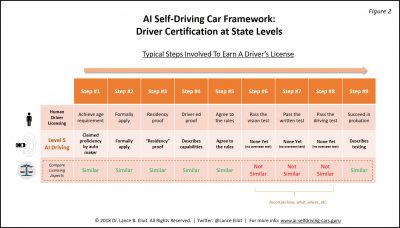 For human drivers, I’ve already mentioned the nine major steps that they must normally perform to be able to get a driver’s license. Of those nine steps, there are some steps that involve testing by the certifying entity, the state, in terms of whether the driver (human) seems ready and able to be a licensed driver.
Humans usually need to pass a vision test. Right now, there is no equivalent to a vision test as administered by a certifying entity for an AI self-driving car. What does a vision test have to do with an AI self-driving car?
You could assert that the equivalent would be a test of the sensory capabilities of an AI self-driving car. An AI self-driving car has cameras and a subsystem devoted to processing visual images. Perhaps that vision processing system should be subject to testing by the entity that might do the certification of the AI driving system. It’s a “vision test” of an AI self-driving car’s vision capability.
Prudently, you would likely enlarge the notion of the vision test to include the other sensory capabilities of the AI self-driving car. We know that vision is crucial, and it is the primary sense used by humans to drive a car, meanwhile for an AI self-driving car it is likely there will also be radar, ultrasonic, LIDAR, and possibly other sensors too, all of which are crucial to the AI driving system. Each and all of those sensors might be broadly placed into the idea of a “vision test” equivalent for an AI self-driving car.
Human drivers usually need to pass a written knowledge test about their driving awareness and understanding. Should there be an equivalent for AI self-driving cars?
Right now, states are tending towards asking for documentation from the auto maker or tech firm, doing so to gauge what the auto maker or tech firm claims their AI system “knows” about. This though does not necessarily involve testing of those aspects. Instead, it tends to be more of a paper-based review, rather than any kind of “test” to ensure that the AI system has or does what the documentation claims that it does.
Should there be a “knowledge” test administered by the certifying entity to an AI driving system for which an auto maker or tech firm is trying to get certified to drive on the public roadways?
And, what about the infamous and terrifying roadway driving test that is administered to human drivers seeking a driver’s license. Should a certifying entity require that an AI self-driving car be taken on a road test by the certifying entity, similar to what is done with human drivers?
At first glance, I am guessing that you might be tempted to say that sure, the certifying entity ought to conduct the vision test, or more broadly tests of the AI sensory systems of the self-driving car, and ought to have the AI undertake some kind of written knowledge test, and ought to have the AI self-driving car undergo a roadway test. This seems like a prudent action. The more the merrier in terms of trying to make sure that the AI driving system is up-to-snuff.
We expect human drivers to pass the battery of tests, why not also expect the AI to do so.
Part of the muddiness involves what kinds of tests you would devise for these purposes. How extensive would the tests be? Where and how would the tests be conducted? Can you do sufficient testing to believe that the AI self-driving car is ready to be on the roadways?
Recall that I had earlier mentioned that human drivers are administered a written test of maybe 20 to 50 questions, and we agreed that this is a rather small subset of the wide range of knowledge that we expect humans to have about driving. Do we feel the same about having such a short shrift when testing an AI driving system?
For the roadway driving test, the human tester of the DMV perhaps observes the human driver for about 30 minutes or so. Would that be sufficient for assessing the capabilities of an AI driving system?
If you are going to do more extensive testing, the odds are that the state testing would require more elaborated testing development, far beyond the kind of testing done today with human drivers. One argument is that maybe have the federal government could do core testing of the AI driving system, and have the states do an augmented testing that examines the state-specifics. Or, another idea is that the federal certification would encompass the state-specifics and indicate which states the AI self-driving car was certified to drive in.
For human drivers, once you are a licensed driver in any of the states, you pretty much can readily drive in another state, doing so without having to get an additional driver’s license.
One concern about AI self-driving cars and testing would be that if a state certified the AI driving system, and suppose that another state does not acknowledge that as a valid certification for AI self-driving cars in their state, it would mean that when your AI self-driving car reached the border of that other state, the AI self-driving car would need to come to a halt and not enter into that state. If the AI self-driving car continued ahead into the other state, doing so would mean that the AI was unlicensed and illegally driving in that state.
Another factor to consider is whether or not we are expecting that the AI of a true AI self-driving car to be able to use common sense reasoning and otherwise have human-like qualities of a sort. If that’s the case, we might need to concoct some kind of Turing Test, which is a long-time and muchly debated means of trying to ascertain whether an AI system is human-like in its cognitive output.
For my article about common sense reasoning aspects, see: https://www.aitrends.com/selfdrivingcars/common-sense-reasoning-and-ai-self-driving-cars/
For the nature of the Turing Test in AI, see my article: https://www.aitrends.com/selfdrivingcars/turing-test-ai-self-driving-cars/
For the matter of the potential of singularity and AI, see my article: https://www.aitrends.com/selfdrivingcars/singularity-and-ai-self-driving-cars/
For my article about safety and AI self-driving cars, see: https://www.aitrends.com/selfdrivingcars/safety-and-ai-self-driving-cars-world-safety-summit-on-autonomous-tech/
More Twists Involved In The AI Driverless Certification
There are additional twists about the testing of AI self-driving cars for certification purposes.
One means of the roadway testing by a human tester would be to do the same as normally is undertaken with human drivers, namely driving on public roadways. This is practical because most DMV’s are not perchance next door to a closed track or proving grounds that could be used for the testing. That being said, some DMV’s require the driver to first do some parking lot driving, essentially akin to doing a limited closed track test.
So, would the AI driving system be tested on the public roadways or instead (or in addition) be tested on a closed track? If it is a closed track, would this be within the confines of state doing the certification, or could be it be outside of that state (since the state might not have such facilities available). Would the closed track be the only done within the proving grounds testing or would it be done in conjunction with public roadways testing?
Another approach to testing could be the use of simulations. The certifying entity might establish a simulation that encompasses driving in their state, and then have the AI driving system have to take that test. The advantage is that the simulation could force the AI to drive millions upon millions of miles, doing so far beyond what might be feasible in roadway driving tests. An obvious downside is that the simulation is not necessarily the same as actual roadway aspects, though you might combine some amount of simulation with some amount of actual roadway testing.
If the AI self-driving car makes use of remote operators, either for controlling the driving of the self-driving car in emergency circumstances or as an augmentation that provides at times guidance to the AI, would this aspect also be encompassed by the testing? One would assume so.
One concern about any of the testing is that the AI you are testing is not necessarily the same AI that will be driving the self-driving car.
If the AI has Machine Learning or Deep Learning capabilities, it is going to be changing over time, doing so by hopefully improving as it “learns” more and more about driving. We don’t know for sure that the AI is going to become better at driving and could actually get worse or introduce nuances that can get itself into trouble.
There are also going to be updates made to the AI system, typically by the use of OTA (Over-The-Air) electronic communications. The OTA is a two-way street. The AI self-driving car can upload data into the cloud such as the collected sensory data. And, the cloud of the auto maker or tech firm can download into the AI self-driving car any patches or updates. This can happen whenever the auto maker or tech firm believes such updates are needed.
Thus, whenever the certifying entity tests the AI driving system, it is only testing at a particular point in time. What about five minutes later? Five days later? Five months later?
Those that aren’t worried about this changing AI system aspect are often quick to point out that humans also change, and yet we don’t seem overly concerned about right away retesting them. Sure, when their driver’s license comes up for renewal every few years, depending upon what their driving records indicates and how long it has been since they were tested, they might be required to do a retest. These such pundits would say that the same can be applied to AI driving systems.
This is not an entirely satisfying argument though, as we aren’t as sure, as one would well argue, about how the AI will be changing versus in the aggregate about human drivers changing over time.
For my article about OTA, see: https://www.aitrends.com/selfdrivingcars/air-ota-updating-ai-self-driving-cars/
For more about Machine Learning and AI self-driving cars, see my article: https://www.aitrends.com/selfdrivingcars/machine-learning-benchmarks-and-ai-self-driving-cars/
For my article about simulations and AI self-driving cars, see: https://www.aitrends.com/selfdrivingcars/simulations-self-driving-cars-machine-learning-without-fear/
For more about closed track testing, see my article: https://www.aitrends.com/selfdrivingcars/proving-grounds-ai-self-driving-cars/
For the aspects of remote operators of AI self-driving cars, see my article: https://www.aitrends.com/selfdrivingcars/remote-piloting-is-a-self-driving-car-crutch/
Edge Or Corner Cases To Be Included
Here’s another interesting twist. When a certifying entity is trying to test an AI self-driving car, how far can they go in doing so? Can they go beyond the normal everyday driving acts and push the boundaries of what might happen while driving a car? These are at times referred to as edge or corner cases.
For example, suppose the front cameras of the self-driving car are suddenly unable to function, maybe obscured by dirt or perhaps they were hit by flying debris. How well does the AI handle this aspect? Is that a proper test by the certifying entity?
I know that some would argue that there is no equivalent for human drivers during their certification testing, namely the DMV tester doesn’t suddenly blind one eye of the human driver or toss mud onto the windshield. Again, I don’t buy into this kind of assertion, and instead believe that we can and should hold the AI to a higher standard of testing.
A somewhat brazen aspect being voiced by some pundits involves having a third party or some set of designated third parties that would do the certification testing of AI self-driving cars, rather than having a governmental entity do so.
On that point, you might be aware that Consumer Reports (CR) recently released their first-ever review of automated driving systems, which is not the same as autonomous driving but nonetheless signifies this notion of third-party testing aspects. Consumer Reports used their Auto Test Center track, along with nearby freeways, and put several of the latest models through a series of tests. They selected four such cars, the Cadillac CT6, the Tesla X/S/3, the Infiniti QX50/Nissan Leaf, and the Volvo XC40/XC60.
Consumer Reports ranked the tested cars based on a variety of factors including automated driving capability, performance, ease of use, and how the respective systems monitored and reacted to human drivers that should be engaged in the driving task. Here’s the Consumer Reports ranking of the four systems tested, listed from highest to lesser on their scale of assessment:
- Cadillac Super Cruise
- Tesla Autopilot
- Nissan/Infiniti ProPilot
- Volvo Pilot Assist
If you are interested in the details of how CR did the testing, take a look at: https://www.consumerreports.org/autonomous-driving/cadillac-tops-tesla-in-automated-systems-ranking/
The overall point being that another approach to the certification topic could involve enlisting private companies, non-profits, consortia, or other third parties to perform the certification. This might be done at the behest of a governmental agency or in conjunction with a governmental agency. There are various efforts underway by numerous entities aiming to see if this approach might be viable.
In terms of the states, California is one of a handful of states that has opted to vigorously pursue the matter of AI self-driving cars. Having adopted California Vehicle Code (CVC) section 38750, taking effect on April 2, 2018, the regulations cover the testing and use of self-driving cars in the state.
There are three major portions of the regulation:
- Auto makers or tech firms can seek a testing permit, requiring the presence of a human driver
- Auto makers or tech firms can seek a driverless testing permit
- Auto makers or tech firms can see the deployment license aka public use permit
If you are interested in seeing the details, along with the checklists and forms required for a submission, take a look at: https://www.dmv.ca.gov/portal/dmv/detail/vr/autonomous/bkgd
Conclusion
We collectively need to ascertain how AI self-driving cars should be certified or licensed to drive on our streets. It’s a big deal.
For human drivers, the path to becoming licensed as a driver is well-worn and shown to be relatively reliable and valid.
AI self-driving cars present a novelty that the existing licensing has yet to adapt to. There is an inherent duality of the car and the AI that makes trying to separate out their testing problematic. We need to know that we have good cars and good AI drivers, and it would seem that we should go further than simply having the auto maker or tech firm provide us with their own testing results.
Currently, we all rely upon an entity to certify that drivers in the cars next to us are at least minimally certified to be able to drive a car. When you look over and see that empty driver’s seat and realize the car next to you is being driven by AI, you ought to feel some comfort that one way or another there was a bona fide and independent process of trying to test and ensure that the AI driving system is up to the task at-hand. That’s a rite of passage needed for AI self-driving cars.
Copyright 2019 Dr. Lance Eliot
This content is originally posted on AI Trends.