By Aditya Kalra
NEW DELHI (Reuters) - Amazon.com Inc <AMZN.O> has complained to India's market regulator that its local partner Future Retail Ltd <FRTL.NS> misled shareholders by incorrectly saying it was complying with its contractual obligations to the U.S. e-commerce giant, a letter seen by Reuters shows.
Amazon is locked in a bitter legal dispute with Future Group, which in August sold its retail assets to Mukesh Ambani-led Reliance Industries Ltd <RELI.NS> for $3.4 billion. The deal, Amazon alleges, breaches 2019 agreements by Future.
The tussle has strained Amazon's ties not just with Future Retail - one of India's top retailers - but also with Ambani, Asia's richest man, and his Reliance group, which is fast expanding its e-commerce business and threatening companies like Amazon.
Amazon last Sunday won an injunction to halt Future's ...
Read More on Datafloq
Saturday, 31 October 2020
Amazon drops French Black Friday ad campaign as lockdown starts
PARIS (Reuters) - Amazon is withdrawing advertising for pre-Black Friday discounts in France, after the government said the campaign was unfair to small shops at time when a coronavirus lockdown has forced them to close.
France entered its second national lockdown on Friday to try to contain a surge in infections. The curbs imposed under it include the closure of non-essential stores.
A spokeswoman for Amazon <AMZN.O> said the group had agreed to halt its radio advertising campaign around pre-Black Friday sales.
A page with discounted items under the header "Black Friday ahead of time" was live on its French website on Saturday, however.
Junior Economy Minister Agnes Pannier-Runchaer said she had asked Amazon to suspend the campaign. It was "not at all appropriate at a time when 200,000 businesses will have to ...
Read More on Datafloq
France entered its second national lockdown on Friday to try to contain a surge in infections. The curbs imposed under it include the closure of non-essential stores.
A spokeswoman for Amazon <AMZN.O> said the group had agreed to halt its radio advertising campaign around pre-Black Friday sales.
A page with discounted items under the header "Black Friday ahead of time" was live on its French website on Saturday, however.
Junior Economy Minister Agnes Pannier-Runchaer said she had asked Amazon to suspend the campaign. It was "not at all appropriate at a time when 200,000 businesses will have to ...
Read More on Datafloq
How Learning a Sitecore Benefits me to get a Lost Job in Pandemic
A Content management system (CMS) is an application that helps organizations in effectively building up a site, overseeing content (text, pictures, recordings), and some extra assignments like coordinating essential SEO rehearses (change of META Tags, ALT ascribes, or versatile status). The universe of CMS is being controlled by WordPress (an open-source CMS dependent on PHP and MySQL). Sitecore, then again, is a .Net based endeavor CMS that empowers designers and substance chiefs to have unlimited authority over all parts of substance distributing, conveyance, advertising, and all these in an intensely customized structure. However, Sitecore professes to be a CXP (client experience stage) with amazing online media combinations, internet business availability, and AI-controlled highlights.What is Sitecore?Sitecore advancement is a developing pattern in the client-driven market. With the immense range of substance, the board devices, organizations are enabled to choose the incomparable CMS and join it with developing arrangements. Sitecore is situated to lead market draws near and named among 2020 Gartner Magic Quadrant for computerized experience stages (DXPs). The decent mixing of promoting and innovation permits them to give various progressed items the incredible CMS at its center. Made in 2001, the .NET based substance the board framework has figured out ...
Read More on Datafloq
Read More on Datafloq
Ahead of U.S. election, Facebook suspends political and new group recommendations
By Elizabeth Culliford
(Reuters) - Facebook Inc confirmed on Friday it was temporarily halting recommendations for all political groups and any new groups in the run-up to Tuesday's U.S. presidential election.
Facebook's Chief Executive Officer Mark Zuckerberg referred to one of the changes during a Senate hearing on Wednesday, saying: "We have taken the steps to stop recommendations in groups for all political content or social issue groups as a precaution."
Facebook Groups are communities that form around shared interests. Public groups can be seen, searched and joined by anyone on Facebook.
Ahead of the U.S. vote, several watchdog and advocacy groups have pushed for Facebook to limit algorithmic group recommendations. They have argued that some Facebook Groups have been used as spaces to spread misinformation and organize extremist activity.
...
Read More on Datafloq
(Reuters) - Facebook Inc confirmed on Friday it was temporarily halting recommendations for all political groups and any new groups in the run-up to Tuesday's U.S. presidential election.
Facebook's Chief Executive Officer Mark Zuckerberg referred to one of the changes during a Senate hearing on Wednesday, saying: "We have taken the steps to stop recommendations in groups for all political content or social issue groups as a precaution."
Facebook Groups are communities that form around shared interests. Public groups can be seen, searched and joined by anyone on Facebook.
Ahead of the U.S. vote, several watchdog and advocacy groups have pushed for Facebook to limit algorithmic group recommendations. They have argued that some Facebook Groups have been used as spaces to spread misinformation and organize extremist activity.
...
Read More on Datafloq
Twitter unfreezes New York Post account days after backlash from Republican lawmakers
By Nandita Bose and David Shepardson
WASHINGTON (Reuters) - Twitter <TWTR.N> said on Friday it had changed its policy on hacked materials and lifted a freeze it had placed on the account of the New York Post.
The New York Post can now send tweets again, the social media platform said. It had blocked the newspaper's account on Oct. 14 after it published articles about Democratic presidential candidate Joe Biden's son, which Twitter said violated its hacked materials policy.
Earlier this week, Twitter's Chief Executive Jack Dorsey drew fire from Republican lawmakers, who accused the company of selective censorship against conservatives.
The New York Post tweeted a picture featuring Twitter's bird logo flying out of a cage, with the caption "Twitter backs down, finally unlocks Post account after Biden ban."
...
Read More on Datafloq
WASHINGTON (Reuters) - Twitter <TWTR.N> said on Friday it had changed its policy on hacked materials and lifted a freeze it had placed on the account of the New York Post.
The New York Post can now send tweets again, the social media platform said. It had blocked the newspaper's account on Oct. 14 after it published articles about Democratic presidential candidate Joe Biden's son, which Twitter said violated its hacked materials policy.
Earlier this week, Twitter's Chief Executive Jack Dorsey drew fire from Republican lawmakers, who accused the company of selective censorship against conservatives.
The New York Post tweeted a picture featuring Twitter's bird logo flying out of a cage, with the caption "Twitter backs down, finally unlocks Post account after Biden ban."
...
Read More on Datafloq
U.S. judge blocks Commerce Department TikTok order
By David Shepardson
WASHINGTON (Reuters) - A U.S. judge in Pennsylvania on Friday blocked a U.S. Commerce Department order set to take effect on Nov. 12 that would have effectively barred Chinese-owned short video-sharing app TikTok from operating in the United States.
U.S. District Court Judge Wendy Beetlestone enjoined the Commerce Department from barring data hosting within the United States for TikTok, content delivery services and other technical transactions.
In her ruling, Beetlestone said the order would "have the effect of shutting down, within the United States, a platform for expressive activity used by approximately 700 million individuals globally. Over 100 million of these TikTok users are within the United States, and at least 50 million of these U.S. users use the app on a daily basis."
The Commerce Department, which did not immediately ...
Read More on Datafloq
WASHINGTON (Reuters) - A U.S. judge in Pennsylvania on Friday blocked a U.S. Commerce Department order set to take effect on Nov. 12 that would have effectively barred Chinese-owned short video-sharing app TikTok from operating in the United States.
U.S. District Court Judge Wendy Beetlestone enjoined the Commerce Department from barring data hosting within the United States for TikTok, content delivery services and other technical transactions.
In her ruling, Beetlestone said the order would "have the effect of shutting down, within the United States, a platform for expressive activity used by approximately 700 million individuals globally. Over 100 million of these TikTok users are within the United States, and at least 50 million of these U.S. users use the app on a daily basis."
The Commerce Department, which did not immediately ...
Read More on Datafloq
Announcing Azure Databricks Power BI Connector (Public Preview)
Databricks and Microsoft Power BI customers will be delighted to know that an enhanced Azure Databricks PowerBI connector is now natively integrated into Power BI Desktop (2.85.681.0 and above ) and Power BI Service!
The native connector lets users connect to Databricks from PowerBI Desktop with a couple of clicks, using Azure Active Directory (Azure AD) credentials and SSO for PowerBI Service users. With support for DirectQuery, users directly access data in Databricks, querying fresh data, enforcing data lake security controls – no need to duplicate security controls in PowerBI. The Databricks ODBC driver has been further optimised to speed up transfer of results.
Support for Azure AD and SSO for PowerBI Service
Users can use their Azure AD credentials to connect to Databricks. Power BI services users can access shared reports using SSO, using their own AAD credentials when accessing Databricks in DirectQuery mode. Administrators no longer need to generate PAT tokens for authentication.
Simple connection configuration
The new Databricks connector is natively integrated into PowerBI. Connections to Databricks are configured with a couple of clicks. In Power BI Desktop, users select Databricks as a data source (1), authenticate once using AAD (2) and enter the Databricks-specific connection details (3). Just like that, you are ready to query the data!
(1) |
(2) |
|
(3) |
||
Direct access to Data Lake via DirectQuery
When using Power BI DirectQuery, data is directly accessed in Databricks, allowing users to query and visualise large datasets, without the size limitations imposed by import queries. Power query results are always fresh and Delta Lake data security controls are enforced. For PowerBi Service users, SSO ensures that users access Databricks with their own credentials. There is no need to duplicate security controls in PowerBI.
Faster results via Databricks ODBC
The Databricks ODBC driver has been optimised with reduced query latency, increased result transfer speed based on Apache Arrow serialization, and improved metadata retrieval performance.
The enhanced Azure Databricks connector is the result of an on-going collaboration between Databricks and Microsoft. Take this enhanced connector for a test drive to improve your Databricks connectivity experience, and let us know what you think. We would love to hear from you!
References
Azure Databricks Power BI Documentation
Databricks ODBC driver release notes.
--
Try Databricks for free. Get started today.
The post Announcing Azure Databricks Power BI Connector (Public Preview) appeared first on Databricks.
AI Contact Tracer Awarded at UNLV

If someone reports sick after a gathering, a new AI-based system can trace contacts across four days and thousands of people in just four seconds.
This week, UNLV Lee Business School awarded Volan Technology the coveted Lee Prize Nevada Innovation Award for its advanced solution for enterprise-scale, precise and private contact tracing software. The technology could enable hospitality operators to make dramatic improvements in virus prevention—and save millions of dollars in manual tracing.
Read the full report by JT Long at SmartMeetings.com.
Alibaba-owned Lazada suffers data hack of 1.1 million accounts
SINGAPORE (Reuters) - Singapore e-commerce firm Lazada said on Friday that personal information including addresses and partial credit card numbers from 1.1 million accounts had been hacked, a major breach in the city-state of 5.7 million.
The Alibaba-owned firm said in an email that the information was taken from a database of its grocery arm RedMart that was more than 18 months out of date.
"The user information that was illegally accessed include names, phone numbers, email and mailing addresses, encrypted passwords and partial credit card numbers," a spokesman for Lazada said.
The firm said it had immediately moved to block access to the database and that its current customer data was not affected.
(Reporting ...
Read More on Datafloq
The Alibaba-owned firm said in an email that the information was taken from a database of its grocery arm RedMart that was more than 18 months out of date.
"The user information that was illegally accessed include names, phone numbers, email and mailing addresses, encrypted passwords and partial credit card numbers," a spokesman for Lazada said.
The firm said it had immediately moved to block access to the database and that its current customer data was not affected.
(Reporting ...
Read More on Datafloq
Walmart unit Sam's Club partners with DoorDash to deliver medicines
(Reuters) - Warehouse chain Sam's Club, a unit of Walmart Inc, said on Friday it will provide prescribed medicines to patients through delivery firm DoorDash Inc, as customers turn to digital orders during the COVID-19 pandemic.
DoorDash will deliver items from more than 500 Sam's Club pharmacies and patients can call the pharmacies to schedule a same-day delivery, the warehouse club operator said.
Demand for online delivery, ranging from meal kits to sporting goods, has soared during the outbreak, as stay-at-home consumers increasingly prefer having items delivered at their doorsteps due to fears of contracting the virus.
Patients can buy prescribed medications from Sam's Club without a membership, according to the club operator's website.
"Businesses have evolved amid the pandemic to prioritize the safety of their communities and to adapt to new consumer ...
Read More on Datafloq
DoorDash will deliver items from more than 500 Sam's Club pharmacies and patients can call the pharmacies to schedule a same-day delivery, the warehouse club operator said.
Demand for online delivery, ranging from meal kits to sporting goods, has soared during the outbreak, as stay-at-home consumers increasingly prefer having items delivered at their doorsteps due to fears of contracting the virus.
Patients can buy prescribed medications from Sam's Club without a membership, according to the club operator's website.
"Businesses have evolved amid the pandemic to prioritize the safety of their communities and to adapt to new consumer ...
Read More on Datafloq
Qualcomm, FedEx, auto executives to propose modernized transport policies
By David Shepardson
WASHINGTON (Reuters) - A group of business leaders and public policy experts will launch a new body to grapple with thorny questions surrounding the future of transportation including self-driving and electric vehicles.
The group, the Future of Mobility Commission, to be formally unveiled Friday, plans to propose a new regulatory framework to address a global transportation sector "on the cusp of a worldwide transition driven by shared, connected, autonomous, and electric technologies."
Alisyn Malek, the commission's executive director, told Reuters the goal is to tackle tough problems and improve safety.
"Let's bring everybody together to talk about how do we want the movement of people and goods to actually work," Malek said in an interview.
Autonomous cars and ...
Read More on Datafloq
WASHINGTON (Reuters) - A group of business leaders and public policy experts will launch a new body to grapple with thorny questions surrounding the future of transportation including self-driving and electric vehicles.
The group, the Future of Mobility Commission, to be formally unveiled Friday, plans to propose a new regulatory framework to address a global transportation sector "on the cusp of a worldwide transition driven by shared, connected, autonomous, and electric technologies."
Alisyn Malek, the commission's executive director, told Reuters the goal is to tackle tough problems and improve safety.
"Let's bring everybody together to talk about how do we want the movement of people and goods to actually work," Malek said in an interview.
Autonomous cars and ...
Read More on Datafloq
Waymo releases Phoenix area self-driving car incident score card
By Jane Lanhee Lee
OAKLAND, Calif (Reuters) - Self-driving tech company Waymo, which this month opened its driverless taxi service in the Phoenix suburbs to the public, on Friday said its autonomous vehicles there had been involved in 18 minor incidents since 2019 during tests and actual rides.
Waymo, a unit of Google parent Alphabet Inc <GOOGL.O>, said it was releasing the data https://ift.tt/3jH6v7P to improve transparency and open a public dialogue. Some residents have complained about the hundreds of Waymo vans driving around town, telling Reuters in the past that their driving patterns were dangerous as they stopped too often, running the risk of being rear-ended by a human driver.
Waymo also said it hopes its safety data will help companies and regulators devise industry-wide safety standards for self-driving cars.
...
Read More on Datafloq
OAKLAND, Calif (Reuters) - Self-driving tech company Waymo, which this month opened its driverless taxi service in the Phoenix suburbs to the public, on Friday said its autonomous vehicles there had been involved in 18 minor incidents since 2019 during tests and actual rides.
Waymo, a unit of Google parent Alphabet Inc <GOOGL.O>, said it was releasing the data https://ift.tt/3jH6v7P to improve transparency and open a public dialogue. Some residents have complained about the hundreds of Waymo vans driving around town, telling Reuters in the past that their driving patterns were dangerous as they stopped too often, running the risk of being rear-ended by a human driver.
Waymo also said it hopes its safety data will help companies and regulators devise industry-wide safety standards for self-driving cars.
...
Read More on Datafloq
Apple shares fall as iPhone sales dip weighs on record quarterly results
By Subrat Patnaik
(Reuters) - Apple Inc's <AAPL.O> shares fell nearly 5% in premarket trading after the world's most valuable public company reported a steep fall in iPhone sales in China, hurt by the delay of its new model due to the COVID-19 pandemic.
Customers put off buying new devices in the second half of September, leading the company to report its steepest quarterly drop in iPhone sales in at least three years.
"We think this was most blatant in China, where 5G service is more accessible, with sales in the region declining 29% - also a bigger decline than we anticipated," Angelo Zino, analyst at CFRA Research said on Thursday.
Analysts also noted that the iPhone represents a larger portion of revenue in China than any other region, making the company more dependent ...
Read More on Datafloq
(Reuters) - Apple Inc's <AAPL.O> shares fell nearly 5% in premarket trading after the world's most valuable public company reported a steep fall in iPhone sales in China, hurt by the delay of its new model due to the COVID-19 pandemic.
Customers put off buying new devices in the second half of September, leading the company to report its steepest quarterly drop in iPhone sales in at least three years.
"We think this was most blatant in China, where 5G service is more accessible, with sales in the region declining 29% - also a bigger decline than we anticipated," Angelo Zino, analyst at CFRA Research said on Thursday.
Analysts also noted that the iPhone represents a larger portion of revenue in China than any other region, making the company more dependent ...
Read More on Datafloq
Friday, 30 October 2020
Sony in talks with AT&T to buy Crunchyroll for more than $950 million: Nikkei
TOKYO (Reuters) - Sony Corp is in final talks with AT&T to acquire U.S. animation-streaming service Crunchyroll in a deal worth more than 100 billion yen ($957 million), the Nikkei business daily reported on Friday.
The acquisition would give Sony access to Crunchyroll's 70 million members around the world, allowing the Japanese entertainment and electronics conglomerate to compete better with Netflix and other global rivals, the Nikkei said.
Sony, which recently obtained exclusive rights to negotiate for Crunchyroll, hopes to leverage the new channel to distribute its own entertainment content, including films and music.
A Sony spokesman declined to comment on the report.
It bought Funimation Productions Ltd, an animation distributor with one million paying subscribers, for about $143 million in 2017.
...
Read More on Datafloq
The acquisition would give Sony access to Crunchyroll's 70 million members around the world, allowing the Japanese entertainment and electronics conglomerate to compete better with Netflix and other global rivals, the Nikkei said.
Sony, which recently obtained exclusive rights to negotiate for Crunchyroll, hopes to leverage the new channel to distribute its own entertainment content, including films and music.
A Sony spokesman declined to comment on the report.
It bought Funimation Productions Ltd, an animation distributor with one million paying subscribers, for about $143 million in 2017.
...
Read More on Datafloq
Witness testimony in Huawei CFO's U.S. extradition case enters final day
By Tessa Vikander and Moira Warburton
VANCOUVER (Reuters) - A fifth and final scheduled day of witness testimony in the extradition case of Huawei Chief Financial Officer Meng Wanzhou in a Canadian court will conclude on Friday, although lawyers for both sides proposed days be added to hear all witnesses.
Meng, 48, was arrested by Canadian police on a U.S. warrant in December 2018 while on a layover in Vancouver, bound for Mexico. The United States charged her with bank fraud, accusing her of misleading HSBC about Huawei Technologies Co Ltd's business dealings in Iran, causing the bank to break U.S. sanctions.
Meng has claimed innocence and is fighting the charges from Vancouver where she is under house arrest, monitored by private security at her home in the upscale neighborhood of Shaughnessy.
On Friday, ...
Read More on Datafloq
VANCOUVER (Reuters) - A fifth and final scheduled day of witness testimony in the extradition case of Huawei Chief Financial Officer Meng Wanzhou in a Canadian court will conclude on Friday, although lawyers for both sides proposed days be added to hear all witnesses.
Meng, 48, was arrested by Canadian police on a U.S. warrant in December 2018 while on a layover in Vancouver, bound for Mexico. The United States charged her with bank fraud, accusing her of misleading HSBC about Huawei Technologies Co Ltd's business dealings in Iran, causing the bank to break U.S. sanctions.
Meng has claimed innocence and is fighting the charges from Vancouver where she is under house arrest, monitored by private security at her home in the upscale neighborhood of Shaughnessy.
On Friday, ...
Read More on Datafloq
Online giants will have to open ad archives to EU antitrust regulators
By Foo Yun Chee
BRUSSELS (Reuters) - Dominant tech companies will have to explain how their algorithms work under proposed new EU rules and also open up their ad archives to regulators and researchers, Europe's digital and antitrust chief said on Friday.
The move is likely to impact U.S. online giants such as Alphabet unit Google, Amazon, Apple and Facebook, with their treasure troves of data and lucrative online advertising businesses.
Advertising algorithms help companies target ads at the users that advertisers want to reach.
European Competition Commissioner Margrethe Vestager said the goal was to shed light on how these algorithms work and to make sure that companies are accountable for their decisions.
"And the biggest platforms would have to provide ...
Read More on Datafloq
BRUSSELS (Reuters) - Dominant tech companies will have to explain how their algorithms work under proposed new EU rules and also open up their ad archives to regulators and researchers, Europe's digital and antitrust chief said on Friday.
The move is likely to impact U.S. online giants such as Alphabet unit Google, Amazon, Apple and Facebook, with their treasure troves of data and lucrative online advertising businesses.
Advertising algorithms help companies target ads at the users that advertisers want to reach.
European Competition Commissioner Margrethe Vestager said the goal was to shed light on how these algorithms work and to make sure that companies are accountable for their decisions.
"And the biggest platforms would have to provide ...
Read More on Datafloq
Why NASA's moonshot, Boeing, Bezos and Musk have a lot riding on U.S. election
By Joey Roulette and Eric M. Johnson
WASHINGTON/SEATTLE (Reuters) - U.S. President Donald Trump's differences with rival presidential candidate Joe Biden extend far beyond planet earth.
President Trump's plans to win the race in space call for a 2024 moon mission, and ending direct U.S. financial support for the International Space Station in 2025 - turning over control of the decades-old orbital laboratory to private space companies.
Biden, on the other hand, would likely call for a delayed moonshot and propose a funding extension for the International Space Station if he wins the White House, according to people familiar with the fledging Biden space agenda.
Pushing back the moon mission could cast more doubt on the long-term fate of Boeing Co's Space Launch System (SLS) rocket, just as Elon Musk's SpaceX and Jeff Bezos' ...
Read More on Datafloq
WASHINGTON/SEATTLE (Reuters) - U.S. President Donald Trump's differences with rival presidential candidate Joe Biden extend far beyond planet earth.
President Trump's plans to win the race in space call for a 2024 moon mission, and ending direct U.S. financial support for the International Space Station in 2025 - turning over control of the decades-old orbital laboratory to private space companies.
Biden, on the other hand, would likely call for a delayed moonshot and propose a funding extension for the International Space Station if he wins the White House, according to people familiar with the fledging Biden space agenda.
Pushing back the moon mission could cast more doubt on the long-term fate of Boeing Co's Space Launch System (SLS) rocket, just as Elon Musk's SpaceX and Jeff Bezos' ...
Read More on Datafloq
Wary of security issues, Japan's government moves to shut China out of its drone supply chain
By Kaori Kaneko and Izumi Nakagawa
TOKYO (Reuters) - Japan may effectively shut off China from supplying drones to its government to protect sensitive information, according to six people in government and the ruling party familiar with the matter, as part of a broad effort to bolster national security.
The primary concerns, those people said, centred on information technology, supply chains, cyber security and intellectual property - worries that have been rising outside Japan as well.
But Japan must balance such fears - particularly Beijing's growing push to export sensitive technologies such as commercial drones and security cameras - against deep economic dependence on China.
It must also navigate increasingly choppy waters between China and Japan's closest ally, the United States, which is at odds with Beijing over many things, including ...
Read More on Datafloq
TOKYO (Reuters) - Japan may effectively shut off China from supplying drones to its government to protect sensitive information, according to six people in government and the ruling party familiar with the matter, as part of a broad effort to bolster national security.
The primary concerns, those people said, centred on information technology, supply chains, cyber security and intellectual property - worries that have been rising outside Japan as well.
But Japan must balance such fears - particularly Beijing's growing push to export sensitive technologies such as commercial drones and security cameras - against deep economic dependence on China.
It must also navigate increasingly choppy waters between China and Japan's closest ally, the United States, which is at odds with Beijing over many things, including ...
Read More on Datafloq
LG Chem shareholders approve plan to split off battery business: source
SEOUL (Reuters) - LG Chem shareholders approved the company's proposal to separate its battery business into a new company, a source familiar with the matter told Reuters on Friday.
The decision paves the way for the battery business, a supplier for Tesla Inc and General Motors Co, to potentially raise funds and go public to finance its high-cost capacity expansion.
More than 82% of LG Chem shareholders who attended the meeting voted in favour of the plan, the source said. LG Chem declined to comment.
The unit, which will be launched on Dec. 1, will first become a wholly-owned subsidiary tentatively named LG Energy Solutions, and then up to 30% of the company's shares may be listed in an initial offering in about a year.
LG Chem's stock price fell 2.8%.
...
Read More on Datafloq
The decision paves the way for the battery business, a supplier for Tesla Inc and General Motors Co, to potentially raise funds and go public to finance its high-cost capacity expansion.
More than 82% of LG Chem shareholders who attended the meeting voted in favour of the plan, the source said. LG Chem declined to comment.
The unit, which will be launched on Dec. 1, will first become a wholly-owned subsidiary tentatively named LG Energy Solutions, and then up to 30% of the company's shares may be listed in an initial offering in about a year.
LG Chem's stock price fell 2.8%.
...
Read More on Datafloq
Xiaomi grabs smartphone marketshare in third quarter as Huawei wobbles: data
SHANGHAI/SINGAPORE (Reuters) - Chinese smartphone maker Xiaomi Corp grabbed market share in China and Europe in the September quarter as rival Huawei Technologies' dominance slipped due to U.S. sanctions, market data showed.
Xiaomi took third spot on the global leaderboard. It sold 47.1 million handsets in the third quarter, a 45% surge from a year earlier, according to market research firm Canalys.
The global smartphone market contracted 1% year-on-year in July-September with shipments down to 348 million units, but rose 22% from the pandemic-pummeled second quarter.
Samsung Electronics Co Ltd regained the top spot, helped by sales in India, where Chinese brands suffered due to political tensions.
Huawei slipped to number two globally, and Apple, which only launched the new iPhone earlier this month, took the number four spot in the September quarter.
...
Read More on Datafloq
Xiaomi took third spot on the global leaderboard. It sold 47.1 million handsets in the third quarter, a 45% surge from a year earlier, according to market research firm Canalys.
The global smartphone market contracted 1% year-on-year in July-September with shipments down to 348 million units, but rose 22% from the pandemic-pummeled second quarter.
Samsung Electronics Co Ltd regained the top spot, helped by sales in India, where Chinese brands suffered due to political tensions.
Huawei slipped to number two globally, and Apple, which only launched the new iPhone earlier this month, took the number four spot in the September quarter.
...
Read More on Datafloq
Instagram pauses 'recent' search listings on U.S. site to stop fake election news
(Reuters) - Facebook Inc's Instagram said on Thursday it was making changes to its image sharing platform for U.S. users to prevent the spread of misinformation around the Nov. 3 presidential election.
For users in the United States, Instagram will temporarily remove the "Recent" tab from hashtag pages starting Thursday, it said in a statement on Twitter.
"We're doing this to reduce the real-time spread of potentially harmful content that could pop up around the election," the statement added.
Instagram's "Recent" tab arranges hashtags in chronological order and amplifies content. Researchers have cautioned that automated amplification can lead to the rapid spread of misinformation on the platform.
The development comes as social media companies face increasing pressure to combat election-related misinformation and prepare for the possibility of violence or poll place intimidation around the ...
Read More on Datafloq
For users in the United States, Instagram will temporarily remove the "Recent" tab from hashtag pages starting Thursday, it said in a statement on Twitter.
"We're doing this to reduce the real-time spread of potentially harmful content that could pop up around the election," the statement added.
Instagram's "Recent" tab arranges hashtags in chronological order and amplifies content. Researchers have cautioned that automated amplification can lead to the rapid spread of misinformation on the platform.
The development comes as social media companies face increasing pressure to combat election-related misinformation and prepare for the possibility of violence or poll place intimidation around the ...
Read More on Datafloq
Wikipedia buttons up key pages ahead of U.S. election
By Elizabeth Culliford
(Reuters) - Wikipedia has locked down its main election page ahead of the U.S. presidential election so that only certain editors can make changes, part of preparations to combat potential disinformation and abuses related to Tuesday's vote.
The online encyclopedia's articles, written primarily by unpaid volunteers, are relied on by platforms from Alphabet Inc's Google to Amazon Inc's voice assistant Alexa to give their users information and context.
"We're not worried about vandals who want to just mess up an article in order to cause a little trouble. The Wikipedia community deals with those issues for breakfast," Ryan Merkley, chief of staff at the Wikimedia Foundation, the nonprofit organization which hosts Wikipedia, said in a phone interview.
"We're really worried about coordinated actors ... trying to ...
Read More on Datafloq
(Reuters) - Wikipedia has locked down its main election page ahead of the U.S. presidential election so that only certain editors can make changes, part of preparations to combat potential disinformation and abuses related to Tuesday's vote.
The online encyclopedia's articles, written primarily by unpaid volunteers, are relied on by platforms from Alphabet Inc's Google to Amazon Inc's voice assistant Alexa to give their users information and context.
"We're not worried about vandals who want to just mess up an article in order to cause a little trouble. The Wikipedia community deals with those issues for breakfast," Ryan Merkley, chief of staff at the Wikimedia Foundation, the nonprofit organization which hosts Wikipedia, said in a phone interview.
"We're really worried about coordinated actors ... trying to ...
Read More on Datafloq
Apple temporarily closes 17 out of 20 French stores amid fresh lockdown
(Reuters) - Apple Inc will temporarily close 17 of its 20 stores in France from Oct. 30, as the country goes into a fresh one-month lockdown due to a resurgence of coronavirus cases, the company's website showed.
Apple's Opéra, Les Quatre Temps, and Rosny 2 stores in Paris will remain open, the company's website showed. Those three stores are using Apple's new "Express" format, according to the site.
Apple is expanding the "Express" format this month in hopes of still being able to serve customers in areas with high numbers of coronavirus cases, while meeting its own health and safety standards for employees and customers, the company's retail chief told Reuters earlier this month.
The new format has a wall in front of the main store, with sales counters protected by plexiglass and a few shelves of accessories. Customers make an appointment to pick up ...
Read More on Datafloq
Apple's Opéra, Les Quatre Temps, and Rosny 2 stores in Paris will remain open, the company's website showed. Those three stores are using Apple's new "Express" format, according to the site.
Apple is expanding the "Express" format this month in hopes of still being able to serve customers in areas with high numbers of coronavirus cases, while meeting its own health and safety standards for employees and customers, the company's retail chief told Reuters earlier this month.
The new format has a wall in front of the main store, with sales counters protected by plexiglass and a few shelves of accessories. Customers make an appointment to pick up ...
Read More on Datafloq
Netflix raises monthly charges for U.S. customers, shares jump
By Lisa Richwine
(Reuters) - Streaming video service Netflix Inc on Thursday raised monthly charges in the United States for its standard and premium subscription plans, a move that sent the company's shares climbing nearly 5%.
Netflix increased the cost of its standard subscription by $1 a month to $14, and the price for the premium tier rose by $2 per month to $18. The standard plan, the company's most popular, enables two streams at the same time, while the premium plan allows for four simultaneous streams.
The price increase was the first for U.S. customers since January 2019.
Shares of Netflix jumped 4.8% to $509.53 in afternoon trading on Nasdaq.
Netflix, the world's dominant streaming service, enjoyed a ...
Read More on Datafloq
(Reuters) - Streaming video service Netflix Inc on Thursday raised monthly charges in the United States for its standard and premium subscription plans, a move that sent the company's shares climbing nearly 5%.
Netflix increased the cost of its standard subscription by $1 a month to $14, and the price for the premium tier rose by $2 per month to $18. The standard plan, the company's most popular, enables two streams at the same time, while the premium plan allows for four simultaneous streams.
The price increase was the first for U.S. customers since January 2019.
Shares of Netflix jumped 4.8% to $509.53 in afternoon trading on Nasdaq.
Netflix, the world's dominant streaming service, enjoyed a ...
Read More on Datafloq
Tech earnings tsunami buoys Alphabet, sinks Apple
By Noel Randewich
(Reuters) - Alphabet rallied, Apple sank and Twitter tumbled on Thursday after a mixed bag of quarterly reports from top-tier technology companies that investors have relied on this year to power a stock market rally through the coronavirus pandemic.
Share swings following the reports from the tech heavyweights after the bell sent exchange-traded funds tracking the S&P 500 and Nasdaq down about 1% each, suggesting Wall Street may open weaker on Friday.
Mostly upbeat results from Facebook , Google-parent Alphabet and Amazon, along with Microsoft's strong report earlier this week, show how the largest U.S. companies have expanded their businesses and outperformed smaller rivals this year as the pandemic accelerates trends toward online shopping, video streaming and other technologies.
Alphabet and Facebook both reported strong rises in advertising sales and ...
Read More on Datafloq
(Reuters) - Alphabet rallied, Apple sank and Twitter tumbled on Thursday after a mixed bag of quarterly reports from top-tier technology companies that investors have relied on this year to power a stock market rally through the coronavirus pandemic.
Share swings following the reports from the tech heavyweights after the bell sent exchange-traded funds tracking the S&P 500 and Nasdaq down about 1% each, suggesting Wall Street may open weaker on Friday.
Mostly upbeat results from Facebook , Google-parent Alphabet and Amazon, along with Microsoft's strong report earlier this week, show how the largest U.S. companies have expanded their businesses and outperformed smaller rivals this year as the pandemic accelerates trends toward online shopping, video streaming and other technologies.
Alphabet and Facebook both reported strong rises in advertising sales and ...
Read More on Datafloq
Twitter warns U.S. election could affect ad sales, shares drop 16%
By Sheila Dang
(Reuters) - Twitter Inc <TWTR.N> on Thursday added fewer users than Wall Street had expected and said a rise in expenses would accelerate in the fourth quarter, sending its shares tumbling 16%.
The San Francisco-based social media company said it expected expenses to increase by close to 20% in the fourth quarter compared with a year ago due to an increase in investments.
The company also cautioned that it was hard to predict how advertisers would react as the U.S. presidential election nears on Nov. 3.
Shares of Twitter fell to $44.00 in after-market trading.
Twitter said many companies paused ad spending during the second quarter due to widespread protests after the death of George Floyd in May ...
Read More on Datafloq
(Reuters) - Twitter Inc <TWTR.N> on Thursday added fewer users than Wall Street had expected and said a rise in expenses would accelerate in the fourth quarter, sending its shares tumbling 16%.
The San Francisco-based social media company said it expected expenses to increase by close to 20% in the fourth quarter compared with a year ago due to an increase in investments.
The company also cautioned that it was hard to predict how advertisers would react as the U.S. presidential election nears on Nov. 3.
Shares of Twitter fell to $44.00 in after-market trading.
Twitter said many companies paused ad spending during the second quarter due to widespread protests after the death of George Floyd in May ...
Read More on Datafloq
Spookier Or Safer: How AI Autonomous Cars Alter Halloween Trick-Or-Treat Activities

By Lance Eliot, the AI Trends Insider
Halloween is just around the corner, waiting to surprise us. Though this year’s celebrations might be less extravagant, requiring special care and precautions, nonetheless we all know that Halloween traditionally has welcomed a slew of joyous activities including pumpkin carving, wearing scary costumes, elaborately decorating our homes, and so on.
The highlight, undoubtedly, has got to be the annual thrill of going trick-or-treating.
Perhaps you remember as a child going door-to-door in your neighborhood and the excitement at approaching the porch of a house covered with cobwebs and ghosts. Do you dare make your way to the front door? What goblins and other frights might await you? And, upon bravely knocking on the imposing door, recall the absolute delight at being given a chocolate bar or your favorite bubble gum. Off you would sprint, heading to the next house on the block.
Now, as an adult, hopefully, you either are the one dispensing those candies when impressionable youngsters knock at your door, or maybe you will be going outdoors and walking along with your children as they experience the same thrills that you did in your youth. It is fun to relish memories and also look toward future Halloweens too.
Speaking of the future (notice that seamless segue), some readers have asked me to comment on Halloween and self-driving cars.
I realize that your first thought might be that there is no particular connection between Halloween, one of the most revered celebrations each year, and the advent of AI-based true self-driving cars, an amazing technological innovation that is gradually emerging. It might seem odd to consider that there would be any type of connection between these two seemingly disparate facets.
Surprise! There is indisputably a means to connect the two, very much so.
Note: I hope that my written yelling of “surprise” at you did not startle you, though if you are reading this on Halloween, consider it the equivalent of being frighteningly startled with a spooky but festive boo.
The question for today’s discussion is this: What kinds of impacts might the prevalence of AI-based true self-driving cars have upon Halloween and our festivities thereof? Great question and I’ll get to it, but first, let’s make sure we all concur on what is meant by referring to AI-based true self-driving cars.
Time to unpack that jargon.
For my framework about AI autonomous cars, see the link here: https://aitrends.com/ai-insider/framework-ai-self-driving-driverless-cars-big-picture/
Why this is a moonshot effort, see my explanation here: https://aitrends.com/ai-insider/self-driving-car-mother-ai-projects-moonshot/
For more about the levels as a type of Richter scale, see my discussion here: https://aitrends.com/ai-insider/richter-scale-levels-self-driving-cars/
For the argument about bifurcating the levels, see my explanation here: https://aitrends.com/ai-insider/reframing-ai-levels-for-self-driving-cars-bifurcation-of-autonomy/
Understanding The Levels Of Self-Driving Cars
As a clarification, true self-driving cars are ones that the AI drives the car entirely on its own and there isn’t any human assistance during the driving task.
These driverless vehicles are considered a Level 4 and Level 5, while a car that requires a human driver to co-share the driving effort is usually considered at a Level 2 or Level 3. The cars that co-share the driving task are described as being semi-autonomous, and typically contain a variety of automated add-on’s that are referred to as ADAS (Advanced Driver-Assistance Systems).
There is not yet a true self-driving car at Level 5. We don’t yet even know if this will be possible to achieve, and nor how long it will take to get there. Meanwhile, the Level 4 efforts are gradually trying to get some traction by undergoing very narrow and selective public roadway trials, though there is controversy over whether this testing should be allowed. We are all life-or-death guinea pigs in an experiment taking place on our highways and byways, some point out.
Since semi-autonomous cars require a human driver, the adoption of those types of cars won’t be markedly different from driving conventional vehicles. But it is important that the public needs to be forewarned about a disturbing aspect that’s been arising lately, namely that despite those human drivers that keep posting videos of themselves falling asleep at the wheel of a Level 2 or Level 3 car, we all need to avoid being misled into believing that the driver can take away their attention from the driving task while driving a semi-autonomous car.
You are the responsible party for the driving actions of the vehicle, regardless of how much automation might be tossed into a Level 2 or Level 3.
For why remote piloting or operating of self-driving cars is generally eschewed, see my explanation here: https://aitrends.com/ai-insider/remote-piloting-is-a-self-driving-car-crutch/
To be wary of fake news about self-driving cars, see my tips here: https://aitrends.com/ai-insider/ai-fake-news-about-self-driving-cars/
The ethical implications of AI driving systems are significant, see my indication here: http://aitrends.com/selfdrivingcars/ethically-ambiguous-self-driving-cars/
Be aware of the pitfalls of normalization of deviance when it comes to self-driving cars, here’s my call to arms: https://aitrends.com/ai-insider/normalization-of-deviance-endangers-ai-self-driving-cars/
Self-Driving Cars And Halloween
For Level 4 and Level 5 true self-driving vehicles, there won’t be a human driver involved in the driving task. All occupants will be passengers. The AI is doing the driving.
Let’s begin with the important and assuredly upbeat insight that by removing the need for a human driver, there will no longer be any drunk drivers or DUI drivers on our roadways (well, at least with respect to the self-driving cars, though keep in mind that conventional human-driven cars will likely also still be on the highways and byways too).
What does it mean that there won’t potentially be intoxicated drivers during Halloween (or, at least a lot fewer ones)? In short, you can generally cross off your list any of those ghastly car crashes that lead to injuries and fatalities due to those out-of-their-mind human drivers.
This is especially noteworthy on the evening of Halloween since there are zillions of young children at risk that night. Kids love to dart out into the street on Halloween while trick-or-treating. They aren’t thinking about cars, they are thinking about the next house that has that inflated menacing ogre and beckons to them via the screeching sounds emanating from the blaring speakers placed in the bushes of the front yard.
Children on Halloween tend to falsely believe that the world has granted them a free pass to run and scamper all around the community. Though that would be a nice ideal, the reality is that there are today those drivers that insist on driving on the evening of Halloween and getting mired into the realm of where kids think they can go. One has to sympathize with the drivers that are sober and have little choice to drive that evening, perhaps to take their children to a Halloween party or for other needed purposes. Unfortunately, the bad apple drivers can spoil the whole barrel, as it were.
Plus, even a cautious and fully aware driver is bound to find themselves unnerved that evening. You need to drive slowly, really slowly, and this is a hard thing for many drivers to do. They are accustomed to driving at normal speeds and when driving a reduced speed it seems as though their vehicular movement is glacial in nature. Add to this the potential pressure of needing to get to someone’s house by a certain time, and you have an adult that can readily misjudge the roadways, leading to a calamity.
Bottom line: The more self-driving cars on the roads, the reduced chances of a human driver in that car that otherwise might have messed-up, one way or another, for whatever reason.
We can stick for the moment with the advantages and benefits side of the self-driving car versus human-driven car equation, and then, once I have covered most of those key points, we’ll consider some downsides too.
Pretend that you are busy at your home while handing out candy and also hosting your own adult-oriented Halloween party. Turns out that your teenage son or daughter was invited to a Halloween activity at the school grounds, but that is several miles away. Teachers at the school will be watching over the teens and you feel comfortable that your offspring will be safe there on their own.
All you need to do is drive your eager youngster to the school.
Instead of you being the driver, you could use a self-driving car to get your child over there. You would of course first make sure your child gets safely into the self-driving car, perhaps one that you own or that was available via a ride-sharing network, and the AI driving system then proceeds to drive over to the school. Once the event is completed, the self-driving car gives your offspring a ride back to your home.
This frees you from having to make the drive. Also, if you didn’t already own a car, or if you didn’t have a driver’s license, the use of the self-driving car solves several issues when desiring to provide your child with a lift to the Halloween event (and, once again, aids in preventing a potentially tipsy driver from getting behind the wheel).
Admittedly, some people repulsively recoil at the notion of having children riding in a self-driving car without any adult supervision. This will never-ever happen some parents exhort fervently. The idea is rather foreign to us currently and seems unimaginable, but we should be cautious in extending today’s cultural norms for what we might accept in the future.
Let’s continue our tour of the ways that self-driving cars will impact Halloween.
Some cities and suburbs have increasingly been setting up areas that allow for a drive-thru Halloween activity (especially due to the pandemic). You and the family pile into your car, and drive over to a park or parking lot that has a kind of haunted mansion or haunted city, as it were, created for providing a fun and spooky experience. Realize that you do not get out of your car. Instead, you remain in the vehicle, as though driving through a fast-food eatery, but in this case, it is an outdoor area set up with Halloween scenery.
If you were driving the car, it would likely be hard to fully relish the festive experience since you would be constantly having to watch where you are driving. Via a self-driving car, you would let the AI do the driving. This means that you and the rest of your family can all enjoy together the Halloween festivities, and nobody needs to be worrying about the driving.
Another somewhat new approach to Halloween that has been getting recent attention consists of trunk-or-treating.
Never heard of it?
You put Halloween decorations on the trunk of your car. Inside the trunk, you put bags or buckets of candies. When ready, you drive around the community, coming to a stop here and there, allowing kids to obtain their Halloween treats directly from the trunk of the vehicle. As to whether you get out of the car to dispense the candies, this depends (some purposely do not get out of the car as an added pandemic precaution for themselves and the kids that come to the car to retrieve the candies).
Not everyone likes this trunk-or-treating phenomenon.
Some point out that with Halloween candies dispensed from a house, you know where to go if there is something untoward handed to a child. The house is permanently affixed. On the other hand, someone driving a car around could be just about anybody, and they might not readily be traceable (for those of you that want to argue this point, it is true that you could copy down the license plate and trace the vehicle, but that’s a far cry from the aspect that a house is pinned to one readily known spot).
Anyway, whether you like or hate the idea, it perhaps is apparent that a self-driving car could enable such an approach if desired.
Yet another possibility for Halloween celebrations is the veritable Halloween car parade. People deck out their cars with Halloween banners and decorations. They put on costumes too if wishing to do so. You and your friends or family then get into the car and drive with other cars in a type of makeshift parade. This conga line of Halloween celebratory cars makes its way throughout the neighborhood. Horns are honked, people inside the cars are making noises befitting Halloween, and kids line the sidewalks, watching as the parade goes past their homes. As you might imagine, this is being spurred partially due to the pandemic, allowing people that already live together to be grouped into their car, and yet going outdoors to celebrate the evening.
One concern that some have about these Halloween parades is the possibility that some drivers will be drinking or have already had a few too many before deciding to join the car procession. Without seeming like a broken record that repeats itself unduly, if those cars were self-driving cars then the parade could meander unabated and without fear of a human driver doing something that could be injuriously unseemly.
For more details about ODDs, see my indication at this link here: https://www.aitrends.com/ai-insider/amalgamating-of-operational-design-domains-odds-for-ai-self-driving-cars/
On the topic of off-road self-driving cars, here’s my details elicitation: https://www.aitrends.com/ai-insider/off-roading-as-a-challenging-use-case-for-ai-autonomous-cars/
I’ve urged that there must be a Chief Safety Officer at self-driving car makers, here’s the scoop: https://www.aitrends.com/ai-insider/chief-safety-officers-needed-in-ai-the-case-of-ai-self-driving-cars/
Expect that lawsuits are going to gradually become a significant part of the self-driving car industry, see my explanatory details here: http://aitrends.com/selfdrivingcars/self-driving-car-lawsuits-bonanza-ahead/
Now For Some Scary Twists Too
Having covered the essence of the presumed upbeat or positive aspects of Halloween and self-driving cars, we now turn our gaze toward the less-so elements.
A perhaps obvious aspect about the advent of self-driving cars on Halloween is that it would allow adults to go to bars or parties and get smashed, if they wanted to do so, and not be held back by having to be a designated driver. Actually, this is true for any evening on any day of the week. You cannot fault the self-driving cars for this human behavior, but nonetheless could be a reaction by humans to the ease of having self-driving cars available.
Will self-driving cars spur people to drink or get drunk?
Nobody knows, and we won’t likely know until the day arrives of a prevalence of self-driving cars on our roadways.
Another aspect is the difficulty of driving on the roadways during Halloween.
Yes, even self-driving cars are going to find this to be a challenging driving task.
Do not falsely assume that merely because the self-driving car is using AI and has a collection of state-of-the-art sensors such as video cameras, LIDAR, radar, ultrasonic, etc., that it will perfectly and unerringly ensure that nobody is ever hit or hurt by a collision.
I’ve stated categorically and repeatedly that the notion of zero fatalities for self-driving cars has a zero chance of occurring. Physics belies such a belief. If a child darts unexpectedly from between two parked cars, and a self-driving car (or even a human-driven car) is cruising down the street, there might be insufficient time to stop the car before striking the suddenly appearing child. That’s a fact of physics.
When I mention this point, those in the self-driving industry are apt to instantly object. Therefore, let me be clear, I am not suggesting that self-driving cars will be less safe than human drivers. In fact, the expectation is going to be that self-driving cars have to be safer than human drivers. Thus, in the aggregate, we are presumably going to have many fewer injuries and fewer fatalities once we have a preponderance of self-driving cars. My point is that realistically it won’t go to zero. There will still be some non-zero number, though hopefully less than, a lot less, in comparison to the 40,000 annual car crash deaths in the U.S. annually and the approximately 2.5 million injuries.
Anyway, back to the point that on Halloween, especially so, the number of children and adults, perhaps even scampering dogs and cats, upon the roadways can be much higher than what normally is seen on the streets. This means many more objects that the AI needs to detect and discern as to which way the “object” is going and what it will do.
Challenges abound.
Children are small in stature and thus tend to be harder to detect. They might be wearing costumes that make their shape irregular in comparison to the expectations of what a person usually looks like. The kids can be erratic in where they go and whether they are sprinting or walking, or perhaps even crawling on the ground. All the kids and adults might be quickly stepping off a curb or willing to run amongst the cars that are making their way down the street.
Amidst all of this, it is nighttime and dark out, so the lighting of the scene can be quite problematic. Indeed, children might be carrying flashlights or lasers that they point at the cars, of which the sensors could be hampered by such actions.
In the self-driving car field, there is a well-known dictum that entails dealing with edge problems, also known as corner cases. Essentially, those developing self-driving cars are prioritizing what needs to be accomplished, of which just safely having the AI drive from a house to a grocery store during daylight is a keystone task. Unusual driving scenarios are labeled as being an edge or corner case, meaning that they are oddball or unique situations and presumably can be dealt with at a later time. The rule-of-thumb is to get the core stuff done first, and then worry about the rest later on.
It is safe to say that Halloween is an edge or corner case.
How many times a year do we all wander out into the streets, at nighttime, in costumes, with children aplenty?
Unless you live in an especially party-vigorous locale, the answer would seem to be that it is a once a year occurrence.
Conclusion
Even though Halloween is reasonably classified as a once-a-year instance, i.e., an edge case, this does not obviate the need to ultimately cope with the zaniness of the driving situation that arises.
Imagine if self-driving cars were unable to sufficiently drive around on Halloween, such that all self-driving cars had to be self-grounded that night. Assuming that people had become dependent upon the use of self-driving cars, it would seem inappropriate to have none available on any particular night, such as Halloween.
There is no doubt that ultimately self-driving cars will be enhanced to handle the particulars of a Halloween driving scenario. Also, to clarify, it is not as though self-driving cars of today could not likely manage to drive around on Halloween evening, it is just that out of an abundance of caution, it would seem unwise to do so at this time.
Consider what might happen if some self-driving car did ram into a child on Halloween (for sake of discussion, assume luckily the child is completely unhurt per se), this would generate unbelievably big news and become the headlines seen or heard all around the world. It would be a public relations nightmare that would exceed any of the scariest things you might ever envision associated with Halloween.
Let’s aim to avoid that kind of ghastly affair.
In any case, when thinking about the future, someday, you’ll be able to park your broom and let the AI do all the driving for you.
Happy Halloween to all and please be safe!
Copyright 2020 Dr. Lance Eliot
This content is originally posted on AI Trends.
[Ed. Note: For reader’s interested in Dr. Eliot’s ongoing business analyses about the advent of self-driving cars, see his online Forbes column: https://forbes.com/sites/lanceeliot/]
Busy Week for Google: Search Enhancements, Followed by an Antitrust Suit

By AI Trends Staff
Google has had an eventful couple of weeks, announcing enhancements to its search and map capabilities at its virtual “Search On” event on Oct. 15, and on Oct. 20 being accused by the US Justice Department of engaging in anti-competitive practices in order to preserve its search engine business.
At the Search On event, Google detailed how it has tapped AI and machine learning techniques to make improvements to Google Maps as well as Search.
In an expansion of its search “busyness metrics,” users will be able to see how busy locations are without identifying the specific beach, grocery store, pharmacy or other location. COVID-19 safety information will also be added to business profiles across Search and Maps, indicating whether the business is using safety precautions such as temperature checks or plexiglass shields, according to an account in VentureBeat.

An improvement to the algorithm beneath the “Did you mean?” features of search, will enable more accurate and precise spelling suggestions. The new underlying model contains 680 million parameters and is said to run in less than three milliseconds. “This single change makes a greater improvement to spelling than all of our improvements over the last five years,” stated Google head of search Prabhakar Raghavan in a blog post.
In an improvement called Passages, an individual passage can be served up in response to a question, instead of a single web page. It does this by assessing the relevancy of specific passages, not just the overall page, helping to find “needle-in-a-haystack” information. Raghavan suggested the improvement will improve 7% of search queries worldwide.
In an example, a person asked, “how can I determine if my house windows a UV glass?” A ‘before’ screen on a list returns some website links; the ‘after’ screen on the right offers specific instructions, to hold a match up to the window.
“We’ve applied neural nets to understand subtopics around an interest, which helps deliver a greater diversity of content when you search for something broad,” Raghavan stated.
Data Commons Project Data More Plugged into Search
Google has been working since 2018, on the Data Commons Project, an open knowledge database of statistical data started in collaboration with the US Census, Bureau of Labor Statistics, World Bank and other organizations. New improvements make the information more accessible through Google Search.
If the user asks, “how many people work in Chicago?” the modified version taps into the Data Commons dataset. “We use natural language processing to map your search to one specific set of the billions of data points in Data Commons to provide the right stat in a visual, easy to understand format,” Raghavan stated.
Google Maps, in use since 2016, gathers its “busyness” insights from analyzing, aggregating and anonymizing location history data from users who have opted to turn the setting on in Google Account. The data is used to calculate the busyness of a place for every hour of the week. “The busiest hour becomes our benchmark—and we then display busyness data for the rest of the week relative to that hour,” stated Matt D’Zmura, Software engineer of Google Maps, in an account in Analytics Insight.
The “busyness” information will surface in directions and on maps, so that users do not need to search for a specific place to see how busy it is. The features will soon be available to Android, iOS, and desktop users worldwide, Google indicated.
On the business side, the outlook for Google’s digital advertising business remains an issue amid the coronavirus pandemic, according to a recent account in Investor’s Business Daily. A rebound in Google’s core internet search advertising business is key for the stock, stated Bank of American analyst Justin Post in a recent report to clients. Google has a scheduled quarterly earnings report on Oct. 29.
YouTube’s ad revenue growth came in under expectations in the June quarter while cloud computing revenue growth slowed from the previous quarter, Post reported. Google has struggled to gain share in cloud-computing services against Amazon and Microsoft, however Google has strength in its AI-spanning digital advertising, Google Cloud Platform, YouTube and its search technology businesses, the analyst indicated.
Justice Department Alleges Anti-Competitive Practices
The bad news from the Justice Department came in the form of an antitrust lawsuit alleging Google uses anti-competitive tactics to preserve a monopoly for its flagship search engine and related advertising businesses. It was called the most aggressive US legal challenge to a company’s dominance in the tech sector in more than two decades in an account in The Wall Street Journal.
The government alleges that Google’s practice of paying smartphone manufacturers and browser suppliers including Apple (with Safari) to maintain Google as their preset, default search engine, creates an unlawful, self-reinforcing cycle of dominance.
“Google achieved some success in its early years, and no one begrudges that,” stated Deputy U.S. Attorney General Jeffrey Rosen. “If the government does not enforce its antitrust laws to enable competition, we could lose the next wave of innovation. If that happens, Americans may never get to see the next Google.”

Google’s lawyers countered that they see the lawsuit as deeply flawed. “People use Google because they choose to—not because they’re forced to or because they can’t find alternatives,” stated Kent Walker, Google’s chief legal officer. “Like countless other businesses, we pay to promote our services, just like a cereal brand might pay a supermarket to stock its products at the end of a row or on a shelf at eye level.”
The last similar US government antitrust case against a major US technology firm was US against Microsoft in 1998, the same year Google was founded. The Microsoft suit eventually ended in a settlement. The Google case is likely to take years to resolve. Facebook, Apple, and Amazon are also facing antitrust scrutiny from Washington.
Google owns or controls search-distribution channels accounting for about 80% of search queries in the US, according to the lawsuit and third-party researchers. The government states that effectively leaves no room for competition, resulting in less choice and innovation for consumers, and less competitive prices for advertisers.
The Journal reported on tension within the Justice Department about the timing of the suit against Google, with some staffers suggesting Attorney General William Barr was driven by an interest in filing before the Nov. 3 presidential election.
Read the source articles in VentureBeat, a Google blog post, in Analytics Insight, in Investor’s Business Daily and in The Wall Street Journal.
Federal Government Investments in AI Beginning to Pay Off

By AI Trends Staff
The federal government’s investments in AI since President Donald Trump signed an Executive Order calling for the US to maintain its leadership in AI in early 2019 have been substantial and are playing out in a range of agencies, as several speakers outlined on day two of the Second Annual AI World Government conference and expo held virtually this week.

Erwin Gianchandani, Deputy Assistant Director, Computer and Information Science and Engineering, National Science Foundation, described NSF investments in AI, NSF’s National AI Research Institutes and other partnership models. The NSF invested $500 million in AI in fiscal year 2020 just ended, broken down by $320 million in computer and information science, $131 million in engineering and $48 million in math and physical sciences. “We put a spotlight on specific areas of AI and machine learning, often in collaboration with partners,” he said in a talk on AI at the NSF. As an example, he pointed to a $4.5 million investment in Partnership on AI, a nonprofit coalition committed to the responsible use of AI, to help research the social challenges that can arise from AI.
Another example is the Real-Time Machine Learning program in partnership with the Defense Advanced Research Projects Agency (DARPA), to build new hardware and software systems that can combine complex ML algorithms and advanced hardware to stream new data in real time. Yet another is a program on Fairness in AI in collaboration with Amazon, with a focus on transparency, explainability and bias. “This illustrates the breadth of investment we have and how we have worked across government agencies and the public and private sectors,” Gianchandani said.
Funding of some $180 million for a new round of AI Research Institutes is coming in 2021, building on $1 billion in awards given this summer to 12 institutes nationwide, and partnering with Amazon, Google, Intel, and Accenture for support.
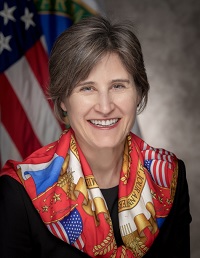
Over 600 AI projects are underway at the Department of Energy, said Cheryl Ingstad, Director of the AI and Technology Office of the DOE, in a talk outlining the agency’s AI efforts. Appointed in February and from a background at 3M and in the Defense Intelligence Agency before that, Ingstad said, “The DOE is positioned to lead the government’s efforts to advance AI.”
One example effort is the First Give Consortium, announced in August in partnership with Microsoft, to use deep learning algorithms to provide near real-time data to improve the decision-making of the nation’s first responders. “The power to save lives is where I see a great opportunity for AI,” Ingstad said.
The DOE’s strategic objectives in AI include an effort to cultivate an “AI-Ready Workforce” by offering new hires AI career pathways and helping meet the demand for AI training. “We have a lot of passion about this, and we are hiring to execute on this strategy,” she said. “I am impressed with the talent we are seeing.” The DOE is also actively seeking partnerships with AI firms. Ingstad provided an email address for interested partners to send queries or proposals: doe_AI_gateway@hq.doe.gov.
Amazon launched Amazon Web Services in 2006, the first cloud computing platform. With the COVID-19 pandemic causing a boom in remote work, Amazon is well-positioned to be of service. “We are experiencing a renaissance in machine learning and AI in the cloud,” said David Levy, a VP at AWS who focuses on the US Government sector, in a talk on how the government is using AI in the cloud. “The cloud is providing computer scientists with the scale they need to run machine learning algorithms. And COVID-19 research shows the importance of being able to run ML models in the cloud,” he said. Amazon is a cofounding member of the recently-formed COVID-19 High Performance Computing Consortium along with many other industry players, federal agencies, and universities.
The US Department of Veterans Affairs late last year launched the National AI Institute for advancing the health and well-being of veterans. “The VA has over nine million patients, making it the largest integrated healthcare system in the US,” said Gil Alterovitz, PhD, Director of AI at the VA, in a talk on how the agency is using AI to improve health services.
The VA’s chief areas of AI concentration are deep learning, explainable AI, privacy protection, trustworthy AI and multiscale AI analysis, he said. A number of stakeholders are consulted to decide what projects to pursue. The VA uses AI Tech Sprints, time-limited engagements to foster collaboration with industry, academic and nonprofit partners. The first was conducted in 2019; the second concludes in November. “The Tech Sprints enable the VA to have a bidirectional link between the government and users of data,” he said.
One example result is the Clinical Trial Selector, developed by a group of high school students from Fairfax County Va., to help connect veterans with clinical trials that could be helpful. The students were members of the Girls Computing League nonprofit that fosters the interest of young people in computer science and technology. The work is continuing through a grant from AWS.
Day three of AI World Government continues tomorrow, Friday, Oct. 30.
Announcing Databricks on AWS Quick Starts to Deploy in Under 15 minutes
We are pleased to announce the availability of Databricks on the AWS Quick Starts program. With this release, our customers can easily deploy the Databricks Unified Data Analytics Platform on Amazon Web Services (AWS) along with the rest of their infrastructure using a flexible and powerful tool.
The AWS Quick Starts include an AWS CloudFormation template that rapidly automates the deployment of a Databricks workspace, a deployment guide that outlines the architecture as well as step-by-step deployment instructions.
Given that security privileges may vary from customer to customer, we have created an AWS Quick Starts solution that allows customers to automate:
- The deployment of a Databricks workspace and creation of a new cross-account IAM role
- The deployment of a Databricks workspace and use an existing cross-account IAM role
AWS CloudFormation templates, custom resource and AWS Lambda
AWS CloudFormation is a service that enables you to describe and provision all the infrastructure resources in your cloud environment. The Databricks CloudFormation templates are written in YAML and extended by an AWS Lambda-backed custom resource written in Python.
You also have direct access to the templates. You can download them, customize them, and extract interesting elements for use in your projects. Please see the deployment guide for customizing the templates.
How to get started?
The Quick Starts solution launches a CloudFormation template that creates and configures the necessary AWS resources needed to deploy and configure the Databricks workspace by invoking the Databricks API calls for a given Databricks Account, AWS Account, and region.
The Databricks Quick Starts solution is available under the Analytics, Data Lake, Machine learning & AI categories or by simply filtering using the search bar.
You can then review the full deployment guide from the Databricks reference deployment page which contains the architecture overview, deployment options and steps.
Simple and easy deployment process
The deployment process is simple and easy and will complete in less than 15 minutes. First, you’ll need to be signed into your account prior to launching the deployment. If you don’t already have an AWS account, sign up at https://aws.amazon.com.
Select the template of your choice and then select the region where to deploy your Databricks workspace from the CloudFormation UI.
In 15 minutes, with just a few parameters …
The template is easy to follow and requires only a few mandatory parameters to launch the workspace deployment as follow:
- CloudFormation stack name
- E2 account ID
- Username
- password
- Unique workspace deployment name
- Unique IAM role
- Unique S3 root bucket
Ability to innovate while enforcing security controls and governance
With the general availability of E2, our AWS customers can unleash their data teams potential by enabling all your data teams to solve your toughest data problems while using a highly secure, scalable, simple to manage, data analytics and machine learning platform.
Innovation is 15 minutes away!
What’s Next?
The new features for the Unified Data Analytics Platform on AWS are now available in the following AWS Regions (ap-south-1, ap-southeast-2, us-west-1, us-west-2, us-east-1, us-east-2, ca-central-1, eu-west-1, and eu-central-1 ). Learn more about how we are enabling you with comprehensive platform security, elastic scalability, and 360° administration for all your data analytics and machine learning needs.
Or by watching the on-demand webinar discussing how to Simplify, Secure, and Scale your Enterprise Cloud Data Platform on AWS in an automated way.
--
Try Databricks for free. Get started today.
The post Announcing Databricks on AWS Quick Starts to Deploy in Under 15 minutes appeared first on Databricks.
Geely's EV maker Polestar recalls all Polestar 2 sedans again
STOCKHOLM (Reuters) - Electric vehicle maker Polestar, owned by Volvo Cars and its parent China's Geely, is recalling its new Polestar 2 cars for the second time in a month, it said on Thursday.
The company, which made its last recall on Oct. 2 after several cars had lost power and stopped running, is recalling close to 4,600 vehicles due to a faulty component.
"Polestar has initiated a voluntary safety recall and a service campaign that contains a number of updates for Polestar 2 vehicles," the firm said in statement.
"The recall involves the replacement of faulty inverters on most delivered customer vehicles," Polestar said, adding the hardware updates can be done in a single workshop visit.
The Sweden-based automaker started producing its Polestar 2 sedans this year in China and sells them in ...
Read More on Datafloq
The company, which made its last recall on Oct. 2 after several cars had lost power and stopped running, is recalling close to 4,600 vehicles due to a faulty component.
"Polestar has initiated a voluntary safety recall and a service campaign that contains a number of updates for Polestar 2 vehicles," the firm said in statement.
"The recall involves the replacement of faulty inverters on most delivered customer vehicles," Polestar said, adding the hardware updates can be done in a single workshop visit.
The Sweden-based automaker started producing its Polestar 2 sedans this year in China and sells them in ...
Read More on Datafloq