(Reuters) - Boston Dynamics' dog-like robot 'Spot' is learning new tricks.
Working on an oil rig operated by BP Plc nearly 190 miles (305 km) offshore in the Gulf of Mexico, the company is programming Spot to read gauges, look for corrosion, map out the facility and even sniff out methane on its Mad Dog rig.
Adam Ballard, BP's facilities technology manager, said tasks performed by Spot will make the work on the rig safer by reducing the number of people. It also will free up personnel to do other work.
"Several hours a day, several operators will walk the facility; read gauges; listen for noise that doesn't sound right; look out at the horizon for anomalies, boats that may not be caught on radar; look for sheens," Ballard said.
"What we're doing with ...
Read More on Datafloq
Saturday, 14 November 2020

Google at odds with U.S. over protective order for firms tied to lawsuit: court filing
WASHINGTON (Reuters) - Alphabet's Google and the U.S. Justice Department have failed to reach agreement over a protective order for third parties like Microsoft that provided data to the government for its lawsuit against the search and advertising giant.
Google is pressing for two in-house attorneys to have access to the confidential data while the Justice Department has disagreed, Google said in a court filing on Friday.
In the filing, Google argued it needed the information to prepare an effective defense. It also offered to ensure that any confidential information would be made available solely to two in-house attorneys at the offices of Google's outside counsel or in another secure manner, adding that it would promptly report any disclosure.
The companies, which apart from Microsoft Corp include Oracle Corp, AT&T Inc, Amazon.com, Comcast Corp and others, have until next Friday to make their proposals for the terms ...
Read More on Datafloq
Google is pressing for two in-house attorneys to have access to the confidential data while the Justice Department has disagreed, Google said in a court filing on Friday.
In the filing, Google argued it needed the information to prepare an effective defense. It also offered to ensure that any confidential information would be made available solely to two in-house attorneys at the offices of Google's outside counsel or in another secure manner, adding that it would promptly report any disclosure.
The companies, which apart from Microsoft Corp include Oracle Corp, AT&T Inc, Amazon.com, Comcast Corp and others, have until next Friday to make their proposals for the terms ...
Read More on Datafloq
Turkey fines Google $26 million for abusing market position: competition board
ISTANBUL (Reuters) - The Turkish Competition Board has fined Google <GOOGL.O> 196.7 million lira ($26 million) after ruling it was abusing its market dominance, a statement by the board said on Friday.
The company has been found to be violating the terms of fair competition due to unfair access to advertisement space, the statement said, and the California-based tech giant "was abusing its dominant power in the market".
In February, the competition authority fined Google 98 million lira for abusing its dominant market position and "aggressive competition tactics."
(Reporting by Daren Butler and Ece Toksabay; Editing by Dominic Evans)
...
Read More on Datafloq
The company has been found to be violating the terms of fair competition due to unfair access to advertisement space, the statement said, and the California-based tech giant "was abusing its dominant power in the market".
In February, the competition authority fined Google 98 million lira for abusing its dominant market position and "aggressive competition tactics."
(Reporting by Daren Butler and Ece Toksabay; Editing by Dominic Evans)
...
Read More on Datafloq
North Korean, Russian hackers target COVID-19 researchers: Microsoft
By Raphael Satter
WASHINGTON (Reuters) - Hackers working for the Russian and North Korean governments have targeted more than half a dozen organizations involved in COVID-19 treatment and vaccine research around the globe, Microsoft <MSFT.O> said on Friday.
The software company said a Russian hacking group commonly nicknamed "Fancy Bear" - along with a pair of North Korean actors dubbed "Zinc" and "Cerium" by Microsoft - were implicated in recent attempts to break into the networks of seven pharmaceutical companies and vaccine researchers in Canada, France, India, South Korea, and the United States.
Microsoft said the majority of the targets were organizations that were in the process of testing COVID-19 vaccines. Most of the break-in attempts failed but an unspecified number succeeded, it added.
Few other details were provided by Microsoft. It declined ...
Read More on Datafloq
WASHINGTON (Reuters) - Hackers working for the Russian and North Korean governments have targeted more than half a dozen organizations involved in COVID-19 treatment and vaccine research around the globe, Microsoft <MSFT.O> said on Friday.
The software company said a Russian hacking group commonly nicknamed "Fancy Bear" - along with a pair of North Korean actors dubbed "Zinc" and "Cerium" by Microsoft - were implicated in recent attempts to break into the networks of seven pharmaceutical companies and vaccine researchers in Canada, France, India, South Korea, and the United States.
Microsoft said the majority of the targets were organizations that were in the process of testing COVID-19 vaccines. Most of the break-in attempts failed but an unspecified number succeeded, it added.
Few other details were provided by Microsoft. It declined ...
Read More on Datafloq
EU Commission seeks feedback on new data transfer tools after court ruling
By Foo Yun Chee
BRUSSELS (Reuters) - The European Commission on Friday sought feedback on two new data transfer tools after Europe's top court in July set strict conditions for such mechanisms used by thousands of companies to transfer Europeans' data around the world for various services.
The Luxembourg-based EU Court of Justice upheld the validity of the data transfer mechanism known as standard contractual clauses (SCCs) in a case involving Facebook and Austrian privacy activist Max Schrems, who has campaigned about the risk of U.S. intelligence agencies accessing data on Europeans.
But judges said privacy watchdogs must suspend or prohibit transfers outside the EU if other countries cannot assure that the data will be protected.
The EU executive has since then scrambled to find a solution as companies grapple with the implications and ...
Read More on Datafloq
BRUSSELS (Reuters) - The European Commission on Friday sought feedback on two new data transfer tools after Europe's top court in July set strict conditions for such mechanisms used by thousands of companies to transfer Europeans' data around the world for various services.
The Luxembourg-based EU Court of Justice upheld the validity of the data transfer mechanism known as standard contractual clauses (SCCs) in a case involving Facebook and Austrian privacy activist Max Schrems, who has campaigned about the risk of U.S. intelligence agencies accessing data on Europeans.
But judges said privacy watchdogs must suspend or prohibit transfers outside the EU if other countries cannot assure that the data will be protected.
The EU executive has since then scrambled to find a solution as companies grapple with the implications and ...
Read More on Datafloq
Nio stock falls after short-seller Citron targets EV maker
(Reuters) - Shares of electric vehicle maker Nio Inc reversed course to trade lower on Friday after short-seller Citron Research recommended investors to sell the stock, citing pricing pressure posed by bigger rival Tesla Inc in the Chinese market.
Nio's ES6 hatchback model faces imminent threat from likely price cuts for Tesla's Model Y in China, Andrew Left-owned Citron said in an investor note.
Left has long targeted companies that he thinks are over-valued. Friday's take is a reversal to the firm's original recommendation two years ago, when it urged investors to buy the stock.
"Anyone buying NIO stock now is not buying a company or its prospects, rather you are buying 3 letters that move on a screen," Citron said in the note.
Nio did not respond to a request for comment.
...
Read More on Datafloq
Nio's ES6 hatchback model faces imminent threat from likely price cuts for Tesla's Model Y in China, Andrew Left-owned Citron said in an investor note.
Left has long targeted companies that he thinks are over-valued. Friday's take is a reversal to the firm's original recommendation two years ago, when it urged investors to buy the stock.
"Anyone buying NIO stock now is not buying a company or its prospects, rather you are buying 3 letters that move on a screen," Citron said in the note.
Nio did not respond to a request for comment.
...
Read More on Datafloq
Volkswagen boosts investment in electric and autonomous car technology to $86 billon
BERLIN (Reuters) - Volkswagen <VOWG_p.DE> has raised its planned investment on digital and electric vehicle technologies to 73 billion euros ($86 billion) over the next five years as it seeks to hold onto its crown as the world's largest carmaker in a new green era.
Under a plan presented on Friday, Volkswagen said it would allocate nearly half its investment budget of 150 billion euros on e-mobility, hybrid cars, a seamless, software-based vehicle operating system and self-driving technologies.
In last year's plan, the German car and truck maker, which owns brands including VW, Audi, Porsche, Seat and Skoda, had earmarked 60 billion euros for electric and self-driving vehicles out of the 150 billion budget.
A global clampdown on emissions, partly triggered by VW's diesel pollution scandal in 2015, has forced carmakers to accelerate the development of low-emission technology, even for their low-margin mainstream models.
...
Read More on Datafloq
Under a plan presented on Friday, Volkswagen said it would allocate nearly half its investment budget of 150 billion euros on e-mobility, hybrid cars, a seamless, software-based vehicle operating system and self-driving technologies.
In last year's plan, the German car and truck maker, which owns brands including VW, Audi, Porsche, Seat and Skoda, had earmarked 60 billion euros for electric and self-driving vehicles out of the 150 billion budget.
A global clampdown on emissions, partly triggered by VW's diesel pollution scandal in 2015, has forced carmakers to accelerate the development of low-emission technology, even for their low-margin mainstream models.
...
Read More on Datafloq
Friday, 13 November 2020
MLflow 1.12 Features Extended PyTorch Integration
MLflow 1.12 features include extended PyTorch integration, SHAP model explainability, autologging MLflow entities for supported model flavors, and a number of UI and document improvements. Now available on PyPI and the docs online, you can install this new release with pip install mlflow==1.12.0 as described in the MLflow quickstart guide.
In this blog, we briefly explain the key features, in particular extended PyTorch integration, and how to use them. For a comprehensive list of additional features, changes and bug fixes read the MLflow 1.12 Changelog.
Support for PyTorch Autologging, TorchScript Models and TorchServing
At the PyTorch Developer Day, Facebook’s AI and PyTorch engineering team, in collaboration with Databricks’ MLflow team and community, announced an extended PyTorch and MLflow integration as part of the MLflow release 1.12. This joint engineering investment and integration with MLflow offer PyTorch developers an “end-to-end exploration to production platform for PyTorch.” We briefly cover three areas of integration:
- Autologging for PyTorch models
- Supporting TorchScript models
- Deploying PyTorch models onto TorchServe
Autologging PyTorch pl.LightningModule Models
As part of the universal autologging feature introduced in this release (see autologging section below), you can automatically log (and track) parameters and metrics from PyTorch Lightning models.
Aside from customized entities to log and track, the PyTorch autolog tracking functionality will log the model’s optimizer names and learning rates; metrics like training loss, validation loss, accuracies; and models as artifacts and checkpoints. For early stopping, model checkpoints, early stopping parameters and metrics are logged too. To understand its mechanics and usage, read the PyTorch autologging example.
Converting PyTorch models to TorchScript
TorchScript is a way to create serializable and optimizable models from PyTorch code. As such any MLflow-logged PyTorch model can be converted into a TorchScript, saved and loaded (or deployed to) a high-performance, independent process, where there is no Python dependency. The process entails following steps:
- Create an MLflow Python model
- Compile the model using JIT and convert to TorchScript model
- Log or save the TorchScript model
- Load or deploy the TorchScript model
# Your PyTorch nn.Module or pl.LightningModule
model = Net()
scripted_model = torch.jit.script(model)
…
mlflow.pytorch.log_model(scripted_model, "scripted_model")
model_uri = mlflow.get_artifact_uri("scripted_model")
loaded_model = mlflow.pytorch.load_model(model_uri)
…
For brevity, we have not included all the code here, but you can examine the example code—IrisClassification and MNIST—in the GitHub mlflow/examples/pytorch/torchscript directory.
One thing you can do with a scripted (fitted or logged) model is use the mflow fluent and mlflow.pytorch APIs to access the model and its properties, as shown in the GitHub examples. Another thing you can do with the scripted model is deploy it to a TorchServe server using TorchServer MLflow Plugin.
Deploying PyTorch models with TorchServe MLflow Plugin
TorchServe offers a flexible, easy tool for serving PyTorch models. Through the TorchServe MLflow deployment plugin, you can deploy any MLflow-logged and fitted PyTorch model. This extended integration completes the PyTorch MLOps lifecycle—from developing, tracking and saving to deploying and serving PyTorch models.

Figure 1: Extended end-to-end PyTorch and MLflow Integration
For demonstration, two PyTorch examples—BertNewsClassifcation and MNIST—enumerate steps in how you can use the TorchServe MLflow deployment plugin to deploy a PyTorch saved model to an existing TorcheServe server. Any MLflow-logged and fitted PyTorch model can easily be deployed using mlflow deployments commands. For example:
mlflow deployments create -t torchserve -m models:/my_pytorch_model/production -n my_pytorch_model
Once deployed, you can just easily use mlflow deployments predict command for inference.
mlflow deployments predict --name my_pytorch_model --target torchserve --input-path sample.json --output-path output.json.
SHAP API Offers Model Explainability
As more and more machine learning models are deployed in production as part of business applications that offer suggestive hints or make decisive predictions, machine learning engineers are obliged to explain how a model was trained and what features contributed to its output. One common technique used to answer these questions is SHAP (SHapley Additive exPlanations), a theoretical approach to explain an output of any machine learning model.
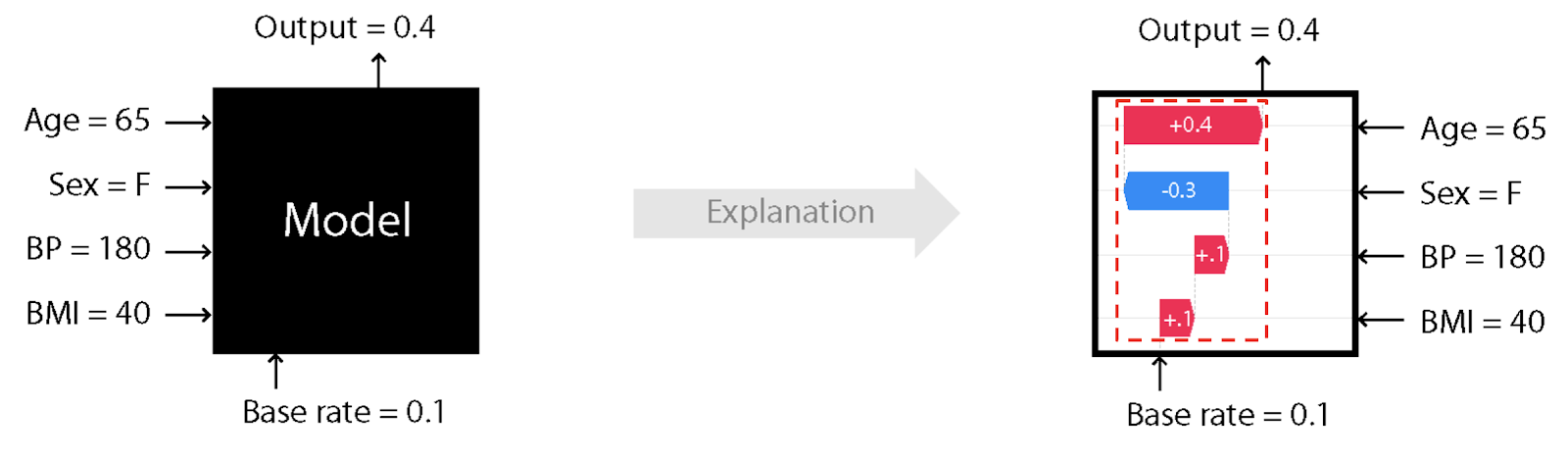
Figure 2: SHAP can estimate how each feature contributes to the model output.
To that end, this release includes an mlflow.shap module with a single method mlflow.shap.log_explanation() to generate an illustrative figure that can be logged
as a model artifact and inspected in the UI.
import mlflow

# prepare training data
dataset = load_boston()
X = pd.DataFrame(dataset.data[:50, :8], columns=dataset.feature_names[:8])
y = dataset.target[:50]

# train a model
model = LinearRegression()
model.fit(X, y)

# log an explanation
with mlflow.start_run() as run:
    mlflow.shap.log_explanation(model.predict, X)
…
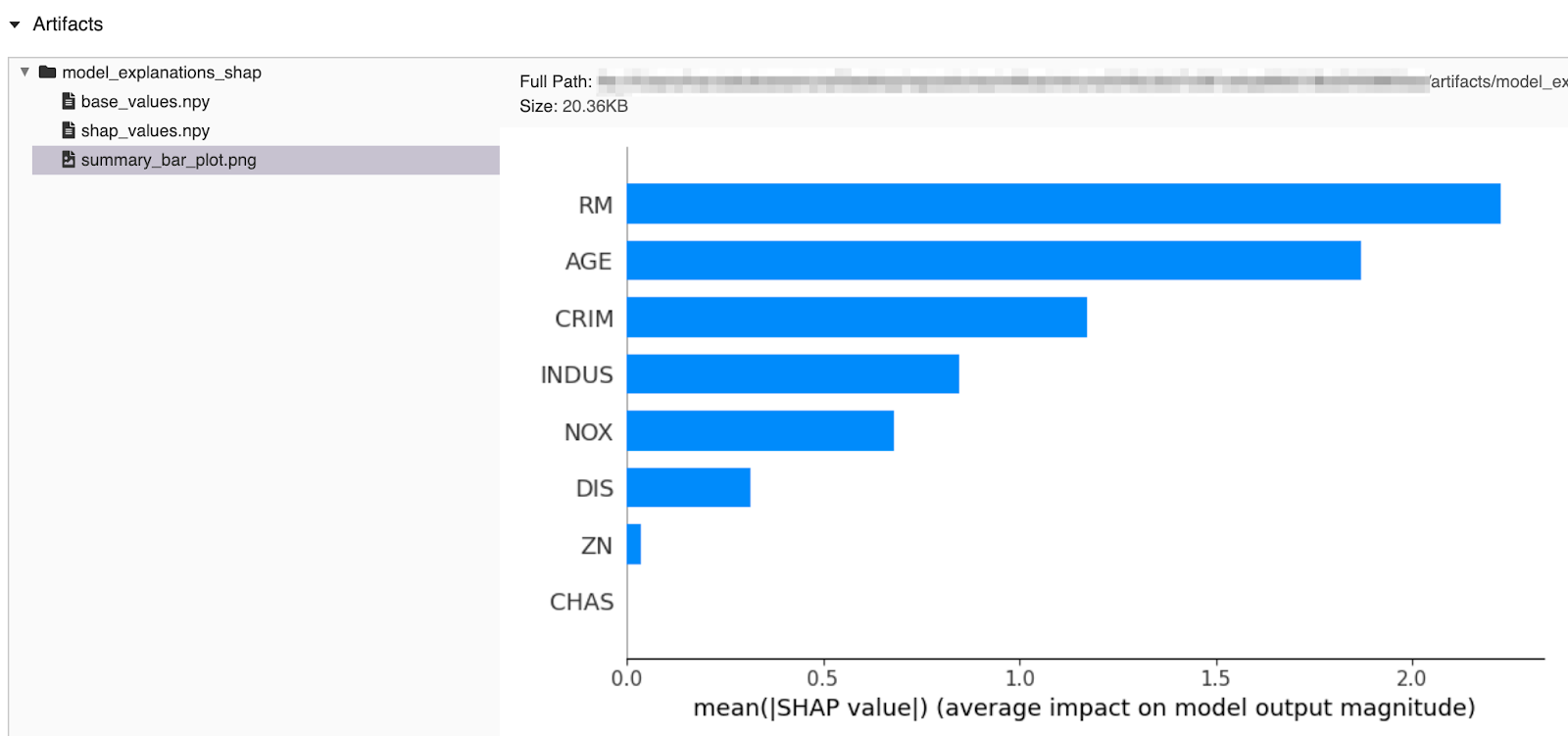
Figure 3: SHAP explanation saved as an MLflow artifact
You can view the example code in the docs page and try other examples of models with SHAP explanations in the MLflow GitHub mlflow/examples/shap directory.
Autologging Simplifies Tracking Experiments
The mlflow.autolog() method is a universal tracking API that simplifies training code by automatically logging all relevant model entities—parameters, metrics, artifacts such as models and model summaries—with a single call, without the need to explicitly call each separate method to log respective model’s entities.
As a universal single method, under the hood, it detects which supported autologging model flavor is used—in our case scikit-learn—and tracks all its respective entities to log. After the run, when viewed in the MLflow UI, you can inspect all automatically logged entities.
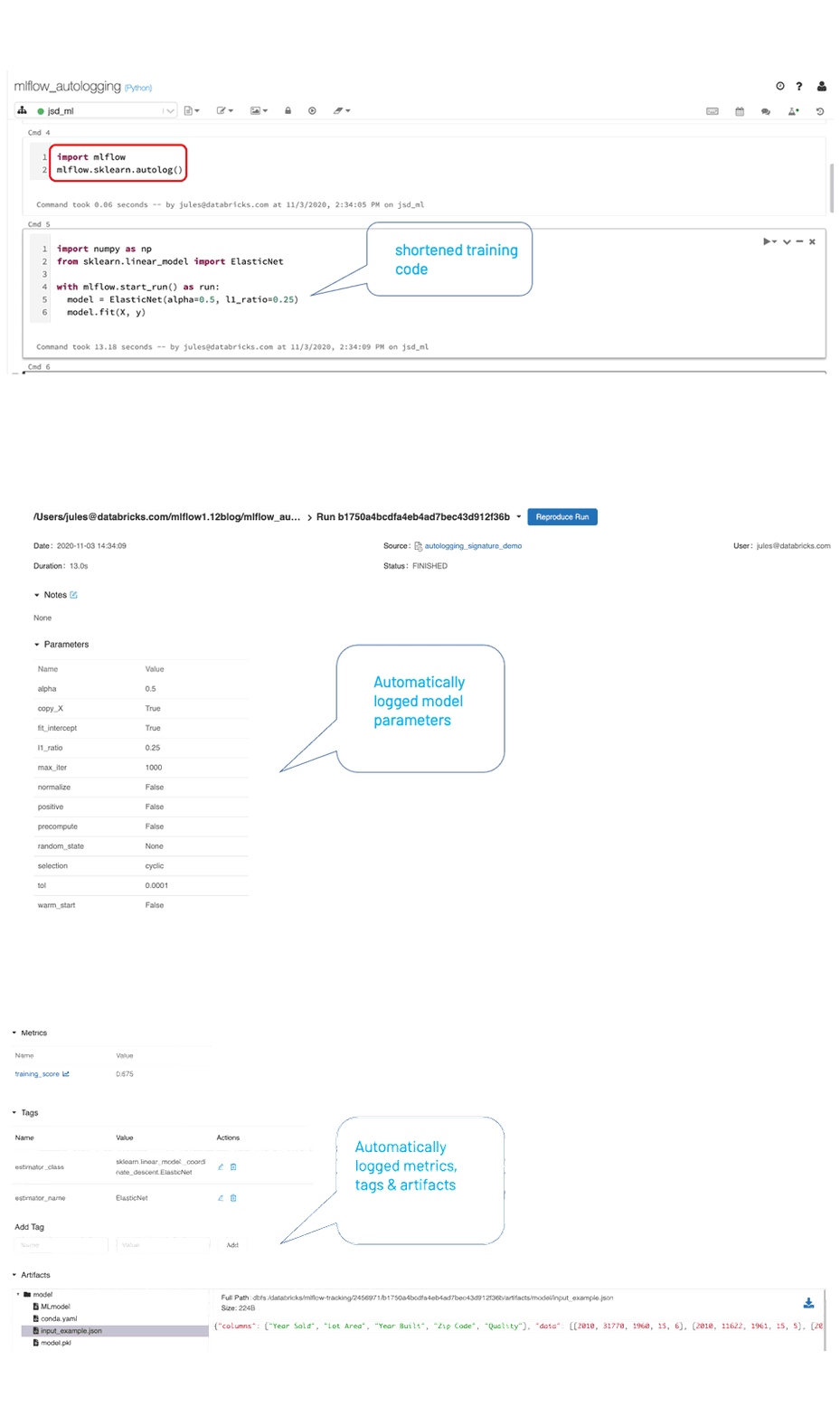
Figure 4: MLflow UI showing automatically logged entities for scikit-learn model
What’s next
Learn more about PyTorch integration at the Data + AI Summit Europe next week, with a keynote from Facebook AI Engineering Director Lin Qiao and a session on Reproducible AI Using PyTorch and MLflow from Facebook’s Geeta Chauhan.
Stay tuned for additional PyTorch and MLflow detailed blogs. For now you can:
- Read MLflow and PyTorch — Where Cutting Edge AI meets MLOps
- Checkout out the PyTorch and MLFlow mlflow/examples/pytorch/
- Examine SHAP GitHub mlflow/examples/shap/
pip install mlflow==1.12.0and have a go at it.
Community Credits
We want to thank the following contributors for updates, doc changes, and contributions to MLflow release 1.12. In particular, we want to thank the Facebook AI and PyTorch engineering team for their extended PyTorch integration contribution and all MLflow community contributors:
Andy Chow, Andrea Kress, Andrew Nitu, Ankit Mathur, Apurva Koti, Arjun DCunha, Avesh Singh, Axel Vivien, Corey Zumar, Fabian Höring, Geeta Chauhan, Harutaka Kawamura, Jean-Denis Lesage, Joseph Berry, Jules S. Damji, Juntai Zheng, Lorenz Walthert, Poruri Sai Rahul, Mark Andersen, Matei Zaharia, Martynov Maxim, Olivier Bondu, Sean Naren, Shrinath Suresh, Siddharth Murching, Sue Ann Hong, Tomas Nykodym, Yitao Li, Zhidong Qu, @abawchen, @cafeal, @bramrodenburg, @danielvdende, @edgan8, @emptalk, @ghisvail, @jgc128 @karthik-77, @kzm4269, @magnus-m, @sbrugman, @simonhessner, @shivp950, @willzhan-db
--
Try Databricks for free. Get started today.
The post MLflow 1.12 Features Extended PyTorch Integration appeared first on Databricks.
Algorithmic Management: What is It (And What’s Next)?
The growth of the “gig economy” in recent years has revolutionised the way that millions of people work. Proponents argue that the gig economy gives people more flexibility and opportunities and lowers barriers of entry to the labour market, while detractors say that it erodes workplace regulations and standards while encouraging businesses to treat workers as increasingly disposable.
No matter which side of the debate you fall on, it’s clear that the gig economy is here to stay. But with more and more people signing up for these flexible and freelance work arrangements, how can businesses manage them effectively?
Enter “algorithmic management”: the use of algorithms to oversee the efforts of human workers. As algorithmic management becomes more commonplace, it’s important to understand what this practice is, the pros and cons of using it, and what the future holds.
What is algorithmic management?
Algorithmic management, as the name suggests, is the use of computer algorithms and artificial intelligence techniques to manage a team of human employees. By collecting massive quantities of data, in particular data about employee performance, algorithmic management seeks to automate large portions of the managerial decision-making process.
While it’s tough to estimate just how prevalent algorithmic management is, there are a few ...
Read More on Datafloq
No matter which side of the debate you fall on, it’s clear that the gig economy is here to stay. But with more and more people signing up for these flexible and freelance work arrangements, how can businesses manage them effectively?
Enter “algorithmic management”: the use of algorithms to oversee the efforts of human workers. As algorithmic management becomes more commonplace, it’s important to understand what this practice is, the pros and cons of using it, and what the future holds.
What is algorithmic management?
Algorithmic management, as the name suggests, is the use of computer algorithms and artificial intelligence techniques to manage a team of human employees. By collecting massive quantities of data, in particular data about employee performance, algorithmic management seeks to automate large portions of the managerial decision-making process.
While it’s tough to estimate just how prevalent algorithmic management is, there are a few ...
Read More on Datafloq
4 New Developments in Big Data and Artificial Intelligence That Will Transform the Way Businesses Operate in 2021
Artificial intelligence was already playing a major role before the pandemic struck. Machine learning was impacting how people carried out business in almost every field.
When the COVID-19 pandemic struck, some might have thought that artificial intelligence and machine learning were going to lose their momentum. Just the opposite is the case. The pandemic has made it all too clear that machine learning and artificial intelligence need to continue to gain momentum, especially if there are going to be other pandemics in the future.
Artificial intelligence will continue to affect the technologies that change how we live and how we work. It is already impacting several top loud accounting and invoicing tools, software designed to monitor how employees spend their time working, medical technology, cloud invoicing logistics, and so much more. We can only expect that in 2021 we are going to see artificial intelligence and machine learning impact our lives even more. Here are some things we might expect.
1. Increased Surveillance
Facial recognition technology has grown more powerful thanks to computer vision algorithms. Using computers to identify specific individuals as opposed to looking for patterns among groups of people is controversial. However, people are becoming more tolerant of facial recognition and surveillance ...
Read More on Datafloq
When the COVID-19 pandemic struck, some might have thought that artificial intelligence and machine learning were going to lose their momentum. Just the opposite is the case. The pandemic has made it all too clear that machine learning and artificial intelligence need to continue to gain momentum, especially if there are going to be other pandemics in the future.
Artificial intelligence will continue to affect the technologies that change how we live and how we work. It is already impacting several top loud accounting and invoicing tools, software designed to monitor how employees spend their time working, medical technology, cloud invoicing logistics, and so much more. We can only expect that in 2021 we are going to see artificial intelligence and machine learning impact our lives even more. Here are some things we might expect.
1. Increased Surveillance
Facial recognition technology has grown more powerful thanks to computer vision algorithms. Using computers to identify specific individuals as opposed to looking for patterns among groups of people is controversial. However, people are becoming more tolerant of facial recognition and surveillance ...
Read More on Datafloq
Swedish telecoms regulator to appeal court decision on Huawei exclusion
STOCKHOLM (Reuters) - Swedish telecoms regulator PTS will appeal a court decision against its plan to exclude Chinese telecom equipment maker Huawei from its 5G networks.
PTS on Monday halted 5G spectrum auctions after a court suspended parts of its earlier decision, in which it followed Britain in banning Huawei equipment from 5G networks, citing national security risks.
The Chinese company had appealed against PTS' decision to exclude it, saying it wanted a court to check if it had been taken according to the law.
"PTS will appeal the administrative court's decision on inhibition to the next instance," the regulator said in a statement on Friday.
The auctions were originally expected to start this week, and would have benefited Nokia and Ericsson as PTS had asked companies taking part to remove Huawei and ZTE ...
Read More on Datafloq
PTS on Monday halted 5G spectrum auctions after a court suspended parts of its earlier decision, in which it followed Britain in banning Huawei equipment from 5G networks, citing national security risks.
The Chinese company had appealed against PTS' decision to exclude it, saying it wanted a court to check if it had been taken according to the law.
"PTS will appeal the administrative court's decision on inhibition to the next instance," the regulator said in a statement on Friday.
The auctions were originally expected to start this week, and would have benefited Nokia and Ericsson as PTS had asked companies taking part to remove Huawei and ZTE ...
Read More on Datafloq
Panasonic appoints company veteran Kusumi as CEO, replacing Tsuga
By Makiko Yamazaki
TOKYO (Reuters) - Japan's Panasonic Corp has appointed its head of automotive business Yuki Kusumi as the company's next chief executive officer, replacing Kazuhiro Tsuga, who was the architect of a partnership with Tesla Inc.
The 55-year-old will take the reins on April 1, Panasonic said on Friday, after a three-decade career at the company which has seen Kusumi lead the automotive component business and the TV operations, much like his predecessor. Tsuga, 63, will become chairman.
The change comes as Panasonic has begun to benefit from a partnership with Tesla, which was central to the incumbent chief's strategy.
Strong sales of Tesla electric vehicles (EV) have allowed Panasonic's battery business to eke out profits this year, following several years of production troubles and delays at the U.S. partner.
...
Read More on Datafloq
TOKYO (Reuters) - Japan's Panasonic Corp has appointed its head of automotive business Yuki Kusumi as the company's next chief executive officer, replacing Kazuhiro Tsuga, who was the architect of a partnership with Tesla Inc.
The 55-year-old will take the reins on April 1, Panasonic said on Friday, after a three-decade career at the company which has seen Kusumi lead the automotive component business and the TV operations, much like his predecessor. Tsuga, 63, will become chairman.
The change comes as Panasonic has begun to benefit from a partnership with Tesla, which was central to the incumbent chief's strategy.
Strong sales of Tesla electric vehicles (EV) have allowed Panasonic's battery business to eke out profits this year, following several years of production troubles and delays at the U.S. partner.
...
Read More on Datafloq
Russia's Ozon targets $750 million in IPO as e-commerce booms: sources
By Olga Popova
MOSCOW (Reuters) - Russian online retailer Ozon plans to raise about $750 million in an initial public offering (IPO) in the United States to help fund its expansion in a rapidly-growing e-commerce market at home, three financial market sources said.
Russia's fragmented e-commerce market is forecast to grow by more than 40% to 2.5 trillion roubles ($32.4 billion) this year, according to Euromonitor research group, and by 10-15% a year over the next five years.
Revenues at Ozon, a Russian version of U.S. e-commerce giant Amazon.com Inc <AMZN.O>, surged as much as 70% in the first nine months of the year, as people switched to online shopping in the coronavirus pandemic.
Ozon was initially aiming for $500 million in the IPO, but has since raised that to $750 million, ...
Read More on Datafloq
MOSCOW (Reuters) - Russian online retailer Ozon plans to raise about $750 million in an initial public offering (IPO) in the United States to help fund its expansion in a rapidly-growing e-commerce market at home, three financial market sources said.
Russia's fragmented e-commerce market is forecast to grow by more than 40% to 2.5 trillion roubles ($32.4 billion) this year, according to Euromonitor research group, and by 10-15% a year over the next five years.
Revenues at Ozon, a Russian version of U.S. e-commerce giant Amazon.com Inc <AMZN.O>, surged as much as 70% in the first nine months of the year, as people switched to online shopping in the coronavirus pandemic.
Ozon was initially aiming for $500 million in the IPO, but has since raised that to $750 million, ...
Read More on Datafloq
Internet can't be Wild West, EU's Breton tells Google CEO Pichai
By Foo Yun Chee
BRUSSELS (Reuters) - Europe's industry chief Thierry Breton has warned Alphabet CEO Sundar Pichai that he plans to rein in U.S. tech giants via a raft of new rules to curb the excesses of a "Wild West" internet.
Breton issued the warning in a video-conference call with Pichai late on Thursday, according to a statement from the European Commision.
The comments came after a Google internal document outlined a 60-day strategy to counter the European Union's push for tough new tech rules by getting U.S. allies to push back against Breton.
The call was initiated by Google before the document was leaked.
Breton will announce new draft rules known as the Digital Services Act and the ...
Read More on Datafloq
BRUSSELS (Reuters) - Europe's industry chief Thierry Breton has warned Alphabet CEO Sundar Pichai that he plans to rein in U.S. tech giants via a raft of new rules to curb the excesses of a "Wild West" internet.
Breton issued the warning in a video-conference call with Pichai late on Thursday, according to a statement from the European Commision.
The comments came after a Google internal document outlined a 60-day strategy to counter the European Union's push for tough new tech rules by getting U.S. allies to push back against Breton.
The call was initiated by Google before the document was leaked.
Breton will announce new draft rules known as the Digital Services Act and the ...
Read More on Datafloq
China drafts rules to govern its booming livestreaming sales industry
By Sophie Yu and Brenda Goh
BEIJING (Reuters) - China's internet watchdog has drafted rules for the first time to regulate the country's livestreaming marketing industry, stepping up scrutiny on e-commerce marketplaces belonging to the likes of tech giant Alibaba Group and JD.Com.
Last week China published draft regulations aimed at preventing anti-monopolistic behaviour by internet platforms which wiped hundreds of billions of dollars off the value of some tech giants including Alibaba and Tencent.
Livestreaming marketing has seen its popularity surge in the last two years among brands like L'Oreal, Nike, Dyson and online shoppers, and most Chinese e-commerce platforms now offer the option to purchase and sell products via livestreaming.
Telegenic hosts sell goods from personal care products to home appliances in real time and top Chinese livestreamers like "lipstick king" ...
Read More on Datafloq
BEIJING (Reuters) - China's internet watchdog has drafted rules for the first time to regulate the country's livestreaming marketing industry, stepping up scrutiny on e-commerce marketplaces belonging to the likes of tech giant Alibaba Group and JD.Com.
Last week China published draft regulations aimed at preventing anti-monopolistic behaviour by internet platforms which wiped hundreds of billions of dollars off the value of some tech giants including Alibaba and Tencent.
Livestreaming marketing has seen its popularity surge in the last two years among brands like L'Oreal, Nike, Dyson and online shoppers, and most Chinese e-commerce platforms now offer the option to purchase and sell products via livestreaming.
Telegenic hosts sell goods from personal care products to home appliances in real time and top Chinese livestreamers like "lipstick king" ...
Read More on Datafloq
Factbox: List of 31 Chinese companies designated by the U.S. as military-backed
(Reuters) - The Trump administration on Thursday unveiled an executive order prohibiting U.S. investments in Chinese firms that Washington says are owned or controlled by the Chinese military.
The order could impact some of China's biggest companies. It is designed to deter U.S. investment firms, pension funds and others from buying and selling shares of 31 Chinese companies that were designated by the Defense Department as backed by the Chinese military earlier this year.
Below is a list of those companies based on Department of Defense data found here https://ift.tt/32FbjVI and here https://ift.tt/36qQHBu. Most of them have subsidiaries listed in mainland China and/or Hong Kong.
Aviation Industry Corporation of China
China Aerospace Science and Technology Corp
...
Read More on Datafloq
The order could impact some of China's biggest companies. It is designed to deter U.S. investment firms, pension funds and others from buying and selling shares of 31 Chinese companies that were designated by the Defense Department as backed by the Chinese military earlier this year.
Below is a list of those companies based on Department of Defense data found here https://ift.tt/32FbjVI and here https://ift.tt/36qQHBu. Most of them have subsidiaries listed in mainland China and/or Hong Kong.
Aviation Industry Corporation of China
China Aerospace Science and Technology Corp
...
Read More on Datafloq
Zuckerberg defends not suspending ex-Trump aide Bannon from Facebook -recording
By Katie Paul
PALO ALTO (Reuters) - Facebook <FB.O> Chief Executive Mark Zuckerberg told an all-staff meeting on Thursday that former Trump White House adviser Steve Bannon had not violated enough of the company's policies to justify his suspension when he urged beheading two senior U.S. officials, according to a recording heard by Reuters.
Zuckerberg acknowledged criticism of Facebook by President-elect Joe Biden but said the company shared some of the Biden team's same concerns about social media. He urged employees not to jump to conclusions about how the new administration might approach regulation of social media companies.
Bannon suggested in a video posted on Nov. 5 that FBI Director Christopher Wray and government infectious diseases expert Anthony Fauci should be beheaded, saying they had been disloyal to U.S. President Donald Trump, who last week lost his re-election bid to Biden.
...
Read More on Datafloq
PALO ALTO (Reuters) - Facebook <FB.O> Chief Executive Mark Zuckerberg told an all-staff meeting on Thursday that former Trump White House adviser Steve Bannon had not violated enough of the company's policies to justify his suspension when he urged beheading two senior U.S. officials, according to a recording heard by Reuters.
Zuckerberg acknowledged criticism of Facebook by President-elect Joe Biden but said the company shared some of the Biden team's same concerns about social media. He urged employees not to jump to conclusions about how the new administration might approach regulation of social media companies.
Bannon suggested in a video posted on Nov. 5 that FBI Director Christopher Wray and government infectious diseases expert Anthony Fauci should be beheaded, saying they had been disloyal to U.S. President Donald Trump, who last week lost his re-election bid to Biden.
...
Read More on Datafloq
Fired Amazon worker files discrimination lawsuit over pandemic conditions
By Jonathan Stempel
NEW YORK (Reuters) - A former Amazon.com Inc worker who protested conditions at his New York City fulfillment center sued the retailer on Thursday, accusing it of discrimination for firing him and for putting Black and Hispanic workers at heightened risk of contracting COVID-19.
In a proposed class action filed in Brooklyn federal court, Christian Smalls alleged Amazon failed to provide needed protective gear to its "predominantly minority" workforce, subjecting them to inferior working conditions than its mainly white managers.
Citing a leaked memo from Amazon's general counsel to Chief Executive Jeff Bezos, Smalls also said Amazon fired him after concluding that as a Black man he was a "weak spokesman" for workers.
He also said Amazon tried to drum up public support by making him the "face" of workers criticizing ...
Read More on Datafloq
NEW YORK (Reuters) - A former Amazon.com Inc worker who protested conditions at his New York City fulfillment center sued the retailer on Thursday, accusing it of discrimination for firing him and for putting Black and Hispanic workers at heightened risk of contracting COVID-19.
In a proposed class action filed in Brooklyn federal court, Christian Smalls alleged Amazon failed to provide needed protective gear to its "predominantly minority" workforce, subjecting them to inferior working conditions than its mainly white managers.
Citing a leaked memo from Amazon's general counsel to Chief Executive Jeff Bezos, Smalls also said Amazon fired him after concluding that as a Black man he was a "weak spokesman" for workers.
He also said Amazon tried to drum up public support by making him the "face" of workers criticizing ...
Read More on Datafloq
American Airlines to offer app detailing pandemic-related travel requirements
(Reuters) - American Airlines Group Inc said on Thursday it would offer its customers a mobile app from Nov. 18 to show COVID-19 testing and documentation requirements for their destination.
The app, VeriFLY, by software firm Daon, allows real-time verification of COVID-19 related credentials, such as diagnostic lab test results, and aims to streamline the check-in and verification process at the airport.
"Piloting this new solution is a direct response to our customers' increasing desire to explore more international travel opportunities," President Robert Isom said in a statement.
After verifying that the traveler's data matches the country's requirements, the app displays either a pass or a fail message.
The app will launch for flights from American's hub in Miami to Jamaica.
...
Read More on Datafloq
The app, VeriFLY, by software firm Daon, allows real-time verification of COVID-19 related credentials, such as diagnostic lab test results, and aims to streamline the check-in and verification process at the airport.
"Piloting this new solution is a direct response to our customers' increasing desire to explore more international travel opportunities," President Robert Isom said in a statement.
After verifying that the traveler's data matches the country's requirements, the app displays either a pass or a fail message.
The app will launch for flights from American's hub in Miami to Jamaica.
...
Read More on Datafloq
U.S. senator urges FTC to interview Facebook ex-officials
By Diane Bartz
WASHINGTON (Reuters) - Senator Marsha Blackburn, a Republican and a tough critic of the big tech companies, urged the Federal Trade Commission on Thursday to interview some former employees of Facebook Inc as part of its probe of the social media giant.
Both the FTC and groups of state attorneys general are widely believed to be planning litigation against Facebook for breaking antitrust law.
In her letter to FTC Chairman Joe Simons, Blackburn referred to an FTC deposition of Facebook chief executive Mark Zuckerberg, adding: "While that is promising, I encourage you to also speak to other Facebook executives and engineers who can reveal the company's real agenda. Many of them fear letting Facebook's dominance go unchecked can hold dark consequences for competitors and consumers alike."
Blackburn specifically urged the ...
Read More on Datafloq
WASHINGTON (Reuters) - Senator Marsha Blackburn, a Republican and a tough critic of the big tech companies, urged the Federal Trade Commission on Thursday to interview some former employees of Facebook Inc as part of its probe of the social media giant.
Both the FTC and groups of state attorneys general are widely believed to be planning litigation against Facebook for breaking antitrust law.
In her letter to FTC Chairman Joe Simons, Blackburn referred to an FTC deposition of Facebook chief executive Mark Zuckerberg, adding: "While that is promising, I encourage you to also speak to other Facebook executives and engineers who can reveal the company's real agenda. Many of them fear letting Facebook's dominance go unchecked can hold dark consequences for competitors and consumers alike."
Blackburn specifically urged the ...
Read More on Datafloq
U.S. government appeals order blocking TikTok ban from taking effect
By David Shepardson
WASHINGTON (Reuters) - The U.S. Justice Department said it had appealed a Pennsylvania judge's Oct. 30 order that blocked the government from imposing restrictions on Chinese-owned TikTok that were set to take effect on Thursday.
The Commerce Department's August restrictions order was to take effect late in the day, barring transactions with ByteDance's short video sharing app TikTok that its owner had warned would have effectively barred its use in the United States.
The Commerce Department said Nov. 1 it would comply with Judge Wendy Beetlestone's order, but would "vigorously defend" its actions.
TikTok did not immediately comment on the government's appeal to the U.S. Third Circuit.
Beetlestone enjoined the agency from barring data hosting within the United ...
Read More on Datafloq
WASHINGTON (Reuters) - The U.S. Justice Department said it had appealed a Pennsylvania judge's Oct. 30 order that blocked the government from imposing restrictions on Chinese-owned TikTok that were set to take effect on Thursday.
The Commerce Department's August restrictions order was to take effect late in the day, barring transactions with ByteDance's short video sharing app TikTok that its owner had warned would have effectively barred its use in the United States.
The Commerce Department said Nov. 1 it would comply with Judge Wendy Beetlestone's order, but would "vigorously defend" its actions.
TikTok did not immediately comment on the government's appeal to the U.S. Third Circuit.
Beetlestone enjoined the agency from barring data hosting within the United ...
Read More on Datafloq
Amazon Beefs Up AI in Alexa, and Gets Charged by EU With Unfair Practices

By John P. Desmond, AI Trends Editor
AI took center stage in recently-announced updates to the Alexa virtual voice assistant, and in the charges this week from the European Commission that Amazon is breaking EU competition rules.
During Amazon’s Alexa Live event held in July, the company announced a major update to Alexa’s developer toolkit that brings AI improvements. Since launching in 2014, Amazon’s voice assistant has shipped hundreds of millions of units, which are targeted by a sizable developer community offering voice apps, called Skills, that extend the Alexa default feature set. Just as the Android and iOS large selections of third party applications differentiate those operating systems, so Skill plays an important role in Amazon’s growth strategy for Alexa, according to a recent account in siliconAngle.
Amazon added deep learning models for natural language understanding that the company said will enable Skills to recognize users’ voice commands with 15% higher accuracy on average. Current Skills users can use the new technology without any modifications, according to Amazon.
Amazon also enhanced the voice assistant platform for more specific uses that are emerging as Alexa is added to more devices, including smartphones, wearables and smart displays. A new tool, Apps for Alexa, allows developers of mobile apps to enable customer control in a hands-free way, such as with the Echo Buds wireless earbuds. Another tool enables developers to allow purchases such as food delivery orders on Alexa-powered smart screens, such as the Echo Show smart display.
Developers of Skills for the Echo Bud are getting a new capability called “skill resumption,” which allows Skills to automatically “resume” at opportune times. For example, if a consumer uses Echo Buds to hail an Uber car, Uber’s Alexa skill can automatically notify them when their ride arrives without requiring a manual invocation.
Skills have momentum; Amazon announced that customer engagement with Alexa Skills nearly doubled over the past year.
AZ1 Edge Processor Can Perform On-Device Processing, a Privacy Win
Alexa is also moving to the edge with its own chip in smart home edge devices. The Echo devices are using the company’s AZ1 Neural Edge processor, which consumes 20x less power, 85% less memory and features double the speech processing power as predecessors, according to an account from ZDNet.

The AZ1 in concert with Amazon’s AI advances is aimed at making the Echo more aware of its surroundings. Dave Limp, senior vice president of devices and services at Amazon, stated that the new Echo devices are designed to make “moments count.” The new versions of Alexa will be able to learn from humans by asking follow-up questions when Alexa has a gap in its understanding, according to Rohit Prasad, VP and head scientist for Alexa AI at Amazon, in a presentation on new Alexa features at the virtual event. New versions will also use deep learning space parsers to understand gaps and extract new concepts, will show more natural conversation, and will engage a follow–up mode when interacting with humans.
Alexa can use visual and acoustic cues to determine the best action to take. “This natural turn-taking allows people to interact with Alexa at their own pace,” Prasad stated.
The new AI foundation technology for Alexa’s ability to interpret context and adjust how to speak to you, has been in development for years at Amazon, Prasad said.
The AZ1 edge processor is making Alexa faster. “The processor on the device is key with a fast-paced conversation,” stated Prasad. “The neural accelerator on the device makes decisions much faster.”
Alexa for Business, rolled out over a year ago, has been adding features via AWS. Skill Blueprints were launched in April 2018 as a way to allow anyone to create skills and publish them to the Skills Stores with a 2019 update.
Prasad did not outline the roadmap for Alexa for Business, but did say Echo’s new capabilities would apply to office settings as well as to yet-to-be-determined use cases. “There’s the potential to be able to teach Alexa anything in principle,” Prasad stated.
The AZ1 processor, built with Taiwanese semiconductor company MediaTek, will speed Alexa’s response to queries and commands by hundreds of milliseconds per response, according to an account in The Verge. That allows for on-device neural speech recognition.
Amazon’s preexisting products without the AZ1 send both the audio and its corresponding interaction to the cloud to be processed and back. Only the Echo and Echo Show 10 currently have the on-device memory needed to support Amazon’s new all-neural speech models. Given that the data is stored and deleted locally, the edge computing is seen as a privacy win.
European Commission Charging Amazon with Unfair Competition
All this smart processing is getting Amazon into trouble in Europe, with the European Commission this week charging the company with gaining an illegal advantage in the European marketplace. This was based on the use by Amazon of sales data of independent retailers selling through its site, data not available to other companies in the European market, and which Amazon uses to sell more of its most profitable products.

Margrethe Vestager, the commission’s executive vice-president, stated that the commission’s preliminary conclusion was that Amazon used “big data” to illegally distort competition in France and Germany, the biggest online retail markets in Europe, according to an account in The Guardian. The investigators will examine whether Amazon set rules on its platform to benefit its own offers and those of independent retailers who use Amazon’s logistics and delivery services.
“We do not take issue with the success of Amazon or its size. Our concern is very specific business contacts which appear to distort genuine competition,” Vestager stated. The EU team has since July analyzed a data sample of more than 18 million transactions on more than 100 million products.
The commission determined that real time business data relating to independent retailers on the site was being fed into an algorithm used by Amazon’s own retail business. “It is based on these algorithms that Amazon decides what new products to launch, the price of each individual offer, the management of inventories and the choice of the best supplier for a product,” Vestager stated. “We therefore come to the preliminary conclusion that the use of this data allows Amazon to focus on the sale of the best-selling products, and this marginalizes third party sellers and caps their ability to grow.”
Amazon faces a possible fine of up to 10% of its annual worldwide revenue. That could amount to as much as $28 billion, based on its 2019 earnings.
In a statement Amazon said it disagreed with the findings. “There are more than 150,000 European businesses selling through our stores that generate tens of billions of euros in revenues annually,” the company stated.
Read the source articles in siliconAngle, ZDNet, The Verge and The Guardian.
Internet of Medical Things is Beginning to Transform Healthcare

By AI Trends Staff
The Internet of Medical Things (IoMT) market is expanding rapidly, with over 500,000 medical technologies currently available, from blood pressure and glucose monitors to MRI scanners. AI poised to contribute analysis crucial to innovations such as smart hospitals.
Today’s internet-connected devices aim to improve efficiencies, lower care costs and drive better outcomes in healthcare, according to a recent account in HealthTech Magazine. Devices in the IoMT domain extend to wearable external medical devices such as skin patches and insulin pumps; implanted medical devices such as pacemakers and cardioverter defibrillators; and stationary devices such as for home monitoring and connecting imaging machines.
Projections for IoMT market size were aggressive before the COVID-19 pandemic hit, with Deloitte sizing the market at $158.1 billion by 2022, with the connected medical device segment expected to take up to $52.2 billion of that by 2022.
Now the estimates are growing. The global IoMT market was valued at $44.5 billion in 2018 and is expected to grow to $254.2 billion in 2026, according to AllTheResearch. The smart wearable device segment of IoMT, inclusive of smartwatches and sensor-laden smart shirts, made up for the largest share of the global market in 2018, at roughly 27 percent, the report found.
This area of IoMT is poised for even further growth as artificial intelligence is integrated into connected devices and can prove capable of real-time, remote measurement and analysis of patient data.
Fitbit Trackers Found to Help Patients with Heart Disease
Evidence is coming in on the effectiveness of IoMT for health care. A study conducted by researchers from Cedars-Sinai Medical Center and UCLA found that Fitbit activity trackers were able to more accurately evaluate patients with ischemic heart disease by recording their heart rate and accelerometer data simultaneously. Some 88% of healthcare providers were found in a survey last year of 100 health IT leaders by Spyglass Consulting Group, to be investing in remote patient monitoring (RPM) equipment. This is especially true for patients whose conditions are considered unstable and at risk for hospital admission.
Cost avoidance was the primary investment driver for RPM solutions, which are hoping to achieve reduced hospital readmissions, emergency department visits, and overall healthcare utilization, the study stated.
Wearable activity trackers have also proven to be a more reliable measure of physical activity and assessing five-year risk than traditional methods, according to a study by Johns Hopkins Medicine, as reported in mHealthIntelligence.
Adult participants between 50 and 85 years old wore an accelerator device at the hip for seven consecutive days to gather information on their physical activity. Individual data came from responses to demographic, socioeconomic, and health-related survey questions, along with medical records and clinical laboratory test results.
IoMT Devices Seen as Helping to Control Health Care Costs
Medical cost reductions of $300 billion are being estimated by Goldman Sachs, through remote patient monitoring and increased oversight of medication use. Startup activity is picking up. Proteus Discover, for example, has focused its smart pill capabilities on measuring the effectiveness of medication treatment; and HQ’s CorTemp is using its smart pills to monitor patients’ internal health and transmit wireless data such as core temperatures, which can be critical in life or death situations.
AI systems are seen as able to reduce therapeutic and therapeutic errors in human clinical practice, according to an account in IDST. Developing IoMT strategies that match sophisticated sensors with AI-backed analytics will be critical for developing smart hospitals of the future. “Sensors, AI and big data analytics are vital technologies for IoMT as they provide multiple benefits to patients and facilities alike,” stated Varun Babu, senior research analyst with Frost & Sullivan TechVision Research, which studies emerging technology for IT.
The rise of AI and its alliance with IoT is one of the critical aspects of the digital transformation in modern healthcare, according to an account in IoTforAll. The central pairing is likely to result in speeding up the complicated procedures and data functionalities that are otherwise tedious and time-consuming. AI along with sensor technologies from IoT can lead to better decision-making. Advances in connectivity through AI are expected to promote an understanding of therapy and enable preventive care that promises a better future.

The impact of AI on personal healthcare is attracting wide comment. “AI is transforming every industry in which it is implemented, with its impact upon the healthcare sector already saving lives and improving medical diagnoses,” stated Dr. Ian Roberts, Director of Therapeutic Technology at Healx, a biotechnology company based in Cambridge, England, in an account in BBH (Building Better Healthcare). “The transformative effect of AI is set to switch healthcare on its head, as the technology leads to a shift from reactive treatments targeting populations to proactive prevention tailored to the individual patient.”
In the future, AI-generated healthcare recommendations are seen as extending to include personalized treatment plans. “Currently we are in the infancy of AI in healthcare, and each company drives forward another piece of the puzzle and once fully integrated the future of medicine will be forever transformed,” Dr. Roberts stated.
However, the increasingly-connected environment of IoMT is seen as bringing new risks as cyber criminals seek to exploit device and network vulnerabilities to wreak havoc. A recent global survey by Extreme Networks, a network infrastructure provider, found that one in five healthcare IT professionals are unsure if every medical device on their network has all the latest software patches installed — creating a porous security infrastructure that could potentially be bypassed.

“2020 will be the year when healthcare organizations of all sizes will need to realize that they are easy pickings for cyber criminals, and put a robust, reliable and resilient network security infrastructure in place to protect themselves adequately,” stated Bob Zemke, director of healthcare solutions for Extreme.
Data science is seen as leading to more precise analytics. “In 2020, we can expect to see better patient outcomes fueled largely by the growing prevalence of data science and analytics,” stated lan Jacobson, chief data and analytic officer at Alteryx, a software company providing advanced analytics tools. “Much of the data that is required to solve some really-key challenges already exists in the public domain, and in the next year we expect more and more healthcare organizations will implement tools that help to assess this rich information as well as gain actionable insight.” The tools are seen as being effective in monitoring proper use of prescription drugs.
Read the source articles and information in HealthTech Magazine, Deloitte, AllTheResearch, mHealthIntelligence, IDST, IoTforAll and in BBH (Building Better Healthcare).
Scientists Employing ‘Chemputers’ in Efforts to Digitize Chemistry

By AI Trends Staff
A “chemputer” is a robotic method of producing drug molecules that uses downloadable blueprints to synthesize organic chemicals via programming. Originated in the University of Glasgow lab of chemist Lee Cronin, the method has produced several blueprints available on the GitHub software repository, including blueprints for Remdesivir, the FDA-approved drug for antiviral treatment of COVID-19.

Cronin, who designed the “bird’s nest” of tubing, pumps, and flasks that make up the chemputer, spent years thinking of a way researchers could distribute and produce molecules as easily as they email and print PDFs, according to a recent account from CNBC.
“If we have a standard way of discovering molecules, making molecules, and then manufacturing them, suddenly nothing goes out of print,” Cronin stated. “It’s like an ebook reader for chemistry.”
Beyond creating the chemputer, Cronin’s team recently took a second major step towards digitizing chemistry with an accessible way to program the machine. The software enables academic papers to be made into ‘chemputer-executable’ programs that researchers can edit without learning to code, the scientists announced in a recent edition of Science. The University of Glasgow team is one of dozens spread across academia and industry racing to bring chemistry into the digital age, a development that could lead to safer drugs, more efficient solar panels, and a disruptive new industry.
Cronin’s team hopes their work will enable a “Spotify for chemistry” — an online repository of downloadable recipes for molecules that could enable more efficient international scientific collaboration, including helping developing countries more easily access medications.

“The majority of chemistry hasn’t changed from the way we’ve been doing it for the last 200 years. It’s a very manual, artisan–driven process,” stated Nathan Collins, the chief strategy officer of SRI Biosciences, a division of SRI International. “There are billions of dollars of opportunity there.” He added, “This is still a very new science; it’s started to really explode in the last 18 months.”
The Glasgow team’s software includes the SynthReader tool, which scans a chemical recipe in peer-reviewed literature — like the six-step process for cooking up Remdesivir — and uses natural language processing to pick out verbs such as “add,” “stir,” or “heat;” modifiers like “dropwise;” and other details like durations and temperatures. The system translates those instructions into XDL, which directs the chemputer to execute mechanical actions with its heaters and test tubes.
The group reported extracting 12 demonstration recipes from the chemical literature, which the chemputer carried out with an efficiency similar to that of human chemists.
Cronin founded a company called Chemify to sell the chemistry robots and software. In May of 2019, the group installed a prototype at the pharmaceutical company GlaxoSmithKline.

“The chemputer as a concept and the work [Cronin]’s done is really quite transformational,” stated Kim Branson, the global head of artificial intelligence and machine learning at GSK. The company is exploring various automation technologies to help it make a wide array of chemicals more efficiently. Cronin’s work may let GSK “teleport expertise” around the company, he stated.
Researchers at SRI are pursuing their SynFyn synthetic-chemistry system to expedite discovery of selective molecules. Collins recently published related research, Fully Automated Chemical Synthesis: Toward the Universal Synthesizer. AutoSyn, “makes milligram-to-gram-scale amounts of virtually any drug-like small molecule in a matter of hours,” he said in a recent account in The Health Care Blog.
He sees the combination of AI and automation as an opportunity to improve the pharma R&D process. “Progress in AI offers the exciting possibility of pairing it with cutting-edge lab automation, essentially automating the entire R&D process from molecular design to synthesis and testing — greatly expediting the drug development process,” Dr. Collins stated.
SRI is pursuing partnerships to help accelerate the digitized drug discovery. A recent example is a collaboration with Exscientia, a clinical state AI drug discovery company, to work on integration of Exscientia’s Centaur Chemist AI platform to the SynFini synthetic chemistry system, described recently in a press release from SRI.
Exscientia applies AI technologies to design small molecule compounds that have reached the clinic. Molecules generated by Exscientia’s platform are highly optimized to satisfy the multiple pharmacology criteria required to enter a compound into the clinic in record time. Centaur Chemist is said to transform drug discovery into a formalized set of moves while also allowing the system to learn strategy from human experts.
Andrew Hopkins, CEO of Exscientia stated, ”The opportunity to apply AI drug design through our Centaur Chemist system with SynFini automated chemistry offers an exciting opportunity to accelerate drug discovery timelines through scientific innovation and automation.”
SRI also announced a partnership earlier this year with Iktos, a company specializing in using AI for novel drug design, to use Iktos’ generative modeling technology will be combined with SRI’s SynFini platform, according to a press release from Iktos. The goal is to accelerate the identification of drug candidates to treat multiple viruses, including influenza and COVID-19.
The Iktos AI technology is based on deep generative models, which help design virtual novel molecules that have all the desirable characteristics of a novel drug candidate, addressing challenges including simultaneous validation of multiple bioactive attributes and drug-like criteria for clinical testing.
“We hope our collaboration with SRI can make a difference and speed up the identification of promising new therapeutic options for the treatment of COVID-19,” stated Yann Gaston-Mathé, co-founder and CEO of Iktos.
Read the source articles and information in CNBC, Science, The Health Care Blog, a press release from SRI and a press release from Iktos.
AI Holistic Adoption for Manufacturing and Operations: Data

By Dawn Fitzgerald, the AI Executive Leadership Insider

Part Three of Four Part Series: “AI Holistic Adoption for Manufacturing and Operations” is a four-part series which focuses on the executive leadership perspective including key execution topics required for the enterprise digital transformation journey and AI Holistic Adoption for manufacturing and operations organizations. Planned topics include: Value, Program, Data and Ethics. Here we address our third topic: Data.
The Executive Leadership Perspective
For the executive leader who is taking their enterprise on a journey of Digital Transformation and AI Holistic Adoption, we started this series with the foundation of Value and then moved to the framework of the Program. Although these are the fundamental building blocks required for success, the results of any enterprise’s analytics, do, in the end, rely on the Data.
The executive leader has the responsibility to ensure that they and their team are dedicated to mastering data fluency and data excellence in the enterprise. The facets of Data Management are vast with the standard areas of focus including data discovery, collection, preparation, categorization and protection. Strategies for achieving maturity in these areas are well-established in most industries, and yet many industries still struggle. These standard areas of focus in Data Management are indeed necessary but are not sufficient for the needed AI Holistic Adoption.
To incorporate AI Holistic Adoption, a value focus must be employed where we create Value Analytics (VAs) as output from our enterprise Analytics Program. To support this program, we must expand our enterprise Data Management definition to include a Data Optimality metric, a Data Evolution Roadmap and a Data Value Efficiency metric.
The Data Optimality metric tells us how close the Value Analytics (VA) Baseline Dataset is to ‘optimal’. The Data Evolution Roadmap captures the milestones for the evolution of our Baseline Dataset for each Value Analytics release and the corresponding goals for harvesting data. The Data Value Efficiency metric simply measures how much value we achieve from harvested data. The combination of these is a powerful tool set for the executive leader to ensure the data provides the highest value to enterprise analytics at the lowest cost to the organization.
The Data Optimality Metric Definition
The Data Optimality metric tells us how close the Value Analytics (VA) Baseline Dataset is to the Data Scientist-defined ‘optimal’. The Baseline Dataset is a key component to any Value Analytic. The Baseline Dataset captures the data used for the VA as it relates to a specific development release. This link to a release is a critical distinction. By tying the Baseline Dataset to the VA design release, we recognize a snapshot of the training data associated with a specific release. We recognize that it may not be optimal so may change during the lifetime of the VA, and we plan for its change on a Data Evolution Roadmap.
To achieve enterprise AI Holistic Adoption the executive leader must ensure the foundation of Value which anchors the effort. They must also incorporate the nature of a technical development effort. Specifically, they must account for the go-to-market demands that drive risk management decisions regarding minimal viable product (MVP) in Agile or SAFe (Scaled Agile Framework) methodologies. By the very nature of development, the MVP-driven organization will plan early deliverables with incremental improvements over time. This will apply to the Baseline Dataset as well and thus, the Data Optimality Metric is created. It is used for visibility of the state of our Baseline Dataset, used to communicate expectations of its impact on the VA and used to drive the evolution of the data.
Data Optimality Metric Example
To illustrate the power of the Data Optimality metric, consider the Data Scientist who has defined an equipment predictive maintenance algorithm and has a corresponding Baseline Dataset definition. They will have defined the optimal dataset that they want which includes the IoT measurements (for example: temp, pressure and vibration), the duration of time they would like the Data collected over (for example: 6 months), the population size (for example: data collected from 10 Data Centers covering four key climate zone geographies) and a guaranteed data quality level (for example less than 10% data gaps). Since there is a low probability of this optimal Baseline Dataset availability aligning with the market-driven release timeline demands, the Data Scientist may be forced to compromise their initial Baseline Dataset by taking fewer IoT parameters (for example: only temp and pressure but no vibration), having shorter collection duration (for example: 3 months vs 6), having a smaller population size (for example: only 3 Data Centers vs 10) or accepting a lower quality level guarantee. The Data Scientist may also create simulated data for some or all of the data gaps.
The Data Scientist will then assign a Data Optimality metric to the current release Baseline Dataset (for example: current available data achieves 60% of the optimal dataset criteria). They will also state the lower Data Optimality metrics potential impact on the Value Analytic (for example: customers can expect only a 30-day prediction vs 90-day prediction pre-failure).
The executive leader can then make a business decision to go forward with this Data Optimality metric or wait the extra time necessary to harvest improved data to achieve a higher Data Optimality metric and corresponding VA improvement. To conclude this scenario example, input from the marketing team may indicate that a Q2 release of the VA with the current Data Optimality metric is acceptable due to first mover advantage and significant value, compared to competitive offers, delivered to the customer.
They may also specify that the higher Data Optimality metric must be achieved by Q4 in order to remain competitive. The Data Optimality metric enables defined incremental improvements to the Baseline Dataset over time which transcend to the ongoing VA improvement lifecycle.
The visibility provided by the Data Optimality metric is especially valuable with leading edge Value Analytic capabilities where first mover advantage in the market can lead to a substantial market penetration foothold for the business. The metric drives cost saving by bringing the decision point of release impacting information down to the local business, where the knowledge of the business is the highest. This simultaneously gives visibility to future data management actions through the enterprise and should be captured in the Data Evolution Roadmap.
The Data Evolution Roadmap
Driven by Data Optimality metric inputs, the Data Evolution Roadmap captures the milestones for the evolution of our Baseline Dataset for each Value Analytics release and the corresponding goals for harvesting future required data. The Data Evolution Roadmap establishes an enterprise framework that provides visibility, alignment, clarity and flexibility for local business decisions. It also challenges the business to define the Data Optimality metric and track Baseline Dataset improvements.
The power of the Data Evolution Roadmap enables the local businesses’ Agile development methodologies, gives cross-functional visibility of data management actions and delivers Data Management cost saving to the enterprise. Incremental improvements of the Data Optimality metric for a specific Value Analytic can be timed on the Data Evolution Roadmap based on demand. Early market traction data can be incorporated to update the business decision thus generating higher confidence in the data management expenditures and potential cost savings if deemed no longer necessary.
To achieve AI Holistic Adoption, the Data Evolution Roadmap must align directly to the Value Analytics Roadmap. Data management tasks must align and be traceable through both roadmaps to a higher end value. Successful execution of this requires rapid, tightly coupled agile development teams that span the key enterprise stakeholders such as IoT development, Data management, Data Science, platform development and marketing/sales functions. This demand-pull approach to Data Management aligns well with Agile development practices and combats the seemingly overwhelming challenges of exponential data repository growth and corresponding data management costs.
Data Repository Growth
The growth of the data repository should parallel the growth and maturity of the Analytics Program to ensure data excellence and avoid dark data obsolescence. The cost of technical debt must be acknowledged and measured.
Many companies make the mistake of a volume goal of collecting IoT data without a defined data evolution strategy aligned with the Analytics Program grounded in value. This leads to the data swamp, a stalling of the realization of Value from the AI solutions and an overall low Data Value Efficiency score as defined below.
A tighter alignment of the Data Management tasks with the Value Analytics also provides opportunity for more value-based incremental improvements of the enterprises’ tagging strategy. Tagging data with both technical and business metadata is critical but seldom done correctly first pass and certainly not without a Value focus, which requires a cross-functional team of a data architect, data scientist, subject-matter expert and marketing that anchor the value. The mechanism to continuously improve your data tagging methodology must be close to the value goals of the Analytics Program.
The Data Value Efficiency
Once the Data Optimality metric and Data Evolution Roadmap are established, a Digital Value Efficiency (DVE) metric can be measured. The Data Value Efficiency (DVE), a measurement attached to data elements, is simply the measure of how much value we achieve from harvested data. The DVE tracks the use of the data by its inclusion in different VA Baseline Datasets over time.
In most industries using AI, this metric would be considered very low. IDC research defines that currently, “80% of time is spent on data discovery, preparation, and protection, and only 20% of time is spent on actual analytics and getting to insight.” To achieve high DVE, a larger portion of our data harvested must translate into higher value actionable insights.
Since the executive leader’s responsibility is to ensure that the organization is efficient with the data management, they must focus their organization on shifting the percentage of time invested from data discovery, collection and preparation to a higher amount of time used in training models and insight generation. The DVE metric gives visibility to progress toward this goal.
The Data Evolution Roadmap pivots the enterprise focus from one of maximum data collection, and corresponding cost, to one of minimized data collection driven by the Value Analytics roadmap. Over time, this will improve the DVE metric and overall data excellence of the enterprise.
Dawn Fitzgerald is VP of Engineering and Technical Operations at Homesite, an American Family Insurance company, where she is focused on Digital Transformation. Prior to this role, Dawn was a Digital Transformation & Analytics executive at Schneider Electric for 11 years. She is also currently the Chair of the Advisory Board for MIT’s Machine Intelligence for Manufacturing and Operations program. All opinions in this article are solely her own and are not reflective of any organization.
Subscribe to:
Comments (Atom)